
Homework Answers
Add Answer to:
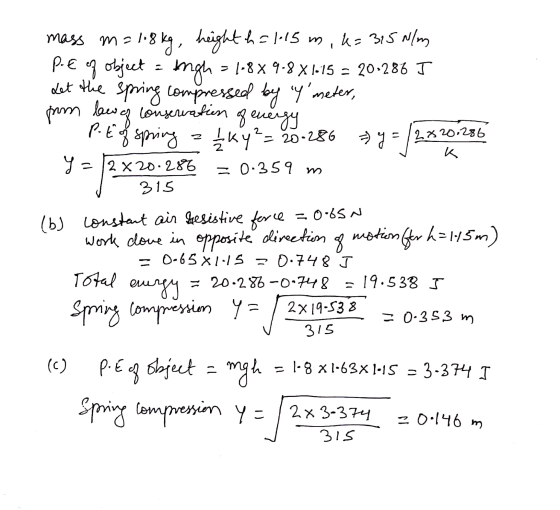
A 1.80-kg object is held 1.15 m above a relaxed, massless vertical spring with a force...
A 1.30 kg object is held 1.35 m above a relaxed, massless vertical spring with a force constant of 300 N/m. The...
A 1.30 kg object is held 1.35 m above a relaxed, massless vertical spring with a force constant of 300 N/m. The object is dropped onto the spring. (a) How far does the object compress the spring? m (b) Repeat part (a), but now assume that a constant air-resistance force of 0.650 N acts on the object during its motion. m (c) How far does the object compress the spring if the same experiment is performed on the moon, where g = 1.63 m/s2 and air resistance is neglected? m
A 1.60-kg object is held 1.40 m above a relaxed, massless vertical spring with a force...
A 1.60-kg object is held 1.40 m above a relaxed, massless vertical spring with a force constant of 305 N/m. The object is dropped onto the spring. (a) How far does the object compress the spring? m (b) Repeat part (a), but this time assume a constant air-resistance force of 0.600 N acts on the object during its motion. m (c) How far does the object compress the spring if the same experiment is performed on the Moon, where g...
A 1.7kg object is held 1.10m above a relaxed, massless vertical spring with a force constant...
 A 1.7kg object is held 1.10m above a relaxed, massless vertical spring with a force constant of 280 N/m. The object is dropped onto the spring. (A) How far does a object compress the spring? (B) Repeat part A, but this time assume a constant air resistant force of 0.650 in acts on an object during its motion
please answer both questions. A boy in a wheelchair (total mass 53.5 kg) has speed 1,40...
 please answer both questions.
A boy in a wheelchair (total mass 53.5 kg) has speed 1,40 m/s at the crest of a slope 2.30 m high and 12.4 m long. At the bottom of the slope his speed is 7.00 m/s. Assume air resistance and rolling resistance can be modeled as a constant friction force of 41.0 N. Find the work he did in pushing forward on his wheels during the downh ride. 245.45 Your response differs from the correct...
please answer both questions.
A boy in a wheelchair (total mass 53.5 kg) has speed 1,40 m/s at the crest of a slope 2.30 m high and 12.4 m long. At the bottom of the slope his speed is 7.00 m/s. Assume air resistance and rolling resistance can be modeled as a constant friction force of 41.0 N. Find the work he did in pushing forward on his wheels during the downh ride. 245.45 Your response differs from the correct...
A 10.7 kg object oscillates at the end of a vertical spring that has a spring...
A 10.7 kg object oscillates at the end of a vertical spring that has a spring constant of 2.10 104 N/m. The effect of air resistance is represented by the damping coefficient b = 3.00 N·s/m. (a) Calculate the frequency of the dampened oscillation. 2.15 Incorrect: Your answer is incorrect. Your response differs from the correct answer by more than 10%. Double check your calculations. Hz (b) By what percentage does the amplitude of the oscillation decrease in each cycle?...
A 0.600 kg object attached to a spring with a force constant of 8.00 N/m vibrates...
 A 0.600 kg object attached to a spring with a force constant of 8.00 N/m vibrates in simple harmonic motion with an amplitude of 11.0 cm. (Assume the position of the object is at the origin at t = 0.) (a) Calculate the maximum value (magnitude) of its speed and acceleration. (b) Calculate the speed and acceleration when the object is 5.00 cm from the equilibrium position. (c) Calculate the time interval required for the object to move from x...
A block of mass m = 6.04 kg is attached to a spring with spring constant...
 A block of mass m = 6.04 kg is attached to a spring with spring constant k = 1572 N/m and rests on a frictionless surface. The block is pulled, stretching the spring a distance of 0.170 m, and is held still. The block is then released and moves in simple harmonic motion about the equilibrium position. (Assume that the block is stretched in the positive direction.) (a) What is the frequency of this oscillation? 2.57 Hz (b) Where is...
.A horizontal spring, of force constant 200 N/m, is placed in front of a ramp, such that a 175g p...
 please help!
.A horizontal spring, of force constant 200 N/m, is placed in front of a ramp, such that a 175g plastic ball 10cm a) Ignoring any friction or air resistance, how fast is the plastic ball fired from the spring? b) If friction does-0.15J of work while the ball rises up the ramp, what is the maximum height the ball will roll up the ramp to? c) If friction does the same amount of work on the way down,...
please help!
.A horizontal spring, of force constant 200 N/m, is placed in front of a ramp, such that a 175g plastic ball 10cm a) Ignoring any friction or air resistance, how fast is the plastic ball fired from the spring? b) If friction does-0.15J of work while the ball rises up the ramp, what is the maximum height the ball will roll up the ramp to? c) If friction does the same amount of work on the way down,...
1) A block of mass m = 0.52 kg is attached to a spring with force...
 1) A block of mass m = 0.52 kg is attached to a spring with
force constant 119 N/m is free to move on a frictionless,
horizontal surface as in the figure below. The block is released
from rest after the spring is stretched a distance A = 0.13 m.
(Indicate the direction with the sign of your answer. Assume that
the positive direction is to the right.)
(a) At that instant, find the force on the block. N
(b)...
1) A block of mass m = 0.52 kg is attached to a spring with
force constant 119 N/m is free to move on a frictionless,
horizontal surface as in the figure below. The block is released
from rest after the spring is stretched a distance A = 0.13 m.
(Indicate the direction with the sign of your answer. Assume that
the positive direction is to the right.)
(a) At that instant, find the force on the block. N
(b)...
A 0.52-kg object connected to a light spring with a force constant of 19.4 N/m oscillates...
A 0.52-kg object connected to a light spring with a force constant of 19.4 N/m oscillates on a frictionless horizontal surface. The spring is compressed 4.0 cm and released from rest. (a) Determine the maximum speed of the object. Correct: Your answer is correct. m/s (b) Determine the speed of the object when the spring is compressed 1.5 cm. Correct: Your answer is correct. m/s (c) Determine the speed of the object as it passes the point 1.5 cm from...
 A 1.7kg object is held 1.10m above a relaxed, massless vertical spring with a force constant of 280 N/m. The object is dropped onto the spring. (A) How far does a object compress the spring? (B) Repeat part A, but this time assume a constant air resistant force of 0.650 in acts on an object during its motion
 please answer both questions.
A boy in a wheelchair (total mass 53.5 kg) has speed 1,40 m/s at the crest of a slope 2.30 m high and 12.4 m long. At the bottom of the slope his speed is 7.00 m/s. Assume air resistance and rolling resistance can be modeled as a constant friction force of 41.0 N. Find the work he did in pushing forward on his wheels during the downh ride. 245.45 Your response differs from the correct...
please answer both questions.
A boy in a wheelchair (total mass 53.5 kg) has speed 1,40 m/s at the crest of a slope 2.30 m high and 12.4 m long. At the bottom of the slope his speed is 7.00 m/s. Assume air resistance and rolling resistance can be modeled as a constant friction force of 41.0 N. Find the work he did in pushing forward on his wheels during the downh ride. 245.45 Your response differs from the correct...
 A 0.600 kg object attached to a spring with a force constant of 8.00 N/m vibrates in simple harmonic motion with an amplitude of 11.0 cm. (Assume the position of the object is at the origin at t = 0.) (a) Calculate the maximum value (magnitude) of its speed and acceleration. (b) Calculate the speed and acceleration when the object is 5.00 cm from the equilibrium position. (c) Calculate the time interval required for the object to move from x...
 A block of mass m = 6.04 kg is attached to a spring with spring constant k = 1572 N/m and rests on a frictionless surface. The block is pulled, stretching the spring a distance of 0.170 m, and is held still. The block is then released and moves in simple harmonic motion about the equilibrium position. (Assume that the block is stretched in the positive direction.) (a) What is the frequency of this oscillation? 2.57 Hz (b) Where is...
 please help!
.A horizontal spring, of force constant 200 N/m, is placed in front of a ramp, such that a 175g plastic ball 10cm a) Ignoring any friction or air resistance, how fast is the plastic ball fired from the spring? b) If friction does-0.15J of work while the ball rises up the ramp, what is the maximum height the ball will roll up the ramp to? c) If friction does the same amount of work on the way down,...
please help!
.A horizontal spring, of force constant 200 N/m, is placed in front of a ramp, such that a 175g plastic ball 10cm a) Ignoring any friction or air resistance, how fast is the plastic ball fired from the spring? b) If friction does-0.15J of work while the ball rises up the ramp, what is the maximum height the ball will roll up the ramp to? c) If friction does the same amount of work on the way down,...
 1) A block of mass m = 0.52 kg is attached to a spring with
force constant 119 N/m is free to move on a frictionless,
horizontal surface as in the figure below. The block is released
from rest after the spring is stretched a distance A = 0.13 m.
(Indicate the direction with the sign of your answer. Assume that
the positive direction is to the right.)
(a) At that instant, find the force on the block. N
(b)...
1) A block of mass m = 0.52 kg is attached to a spring with
force constant 119 N/m is free to move on a frictionless,
horizontal surface as in the figure below. The block is released
from rest after the spring is stretched a distance A = 0.13 m.
(Indicate the direction with the sign of your answer. Assume that
the positive direction is to the right.)
(a) At that instant, find the force on the block. N
(b)...
Most questions answered within 3 hours.
-
Where is the error in this code sequence?
String s1 = "Hello";
String s2 = "ello";...
asked 10 months ago -
Financial data for Joel de Paris, Inc., for last year
follow:
Joel de Paris, Inc.
Balance...
asked 10 months ago -
Consider this reaction:
Al2(SO4)3 (aq)+ BaCl3
(aq) Al2Cl6 (aq)- +
3BaSO4(s) . What is the...
asked 10 months ago -
Suppose that Savneet is considering increasing her
recent random sample from 20 car rentals to 40...
asked 10 months ago -
Trucks arrive at an unloading terminal at an average rate of 120
per hour.
Trucks arrive...
asked 10 months ago -
Why are methanol and ethanol completely soluble in water while
octanol is not very little soluble....
asked 10 months ago -
A facilities manager at a university reads in a research report
that the mean amount of...
asked 10 months ago -
When the CuSO4 is rehydrated by adding water to the anhydrous
compound, is this an endothermic...
asked 10 months ago -
A ray of sunlight is passing from diamond into crown glass; the
angle of incidence is...
asked 10 months ago -
A block of mass 0.249 kg is placed on top of a light, vertical
spring of...
asked 10 months ago -
how do the kidneys compensate in the presences of acidosis
a) trigger hyperventilate
b) reserve acid...
asked 10 months ago -
Question 501 pts
The rental rate of capital to the firm increases. Which of the
following...
asked 10 months ago