
Homework Answers
Typically business marketers faces derived demand.
Derived demand refers to the term describing the arise of demand of a product due to the demand for another product.
For example, the demand for Cement is derived demand, because it's demand arise when there is a demand of building, house construction. So, if there is a demand for new house or building, then there is a demand for Cement.
So, the correct answer is an option (3).
Add Answer to:
Question 8 (1 point) Typically, business marketers face: 1) Hypothetical demand 2) Highly elastic demand 3)...
Question 8 (1 point) The pricing decision is of concern to for-profit marketers and not a...
 Question 8 (1 point) The pricing decision is of concern to for-profit marketers and not a concern of not- for-profit marketers. True False
1)What happens to revenue when a price is increased at a point where demand is elastic?...
1)What happens to revenue when a price is increased at a point where demand is elastic? Group of answer choices a)revenue decreases b)revenue will not change c)revenue decreases after a period of increase d)revenue increases 2)First-class plane tickets (for personal travel) are a product that has a ____________ demand curve. Group of answer choices a)highly elastic b)unitary elastic c)very inelastic d)neither elastic or inelastic 3)Demand is usually ____________ in the short run than in the long run. Group of answer...
To measure the effectiveness of an advertising campaign, marketers typically conduct a(n) ________ before the ad...
To measure the effectiveness of an advertising campaign, marketers typically conduct a(n) ________ before the ad campaign begins and a(n) ________ after the campaign. Question 59 options: 1) benchmark test; recognition 2) aided recall test; unaided recall test 3) pretest; posttest 4) frequency; reach 5) recognition test; recall test
question 11 rlexibility responsiveness Question 11 (1 point) When a demand curve is perfectly elastic, its...
 question 11
rlexibility responsiveness Question 11 (1 point) When a demand curve is perfectly elastic, its price elasticity of demand coefficient is less than one zero greater than one B infinity Question 12 (1 point) When a demand curve is perfectly inelastic, we can describe it as being
question 11
rlexibility responsiveness Question 11 (1 point) When a demand curve is perfectly elastic, its price elasticity of demand coefficient is less than one zero greater than one B infinity Question 12 (1 point) When a demand curve is perfectly inelastic, we can describe it as being
what is one reason the demand for health services is considered elastic Question 21 (1 point)...
 what is one reason the demand for health services is considered
elastic
Question 21 (1 point) What is one reason the demand for health services is considered elastic? O A) Demand for healthcare is influenced by physician practice standards. OB) Demand for healthcare is not dependent on the state of the economy, O C) Demand for healthcare is based only on health status, O D) Demand for healthcare is higher among people with poor health insurance.
what is one reason the demand for health services is considered
elastic
Question 21 (1 point) What is one reason the demand for health services is considered elastic? O A) Demand for healthcare is influenced by physician practice standards. OB) Demand for healthcare is not dependent on the state of the economy, O C) Demand for healthcare is based only on health status, O D) Demand for healthcare is higher among people with poor health insurance.
Question 8 1 pts When demand is more elastic in an oligopolistic industry the markup over...
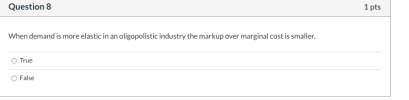 Question 8 1 pts When demand is more elastic in an oligopolistic industry the markup over marginal cost is smaller. True False
1.) Why is demand in the business market mostly inelastic? 2.) Distinguish between undifferentiated and differentiated...
1.) Why is demand in the business market mostly inelastic? 2.) Distinguish between undifferentiated and differentiated marketing strategies. 3.) How are specialty products distributed? 4.) What are the key service characteristics a company must consider when designing marketing programs? Briefly describe each characteristic. 5) What is a private brand or store brand? 6) Compare and contrast pure competition and oligopolistic competition. 7) How do intermediaries add value to a marketing system? 8) Describe the three types of appeals that marketers...
Question 1 2 pts If demand is price inelastic, then the demand curve is very flat....
 Question 1 2 pts If demand is price inelastic, then the demand curve is very flat. buyers respond substantially to a change in price, but the response is very slow. buyers do not respond much to a change in price. buyers do not alter their quantities demanded much in response to advertising. Question 2 2 pts Which of the following is likely to have the most price elastic demand? doctor's visits diamond earrings salt milk Question 3 2 pts Suppose...
1)Explain what it means when demand is inelastic? 2) If demand is elastic, total revenue will...
1)Explain what it means when demand is inelastic? 2) If demand is elastic, total revenue will increase when the price decreases? True or False? 3) The price elasticity of supply will be a smaller number when it is relatively easy for sellers to increase their supply. ( True or False)? 4) Demand is more elastic when the absolute value of the price elasticity of demand is larger. ( True or False)? 5) If the quantity demanded of one good increases...
Question 6 (1 point) The bullwhip effect is typically caused by: 1. Limited information sharing between...
 Question 6 (1 point) The bullwhip effect is typically caused by: 1. Limited information sharing between supply chain members 11. Retailers making ordering decisions based on their own interests 1. Increased levels of collaboration between distribution and production systems W. Outdated inventories V. Inaccurate forecasts of future demand 1) I & II 2) TV & V 3) 1, 11 & V 4) 1, 11 & 111 5) IV
 Question 8 (1 point) The pricing decision is of concern to for-profit marketers and not a concern of not- for-profit marketers. True False
 question 11
rlexibility responsiveness Question 11 (1 point) When a demand curve is perfectly elastic, its price elasticity of demand coefficient is less than one zero greater than one B infinity Question 12 (1 point) When a demand curve is perfectly inelastic, we can describe it as being
question 11
rlexibility responsiveness Question 11 (1 point) When a demand curve is perfectly elastic, its price elasticity of demand coefficient is less than one zero greater than one B infinity Question 12 (1 point) When a demand curve is perfectly inelastic, we can describe it as being
 what is one reason the demand for health services is considered
elastic
Question 21 (1 point) What is one reason the demand for health services is considered elastic? O A) Demand for healthcare is influenced by physician practice standards. OB) Demand for healthcare is not dependent on the state of the economy, O C) Demand for healthcare is based only on health status, O D) Demand for healthcare is higher among people with poor health insurance.
what is one reason the demand for health services is considered
elastic
Question 21 (1 point) What is one reason the demand for health services is considered elastic? O A) Demand for healthcare is influenced by physician practice standards. OB) Demand for healthcare is not dependent on the state of the economy, O C) Demand for healthcare is based only on health status, O D) Demand for healthcare is higher among people with poor health insurance.
 Question 8 1 pts When demand is more elastic in an oligopolistic industry the markup over marginal cost is smaller. True False
 Question 1 2 pts If demand is price inelastic, then the demand curve is very flat. buyers respond substantially to a change in price, but the response is very slow. buyers do not respond much to a change in price. buyers do not alter their quantities demanded much in response to advertising. Question 2 2 pts Which of the following is likely to have the most price elastic demand? doctor's visits diamond earrings salt milk Question 3 2 pts Suppose...
 Question 6 (1 point) The bullwhip effect is typically caused by: 1. Limited information sharing between supply chain members 11. Retailers making ordering decisions based on their own interests 1. Increased levels of collaboration between distribution and production systems W. Outdated inventories V. Inaccurate forecasts of future demand 1) I & II 2) TV & V 3) 1, 11 & V 4) 1, 11 & 111 5) IV
Most questions answered within 3 hours.
-
Where is the error in this code sequence?
String s1 = "Hello";
String s2 = "ello";...
asked 10 months ago -
Financial data for Joel de Paris, Inc., for last year
follow:
Joel de Paris, Inc.
Balance...
asked 10 months ago -
Consider this reaction:
Al2(SO4)3 (aq)+ BaCl3
(aq) Al2Cl6 (aq)- +
3BaSO4(s) . What is the...
asked 10 months ago -
Suppose that Savneet is considering increasing her
recent random sample from 20 car rentals to 40...
asked 10 months ago -
Trucks arrive at an unloading terminal at an average rate of 120
per hour.
Trucks arrive...
asked 10 months ago -
Why are methanol and ethanol completely soluble in water while
octanol is not very little soluble....
asked 10 months ago -
A facilities manager at a university reads in a research report
that the mean amount of...
asked 10 months ago -
When the CuSO4 is rehydrated by adding water to the anhydrous
compound, is this an endothermic...
asked 10 months ago -
A ray of sunlight is passing from diamond into crown glass; the
angle of incidence is...
asked 10 months ago -
A block of mass 0.249 kg is placed on top of a light, vertical
spring of...
asked 10 months ago -
how do the kidneys compensate in the presences of acidosis
a) trigger hyperventilate
b) reserve acid...
asked 10 months ago -
Question 501 pts
The rental rate of capital to the firm increases. Which of the
following...
asked 10 months ago