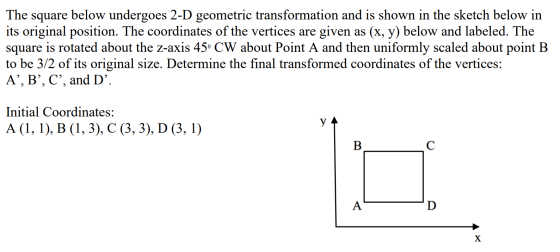
How can I solve this using MATLAB?
Homework Answers
CODE
![LL LLL LLL LLL %% We will use homogeneous coordinate system A-[1 1 1]; % first two value denote x and y coordinate of vertice](http://img.homeworklib.com/questions/42214eb0-9667-11ea-86dc-cfde0c31b574.png?x-oss-process=image/resize,w_560)
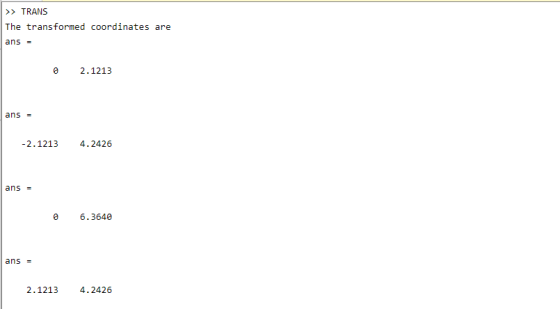
OUTPUT
Add Answer to:
How can I solve this using MATLAB?
The square below undergoes 2-D geometric transformation and is...
hello guys can u help me :) Question 1. For each of the plane-stress conditions given...
 hello guys can u help me :)
Question 1. For each of the plane-stress conditions given below, using the matrix transformation law, determine the state of stress at the same point for an element rotated in the x-y plane 30° clockwise from its original position: (a) Ox = 200 MPa Oy = 400 MPa Txy = - 60 MPa (b) Ox = 300 MPa Oy = -180 MPa Txy = 320 MPa Question 2 my x2 The state of stress...
hello guys can u help me :)
Question 1. For each of the plane-stress conditions given below, using the matrix transformation law, determine the state of stress at the same point for an element rotated in the x-y plane 30° clockwise from its original position: (a) Ox = 200 MPa Oy = 400 MPa Txy = - 60 MPa (b) Ox = 300 MPa Oy = -180 MPa Txy = 320 MPa Question 2 my x2 The state of stress...
linear algebra Remember we were able to express rotations and reflections, which are geometric transformations, using...
 linear algebra
Remember we were able to express rotations and reflections, which are geometric transformations, using a linear transformation T, the coef- ficient matrix corresponding to the geometric transformation (r. y) (r', ) (a) What problem do you encounter with translations (r. y) (r+ h.y+k)? To handle this problem, We let the vector (x, y1 ) in R2 correspond to the vector (x1, y1, 1), and conversely. (In effect, we're projecting the :xy-plane onto the plane 1) introduce homogeneous coordinates....
linear algebra
Remember we were able to express rotations and reflections, which are geometric transformations, using a linear transformation T, the coef- ficient matrix corresponding to the geometric transformation (r. y) (r', ) (a) What problem do you encounter with translations (r. y) (r+ h.y+k)? To handle this problem, We let the vector (x, y1 ) in R2 correspond to the vector (x1, y1, 1), and conversely. (In effect, we're projecting the :xy-plane onto the plane 1) introduce homogeneous coordinates....
MATLAB codes please 3. Adapt the procedure developed in Example 6 to rotate the square counterclockwise...
 MATLAB codes please 3. Adapt the procedure developed in Example 6 to rotate the square counterclockwise by incre ments of /10 about the origin. Stop when the square is in its original location and then rotate it in the clockwise direction until the square is in its original location again. You may want to rescale the axis by using axis((-2,2-2,21). Include the M-lile. Do not include the figure Hint: Since you are performing a computation several times, you will want...
The 3D state of stress in a point of an elastic solid is given in the...
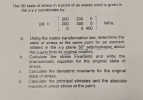 The 3D state of stress in a point of an elastic solid is given in the x-y-z coordinates by: 「200 200 01 [o] 1 200 300 01 Using the matrix transformation law, determine the state of stress at the same point for an element rotated in the x-y plane 30° anticlockwise about the z-axis from its original position. a. b. Calculate the stress invariants and write the characteristic equation for the original state of stress Calculate the deviatoric invariants for...
Question 6 (3 points) a -- 2 points) Find the Jacobian of the transformation the shear...
 Question 6 (3 points) a -- 2 points) Find the Jacobian of the transformation the shear transformation: x = au + bv + cw, y=dy + ew, and z fw, where a, b, c, d, e, and f are positive real numbers, and describe the how the volume of the unit cube in uvw coordinates compares to the volume of its transformation in Cartesian coordinates. = b -- 1 point) State one example of a practical application shown in lecture...
Let T : R2 → R2 be the linear transformation given by T(v) = Av that consists of a counterclockwise rotation about the origin through an angle of 30 2, Find the matrix that produces a countercloc...
 Let T : R2 → R2 be the linear transformation given by T(v) = Av that consists of a counterclockwise rotation about the origin through an angle of 30 2, Find the matrix that produces a counterclockwise rotation about the origin through an angle of 30°. Be sure to give the EXACT value of each entry in A. a. b. Plot the parallelogram whose vertices are given by the points A(0, 0), B(4, 0), C(5, 3), and D 1, 3)...
Physics 12 Module 6 Test A On-Line Course 3. The diagram below shows a single square...
 Physics 12 Module 6 Test A On-Line Course 3. The diagram below shows a single square loop of wire with equal sides of 0.23 m situated in a magnetic field with lines directed out-of-page. The loop is free to spin horizontally about an axis of rotation. * B= 5.0 x 10⁻⁵T axis of rotation Use this information to answer the following 3 questions. a) How much flux is threading through the loop in its current position? 2 marks b) The...
Question 2 Relaunch transformation sequences . Locate quadrilateral ABCD and quadrilateral KLMN on the coordinate plane....
 Question 2 Relaunch transformation sequences . Locate quadrilateral ABCD and quadrilateral KLMN on the coordinate plane. Use GeoGebra to identify the transformations that will map ABCD onto KLMN, and then describe them in the table. Enter the coordinates of the vertices of the images that you created. Paste a screen capture of the images below the table. в тух х, Font Sizes E 3 А D А B D (1.-2) (3.-1) (2.-4) (1.-3) A' B С" DO (-1,-2) (-3,-1) 1.2,...
1. Construct affine linear transformations to do the following to the square in Figure 4.la (a) R...
 please do the number 2
1. Construct affine linear transformations to do the following to the square in Figure 4.la (a) Rotate the square 180° counterclockwise around the origin (in the plane) width. unchanged) (b) Move the square 7 units to the right, 3 units up, and double its (c) Make the vertical lines of the square slant at a 45 angle (height (d) Reflect the square about the y-axis. u Au + b, giving A and b. 4.la for...
please do the number 2
1. Construct affine linear transformations to do the following to the square in Figure 4.la (a) Rotate the square 180° counterclockwise around the origin (in the plane) width. unchanged) (b) Move the square 7 units to the right, 3 units up, and double its (c) Make the vertical lines of the square slant at a 45 angle (height (d) Reflect the square about the y-axis. u Au + b, giving A and b. 4.la for...
Determine the total area enclosed by the points A, B, C, and D as shown in the figure below [units]^2. The coordinates...
 Determine the total area enclosed by the points A, B, C, and D as shown in the figure below [units]^2. The coordinates of D are not at the position shown but are at x 6, y = 4 5 4 3 2 1 X 0 2 3 5 Answer: Determine the second moment of area about the x-axis enclosed by the points A, B, C and D [units]^4 Answer: Determine the second moment of area about the y-axis enclosed by...
 hello guys can u help me :)
Question 1. For each of the plane-stress conditions given below, using the matrix transformation law, determine the state of stress at the same point for an element rotated in the x-y plane 30° clockwise from its original position: (a) Ox = 200 MPa Oy = 400 MPa Txy = - 60 MPa (b) Ox = 300 MPa Oy = -180 MPa Txy = 320 MPa Question 2 my x2 The state of stress...
hello guys can u help me :)
Question 1. For each of the plane-stress conditions given below, using the matrix transformation law, determine the state of stress at the same point for an element rotated in the x-y plane 30° clockwise from its original position: (a) Ox = 200 MPa Oy = 400 MPa Txy = - 60 MPa (b) Ox = 300 MPa Oy = -180 MPa Txy = 320 MPa Question 2 my x2 The state of stress...
 linear algebra
Remember we were able to express rotations and reflections, which are geometric transformations, using a linear transformation T, the coef- ficient matrix corresponding to the geometric transformation (r. y) (r', ) (a) What problem do you encounter with translations (r. y) (r+ h.y+k)? To handle this problem, We let the vector (x, y1 ) in R2 correspond to the vector (x1, y1, 1), and conversely. (In effect, we're projecting the :xy-plane onto the plane 1) introduce homogeneous coordinates....
linear algebra
Remember we were able to express rotations and reflections, which are geometric transformations, using a linear transformation T, the coef- ficient matrix corresponding to the geometric transformation (r. y) (r', ) (a) What problem do you encounter with translations (r. y) (r+ h.y+k)? To handle this problem, We let the vector (x, y1 ) in R2 correspond to the vector (x1, y1, 1), and conversely. (In effect, we're projecting the :xy-plane onto the plane 1) introduce homogeneous coordinates....
 MATLAB codes please 3. Adapt the procedure developed in Example 6 to rotate the square counterclockwise by incre ments of /10 about the origin. Stop when the square is in its original location and then rotate it in the clockwise direction until the square is in its original location again. You may want to rescale the axis by using axis((-2,2-2,21). Include the M-lile. Do not include the figure Hint: Since you are performing a computation several times, you will want...
 The 3D state of stress in a point of an elastic solid is given in the x-y-z coordinates by: 「200 200 01 [o] 1 200 300 01 Using the matrix transformation law, determine the state of stress at the same point for an element rotated in the x-y plane 30° anticlockwise about the z-axis from its original position. a. b. Calculate the stress invariants and write the characteristic equation for the original state of stress Calculate the deviatoric invariants for...
 Question 6 (3 points) a -- 2 points) Find the Jacobian of the transformation the shear transformation: x = au + bv + cw, y=dy + ew, and z fw, where a, b, c, d, e, and f are positive real numbers, and describe the how the volume of the unit cube in uvw coordinates compares to the volume of its transformation in Cartesian coordinates. = b -- 1 point) State one example of a practical application shown in lecture...
 Let T : R2 → R2 be the linear transformation given by T(v) = Av that consists of a counterclockwise rotation about the origin through an angle of 30 2, Find the matrix that produces a counterclockwise rotation about the origin through an angle of 30°. Be sure to give the EXACT value of each entry in A. a. b. Plot the parallelogram whose vertices are given by the points A(0, 0), B(4, 0), C(5, 3), and D 1, 3)...
 Physics 12 Module 6 Test A On-Line Course 3. The diagram below shows a single square loop of wire with equal sides of 0.23 m situated in a magnetic field with lines directed out-of-page. The loop is free to spin horizontally about an axis of rotation. * B= 5.0 x 10⁻⁵T axis of rotation Use this information to answer the following 3 questions. a) How much flux is threading through the loop in its current position? 2 marks b) The...
 Question 2 Relaunch transformation sequences . Locate quadrilateral ABCD and quadrilateral KLMN on the coordinate plane. Use GeoGebra to identify the transformations that will map ABCD onto KLMN, and then describe them in the table. Enter the coordinates of the vertices of the images that you created. Paste a screen capture of the images below the table. в тух х, Font Sizes E 3 А D А B D (1.-2) (3.-1) (2.-4) (1.-3) A' B С" DO (-1,-2) (-3,-1) 1.2,...
 please do the number 2
1. Construct affine linear transformations to do the following to the square in Figure 4.la (a) Rotate the square 180° counterclockwise around the origin (in the plane) width. unchanged) (b) Move the square 7 units to the right, 3 units up, and double its (c) Make the vertical lines of the square slant at a 45 angle (height (d) Reflect the square about the y-axis. u Au + b, giving A and b. 4.la for...
please do the number 2
1. Construct affine linear transformations to do the following to the square in Figure 4.la (a) Rotate the square 180° counterclockwise around the origin (in the plane) width. unchanged) (b) Move the square 7 units to the right, 3 units up, and double its (c) Make the vertical lines of the square slant at a 45 angle (height (d) Reflect the square about the y-axis. u Au + b, giving A and b. 4.la for...
 Determine the total area enclosed by the points A, B, C, and D as shown in the figure below [units]^2. The coordinates of D are not at the position shown but are at x 6, y = 4 5 4 3 2 1 X 0 2 3 5 Answer: Determine the second moment of area about the x-axis enclosed by the points A, B, C and D [units]^4 Answer: Determine the second moment of area about the y-axis enclosed by...
Most questions answered within 3 hours.
-
Where is the error in this code sequence?
String s1 = "Hello";
String s2 = "ello";...
asked 10 months ago -
Financial data for Joel de Paris, Inc., for last year
follow:
Joel de Paris, Inc.
Balance...
asked 10 months ago -
Consider this reaction:
Al2(SO4)3 (aq)+ BaCl3
(aq) Al2Cl6 (aq)- +
3BaSO4(s) . What is the...
asked 10 months ago -
Suppose that Savneet is considering increasing her
recent random sample from 20 car rentals to 40...
asked 10 months ago -
Trucks arrive at an unloading terminal at an average rate of 120
per hour.
Trucks arrive...
asked 10 months ago -
Why are methanol and ethanol completely soluble in water while
octanol is not very little soluble....
asked 10 months ago -
A facilities manager at a university reads in a research report
that the mean amount of...
asked 10 months ago -
When the CuSO4 is rehydrated by adding water to the anhydrous
compound, is this an endothermic...
asked 10 months ago -
A ray of sunlight is passing from diamond into crown glass; the
angle of incidence is...
asked 10 months ago -
A block of mass 0.249 kg is placed on top of a light, vertical
spring of...
asked 10 months ago -
how do the kidneys compensate in the presences of acidosis
a) trigger hyperventilate
b) reserve acid...
asked 10 months ago -
Question 501 pts
The rental rate of capital to the firm increases. Which of the
following...
asked 10 months ago