
Solve the question in Matlab and please show Matlab code
Homework Answers
Solution

Free Body Diagram
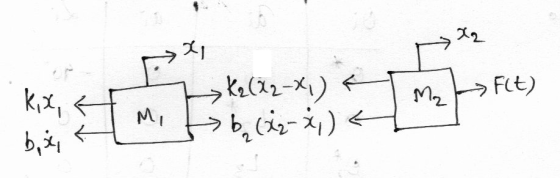
Using Newton's law,




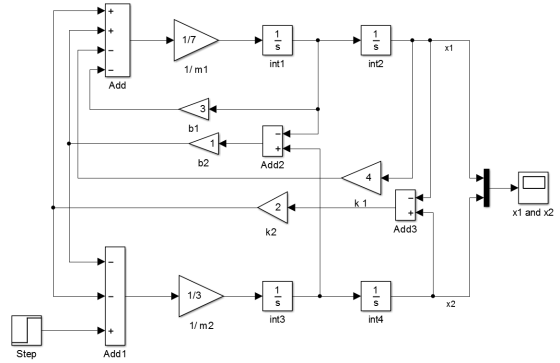
SIMULINK Model
Using the equations above we can construct the following SIMULINK model
Scope Output
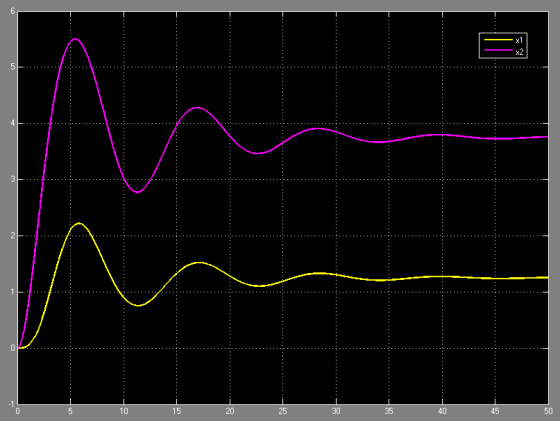
From the plot we can observe that  has higher displacement compared to
  .
.
Add Answer to:
Solve the question in Matlab and please show Matlab code
Consider a double Spring-Mass-Damper System as...
a can be skipped Consider the following second-order ODE representing a spring-mass-damper system for zero initial...
 a can be skipped
Consider the following second-order ODE representing a spring-mass-damper system for zero initial conditions (forced response): 2x + 2x + x=u, x(0) = 0, *(0) = 0 where u is the Unit Step Function (of magnitude 1). a. Use MATLAB to obtain an analytical solution x(t) for the differential equation, using the Laplace Transforms approach (do not use DSOLVE). Obtain the analytical expression for x(t). Also obtain a plot of .x(t) (for a simulation of 14 seconds)...
a can be skipped
Consider the following second-order ODE representing a spring-mass-damper system for zero initial conditions (forced response): 2x + 2x + x=u, x(0) = 0, *(0) = 0 where u is the Unit Step Function (of magnitude 1). a. Use MATLAB to obtain an analytical solution x(t) for the differential equation, using the Laplace Transforms approach (do not use DSOLVE). Obtain the analytical expression for x(t). Also obtain a plot of .x(t) (for a simulation of 14 seconds)...
4. Consider the mechanical system shown below with a spring with stiffness, k (N/m), in parallel...
 4. Consider the mechanical system shown below with a spring with stiffness, k (N/m), in parallel with a viscous damper with coefficient, h (Nós/m) and an externally applied force, Fexi(t) (N). u(t) a. Find the equation that relates the applied force, Fext(t) and the displacement, u(t). b. If the spring component has a stiffness of k = 75 N/m, the damper component has coefficient h = 50 N s/m and the externally applied force is a constant 4.5 N applied...
Consider the Spring-Mass-Damper system: 17 →xt) linn M A Falt) Ffl v) Consider the following system...
 Consider the Spring-Mass-Damper system: 17 →xt) linn M A Falt) Ffl v) Consider the following system parameter values: Case 1: m= 7 kg; b = 1 Nsec/m; Fa = 3N; k = 2 N/m; x(0) = 4 m;x_dot(0)=0 m/s Case2:m=30kg;b=1Nsec/m; Fa=3N; k=2N/m;x(0)=2m;x_dot(0)=0m/s Use MATLAB in order to do the following: 1. Solve the system equations numerically (using the ODE45 function). 2. For the two cases, plot the Position x(t) of the mass, on the same graph (include proper titles, axis...
Problem 1. Consider the following mass, spring, and damper system. Let the force F be the...
 Problem 1. Consider the following mass, spring, and damper system. Let the force F be the input and the position x be the output. M-1 kg b- 10 N s/m k 20 N/nm F = 1 N when t>=0 PART UNIT FEEDBACK CONTROL SYSTEM 5) Construct a unit feedback control for the mass-spring-damper system 6) Draw the block diagram of the unit feedback control system 7) Find the Transfer Function of the closed-loop (CL) system 8) Find and plot the...
For the single DOF spring-mass-damper system shown, the displacement of the mass is x. Assume m-...
 For the single DOF spring-mass-damper system shown, the displacement of the mass is x. Assume m- 1 kg, c 1 N-s/m, k = 1 N/m, and f(t)-1 N for all time. If the initial displacement and velocity of the mass are zero, then based on the central difference numerical integration method as discussed in the notes, using an integration time step of h 0.5 s, what is the displacement of the mass at t 0.5 s? In other words, what...
Problem 1 (Harmonic Oscillators) A mass-damper-spring system is a simple harmonic oscillator whose dynamics is governed...
 Problem 1 (Harmonic Oscillators) A mass-damper-spring system is a simple harmonic oscillator whose dynamics is governed by the equation of motion where m is the mass, c is the damping coefficient of the damper, k is the stiffness of the spring, F is the net force applied on the mass, and x is the displacement of the mass from its equilibrium point. In this problem, we focus on a mass-damper-spring system with m = 1 kg, c-4 kg/s, k-3 N/m,...
(20pts) Consider the vertical spring-mass-damper system shown below, where m 2 kg, b 4 N-s/m, and...
 (20pts) Consider the vertical spring-mass-damper system shown below, where m 2 kg, b 4 N-s/m, and k 20N/m. Assume that x(0) 0.1 m and (0) 0. The displacement is measured form the equilibrium position. Derive a mathematical model of the system (i.e. an ODE). Then find x(t) as a function of time t.
In this problem, we will try to illustrate the following: a waggon is linked to a...
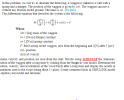 In this problem, we will try to illustrate the following: a waggon is linked to a wall with a spring and a damper. The position of the waggon is given by x(t). The waggon can move without any friction on the ground. The mass is M. (35 pnts) The differential equation that describes the system is the following: d2x M + b + cx(t) = F dt2 Where: M=5 [kg] mass of the waggon b= 1 [Ns/m] damper constant C=...
can you show how the model would look like on matlab ? please help with this question For the circuit given below, find the normal form for the inductor current and capacitor voltage. Use Matlab (...
 can you show how the model would look like on matlab ? please
help with this question
For the circuit given below, find the normal form for the inductor current and capacitor voltage. Use Matlab (Create an.m file. Use Isim function) and Simulink (Create a Simulink Model). Plot the responses x1 and x2 over time from the M file and Simulink Model. Do they match? Please explain. Use f(t)-e-cos(2t)u(t) for the input. Assume Zero Initial Conditions. 2Ω I H On...
can you show how the model would look like on matlab ? please
help with this question
For the circuit given below, find the normal form for the inductor current and capacitor voltage. Use Matlab (Create an.m file. Use Isim function) and Simulink (Create a Simulink Model). Plot the responses x1 and x2 over time from the M file and Simulink Model. Do they match? Please explain. Use f(t)-e-cos(2t)u(t) for the input. Assume Zero Initial Conditions. 2Ω I H On...
Solve it with matlab 25.16 The motion of a damped spring-mass system (Fig. P25.16) is described...
 Solve it with matlab
25.16 The motion of a damped spring-mass system (Fig. P25.16) is described by the following ordinary differential equation: d’x dx ++ kx = 0 m dr dt where x = displacement from equilibrium position (m), t = time (s), m 20-kg mass, and c = the damping coefficient (N · s/m). The damping coefficient c takes on three values of 5 (under- damped), 40 (critically damped), and 200 (overdamped). The spring constant k = 20 N/m....
Solve it with matlab
25.16 The motion of a damped spring-mass system (Fig. P25.16) is described by the following ordinary differential equation: d’x dx ++ kx = 0 m dr dt where x = displacement from equilibrium position (m), t = time (s), m 20-kg mass, and c = the damping coefficient (N · s/m). The damping coefficient c takes on three values of 5 (under- damped), 40 (critically damped), and 200 (overdamped). The spring constant k = 20 N/m....
 a can be skipped
Consider the following second-order ODE representing a spring-mass-damper system for zero initial conditions (forced response): 2x + 2x + x=u, x(0) = 0, *(0) = 0 where u is the Unit Step Function (of magnitude 1). a. Use MATLAB to obtain an analytical solution x(t) for the differential equation, using the Laplace Transforms approach (do not use DSOLVE). Obtain the analytical expression for x(t). Also obtain a plot of .x(t) (for a simulation of 14 seconds)...
a can be skipped
Consider the following second-order ODE representing a spring-mass-damper system for zero initial conditions (forced response): 2x + 2x + x=u, x(0) = 0, *(0) = 0 where u is the Unit Step Function (of magnitude 1). a. Use MATLAB to obtain an analytical solution x(t) for the differential equation, using the Laplace Transforms approach (do not use DSOLVE). Obtain the analytical expression for x(t). Also obtain a plot of .x(t) (for a simulation of 14 seconds)...
 4. Consider the mechanical system shown below with a spring with stiffness, k (N/m), in parallel with a viscous damper with coefficient, h (Nós/m) and an externally applied force, Fexi(t) (N). u(t) a. Find the equation that relates the applied force, Fext(t) and the displacement, u(t). b. If the spring component has a stiffness of k = 75 N/m, the damper component has coefficient h = 50 N s/m and the externally applied force is a constant 4.5 N applied...
 Consider the Spring-Mass-Damper system: 17 →xt) linn M A Falt) Ffl v) Consider the following system parameter values: Case 1: m= 7 kg; b = 1 Nsec/m; Fa = 3N; k = 2 N/m; x(0) = 4 m;x_dot(0)=0 m/s Case2:m=30kg;b=1Nsec/m; Fa=3N; k=2N/m;x(0)=2m;x_dot(0)=0m/s Use MATLAB in order to do the following: 1. Solve the system equations numerically (using the ODE45 function). 2. For the two cases, plot the Position x(t) of the mass, on the same graph (include proper titles, axis...
 Problem 1. Consider the following mass, spring, and damper system. Let the force F be the input and the position x be the output. M-1 kg b- 10 N s/m k 20 N/nm F = 1 N when t>=0 PART UNIT FEEDBACK CONTROL SYSTEM 5) Construct a unit feedback control for the mass-spring-damper system 6) Draw the block diagram of the unit feedback control system 7) Find the Transfer Function of the closed-loop (CL) system 8) Find and plot the...
 For the single DOF spring-mass-damper system shown, the displacement of the mass is x. Assume m- 1 kg, c 1 N-s/m, k = 1 N/m, and f(t)-1 N for all time. If the initial displacement and velocity of the mass are zero, then based on the central difference numerical integration method as discussed in the notes, using an integration time step of h 0.5 s, what is the displacement of the mass at t 0.5 s? In other words, what...
 Problem 1 (Harmonic Oscillators) A mass-damper-spring system is a simple harmonic oscillator whose dynamics is governed by the equation of motion where m is the mass, c is the damping coefficient of the damper, k is the stiffness of the spring, F is the net force applied on the mass, and x is the displacement of the mass from its equilibrium point. In this problem, we focus on a mass-damper-spring system with m = 1 kg, c-4 kg/s, k-3 N/m,...
 (20pts) Consider the vertical spring-mass-damper system shown below, where m 2 kg, b 4 N-s/m, and k 20N/m. Assume that x(0) 0.1 m and (0) 0. The displacement is measured form the equilibrium position. Derive a mathematical model of the system (i.e. an ODE). Then find x(t) as a function of time t.
 In this problem, we will try to illustrate the following: a waggon is linked to a wall with a spring and a damper. The position of the waggon is given by x(t). The waggon can move without any friction on the ground. The mass is M. (35 pnts) The differential equation that describes the system is the following: d2x M + b + cx(t) = F dt2 Where: M=5 [kg] mass of the waggon b= 1 [Ns/m] damper constant C=...
 can you show how the model would look like on matlab ? please
help with this question
For the circuit given below, find the normal form for the inductor current and capacitor voltage. Use Matlab (Create an.m file. Use Isim function) and Simulink (Create a Simulink Model). Plot the responses x1 and x2 over time from the M file and Simulink Model. Do they match? Please explain. Use f(t)-e-cos(2t)u(t) for the input. Assume Zero Initial Conditions. 2Ω I H On...
can you show how the model would look like on matlab ? please
help with this question
For the circuit given below, find the normal form for the inductor current and capacitor voltage. Use Matlab (Create an.m file. Use Isim function) and Simulink (Create a Simulink Model). Plot the responses x1 and x2 over time from the M file and Simulink Model. Do they match? Please explain. Use f(t)-e-cos(2t)u(t) for the input. Assume Zero Initial Conditions. 2Ω I H On...
 Solve it with matlab
25.16 The motion of a damped spring-mass system (Fig. P25.16) is described by the following ordinary differential equation: d’x dx ++ kx = 0 m dr dt where x = displacement from equilibrium position (m), t = time (s), m 20-kg mass, and c = the damping coefficient (N · s/m). The damping coefficient c takes on three values of 5 (under- damped), 40 (critically damped), and 200 (overdamped). The spring constant k = 20 N/m....
Solve it with matlab
25.16 The motion of a damped spring-mass system (Fig. P25.16) is described by the following ordinary differential equation: d’x dx ++ kx = 0 m dr dt where x = displacement from equilibrium position (m), t = time (s), m 20-kg mass, and c = the damping coefficient (N · s/m). The damping coefficient c takes on three values of 5 (under- damped), 40 (critically damped), and 200 (overdamped). The spring constant k = 20 N/m....
Most questions answered within 3 hours.
-
Where is the error in this code sequence?
String s1 = "Hello";
String s2 = "ello";...
asked 11 months ago -
Financial data for Joel de Paris, Inc., for last year
follow:
Joel de Paris, Inc.
Balance...
asked 11 months ago -
Consider this reaction:
Al2(SO4)3 (aq)+ BaCl3
(aq) Al2Cl6 (aq)- +
3BaSO4(s) . What is the...
asked 11 months ago -
Suppose that Savneet is considering increasing her
recent random sample from 20 car rentals to 40...
asked 11 months ago -
Trucks arrive at an unloading terminal at an average rate of 120
per hour.
Trucks arrive...
asked 11 months ago -
Why are methanol and ethanol completely soluble in water while
octanol is not very little soluble....
asked 11 months ago -
A facilities manager at a university reads in a research report
that the mean amount of...
asked 11 months ago -
When the CuSO4 is rehydrated by adding water to the anhydrous
compound, is this an endothermic...
asked 11 months ago -
A ray of sunlight is passing from diamond into crown glass; the
angle of incidence is...
asked 11 months ago -
A block of mass 0.249 kg is placed on top of a light, vertical
spring of...
asked 11 months ago -
how do the kidneys compensate in the presences of acidosis
a) trigger hyperventilate
b) reserve acid...
asked 11 months ago -
Question 501 pts
The rental rate of capital to the firm increases. Which of the
following...
asked 11 months ago