
Homework Answers

Add Answer to:
6. Consider the second-order difference equation, 114 pt 16 a. Find the characteristie polynomial and characteristic...
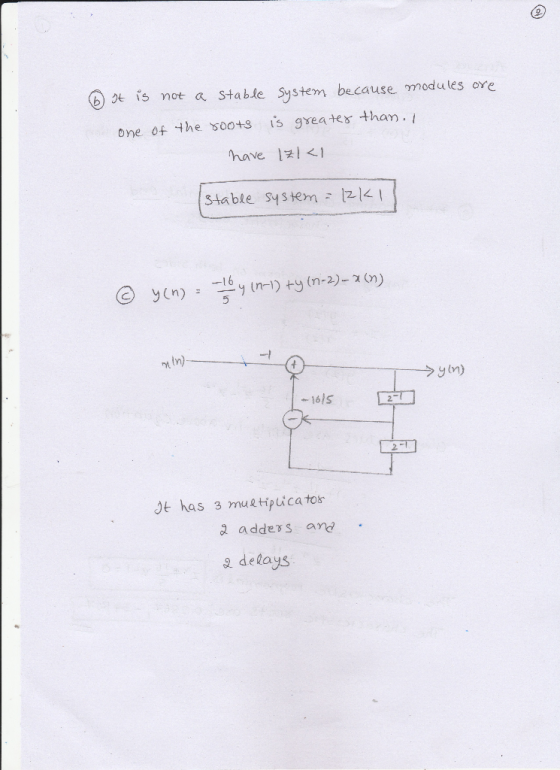
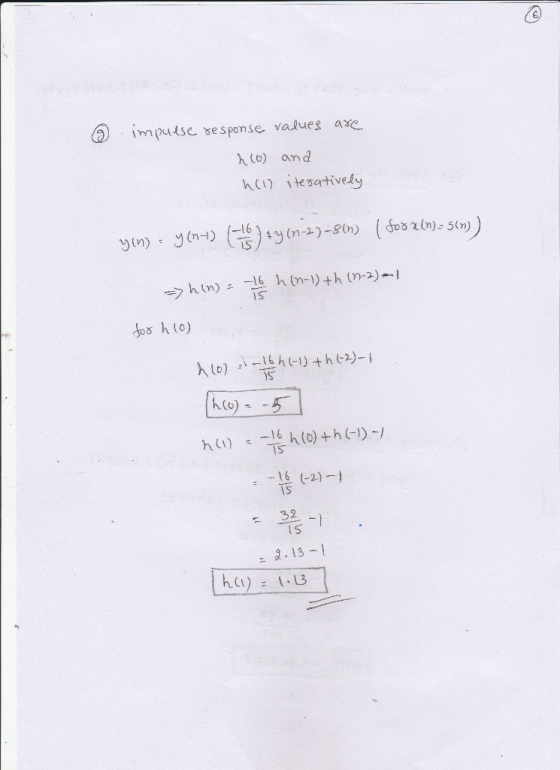
Problem 2. For the following system described by the difference equation where y[-1-y[-2] = 0 and...
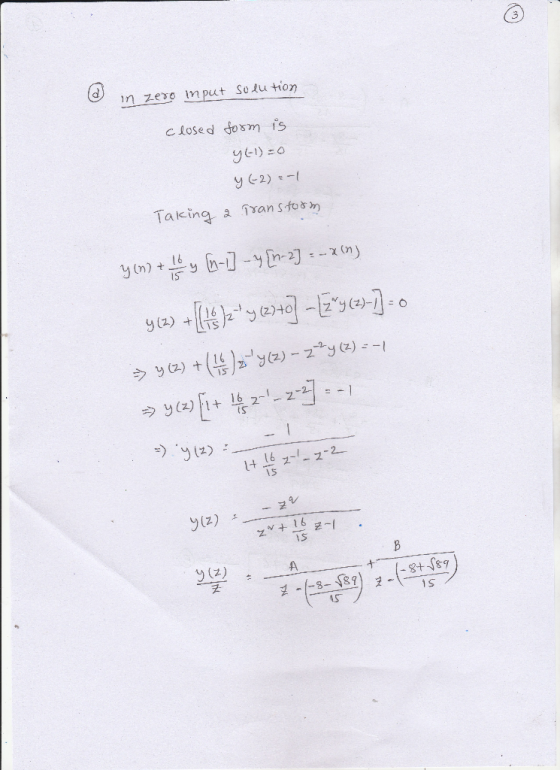
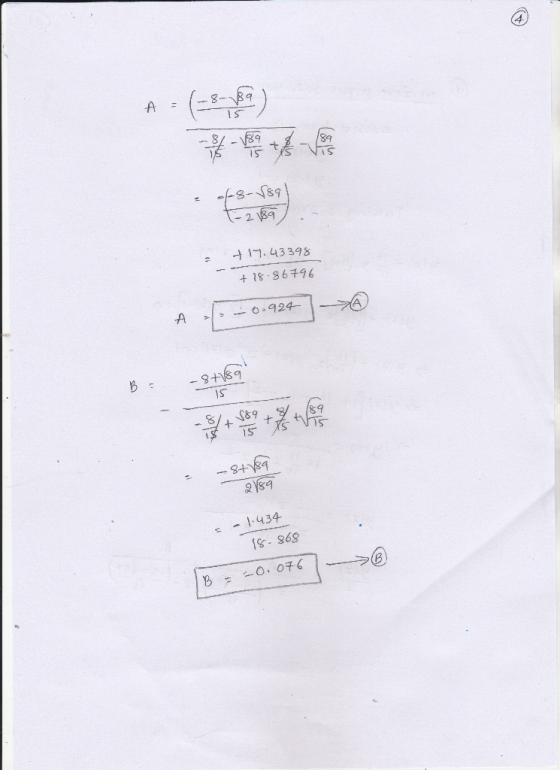
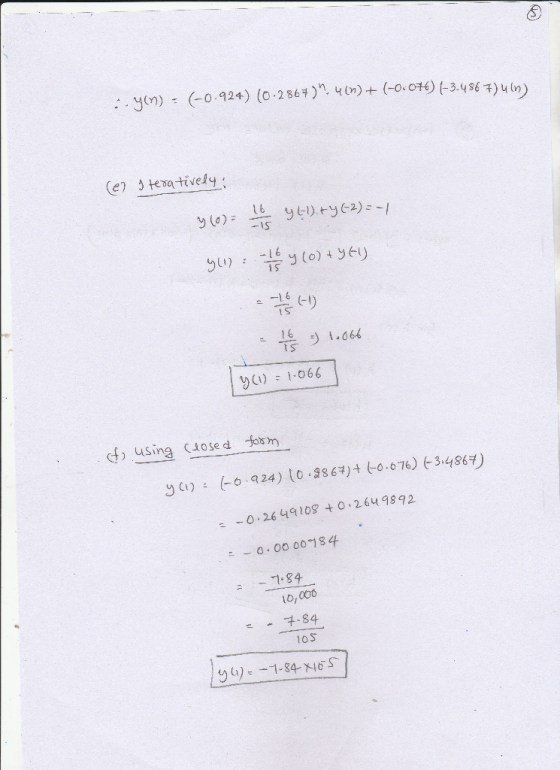
 Problem 2. For the following system described by the difference equation where y[-1-y[-2] = 0 and x[n] = 2u[n]: a. Draw a block diagram of this system using delays, multipliers, and adders b. Determine the impulse response of the system, h[n], and plot it in MATLAB for n = 0, 1, ,20. (Hint: use Euler's Formula to simplify) c. Is this system stable? d. Determine the initial conditioned repsonse, in. e. Find the total response of the system, yn nln....
Please solve using the general solution method. Do not use Z-Transforms. 3.34. Consider the second-order homogeneous...
 Please solve using the general
solution method. Do not use Z-Transforms.
3.34. Consider the second-order homogeneous difference equation with initial conditions yl-1] pi and yl-2 P2. The coefficients a and a2 of the difference equation and the initial values p? and p2 are all real-valued, and will be left as parameters. a. Let z1 and 22 be the roots of the characteristic polynomial. On paper, solve the homogeneous difference equation for the three possibilities for the roots: 1. The roots...
Please solve using the general
solution method. Do not use Z-Transforms.
3.34. Consider the second-order homogeneous difference equation with initial conditions yl-1] pi and yl-2 P2. The coefficients a and a2 of the difference equation and the initial values p? and p2 are all real-valued, and will be left as parameters. a. Let z1 and 22 be the roots of the characteristic polynomial. On paper, solve the homogeneous difference equation for the three possibilities for the roots: 1. The roots...
Please use MATLAB Vs 2. Identify the initial conditions. Write an m-file that does the following: 3. If Vs-12V, R-280Ω, L-10mH, C-0.9μF, use matlab solve the roots of characteristic equation, find th...
 Please use MATLAB
Vs 2. Identify the initial conditions. Write an m-file that does the following: 3. If Vs-12V, R-280Ω, L-10mH, C-0.9μF, use matlab solve the roots of characteristic equation, find the expression of vdt), choose proper time range to plot ve What type of damping is it? 4. What is the difference in response with both open and closed loop systems. Explain the differences
Vs
2. Identify the initial conditions. Write an m-file that does the following: 3. If...
Please use MATLAB
Vs 2. Identify the initial conditions. Write an m-file that does the following: 3. If Vs-12V, R-280Ω, L-10mH, C-0.9μF, use matlab solve the roots of characteristic equation, find the expression of vdt), choose proper time range to plot ve What type of damping is it? 4. What is the difference in response with both open and closed loop systems. Explain the differences
Vs
2. Identify the initial conditions. Write an m-file that does the following: 3. If...
please help. Note: u(t) is unit-step function Consider the system with the differential equation: dyt) +...
 please help.
Note: u(t) is unit-step function Consider the system with the differential equation: dyt) + 2 dy(t) + 2y(t) = dr(t) – r(e) dt2 dt where r(t) is input and y(t) is output. 1. Find the transfer function of the system. Note that transfer function is Laplace transform ratio of input and output under the assumption that all initial conditions are zero. 2. Find the impulse response of the system. 3. Find the unit step response of the system...
please help.
Note: u(t) is unit-step function Consider the system with the differential equation: dyt) + 2 dy(t) + 2y(t) = dr(t) – r(e) dt2 dt where r(t) is input and y(t) is output. 1. Find the transfer function of the system. Note that transfer function is Laplace transform ratio of input and output under the assumption that all initial conditions are zero. 2. Find the impulse response of the system. 3. Find the unit step response of the system...
Consider the following second-order ODE representing a spring-mass-damper system for zero initial...
 Consider the following second-order ODE representing a spring-mass-damper system for zero initial conditions (forced response): where u is the Unit Step Function (of magnitude 1 a. Use MATLAB to obtain an analytical solution x() for the differential equation, using the Laplace Transforms approach (do not use DSOLVE). Obtain the analytical expression for ao. Also obtain a plot of x() (for a simulation of 14 seconds) b. Obtain the Transfer Function representation for the system. c. Use MATLAB to obtain the...
Consider the differential equation: -9ty" – 6t(t – 3)y' + 6(t – 3)y=0, t> 0. a....
 Consider the differential equation: -9ty" – 6t(t – 3)y' + 6(t – 3)y=0, t> 0. a. Given that yı(t) = 3t is a solution, apply the reduction of order method to find another solution y2 for which yı and y2 form a fundamental solution set. i. Starting with yi, solve for w in yıw' + (2y + p(t)yı)w = 0 so that w(1) = -3. w(t) = ii. Now solve for u where u = w so that u(1) =...
Engineering Mathematics IIA Page 3 of 8 3. Consider the second-order ordinary differential equation for y(x)...
 Engineering Mathematics IIA Page 3 of 8 3. Consider the second-order ordinary differential equation for y(x) given by (3) xy"2y' +xy = 0. (a) Determine whether = 0 is an ordinary point, regular singular, or an irregular a singular point of (3). (b) By assuming a series solution of the form y = x ama, employ the Method of m-0 Frobenius on (3) to determine the indicial equation for r. (c) Using an indicial value r = -1, derive the...
help with all except numbers 21-26 16. Solve the differential equation by using the Cauchy-Euler Equation 17. Find the solution to the given Initial Value Problem using Green's Theorem 0,y'...
 help with all except numbers 21-26
16. Solve the differential equation by using the Cauchy-Euler Equation 17. Find the solution to the given Initial Value Problem using Green's Theorem 0,y'(0)s 0 y(0) y" + 6y' + 9y x, 18. Find the solution to the given Boundary Value Problem y" ty-1, y(O)0, y(1) 19. Solve the system of differential equations by systematic elimination. dy dt dt 20. Use any procedure in Chapter 4 to solve the differential equation subjected to the...
help with all except numbers 21-26
16. Solve the differential equation by using the Cauchy-Euler Equation 17. Find the solution to the given Initial Value Problem using Green's Theorem 0,y'(0)s 0 y(0) y" + 6y' + 9y x, 18. Find the solution to the given Boundary Value Problem y" ty-1, y(O)0, y(1) 19. Solve the system of differential equations by systematic elimination. dy dt dt 20. Use any procedure in Chapter 4 to solve the differential equation subjected to the...
Problem 1: Consider a 2nd order homogeneous differential equation of the form aa2y"(x)bay(x) + cy =...
 Problem 1: Consider a 2nd order homogeneous differential equation of the form aa2y"(x)bay(x) + cy = 0 (1) where a, b, c are constants satisfy so that y(x) = x (a) Find and justify what conditions should a constant m to (1) is a solution (b) Using your solution to (1) Write these three different cases as an equation that a, b,c satisfy. Hint: Use the quadratic formula we should get three different cases for the values that m can...
Question 7. (15 marks] Consider the discrete time system given by the state equation 07 x4...
 Question 7. (15 marks] Consider the discrete time system given by the state equation 07 x4 + 11-18 8/11 - 10/n VIK) = 10 11 **) 1. [3 marks) Determine if the system is (a) Lyapunov state, syptereally ) Bounded input Bounded Output (BIBO) stable. Provide brief explanations 2. (8 marks) Design a discrete-time state feedback control law of the form - Kxkl by finding the gain K to place the closed-loop eigenvalues at 0.5 3. [4 marks) Suppose the...
 Problem 2. For the following system described by the difference equation where y[-1-y[-2] = 0 and x[n] = 2u[n]: a. Draw a block diagram of this system using delays, multipliers, and adders b. Determine the impulse response of the system, h[n], and plot it in MATLAB for n = 0, 1, ,20. (Hint: use Euler's Formula to simplify) c. Is this system stable? d. Determine the initial conditioned repsonse, in. e. Find the total response of the system, yn nln....
 Please solve using the general
solution method. Do not use Z-Transforms.
3.34. Consider the second-order homogeneous difference equation with initial conditions yl-1] pi and yl-2 P2. The coefficients a and a2 of the difference equation and the initial values p? and p2 are all real-valued, and will be left as parameters. a. Let z1 and 22 be the roots of the characteristic polynomial. On paper, solve the homogeneous difference equation for the three possibilities for the roots: 1. The roots...
Please solve using the general
solution method. Do not use Z-Transforms.
3.34. Consider the second-order homogeneous difference equation with initial conditions yl-1] pi and yl-2 P2. The coefficients a and a2 of the difference equation and the initial values p? and p2 are all real-valued, and will be left as parameters. a. Let z1 and 22 be the roots of the characteristic polynomial. On paper, solve the homogeneous difference equation for the three possibilities for the roots: 1. The roots...
 Please use MATLAB
Vs 2. Identify the initial conditions. Write an m-file that does the following: 3. If Vs-12V, R-280Ω, L-10mH, C-0.9μF, use matlab solve the roots of characteristic equation, find the expression of vdt), choose proper time range to plot ve What type of damping is it? 4. What is the difference in response with both open and closed loop systems. Explain the differences
Vs
2. Identify the initial conditions. Write an m-file that does the following: 3. If...
Please use MATLAB
Vs 2. Identify the initial conditions. Write an m-file that does the following: 3. If Vs-12V, R-280Ω, L-10mH, C-0.9μF, use matlab solve the roots of characteristic equation, find the expression of vdt), choose proper time range to plot ve What type of damping is it? 4. What is the difference in response with both open and closed loop systems. Explain the differences
Vs
2. Identify the initial conditions. Write an m-file that does the following: 3. If...
 please help.
Note: u(t) is unit-step function Consider the system with the differential equation: dyt) + 2 dy(t) + 2y(t) = dr(t) – r(e) dt2 dt where r(t) is input and y(t) is output. 1. Find the transfer function of the system. Note that transfer function is Laplace transform ratio of input and output under the assumption that all initial conditions are zero. 2. Find the impulse response of the system. 3. Find the unit step response of the system...
please help.
Note: u(t) is unit-step function Consider the system with the differential equation: dyt) + 2 dy(t) + 2y(t) = dr(t) – r(e) dt2 dt where r(t) is input and y(t) is output. 1. Find the transfer function of the system. Note that transfer function is Laplace transform ratio of input and output under the assumption that all initial conditions are zero. 2. Find the impulse response of the system. 3. Find the unit step response of the system...
 Consider the following second-order ODE representing a spring-mass-damper system for zero initial conditions (forced response): where u is the Unit Step Function (of magnitude 1 a. Use MATLAB to obtain an analytical solution x() for the differential equation, using the Laplace Transforms approach (do not use DSOLVE). Obtain the analytical expression for ao. Also obtain a plot of x() (for a simulation of 14 seconds) b. Obtain the Transfer Function representation for the system. c. Use MATLAB to obtain the...
 Consider the differential equation: -9ty" – 6t(t – 3)y' + 6(t – 3)y=0, t> 0. a. Given that yı(t) = 3t is a solution, apply the reduction of order method to find another solution y2 for which yı and y2 form a fundamental solution set. i. Starting with yi, solve for w in yıw' + (2y + p(t)yı)w = 0 so that w(1) = -3. w(t) = ii. Now solve for u where u = w so that u(1) =...
 Engineering Mathematics IIA Page 3 of 8 3. Consider the second-order ordinary differential equation for y(x) given by (3) xy"2y' +xy = 0. (a) Determine whether = 0 is an ordinary point, regular singular, or an irregular a singular point of (3). (b) By assuming a series solution of the form y = x ama, employ the Method of m-0 Frobenius on (3) to determine the indicial equation for r. (c) Using an indicial value r = -1, derive the...
 help with all except numbers 21-26
16. Solve the differential equation by using the Cauchy-Euler Equation 17. Find the solution to the given Initial Value Problem using Green's Theorem 0,y'(0)s 0 y(0) y" + 6y' + 9y x, 18. Find the solution to the given Boundary Value Problem y" ty-1, y(O)0, y(1) 19. Solve the system of differential equations by systematic elimination. dy dt dt 20. Use any procedure in Chapter 4 to solve the differential equation subjected to the...
help with all except numbers 21-26
16. Solve the differential equation by using the Cauchy-Euler Equation 17. Find the solution to the given Initial Value Problem using Green's Theorem 0,y'(0)s 0 y(0) y" + 6y' + 9y x, 18. Find the solution to the given Boundary Value Problem y" ty-1, y(O)0, y(1) 19. Solve the system of differential equations by systematic elimination. dy dt dt 20. Use any procedure in Chapter 4 to solve the differential equation subjected to the...
 Problem 1: Consider a 2nd order homogeneous differential equation of the form aa2y"(x)bay(x) + cy = 0 (1) where a, b, c are constants satisfy so that y(x) = x (a) Find and justify what conditions should a constant m to (1) is a solution (b) Using your solution to (1) Write these three different cases as an equation that a, b,c satisfy. Hint: Use the quadratic formula we should get three different cases for the values that m can...
 Question 7. (15 marks] Consider the discrete time system given by the state equation 07 x4 + 11-18 8/11 - 10/n VIK) = 10 11 **) 1. [3 marks) Determine if the system is (a) Lyapunov state, syptereally ) Bounded input Bounded Output (BIBO) stable. Provide brief explanations 2. (8 marks) Design a discrete-time state feedback control law of the form - Kxkl by finding the gain K to place the closed-loop eigenvalues at 0.5 3. [4 marks) Suppose the...
Most questions answered within 3 hours.
-
Where is the error in this code sequence?
String s1 = "Hello";
String s2 = "ello";...
asked 10 months ago -
Financial data for Joel de Paris, Inc., for last year
follow:
Joel de Paris, Inc.
Balance...
asked 10 months ago -
Consider this reaction:
Al2(SO4)3 (aq)+ BaCl3
(aq) Al2Cl6 (aq)- +
3BaSO4(s) . What is the...
asked 10 months ago -
Suppose that Savneet is considering increasing her
recent random sample from 20 car rentals to 40...
asked 10 months ago -
Trucks arrive at an unloading terminal at an average rate of 120
per hour.
Trucks arrive...
asked 10 months ago -
Why are methanol and ethanol completely soluble in water while
octanol is not very little soluble....
asked 10 months ago -
A facilities manager at a university reads in a research report
that the mean amount of...
asked 10 months ago -
When the CuSO4 is rehydrated by adding water to the anhydrous
compound, is this an endothermic...
asked 10 months ago -
A ray of sunlight is passing from diamond into crown glass; the
angle of incidence is...
asked 10 months ago -
A block of mass 0.249 kg is placed on top of a light, vertical
spring of...
asked 10 months ago -
how do the kidneys compensate in the presences of acidosis
a) trigger hyperventilate
b) reserve acid...
asked 10 months ago -
Question 501 pts
The rental rate of capital to the firm increases. Which of the
following...
asked 10 months ago