How should any excess pyridinium tribromide be neutralized?
How should any excess pyridinium tribromide be neutralized?
Homework Answers
1) Using sodium bisulfite (NaHSO3), excess pyridinium tribromide be neutralized.
Reaction is
HSO3- + Br3- + H2O ...................> SO42- + 3 Br- + Br2
Here sodium bisufite reduce the tribromide ion .
2) Using external alkene such cyclohexene, we can destroy excess pyridinium tribromide be neutralized.
Reaction:
cyclohexene + pyridinium tribromide ...............> cyclohexane.
2. Tribromide ion (in the form of the pyridinium tribromide salt) is used because it is...
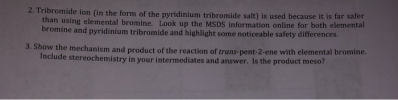 2. Tribromide ion (in the form of the pyridinium tribromide salt) is used because it is far safer than using elemental bromine. Look up the MSDS information online for both elemental bromine and pyridinium tribromide and highlight some noticeable safety differences. 3. Show the mechanism and product of the reaction of trans-pent-2-ene with elemental bromine. Include stereochemistry in your intermediates and answer. Is the product meso?
The use of pyridinium tribromide results in the formation of pyridinium bromide as a byproduct. Where...
 The use of pyridinium tribromide
results in the formation of pyridinium bromide as a byproduct.
Where does this end up in our experiment, and why does it not
contaminate our product?
160°C
The use of pyridinium tribromide
results in the formation of pyridinium bromide as a byproduct.
Where does this end up in our experiment, and why does it not
contaminate our product?
160°C
how could you tell if the reaction of trans stilbene + pyridinium tribromide to form 1,2...
how could you tell if the reaction of trans stilbene + pyridinium tribromide to form 1,2 dibromo-1,2 diphenylethane is stereospecific using melting point analysis?
Pre-Laboratory Assignment 1. What safety precautions must be observed when using (a) pyridinium tribromide? (b) acetic...
 Pre-Laboratory Assignment 1. What safety precautions must be observed when using (a) pyridinium tribromide? (b) acetic acid? 2. Calculate the theoretical yield for the bromination of both stilbenes and cinamic acid, assuming the presence of excess pyridinium tribromide. Note the theoretical yields here and in your laboratory notebook 3. Draw the mechanism, including the intermediate bromonium ion, generated in the bromination of trans-2-butene. 4. (a) Look up and draw structures for cinnamic acid, cis-stilbene, and trans-stilbene. (b) Predict the relative...
0.8002 g of (E)-cinnamic acid, 10 mL of glacial acetic acid and 1.7610g of pyridinium tribromide...
0.8002 g of (E)-cinnamic acid, 10 mL of glacial acetic acid and 1.7610g of pyridinium tribromide was heated under reflux to demonstrate the bromination of (E)-cinnamic acid. The mass of the final product was 3.4143 g and the melting point range was 175.4-203.4 ℃. What is the theoretical yield, actual yield, percent yield? Please show work! (Pyridinium tribromide and cinnamic reaction react in a 1:1 ratio).
what is the balanced chemical equation of pyridinium tribromide and E-stilbene that forms meso-stilbene dibromide?
what is the balanced chemical equation of pyridinium tribromide and E-stilbene that forms meso-stilbene dibromide?
What is the theoretical yield of 1mmol of trans cinnamic acid+1.2 mmols of pyridinium tribromide and...
What is the theoretical yield of 1mmol of trans cinnamic acid+1.2 mmols of pyridinium tribromide and what product is made? please note in this reaction acetic acid is added making me believe it is a catalyst.
A students weighed out 10.043 g aniline and reacted it with 40.497 g pyridinium tribromide. In...
 A students weighed out 10.043 g aniline and reacted it with 40.497 g pyridinium tribromide. In the end, they isolated 23.617 g pure 2,4,6-tribromoaniline. What was their percent yield? Type your answer rounded to the second decimal place without units or a percent sign (ex N.NN)
Suppose a student started with 133.0 mg of trans-cinnamic acid, 443 mg of pyridinium tribromide, and...
Suppose a student started with 133.0 mg of trans-cinnamic acid, 443 mg of pyridinium tribromide, and 2.60 mL of glacial acetic acid. After the reaction and workup, the student ended up with 0.1683 g of brominated product. Calculate the student\'s theoretical and percent yields.
2. Cover Page Questions 2.1. Draw the chemical structures of cinnamic acid, pyridinium tribromide and acetic...
 2. Cover Page Questions 2.1. Draw the chemical structures of cinnamic acid, pyridinium tribromide and acetic acid. Draw the reaction equation of the chemicals. (3 points) 2.2. What is the anti-addition reaction? Discuss the difference in the conformation of the resultant di-vicinal brominated compounds of cyclic alkenes and acyclic alkenes in the anti-addition reaction List the examples of the anti-addition bromination reaction of the cyclic and acyclic alkenes. (4 points)
 2. Tribromide ion (in the form of the pyridinium tribromide salt) is used because it is far safer than using elemental bromine. Look up the MSDS information online for both elemental bromine and pyridinium tribromide and highlight some noticeable safety differences. 3. Show the mechanism and product of the reaction of trans-pent-2-ene with elemental bromine. Include stereochemistry in your intermediates and answer. Is the product meso?
 The use of pyridinium tribromide
results in the formation of pyridinium bromide as a byproduct.
Where does this end up in our experiment, and why does it not
contaminate our product?
160°C
The use of pyridinium tribromide
results in the formation of pyridinium bromide as a byproduct.
Where does this end up in our experiment, and why does it not
contaminate our product?
160°C
 Pre-Laboratory Assignment 1. What safety precautions must be observed when using (a) pyridinium tribromide? (b) acetic acid? 2. Calculate the theoretical yield for the bromination of both stilbenes and cinamic acid, assuming the presence of excess pyridinium tribromide. Note the theoretical yields here and in your laboratory notebook 3. Draw the mechanism, including the intermediate bromonium ion, generated in the bromination of trans-2-butene. 4. (a) Look up and draw structures for cinnamic acid, cis-stilbene, and trans-stilbene. (b) Predict the relative...
 A students weighed out 10.043 g aniline and reacted it with 40.497 g pyridinium tribromide. In the end, they isolated 23.617 g pure 2,4,6-tribromoaniline. What was their percent yield? Type your answer rounded to the second decimal place without units or a percent sign (ex N.NN)
 2. Cover Page Questions 2.1. Draw the chemical structures of cinnamic acid, pyridinium tribromide and acetic acid. Draw the reaction equation of the chemicals. (3 points) 2.2. What is the anti-addition reaction? Discuss the difference in the conformation of the resultant di-vicinal brominated compounds of cyclic alkenes and acyclic alkenes in the anti-addition reaction List the examples of the anti-addition bromination reaction of the cyclic and acyclic alkenes. (4 points)
Most questions answered within 3 hours.
-
Where is the error in this code sequence?
String s1 = "Hello";
String s2 = "ello";...
asked 10 months ago -
Financial data for Joel de Paris, Inc., for last year
follow:
Joel de Paris, Inc.
Balance...
asked 10 months ago -
Consider this reaction:
Al2(SO4)3 (aq)+ BaCl3
(aq) Al2Cl6 (aq)- +
3BaSO4(s) . What is the...
asked 10 months ago -
Suppose that Savneet is considering increasing her
recent random sample from 20 car rentals to 40...
asked 10 months ago -
Trucks arrive at an unloading terminal at an average rate of 120
per hour.
Trucks arrive...
asked 10 months ago -
Why are methanol and ethanol completely soluble in water while
octanol is not very little soluble....
asked 10 months ago -
A facilities manager at a university reads in a research report
that the mean amount of...
asked 10 months ago -
When the CuSO4 is rehydrated by adding water to the anhydrous
compound, is this an endothermic...
asked 10 months ago -
A ray of sunlight is passing from diamond into crown glass; the
angle of incidence is...
asked 10 months ago -
A block of mass 0.249 kg is placed on top of a light, vertical
spring of...
asked 10 months ago -
how do the kidneys compensate in the presences of acidosis
a) trigger hyperventilate
b) reserve acid...
asked 10 months ago -
Question 501 pts
The rental rate of capital to the firm increases. Which of the
following...
asked 10 months ago