
Homework Answers
Add Answer to:
3. Circle the product for the following SN2 reaction: (1 mark) 4. What is the IUPAC...
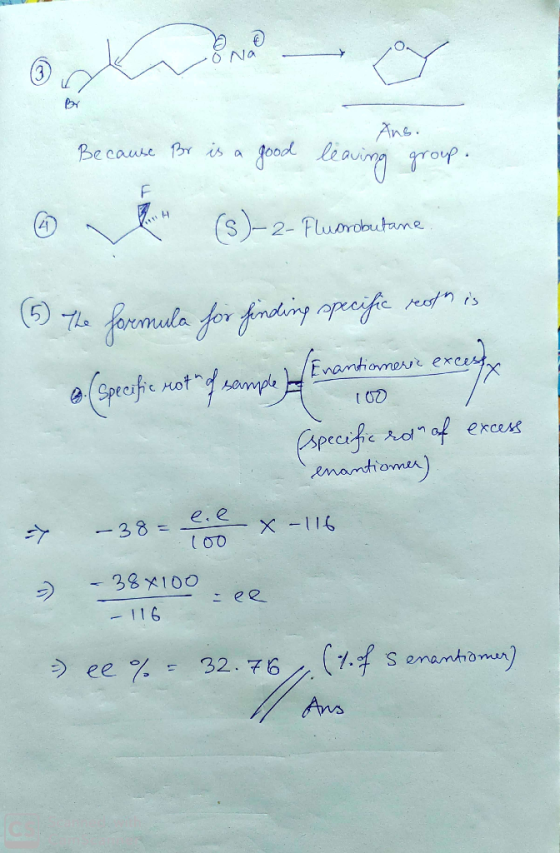
64. What is the percentage of the R enantionmer in a sample of limonene that has a specific rotation of-38, given...
 64. What is the percentage of the R enantionmer in a sample of limonene that has a specific rotation of-38, given that the specific rotation of (S)-limonene is-1 16? ) ug to noilor ofiooge odi at ted W SAC-FO Noitclon fooqa Ans: 8 o07 Ato oiqmse s lion
64. What is the percentage of the R enantionmer in a sample of limonene that has a specific rotation of-38, given...
 64. What is the percentage of the R enantionmer in a sample of limonene that has a specific rotation of-38, given that the specific rotation of (S)-limonene is-1 16? ) ug to noilor ofiooge odi at ted W SAC-FO Noitclon fooqa Ans: 8 o07 Ato oiqmse s lion
Write the reaction of hydration of 2-methyl-1-butene. What is the IUPAC name of the reaction product?...
Write the reaction of hydration of 2-methyl-1-butene. What is the IUPAC name of the reaction product? What is the IUPAC name for the compound below? Write the dehydration reaction of this compound. What is the name of the major product? CH3 OH || CH3 - CH - CH – CH3
question #4 Prelab Question #1: (answer the three prelab questions on this printed handout; this question...
 question #4
Prelab Question #1: (answer the three prelab questions on this printed handout; this question is 2) related to polarimetry of Limonene): A student dissolves 0.20g of pure R-Limonene in a total of 5 mL of ethanol using a volumetric flask. The student fills a 2 dm polarimetry tube with this solution and observes a rotation of + 8.2° from that sample. Calculate the specific rotation of the student's sample of R-Limonene. 102.5 Formula to use: [a] = 1075...
question #4
Prelab Question #1: (answer the three prelab questions on this printed handout; this question is 2) related to polarimetry of Limonene): A student dissolves 0.20g of pure R-Limonene in a total of 5 mL of ethanol using a volumetric flask. The student fills a 2 dm polarimetry tube with this solution and observes a rotation of + 8.2° from that sample. Calculate the specific rotation of the student's sample of R-Limonene. 102.5 Formula to use: [a] = 1075...
7. The IUPAC name for the he IUPAC name for the following compound is: hint: the...
 7. The IUPAC name for the he IUPAC name for the following compound is: hint: the OH controls the name a) 3-chloro-2-methylcyclohexanol b) 1-chloro-4-methylcyclohexanol c) 2-methyl-3-chlorocyclohexanol d) 2-methyl-5-chlorocyclohexanol e) 5-chloro-2-methylcyclohexanol 8. Which of the following cannot be an electrophile? b) BF, c) *NO d) Fel a) H e ) CH2=CH, BF 9. Based on the following energy diagram, which compound is formed faster? Reacton a) A from B b ) B from A c) Cfrom 8 d) CB from C...
1) What is the product and Mechanism for the following SN2 reaction? (5 Points) 2) What...
 1) What is the product and Mechanism for the following SN2 reaction? (5 Points) 2) What is/are the product(s) and Mechanism for the following E2 reaction? (5 Points) NaOCH 3) What is/are the product(s) and Mechanism for the following SN1/E1 Reaction? (5 Points) CH,CH,OH 4) What kind of reagent would be needed in order to get this SN2 product? (5 Points) SN2
S-3-chloro-3-methylhexane reacts with an iodide anion, I-. a) Will this reaction proceed via an SN1, SN2,...
S-3-chloro-3-methylhexane reacts with an iodide anion, I-. a) Will this reaction proceed via an SN1, SN2, E1, or E2 reaction mechanism? b) What is the IUPAC name of the product(s) of this reaction? Include R and S designations if relevant. c) After the reaction has occurred, will the product solution be optically active?
9. What is the IUPAC name of the product obtained by hydration reaction of the following...
 9. What is the IUPAC name of the product obtained by hydration reaction of the following alkene: Name Date tert two Husein ?? A. 2,3-Dimethyl-3-hexanol B. 2,3-Dimethyl-4-sulfatehexene C. 2,3-Dimethi-4-hydroxyhexane D. 2,3-Dimethyl-4-hexanol E. Alkenes do not show hydration reaction revious 7. Write the IUPAC name of following alkane. 8. What is the IUPAC name of the compound below? ce fach OH A. 2-Chloro-6-methylphenol B. 2-Chloro-6-methyl-1-phenol C. 3-Chloro-2-hydroxy-1-toluene D. 1-Chloro-5-methyl-1-hydroxybenzene E. Ortho-Chloro hydroxymethyl benzene
Predict the product for the following reaction. A B C D What is the IUPAC name...
 Predict the product for the following reaction. A B C D What is the IUPAC name for the following compound?
question 4 3) Provide IUPAC names for the following compounds including the correct stereochemical descriptors (i.e....
 question 4
3) Provide IUPAC names for the following compounds including the correct stereochemical descriptors (i.e. R and S). 4) The pure (R)-enantiomer of compound A has an optical rotation of +100°. Your sample of A has an optical rotation of -50°. What is the %ee of your sample and which enantiomer is more prevalent?
question 4
3) Provide IUPAC names for the following compounds including the correct stereochemical descriptors (i.e. R and S). 4) The pure (R)-enantiomer of compound A has an optical rotation of +100°. Your sample of A has an optical rotation of -50°. What is the %ee of your sample and which enantiomer is more prevalent?
 64. What is the percentage of the R enantionmer in a sample of limonene that has a specific rotation of-38, given that the specific rotation of (S)-limonene is-1 16? ) ug to noilor ofiooge odi at ted W SAC-FO Noitclon fooqa Ans: 8 o07 Ato oiqmse s lion
 64. What is the percentage of the R enantionmer in a sample of limonene that has a specific rotation of-38, given that the specific rotation of (S)-limonene is-1 16? ) ug to noilor ofiooge odi at ted W SAC-FO Noitclon fooqa Ans: 8 o07 Ato oiqmse s lion
 question #4
Prelab Question #1: (answer the three prelab questions on this printed handout; this question is 2) related to polarimetry of Limonene): A student dissolves 0.20g of pure R-Limonene in a total of 5 mL of ethanol using a volumetric flask. The student fills a 2 dm polarimetry tube with this solution and observes a rotation of + 8.2° from that sample. Calculate the specific rotation of the student's sample of R-Limonene. 102.5 Formula to use: [a] = 1075...
question #4
Prelab Question #1: (answer the three prelab questions on this printed handout; this question is 2) related to polarimetry of Limonene): A student dissolves 0.20g of pure R-Limonene in a total of 5 mL of ethanol using a volumetric flask. The student fills a 2 dm polarimetry tube with this solution and observes a rotation of + 8.2° from that sample. Calculate the specific rotation of the student's sample of R-Limonene. 102.5 Formula to use: [a] = 1075...
 7. The IUPAC name for the he IUPAC name for the following compound is: hint: the OH controls the name a) 3-chloro-2-methylcyclohexanol b) 1-chloro-4-methylcyclohexanol c) 2-methyl-3-chlorocyclohexanol d) 2-methyl-5-chlorocyclohexanol e) 5-chloro-2-methylcyclohexanol 8. Which of the following cannot be an electrophile? b) BF, c) *NO d) Fel a) H e ) CH2=CH, BF 9. Based on the following energy diagram, which compound is formed faster? Reacton a) A from B b ) B from A c) Cfrom 8 d) CB from C...
 1) What is the product and Mechanism for the following SN2 reaction? (5 Points) 2) What is/are the product(s) and Mechanism for the following E2 reaction? (5 Points) NaOCH 3) What is/are the product(s) and Mechanism for the following SN1/E1 Reaction? (5 Points) CH,CH,OH 4) What kind of reagent would be needed in order to get this SN2 product? (5 Points) SN2
 9. What is the IUPAC name of the product obtained by hydration reaction of the following alkene: Name Date tert two Husein ?? A. 2,3-Dimethyl-3-hexanol B. 2,3-Dimethyl-4-sulfatehexene C. 2,3-Dimethi-4-hydroxyhexane D. 2,3-Dimethyl-4-hexanol E. Alkenes do not show hydration reaction revious 7. Write the IUPAC name of following alkane. 8. What is the IUPAC name of the compound below? ce fach OH A. 2-Chloro-6-methylphenol B. 2-Chloro-6-methyl-1-phenol C. 3-Chloro-2-hydroxy-1-toluene D. 1-Chloro-5-methyl-1-hydroxybenzene E. Ortho-Chloro hydroxymethyl benzene
 Predict the product for the following reaction. A B C D What is the IUPAC name for the following compound?
 question 4
3) Provide IUPAC names for the following compounds including the correct stereochemical descriptors (i.e. R and S). 4) The pure (R)-enantiomer of compound A has an optical rotation of +100°. Your sample of A has an optical rotation of -50°. What is the %ee of your sample and which enantiomer is more prevalent?
question 4
3) Provide IUPAC names for the following compounds including the correct stereochemical descriptors (i.e. R and S). 4) The pure (R)-enantiomer of compound A has an optical rotation of +100°. Your sample of A has an optical rotation of -50°. What is the %ee of your sample and which enantiomer is more prevalent?
Most questions answered within 3 hours.
-
Where is the error in this code sequence?
String s1 = "Hello";
String s2 = "ello";...
asked 10 months ago -
Financial data for Joel de Paris, Inc., for last year
follow:
Joel de Paris, Inc.
Balance...
asked 10 months ago -
Consider this reaction:
Al2(SO4)3 (aq)+ BaCl3
(aq) Al2Cl6 (aq)- +
3BaSO4(s) . What is the...
asked 10 months ago -
Suppose that Savneet is considering increasing her
recent random sample from 20 car rentals to 40...
asked 10 months ago -
Trucks arrive at an unloading terminal at an average rate of 120
per hour.
Trucks arrive...
asked 10 months ago -
Why are methanol and ethanol completely soluble in water while
octanol is not very little soluble....
asked 10 months ago -
A facilities manager at a university reads in a research report
that the mean amount of...
asked 10 months ago -
When the CuSO4 is rehydrated by adding water to the anhydrous
compound, is this an endothermic...
asked 10 months ago -
A ray of sunlight is passing from diamond into crown glass; the
angle of incidence is...
asked 10 months ago -
A block of mass 0.249 kg is placed on top of a light, vertical
spring of...
asked 10 months ago -
how do the kidneys compensate in the presences of acidosis
a) trigger hyperventilate
b) reserve acid...
asked 10 months ago -
Question 501 pts
The rental rate of capital to the firm increases. Which of the
following...
asked 10 months ago