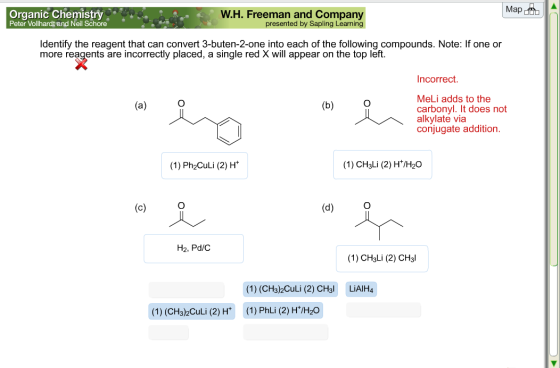
Identify the reagent that can convert 3-buten-2-one into each of the following compounds. Note: If one or more reagents are incorrectly placed, a single red X will appear on the top left.
(1) PH2CuLi (2) H+
(1) (CH3)2CuLi (2) CH3I
H2, Pd/C
(1) (CH3)2CuLi (2) H+
LiAlH4
(1) CH3Li (2) CH3I
(1) PhLi (2) H+/H2O
(1) CH3Li (2) H+/H2O
Homework Answers

Add Answer to:
Identify the reagent that can convert 3-buten-2-one into each of the following compounds. Note: If one or more reagents are incorrectly placed, a single red X will appear on the top left.
Hello, can you please help me out with these problems. Thanks in advance. What reagents and...
 Hello, can you please help me out with these problems. Thanks in
advance.
What reagents and conditions produce this transformation? 58. OH steps (A) 1. H2, Pd/C 3. NaOH, H2CO 4. NaBH4, CH3OH 5. Нзо", (CH3)2CO (B) 1. H2, Pd/C 2. NaBH4, CH OH 3. NaOH, Н.СО 4. pyridine-HCICrOs (PCC) 5. Нзо", (CH3)2CO (C) 1·Hao", (CH3)2CO 2. H Cros, H2S04, H2O 3. CH3MgBr 4. CHsCoH So2Cl (TsCl) 5. H2, Pd/C (D) 1. 1,3-butadiene, heat 2. H2, Pd/C 3. SOC12, pyridine...
Hello, can you please help me out with these problems. Thanks in
advance.
What reagents and conditions produce this transformation? 58. OH steps (A) 1. H2, Pd/C 3. NaOH, H2CO 4. NaBH4, CH3OH 5. Нзо", (CH3)2CO (B) 1. H2, Pd/C 2. NaBH4, CH OH 3. NaOH, Н.СО 4. pyridine-HCICrOs (PCC) 5. Нзо", (CH3)2CO (C) 1·Hao", (CH3)2CO 2. H Cros, H2S04, H2O 3. CH3MgBr 4. CHsCoH So2Cl (TsCl) 5. H2, Pd/C (D) 1. 1,3-butadiene, heat 2. H2, Pd/C 3. SOC12, pyridine...
In each reaction box, place the best reagent and conditions from the list below. CH3-C=O-OH 1....
In each reaction box, place the best reagent and conditions from the list below. CH3-C=O-OH 1. 2. __________________________________> CH3-C=(N-H)-H 3. 4. Possible reagents: CH3MgBr H2, Pd NH(CH3)2, cat. H3O+ CH3Br PCC NH2NH2 LiAlH4 NH2CH3, cat. H3O+ KMnO4 NH3,cat. H3O+ NaBH4 H2CrO4 H2O
Draw the product formed when 1-bromobutane is treated with cach reagent. 1. Li (2 equiv) 2....
 Draw the product formed when 1-bromobutane is treated with cach reagent. 1. Li (2 equiv) 2. Mg in (CHCH2):0 solvent 3. Li (2 equiv), then Cul (0.5 equiv) 4. The answer in (a), then H;O 5. The answer in (b), then D20 6. The answer in (a), then CH,CCH Draw the product formed when (CH3CH2CH2CH2) CuLi is treated with each compound. In so cases, no reaction occurs. CHн, ,then H,O Draw the product formed when the a.ß-unsaturated ketone A is...
Identify the reagents to be used in the following synthetic schemes: (Specify the reagents you would...
 Identify the reagents to be used in the following synthetic schemes: (Specify the reagents you would use to carry out the conversion by using letters from the table. Write the letters in the order that they are used, e.g., abc.) Scheme1 CH3 CH3 CH3 CH3 OH Scheme 2 Br CH3 H3C CH3 CH3 a. BH3, THF then H202, OH h. NBS, CCl b. PBr3 c. Mg, ether then H3o* d. (CH3)2Culi e. Br2 f. NaNH2, NH3 g. H2O, H2SO4, HgSO4...
From the table of available reagents select the one(s) you would use to convert butanoic acid...
 From the table of available reagents select the one(s) you would use to convert butanoic acid to each of the following products: (Use the minimum number of steps; from one to six are required. List reagents by letter in the order that they are used; example: f. NOTE: Assume that a normal aqueous (or mild acid) workup follows cach reaction, you do not need to add reagents for the workup.) Reagents Available a benzene/AlCl3 d. H2O, H,804 9. LIAIH 1....
Choose reagents to convert 2-cyclohexenone to the following compounds. Syntheses may require several steps. Use letters...
 Choose reagents to convert 2-cyclohexenone to the following compounds. Syntheses may require several steps. Use letters from the table to list reagents in the order used (first at the left) with no commas. Reagents 1. Li(CH3)2Cu 2. H30* 1. NaBHA 2. H30* NH3 / KOH 1. Li(CH3)2Cu 2. H30* CH2lz / Zn(Cu) /ether 1. Li(CH2=CH)2Cu 2. H30* (C6H5)3P*-CH2 b C k H2 over Pd/C 1. CH3 MgBr / dry ether 2 H30* HN(CH3)2 d H2NNH2 / KOH h KMnO4 /H30*...
Complete the following synthesis by selecting from the list of 14 reagents below. Each reagent (or...
 Complete the following synthesis by selecting from the list of 14 reagents below. Each reagent (or set of reagents) is labeled as a letter. In the answer box, simply place the order of reagents used as uppercase letters. For example, if your synthesis involves using reagent A followed by B and then C, and then D, your answer would be: ABCD. OLU SO3 Br2 PBra OH H2PO2 1. LiAlH4 2. H20 NaNO2 HCI H2SO4 FeBrz H2O, heat HNO3 NaBH3CN NBS...
please expain each one too. thank you! e reagents for the following chemoselective transformations. You may...
 please expain each one too. thank you!
e reagents for the following chemoselective transformations. You may select from the wa reagents and write the reagents above the reaction arrows. If the transformation takes two “1." and "2." to label each step (24 pts) ni wahuni on to gro no z no NaBH4; H:0: LiAlH4; Pd/C, H: Raney Ni, H; HO(CH3),Culi; ( CH2)2NLi (LDA) CH31: (CH3),COK: H.CrOs/H S04; pyridinium chlorochromate (PCC)
please expain each one too. thank you!
e reagents for the following chemoselective transformations. You may select from the wa reagents and write the reagents above the reaction arrows. If the transformation takes two “1." and "2." to label each step (24 pts) ni wahuni on to gro no z no NaBH4; H:0: LiAlH4; Pd/C, H: Raney Ni, H; HO(CH3),Culi; ( CH2)2NLi (LDA) CH31: (CH3),COK: H.CrOs/H S04; pyridinium chlorochromate (PCC)
Reactions and Reagents 17,37 Draw the product formed when pentanal (CH,CH,CH,CH,CHO) is treated with each reagent....
 Reactions and Reagents 17,37 Draw the product formed when pentanal (CH,CH,CH,CH,CHO) is treated with each reagent. With some reagents, no reaction occurs. a. NaBH. CH,OH e. Na,Cr,O, H,SO4, H,0 1. [1] (CH3)2CuLi; [2] HO b. [1] LIAIH[2] H,0 f. Ag,O, NH,OH J. [1] HCCN: (2] H,0 c. Hz. Pd-C g. (1] CHẠMgar, [2] HẠO k. [CH,CECLI: [2] H,0 d. PCC b. [1] CH, LH: (2] HẠO 1. The product in (a), then TBDMS-CI, Imidazole
1. 2. Show how you would synthesize benzylamine from each of these compounds, using the following...
 1.
2.
Show how you would synthesize benzylamine from each of these compounds, using the following available reagents More than one step may be required. Enter the letters of the reagents necessary, in the order that they are to be used. Do not separate the reagents with punctuation. OH CI Reagents Available (a) NH3 (b) excess NH3 (c) H*, A (d) SOCl2 (e) N3 (f) H2, Pd/C (g) LiAlH4 then H20 (h) NaOH (i) CO, H2, heat and pressure Previous...
1.
2.
Show how you would synthesize benzylamine from each of these compounds, using the following available reagents More than one step may be required. Enter the letters of the reagents necessary, in the order that they are to be used. Do not separate the reagents with punctuation. OH CI Reagents Available (a) NH3 (b) excess NH3 (c) H*, A (d) SOCl2 (e) N3 (f) H2, Pd/C (g) LiAlH4 then H20 (h) NaOH (i) CO, H2, heat and pressure Previous...
 Hello, can you please help me out with these problems. Thanks in
advance.
What reagents and conditions produce this transformation? 58. OH steps (A) 1. H2, Pd/C 3. NaOH, H2CO 4. NaBH4, CH3OH 5. Нзо", (CH3)2CO (B) 1. H2, Pd/C 2. NaBH4, CH OH 3. NaOH, Н.СО 4. pyridine-HCICrOs (PCC) 5. Нзо", (CH3)2CO (C) 1·Hao", (CH3)2CO 2. H Cros, H2S04, H2O 3. CH3MgBr 4. CHsCoH So2Cl (TsCl) 5. H2, Pd/C (D) 1. 1,3-butadiene, heat 2. H2, Pd/C 3. SOC12, pyridine...
Hello, can you please help me out with these problems. Thanks in
advance.
What reagents and conditions produce this transformation? 58. OH steps (A) 1. H2, Pd/C 3. NaOH, H2CO 4. NaBH4, CH3OH 5. Нзо", (CH3)2CO (B) 1. H2, Pd/C 2. NaBH4, CH OH 3. NaOH, Н.СО 4. pyridine-HCICrOs (PCC) 5. Нзо", (CH3)2CO (C) 1·Hao", (CH3)2CO 2. H Cros, H2S04, H2O 3. CH3MgBr 4. CHsCoH So2Cl (TsCl) 5. H2, Pd/C (D) 1. 1,3-butadiene, heat 2. H2, Pd/C 3. SOC12, pyridine...
 Draw the product formed when 1-bromobutane is treated with cach reagent. 1. Li (2 equiv) 2. Mg in (CHCH2):0 solvent 3. Li (2 equiv), then Cul (0.5 equiv) 4. The answer in (a), then H;O 5. The answer in (b), then D20 6. The answer in (a), then CH,CCH Draw the product formed when (CH3CH2CH2CH2) CuLi is treated with each compound. In so cases, no reaction occurs. CHн, ,then H,O Draw the product formed when the a.ß-unsaturated ketone A is...
 Identify the reagents to be used in the following synthetic schemes: (Specify the reagents you would use to carry out the conversion by using letters from the table. Write the letters in the order that they are used, e.g., abc.) Scheme1 CH3 CH3 CH3 CH3 OH Scheme 2 Br CH3 H3C CH3 CH3 a. BH3, THF then H202, OH h. NBS, CCl b. PBr3 c. Mg, ether then H3o* d. (CH3)2Culi e. Br2 f. NaNH2, NH3 g. H2O, H2SO4, HgSO4...
 From the table of available reagents select the one(s) you would use to convert butanoic acid to each of the following products: (Use the minimum number of steps; from one to six are required. List reagents by letter in the order that they are used; example: f. NOTE: Assume that a normal aqueous (or mild acid) workup follows cach reaction, you do not need to add reagents for the workup.) Reagents Available a benzene/AlCl3 d. H2O, H,804 9. LIAIH 1....
 Choose reagents to convert 2-cyclohexenone to the following compounds. Syntheses may require several steps. Use letters from the table to list reagents in the order used (first at the left) with no commas. Reagents 1. Li(CH3)2Cu 2. H30* 1. NaBHA 2. H30* NH3 / KOH 1. Li(CH3)2Cu 2. H30* CH2lz / Zn(Cu) /ether 1. Li(CH2=CH)2Cu 2. H30* (C6H5)3P*-CH2 b C k H2 over Pd/C 1. CH3 MgBr / dry ether 2 H30* HN(CH3)2 d H2NNH2 / KOH h KMnO4 /H30*...
 Complete the following synthesis by selecting from the list of 14 reagents below. Each reagent (or set of reagents) is labeled as a letter. In the answer box, simply place the order of reagents used as uppercase letters. For example, if your synthesis involves using reagent A followed by B and then C, and then D, your answer would be: ABCD. OLU SO3 Br2 PBra OH H2PO2 1. LiAlH4 2. H20 NaNO2 HCI H2SO4 FeBrz H2O, heat HNO3 NaBH3CN NBS...
 please expain each one too. thank you!
e reagents for the following chemoselective transformations. You may select from the wa reagents and write the reagents above the reaction arrows. If the transformation takes two “1." and "2." to label each step (24 pts) ni wahuni on to gro no z no NaBH4; H:0: LiAlH4; Pd/C, H: Raney Ni, H; HO(CH3),Culi; ( CH2)2NLi (LDA) CH31: (CH3),COK: H.CrOs/H S04; pyridinium chlorochromate (PCC)
please expain each one too. thank you!
e reagents for the following chemoselective transformations. You may select from the wa reagents and write the reagents above the reaction arrows. If the transformation takes two “1." and "2." to label each step (24 pts) ni wahuni on to gro no z no NaBH4; H:0: LiAlH4; Pd/C, H: Raney Ni, H; HO(CH3),Culi; ( CH2)2NLi (LDA) CH31: (CH3),COK: H.CrOs/H S04; pyridinium chlorochromate (PCC)
 Reactions and Reagents 17,37 Draw the product formed when pentanal (CH,CH,CH,CH,CHO) is treated with each reagent. With some reagents, no reaction occurs. a. NaBH. CH,OH e. Na,Cr,O, H,SO4, H,0 1. [1] (CH3)2CuLi; [2] HO b. [1] LIAIH[2] H,0 f. Ag,O, NH,OH J. [1] HCCN: (2] H,0 c. Hz. Pd-C g. (1] CHẠMgar, [2] HẠO k. [CH,CECLI: [2] H,0 d. PCC b. [1] CH, LH: (2] HẠO 1. The product in (a), then TBDMS-CI, Imidazole
 1.
2.
Show how you would synthesize benzylamine from each of these compounds, using the following available reagents More than one step may be required. Enter the letters of the reagents necessary, in the order that they are to be used. Do not separate the reagents with punctuation. OH CI Reagents Available (a) NH3 (b) excess NH3 (c) H*, A (d) SOCl2 (e) N3 (f) H2, Pd/C (g) LiAlH4 then H20 (h) NaOH (i) CO, H2, heat and pressure Previous...
1.
2.
Show how you would synthesize benzylamine from each of these compounds, using the following available reagents More than one step may be required. Enter the letters of the reagents necessary, in the order that they are to be used. Do not separate the reagents with punctuation. OH CI Reagents Available (a) NH3 (b) excess NH3 (c) H*, A (d) SOCl2 (e) N3 (f) H2, Pd/C (g) LiAlH4 then H20 (h) NaOH (i) CO, H2, heat and pressure Previous...
Most questions answered within 3 hours.
-
Where is the error in this code sequence?
String s1 = "Hello";
String s2 = "ello";...
asked 10 months ago -
Financial data for Joel de Paris, Inc., for last year
follow:
Joel de Paris, Inc.
Balance...
asked 10 months ago -
Consider this reaction:
Al2(SO4)3 (aq)+ BaCl3
(aq) Al2Cl6 (aq)- +
3BaSO4(s) . What is the...
asked 10 months ago -
Suppose that Savneet is considering increasing her
recent random sample from 20 car rentals to 40...
asked 10 months ago -
Trucks arrive at an unloading terminal at an average rate of 120
per hour.
Trucks arrive...
asked 10 months ago -
Why are methanol and ethanol completely soluble in water while
octanol is not very little soluble....
asked 10 months ago -
A facilities manager at a university reads in a research report
that the mean amount of...
asked 10 months ago -
When the CuSO4 is rehydrated by adding water to the anhydrous
compound, is this an endothermic...
asked 10 months ago -
A ray of sunlight is passing from diamond into crown glass; the
angle of incidence is...
asked 10 months ago -
A block of mass 0.249 kg is placed on top of a light, vertical
spring of...
asked 10 months ago -
how do the kidneys compensate in the presences of acidosis
a) trigger hyperventilate
b) reserve acid...
asked 10 months ago -
Question 501 pts
The rental rate of capital to the firm increases. Which of the
following...
asked 10 months ago