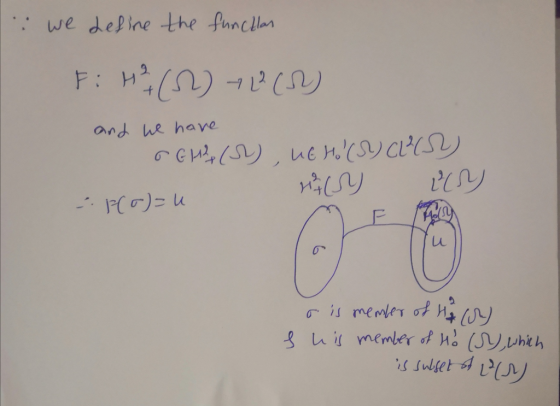
 can please explain why F(sigma)= u?
Homework Answers
Add Answer to:
can please explain why F(sigma)= u?
We consider the PDE: for given o(t) € H|(12) find...
2. Consider the following 1-D wave equation with initial condition u (x, 0)- F (x) where F(x) is a given function. a) Show that u (x, t)-F (x - t) is a solution to the given PDE. b) If the function F...
 2. Consider the following 1-D wave equation with initial condition u (x, 0)- F (x) where F(x) is a given function. a) Show that u (x, t)-F (x - t) is a solution to the given PDE. b) If the function F is given as 1; x< 10 x > 10 u(x, 0) = F(x) = use part (a) to write the solution u(x, t) c) Sketch u(x,0) and u(x,1) on the same u-versus-x graph d) Explain in your own...
Determine the system response y(t) for h(t)=u(t)+u(t-2) and x(t)=u(t). [Hint: use Laplace Transform multiplication: L[x(t)h(t)) =...
 Determine the system response y(t) for h(t)=u(t)+u(t-2) and x(t)=u(t). [Hint: use Laplace Transform multiplication: L[x(t)h(t)) = x(s)H(s). Useful Formula: Fourier Transform: F[f(t)] = F(w) sof(t)e-jw dt Inverse Fourier Transform: F-1[F(w)] = f (t) = 24., F(w)ejwidw Time Transformation property of Fourier Transform: f(at – to). FC)e=itoch Laplace Transform: L[f(t)] = F(s) = $© f(t)e-st dt Shifting property: L[f(t – to)u(t – to)] = e-toSF(s) e [tuce) = 1 and c [u(e) = )
Can anyone help with this question please? Given a domain Ω c R2 and a smooth function f,uo : Ω-+ R consider the proble...
 Can anyone help with this question please?
Given a domain Ω c R2 and a smooth function f,uo : Ω-+ R consider the problem Uz (x, t)-Au (x, t) + u(x, t) u(x, t = f(x) Y(x, t) E Ω × (0, oo), V(x, t) E 2 x (0, 00), Assume that u(z, t) is a smooth solution and that v(x) is a smooth stationary (i.e., time-independent) solution. Derive a PDE problem for the difference w(x, t)u(x, t)(x) By multiplying...
Can anyone help with this question please?
Given a domain Ω c R2 and a smooth function f,uo : Ω-+ R consider the problem Uz (x, t)-Au (x, t) + u(x, t) u(x, t = f(x) Y(x, t) E Ω × (0, oo), V(x, t) E 2 x (0, 00), Assume that u(z, t) is a smooth solution and that v(x) is a smooth stationary (i.e., time-independent) solution. Derive a PDE problem for the difference w(x, t)u(x, t)(x) By multiplying...
3. Consider the non homogeneous heat equation ut- urr+ 1 with non homogeneous boundary conditions u(0. t) 1, u(1t) (a) Find the equilibrium solution ueqx) to the non homogeneous equation. (b) The sol...
 3. Consider the non homogeneous heat equation ut- urr+ 1 with non homogeneous boundary conditions u(0. t) 1, u(1t) (a) Find the equilibrium solution ueqx) to the non homogeneous equation. (b) The solution w(r, t) to the homogenized PDE wt-Wra, with w(0,t,t)0 1S -1 Verify that ugen(x, t)Ue(x) +w(x, t) solves the full PDE and BCs (c) Let u(x,0)- f(x) - 2 - ^2 be the initial condition. Find the particular solution by specifying all Fourier coefficients
3. Consider the...
3. Consider the non homogeneous heat equation ut- urr+ 1 with non homogeneous boundary conditions u(0. t) 1, u(1t) (a) Find the equilibrium solution ueqx) to the non homogeneous equation. (b) The solution w(r, t) to the homogenized PDE wt-Wra, with w(0,t,t)0 1S -1 Verify that ugen(x, t)Ue(x) +w(x, t) solves the full PDE and BCs (c) Let u(x,0)- f(x) - 2 - ^2 be the initial condition. Find the particular solution by specifying all Fourier coefficients
3. Consider the...
solution help, tq. What is the Inverse Fourier transform of Your answer should be expressed as a function of t using the correct syntax. Inverse FT. is f(t) = Skipped F(u)-(15ru2 +4ιτω4)sgn(a)? Find...
 solution help, tq.
What is the Inverse Fourier transform of Your answer should be expressed as a function of t using the correct syntax. Inverse FT. is f(t) = Skipped F(u)-(15ru2 +4ιτω4)sgn(a)? Find the Inverse Fourier transform of: F(u)--8πΗ(w+5)-H(w-5) e- Your answer should be expressed as a function of t using the correct syntax. Inverse F.T. is ft)Skipped 8iu Find the Inverse Fourier transform of: F(w) 16 πυ) sgn(w)e-20 Your answer should be expressed as a function of t using...
solution help, tq.
What is the Inverse Fourier transform of Your answer should be expressed as a function of t using the correct syntax. Inverse FT. is f(t) = Skipped F(u)-(15ru2 +4ιτω4)sgn(a)? Find the Inverse Fourier transform of: F(u)--8πΗ(w+5)-H(w-5) e- Your answer should be expressed as a function of t using the correct syntax. Inverse F.T. is ft)Skipped 8iu Find the Inverse Fourier transform of: F(w) 16 πυ) sgn(w)e-20 Your answer should be expressed as a function of t using...
That is u(x,0)-f(x) where f(x) (L-x)/(L-a), a<x<L. (a) State the problem including the PDE and all boundary and i...
 That is u(x,0)-f(x) where f(x) (L-x)/(L-a), a<x<L. (a) State the problem including the PDE and all boundary and initial conditions (b) Using separation of variables find the displacement u(z,t) for any 0 < z < L, and t > 0. (c) Using values of L = 65 cm, a 15 cm and c-10 cm/sec, produce a surface plot of your solution over the length of the string and the time interval 0<t<10. Include the first 20 terms of your series...
thank you for the help :) Question Question 17 (2 marks) Attempt 1 f(t) satisfies the integral equation: f(t)-5 | f(t-u) e-liu H(u) du=12 sgn(t-2) Find the solution of the integral equation using...
 thank you for the help :)
Question Question 17 (2 marks) Attempt 1 f(t) satisfies the integral equation: f(t)-5 | f(t-u) e-liu H(u) du=12 sgn(t-2) Find the solution of the integral equation using Fourier transforms. Your answer should be expressed as a function of t using the correct syntax f() Skipped
Question Question 17 (2 marks) Attempt 1 f(t) satisfies the integral equation: f(t)-5 | f(t-u) e-liu H(u) du=12 sgn(t-2) Find the solution of the integral equation using Fourier transforms....
thank you for the help :)
Question Question 17 (2 marks) Attempt 1 f(t) satisfies the integral equation: f(t)-5 | f(t-u) e-liu H(u) du=12 sgn(t-2) Find the solution of the integral equation using Fourier transforms. Your answer should be expressed as a function of t using the correct syntax f() Skipped
Question Question 17 (2 marks) Attempt 1 f(t) satisfies the integral equation: f(t)-5 | f(t-u) e-liu H(u) du=12 sgn(t-2) Find the solution of the integral equation using Fourier transforms....
Question 13 (2 marks) Attempt 1 ,2/144-aw Find the Inverse Fourier transform of: Te-v F(u)--3 Your answer should be expressed as a function of t using the correct syntax. Inverse F.T. is f(t)- Skippe...
 Question 13 (2 marks) Attempt 1 ,2/144-aw Find the Inverse Fourier transform of: Te-v F(u)--3 Your answer should be expressed as a function of t using the correct syntax. Inverse F.T. is f(t)- Skipped a Screen Shot 2019-05-17 at 2.07.40 AM Search Question 14 (2 marks) Attempt 1 Find the inverse Fourier transform of: F(w-5 π w sgn(w) e-Tw Your answer should be expressed as a function of t using the correct syntax. Inverse F.T. is f(t)- Skipped Question 15...
please solve, previous ones all wrong! Question 11 1 mark) Attempt 2 What is the Inverse Fourier transform of F(u)- 10-5? Reflection: F-1[F(-u)]=f(-t) Your answer should be expressed as a function of...
 please solve, previous ones all wrong!
Question 11 1 mark) Attempt 2 What is the Inverse Fourier transform of F(u)- 10-5? Reflection: F-1[F(-u)]=f(-t) Your answer should be expressed as a function of t using the correct syntax. Inverse F.T. is f(t) Question 12 (T mark) Attempt 2 What is the Inverse Fourier transform of: 7 16+iw-4)2 Reflection: F--) Your answer should be expressed as a function of t using the correct syntax. Inverse F.T. is f(t) Question 13 (2 marks)...
please solve, previous ones all wrong!
Question 11 1 mark) Attempt 2 What is the Inverse Fourier transform of F(u)- 10-5? Reflection: F-1[F(-u)]=f(-t) Your answer should be expressed as a function of t using the correct syntax. Inverse F.T. is f(t) Question 12 (T mark) Attempt 2 What is the Inverse Fourier transform of: 7 16+iw-4)2 Reflection: F--) Your answer should be expressed as a function of t using the correct syntax. Inverse F.T. is f(t) Question 13 (2 marks)...
Mark which statements below are true, using the following Consider the diffusion problem u(0,t)=0...
 Mark which statements below are true, using the following Consider the diffusion problem u(0,t)=0, u(L,t)=50 where FER is a constant, forcing term Any attempt to solve this using separation of variables fails. This is because the PDE is not homogeneous. A more fruitful approach arises from splitting the solution into the sum of two u(z,t) = X(z)T(t) + us(z), where the subscript designates the function as the steady limit and does not represent a derlvative. BEWARE: MARKING A STATEMENT TRUE...
 2. Consider the following 1-D wave equation with initial condition u (x, 0)- F (x) where F(x) is a given function. a) Show that u (x, t)-F (x - t) is a solution to the given PDE. b) If the function F is given as 1; x< 10 x > 10 u(x, 0) = F(x) = use part (a) to write the solution u(x, t) c) Sketch u(x,0) and u(x,1) on the same u-versus-x graph d) Explain in your own...
 Determine the system response y(t) for h(t)=u(t)+u(t-2) and x(t)=u(t). [Hint: use Laplace Transform multiplication: L[x(t)h(t)) = x(s)H(s). Useful Formula: Fourier Transform: F[f(t)] = F(w) sof(t)e-jw dt Inverse Fourier Transform: F-1[F(w)] = f (t) = 24., F(w)ejwidw Time Transformation property of Fourier Transform: f(at – to). FC)e=itoch Laplace Transform: L[f(t)] = F(s) = $© f(t)e-st dt Shifting property: L[f(t – to)u(t – to)] = e-toSF(s) e [tuce) = 1 and c [u(e) = )
 Can anyone help with this question please?
Given a domain Ω c R2 and a smooth function f,uo : Ω-+ R consider the problem Uz (x, t)-Au (x, t) + u(x, t) u(x, t = f(x) Y(x, t) E Ω × (0, oo), V(x, t) E 2 x (0, 00), Assume that u(z, t) is a smooth solution and that v(x) is a smooth stationary (i.e., time-independent) solution. Derive a PDE problem for the difference w(x, t)u(x, t)(x) By multiplying...
Can anyone help with this question please?
Given a domain Ω c R2 and a smooth function f,uo : Ω-+ R consider the problem Uz (x, t)-Au (x, t) + u(x, t) u(x, t = f(x) Y(x, t) E Ω × (0, oo), V(x, t) E 2 x (0, 00), Assume that u(z, t) is a smooth solution and that v(x) is a smooth stationary (i.e., time-independent) solution. Derive a PDE problem for the difference w(x, t)u(x, t)(x) By multiplying...
 3. Consider the non homogeneous heat equation ut- urr+ 1 with non homogeneous boundary conditions u(0. t) 1, u(1t) (a) Find the equilibrium solution ueqx) to the non homogeneous equation. (b) The solution w(r, t) to the homogenized PDE wt-Wra, with w(0,t,t)0 1S -1 Verify that ugen(x, t)Ue(x) +w(x, t) solves the full PDE and BCs (c) Let u(x,0)- f(x) - 2 - ^2 be the initial condition. Find the particular solution by specifying all Fourier coefficients
3. Consider the...
3. Consider the non homogeneous heat equation ut- urr+ 1 with non homogeneous boundary conditions u(0. t) 1, u(1t) (a) Find the equilibrium solution ueqx) to the non homogeneous equation. (b) The solution w(r, t) to the homogenized PDE wt-Wra, with w(0,t,t)0 1S -1 Verify that ugen(x, t)Ue(x) +w(x, t) solves the full PDE and BCs (c) Let u(x,0)- f(x) - 2 - ^2 be the initial condition. Find the particular solution by specifying all Fourier coefficients
3. Consider the...
 solution help, tq.
What is the Inverse Fourier transform of Your answer should be expressed as a function of t using the correct syntax. Inverse FT. is f(t) = Skipped F(u)-(15ru2 +4ιτω4)sgn(a)? Find the Inverse Fourier transform of: F(u)--8πΗ(w+5)-H(w-5) e- Your answer should be expressed as a function of t using the correct syntax. Inverse F.T. is ft)Skipped 8iu Find the Inverse Fourier transform of: F(w) 16 πυ) sgn(w)e-20 Your answer should be expressed as a function of t using...
solution help, tq.
What is the Inverse Fourier transform of Your answer should be expressed as a function of t using the correct syntax. Inverse FT. is f(t) = Skipped F(u)-(15ru2 +4ιτω4)sgn(a)? Find the Inverse Fourier transform of: F(u)--8πΗ(w+5)-H(w-5) e- Your answer should be expressed as a function of t using the correct syntax. Inverse F.T. is ft)Skipped 8iu Find the Inverse Fourier transform of: F(w) 16 πυ) sgn(w)e-20 Your answer should be expressed as a function of t using...
 That is u(x,0)-f(x) where f(x) (L-x)/(L-a), a<x<L. (a) State the problem including the PDE and all boundary and initial conditions (b) Using separation of variables find the displacement u(z,t) for any 0 < z < L, and t > 0. (c) Using values of L = 65 cm, a 15 cm and c-10 cm/sec, produce a surface plot of your solution over the length of the string and the time interval 0<t<10. Include the first 20 terms of your series...
 thank you for the help :)
Question Question 17 (2 marks) Attempt 1 f(t) satisfies the integral equation: f(t)-5 | f(t-u) e-liu H(u) du=12 sgn(t-2) Find the solution of the integral equation using Fourier transforms. Your answer should be expressed as a function of t using the correct syntax f() Skipped
Question Question 17 (2 marks) Attempt 1 f(t) satisfies the integral equation: f(t)-5 | f(t-u) e-liu H(u) du=12 sgn(t-2) Find the solution of the integral equation using Fourier transforms....
thank you for the help :)
Question Question 17 (2 marks) Attempt 1 f(t) satisfies the integral equation: f(t)-5 | f(t-u) e-liu H(u) du=12 sgn(t-2) Find the solution of the integral equation using Fourier transforms. Your answer should be expressed as a function of t using the correct syntax f() Skipped
Question Question 17 (2 marks) Attempt 1 f(t) satisfies the integral equation: f(t)-5 | f(t-u) e-liu H(u) du=12 sgn(t-2) Find the solution of the integral equation using Fourier transforms....
 Question 13 (2 marks) Attempt 1 ,2/144-aw Find the Inverse Fourier transform of: Te-v F(u)--3 Your answer should be expressed as a function of t using the correct syntax. Inverse F.T. is f(t)- Skipped a Screen Shot 2019-05-17 at 2.07.40 AM Search Question 14 (2 marks) Attempt 1 Find the inverse Fourier transform of: F(w-5 π w sgn(w) e-Tw Your answer should be expressed as a function of t using the correct syntax. Inverse F.T. is f(t)- Skipped Question 15...
 please solve, previous ones all wrong!
Question 11 1 mark) Attempt 2 What is the Inverse Fourier transform of F(u)- 10-5? Reflection: F-1[F(-u)]=f(-t) Your answer should be expressed as a function of t using the correct syntax. Inverse F.T. is f(t) Question 12 (T mark) Attempt 2 What is the Inverse Fourier transform of: 7 16+iw-4)2 Reflection: F--) Your answer should be expressed as a function of t using the correct syntax. Inverse F.T. is f(t) Question 13 (2 marks)...
please solve, previous ones all wrong!
Question 11 1 mark) Attempt 2 What is the Inverse Fourier transform of F(u)- 10-5? Reflection: F-1[F(-u)]=f(-t) Your answer should be expressed as a function of t using the correct syntax. Inverse F.T. is f(t) Question 12 (T mark) Attempt 2 What is the Inverse Fourier transform of: 7 16+iw-4)2 Reflection: F--) Your answer should be expressed as a function of t using the correct syntax. Inverse F.T. is f(t) Question 13 (2 marks)...
 Mark which statements below are true, using the following Consider the diffusion problem u(0,t)=0, u(L,t)=50 where FER is a constant, forcing term Any attempt to solve this using separation of variables fails. This is because the PDE is not homogeneous. A more fruitful approach arises from splitting the solution into the sum of two u(z,t) = X(z)T(t) + us(z), where the subscript designates the function as the steady limit and does not represent a derlvative. BEWARE: MARKING A STATEMENT TRUE...
Most questions answered within 3 hours.
-
Where is the error in this code sequence?
String s1 = "Hello";
String s2 = "ello";...
asked 10 months ago -
Financial data for Joel de Paris, Inc., for last year
follow:
Joel de Paris, Inc.
Balance...
asked 10 months ago -
Consider this reaction:
Al2(SO4)3 (aq)+ BaCl3
(aq) Al2Cl6 (aq)- +
3BaSO4(s) . What is the...
asked 10 months ago -
Suppose that Savneet is considering increasing her
recent random sample from 20 car rentals to 40...
asked 10 months ago -
Trucks arrive at an unloading terminal at an average rate of 120
per hour.
Trucks arrive...
asked 10 months ago -
Why are methanol and ethanol completely soluble in water while
octanol is not very little soluble....
asked 10 months ago -
A facilities manager at a university reads in a research report
that the mean amount of...
asked 10 months ago -
When the CuSO4 is rehydrated by adding water to the anhydrous
compound, is this an endothermic...
asked 10 months ago -
A ray of sunlight is passing from diamond into crown glass; the
angle of incidence is...
asked 10 months ago -
A block of mass 0.249 kg is placed on top of a light, vertical
spring of...
asked 10 months ago -
how do the kidneys compensate in the presences of acidosis
a) trigger hyperventilate
b) reserve acid...
asked 10 months ago -
Question 501 pts
The rental rate of capital to the firm increases. Which of the
following...
asked 10 months ago