Please make sure to select the rirght answer.
Homework Answers
 thank
you
thank
you
Please UPVOTE
Add Answer to:
Please make sure to select the rirght answer.
thanks
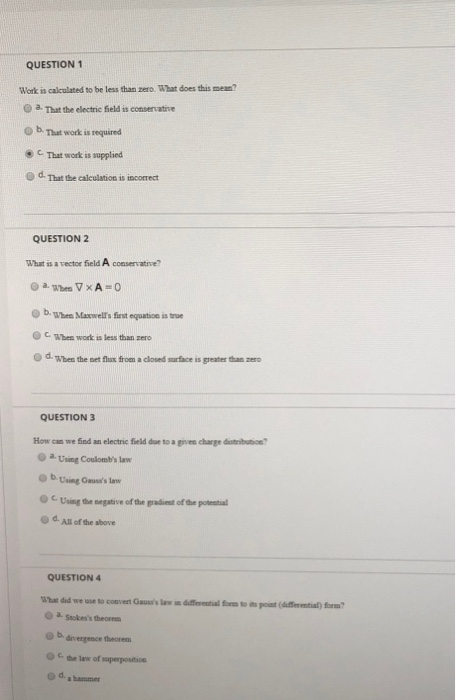
QUESTION 1 Work is calculated to be...
Please could you help me solving this question By saying that the electrostatic filed is conservative,...
 Please could you help me solving this question
By saying that the electrostatic filed is conservative, we do NOT mean that Its curl is identically zero. It is the opposite of the gradient of a scalar potential. The absolute potential at a point is defined relatively to the zero potential location. The work done in a closed path inside the field is zero. The divergence of the electric flux density at a point is equal to the charge density at...
Please could you help me solving this question
By saying that the electrostatic filed is conservative, we do NOT mean that Its curl is identically zero. It is the opposite of the gradient of a scalar potential. The absolute potential at a point is defined relatively to the zero potential location. The work done in a closed path inside the field is zero. The divergence of the electric flux density at a point is equal to the charge density at...
Please look at my answer and make corrections. It is not possible to have an electric...
Please look at my answer and make corrections. It is not possible to have an electric field line be a closed loop. Explain why this is true using potential and/or equipotential lines. Hints: The focus should not be on talking about charge distributions. My answer: Because the force of electric fields is conservative, the change in potential energy from arbitrary points A to B should be the same magnitude as B to A regardless of the path taken. A closed...
I really hope you can give me a complete answer and explain it , please don‘t Answer if you cannot I will definitely rate a good answer. thanks Show that the 3D force field is a conservative fiel...
 I
really hope you can give me a complete answer and explain it ,
please don‘t Answer if you cannot
I will definitely rate a good answer. thanks
Show that the 3D force field is a conservative field. Find the work done against the force when moving from Write down (i) an expression for the gradient of a 3D scalar field Ф(x, y, z) and (ii) the pseudo-determinant expression for the curl of a vector field v. Then show that...
I
really hope you can give me a complete answer and explain it ,
please don‘t Answer if you cannot
I will definitely rate a good answer. thanks
Show that the 3D force field is a conservative field. Find the work done against the force when moving from Write down (i) an expression for the gradient of a 3D scalar field Ф(x, y, z) and (ii) the pseudo-determinant expression for the curl of a vector field v. Then show that...
In red, are the answers, please show the work for each:) 1. Two particles with charges,...
 In red, are the answers, please
show the work for each:)
1. Two particles with charges, q 3 x 10⁶ C and q2 12 x 106 C, are located along the x-axis at positions with coordinates (0, 0) and (4, 0) m respectively. All distances are n meters. (a) At what point along the x-axis, other than infinity, should a third charge q3 5 x 10 C be placed such that the net electric force on it is zero? (b)...
In red, are the answers, please
show the work for each:)
1. Two particles with charges, q 3 x 10⁶ C and q2 12 x 106 C, are located along the x-axis at positions with coordinates (0, 0) and (4, 0) m respectively. All distances are n meters. (a) At what point along the x-axis, other than infinity, should a third charge q3 5 x 10 C be placed such that the net electric force on it is zero? (b)...
Please show all the work to complete the question and explain each step, please. Thank you! Let F(x, y) e*y (y cos x -...
 Please show all the work to complete the question and explain
each step, please. Thank you!
Let F(x, y) e*y (y cos x - centered at (1,0) in the first quadrant, traced clockwise from (0,0) to (2, 0). And suppose that C2 is the line from (0,0) to (2,0). sin x) xexy cos xj. Suppose that C1 is the half of the unit circle (A) Use the curl test to determine whether F is a gradient vector field or not....
Please show all the work to complete the question and explain
each step, please. Thank you!
Let F(x, y) e*y (y cos x - centered at (1,0) in the first quadrant, traced clockwise from (0,0) to (2, 0). And suppose that C2 is the line from (0,0) to (2,0). sin x) xexy cos xj. Suppose that C1 is the half of the unit circle (A) Use the curl test to determine whether F is a gradient vector field or not....
Answer question #4 with ALL work shown. Make sure to show units at every step. Please...
 Answer question #4 with ALL work shown. Make sure to show units at
every step. Please write neatly and not in cursive so I can read
it. Thanks!
4, (10 points) A uniform line of charge with charge density λ extends along the x axis from-a to +a. Find the electric field at a point on the y axis
Answer question #4 with ALL work shown. Make sure to show units at
every step. Please write neatly and not in cursive so I can read
it. Thanks!
4, (10 points) A uniform line of charge with charge density λ extends along the x axis from-a to +a. Find the electric field at a point on the y axis
Question 14 1 pts If the price elasticity of supply was calculated as 0.40 for a...
 Question 14 1 pts If the price elasticity of supply was calculated as 0.40 for a product and the price increases by 12%, what would happen to the quantity supplied? O Quantity supplied would increase by 8%. O Quantity supplied would increase by 6.3%. O Quantity supplied would increase by 4.8%. Question 15 1 pts As we move along a typical negatively sloping, linear demand curve O the elasticity is constant. it results in elasticity and slope being the same....
Please answer this question and show your work please. Thanks! 2- Explain what types of carriers...
 Please answer this question and show your work please.
Thanks!
2- Explain what types of carriers are present in space charge region? Why is it called depletion region? Why an electric field is produced in a depletion region of a pn-junction.
Please answer this question and show your work please.
Thanks!
2- Explain what types of carriers are present in space charge region? Why is it called depletion region? Why an electric field is produced in a depletion region of a pn-junction.
I need help with all these please! Thanks! 1. Two identical metal balls are suspended by...
 I need help with all these please! Thanks!
1. Two identical metal balls are suspended by insulating threads. Both balls have the same net charge. In this problem, do not assume the balls are point charges Ball 2 a. Draw a separate free-body diagram for each ball. Label the forces to indicate: . the object exerting the force, the object on which the force is exerted, • the type of force (gravitational, normal etc.), and • whether the force is...
I need help with all these please! Thanks!
1. Two identical metal balls are suspended by insulating threads. Both balls have the same net charge. In this problem, do not assume the balls are point charges Ball 2 a. Draw a separate free-body diagram for each ball. Label the forces to indicate: . the object exerting the force, the object on which the force is exerted, • the type of force (gravitational, normal etc.), and • whether the force is...
Cool down question number 1. Please make sure to include not only the magnitude, but also...
 Cool down question number 1. Please make sure to include not
only the magnitude, but also the DIRECTION. Please show all work,
detailed, step by step.
Thank you.
Cool Down(s) 1. Think about your work during the recent electric field lab and then consider the plot shown in figure Q21.6 on page 694 of your text. What are the magnitude and direction (to the right or to the lef of the electric field at the position x2.5mP 3. Consider figure...
Cool down question number 1. Please make sure to include not
only the magnitude, but also the DIRECTION. Please show all work,
detailed, step by step.
Thank you.
Cool Down(s) 1. Think about your work during the recent electric field lab and then consider the plot shown in figure Q21.6 on page 694 of your text. What are the magnitude and direction (to the right or to the lef of the electric field at the position x2.5mP 3. Consider figure...
 Please could you help me solving this question
By saying that the electrostatic filed is conservative, we do NOT mean that Its curl is identically zero. It is the opposite of the gradient of a scalar potential. The absolute potential at a point is defined relatively to the zero potential location. The work done in a closed path inside the field is zero. The divergence of the electric flux density at a point is equal to the charge density at...
Please could you help me solving this question
By saying that the electrostatic filed is conservative, we do NOT mean that Its curl is identically zero. It is the opposite of the gradient of a scalar potential. The absolute potential at a point is defined relatively to the zero potential location. The work done in a closed path inside the field is zero. The divergence of the electric flux density at a point is equal to the charge density at...
 I
really hope you can give me a complete answer and explain it ,
please don‘t Answer if you cannot
I will definitely rate a good answer. thanks
Show that the 3D force field is a conservative field. Find the work done against the force when moving from Write down (i) an expression for the gradient of a 3D scalar field Ф(x, y, z) and (ii) the pseudo-determinant expression for the curl of a vector field v. Then show that...
I
really hope you can give me a complete answer and explain it ,
please don‘t Answer if you cannot
I will definitely rate a good answer. thanks
Show that the 3D force field is a conservative field. Find the work done against the force when moving from Write down (i) an expression for the gradient of a 3D scalar field Ф(x, y, z) and (ii) the pseudo-determinant expression for the curl of a vector field v. Then show that...
 In red, are the answers, please
show the work for each:)
1. Two particles with charges, q 3 x 10⁶ C and q2 12 x 106 C, are located along the x-axis at positions with coordinates (0, 0) and (4, 0) m respectively. All distances are n meters. (a) At what point along the x-axis, other than infinity, should a third charge q3 5 x 10 C be placed such that the net electric force on it is zero? (b)...
In red, are the answers, please
show the work for each:)
1. Two particles with charges, q 3 x 10⁶ C and q2 12 x 106 C, are located along the x-axis at positions with coordinates (0, 0) and (4, 0) m respectively. All distances are n meters. (a) At what point along the x-axis, other than infinity, should a third charge q3 5 x 10 C be placed such that the net electric force on it is zero? (b)...
 Please show all the work to complete the question and explain
each step, please. Thank you!
Let F(x, y) e*y (y cos x - centered at (1,0) in the first quadrant, traced clockwise from (0,0) to (2, 0). And suppose that C2 is the line from (0,0) to (2,0). sin x) xexy cos xj. Suppose that C1 is the half of the unit circle (A) Use the curl test to determine whether F is a gradient vector field or not....
Please show all the work to complete the question and explain
each step, please. Thank you!
Let F(x, y) e*y (y cos x - centered at (1,0) in the first quadrant, traced clockwise from (0,0) to (2, 0). And suppose that C2 is the line from (0,0) to (2,0). sin x) xexy cos xj. Suppose that C1 is the half of the unit circle (A) Use the curl test to determine whether F is a gradient vector field or not....
 Answer question #4 with ALL work shown. Make sure to show units at
every step. Please write neatly and not in cursive so I can read
it. Thanks!
4, (10 points) A uniform line of charge with charge density λ extends along the x axis from-a to +a. Find the electric field at a point on the y axis
Answer question #4 with ALL work shown. Make sure to show units at
every step. Please write neatly and not in cursive so I can read
it. Thanks!
4, (10 points) A uniform line of charge with charge density λ extends along the x axis from-a to +a. Find the electric field at a point on the y axis
 Question 14 1 pts If the price elasticity of supply was calculated as 0.40 for a product and the price increases by 12%, what would happen to the quantity supplied? O Quantity supplied would increase by 8%. O Quantity supplied would increase by 6.3%. O Quantity supplied would increase by 4.8%. Question 15 1 pts As we move along a typical negatively sloping, linear demand curve O the elasticity is constant. it results in elasticity and slope being the same....
 Please answer this question and show your work please.
Thanks!
2- Explain what types of carriers are present in space charge region? Why is it called depletion region? Why an electric field is produced in a depletion region of a pn-junction.
Please answer this question and show your work please.
Thanks!
2- Explain what types of carriers are present in space charge region? Why is it called depletion region? Why an electric field is produced in a depletion region of a pn-junction.
 I need help with all these please! Thanks!
1. Two identical metal balls are suspended by insulating threads. Both balls have the same net charge. In this problem, do not assume the balls are point charges Ball 2 a. Draw a separate free-body diagram for each ball. Label the forces to indicate: . the object exerting the force, the object on which the force is exerted, • the type of force (gravitational, normal etc.), and • whether the force is...
I need help with all these please! Thanks!
1. Two identical metal balls are suspended by insulating threads. Both balls have the same net charge. In this problem, do not assume the balls are point charges Ball 2 a. Draw a separate free-body diagram for each ball. Label the forces to indicate: . the object exerting the force, the object on which the force is exerted, • the type of force (gravitational, normal etc.), and • whether the force is...
 Cool down question number 1. Please make sure to include not
only the magnitude, but also the DIRECTION. Please show all work,
detailed, step by step.
Thank you.
Cool Down(s) 1. Think about your work during the recent electric field lab and then consider the plot shown in figure Q21.6 on page 694 of your text. What are the magnitude and direction (to the right or to the lef of the electric field at the position x2.5mP 3. Consider figure...
Cool down question number 1. Please make sure to include not
only the magnitude, but also the DIRECTION. Please show all work,
detailed, step by step.
Thank you.
Cool Down(s) 1. Think about your work during the recent electric field lab and then consider the plot shown in figure Q21.6 on page 694 of your text. What are the magnitude and direction (to the right or to the lef of the electric field at the position x2.5mP 3. Consider figure...
Most questions answered within 3 hours.
-
Where is the error in this code sequence?
String s1 = "Hello";
String s2 = "ello";...
asked 10 months ago -
Financial data for Joel de Paris, Inc., for last year
follow:
Joel de Paris, Inc.
Balance...
asked 10 months ago -
Consider this reaction:
Al2(SO4)3 (aq)+ BaCl3
(aq) Al2Cl6 (aq)- +
3BaSO4(s) . What is the...
asked 10 months ago -
Suppose that Savneet is considering increasing her
recent random sample from 20 car rentals to 40...
asked 10 months ago -
Trucks arrive at an unloading terminal at an average rate of 120
per hour.
Trucks arrive...
asked 10 months ago -
Why are methanol and ethanol completely soluble in water while
octanol is not very little soluble....
asked 10 months ago -
A facilities manager at a university reads in a research report
that the mean amount of...
asked 10 months ago -
When the CuSO4 is rehydrated by adding water to the anhydrous
compound, is this an endothermic...
asked 10 months ago -
A ray of sunlight is passing from diamond into crown glass; the
angle of incidence is...
asked 10 months ago -
A block of mass 0.249 kg is placed on top of a light, vertical
spring of...
asked 10 months ago -
how do the kidneys compensate in the presences of acidosis
a) trigger hyperventilate
b) reserve acid...
asked 10 months ago -
Question 501 pts
The rental rate of capital to the firm increases. Which of the
following...
asked 10 months ago