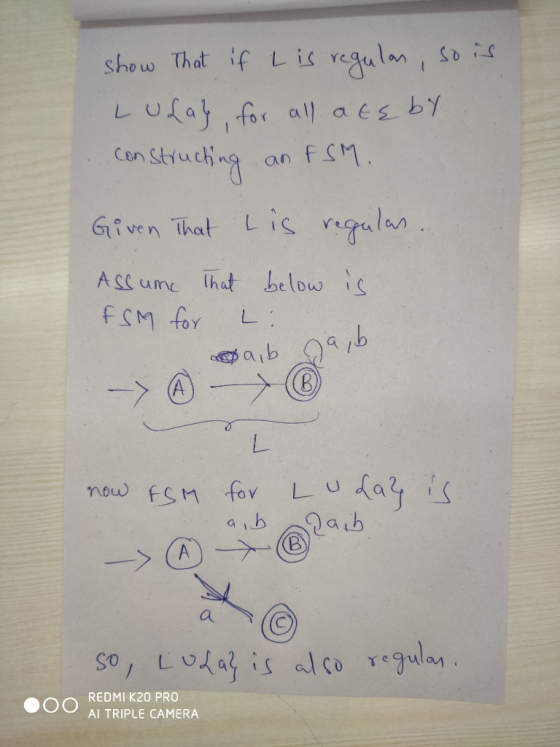
Show that if L is regular, so is L U {a}, for all a ∈ Σ...
Show that if L is regular, so is L U {a}, for all a ∈ Σ by constructing an FSM.
Homework Answers
Show that L = {w|w = a2n} is not regular, where Σ = {a}.
Show that L = {w|w = a2n} is not regular, where Σ = {a}.
Prove that, if L is a regular language over the alphabet Σ=(0,1), then L': { ax...
Prove that, if L is a regular language over the alphabet Σ=(0,1), then L': { ax | x E L } is also regular for any a E Σ
Question 2. Define σ: R2-R by σ(u,t)-(u+cosu, sinu, u), and let S be the image of σ. (1) Show that S is a ruled surface. (2) Give a quadratic equation for S, and show S is a quadric. (3) Show tha...
 Question 2. Define σ: R2-R by σ(u,t)-(u+cosu, sinu, u), and let S be the image of σ. (1) Show that S is a ruled surface. (2) Give a quadratic equation for S, and show S is a quadric. (3) Show that S is an elliptic cylinder, so that a cross section of S perpendicular to the rulings is an ellipse. What are the lengths of its axes?
Question 2. Define σ: R2-R by σ(u,t)-(u+cosu, sinu, u), and let S be...
Question 2. Define σ: R2-R by σ(u,t)-(u+cosu, sinu, u), and let S be the image of σ. (1) Show that S is a ruled surface. (2) Give a quadratic equation for S, and show S is a quadric. (3) Show that S is an elliptic cylinder, so that a cross section of S perpendicular to the rulings is an ellipse. What are the lengths of its axes?
Question 2. Define σ: R2-R by σ(u,t)-(u+cosu, sinu, u), and let S be...
I know that there are non-regular languages, so that L? is regular, but all examples I...
I know that there are non-regular languages, so that L? is regular, but all examples I can find are context-sensitive but not context free. In case there are none how do you prove it?
A Discrete mathematics question shows on the image, could you please show the detailed procedures, thank...
 A Discrete mathematics question shows on the image, could you
please show the detailed procedures, thank you!
Given the following deterministic FSM M over the alphabet Σ- (0,13: 1 S1 S2 1 1 S3 (a) Give an English language description of L(M), the language recognised by M. (b) Add an error state (labelled X) to the diagram, and draw all transitions to it (c) Describe how to derive an FSM that accepts the complement of L(M) over the set ....
A Discrete mathematics question shows on the image, could you
please show the detailed procedures, thank you!
Given the following deterministic FSM M over the alphabet Σ- (0,13: 1 S1 S2 1 1 S3 (a) Give an English language description of L(M), the language recognised by M. (b) Add an error state (labelled X) to the diagram, and draw all transitions to it (c) Describe how to derive an FSM that accepts the complement of L(M) over the set ....
If L is a regular language, prove that the language {uv : u ∈L, v ∈LR}...
If L is a regular language, prove that the language {uv : u ∈L, v ∈LR} is also regular
Let Σ {0, 1, 2} Use the Pumping Lemma to show that the language L defined...
 Let Σ {0, 1, 2} Use the Pumping Lemma to show that the language L defined below is not regular L-(w: w Σ*, w is a palindrome} Note that a palindrome is a word, number, or other sequence of characters which reads the same backward as forward, such as mom or eye.
Which of the following is a method for showing that a language L is not regular?...
 Which of the following is a method for showing that a language L is not regular? a) Constructing a finite state automaton recognizing L b) Showing that the opponent can always win the regular expression game for L. c) Showing that the relation L has infinitely many equivalence classes. d) Constructing a push-down automaton recognizing L
************Theory of Computing ***************** 1. Generate a regular expression of “all words over the alphabet Σ...
************Theory of Computing ***************** 1. Generate a regular expression of “all words over the alphabet Σ = {a b} that either begin with a and end with b OR begin with b and end in a.” Thus, the first few shortest words in this language are “ab” “ba” “aab” “baa” “abb” “bba” “aaab” etc. So, if a word begins with a it must in end b, and if it begins with b it must end in a. 2. Consider the...
6. Determine whether or not the following languages on Σ-(a) are regular (a) L = {an...
 6. Determine whether or not the following languages on Σ-(a) are regular (a) L = {an : n > 2, is a prime number) (b) L fa"n : n is not a prime number. (c) L-(an . Ti--k3 for some k 20} Tt . L={an : n = 2k for some k > 0} (e) L an: n is the product of two prime numbers). (f) L = {an : n is either prime or the product of two or...
 Question 2. Define σ: R2-R by σ(u,t)-(u+cosu, sinu, u), and let S be the image of σ. (1) Show that S is a ruled surface. (2) Give a quadratic equation for S, and show S is a quadric. (3) Show that S is an elliptic cylinder, so that a cross section of S perpendicular to the rulings is an ellipse. What are the lengths of its axes?
Question 2. Define σ: R2-R by σ(u,t)-(u+cosu, sinu, u), and let S be...
Question 2. Define σ: R2-R by σ(u,t)-(u+cosu, sinu, u), and let S be the image of σ. (1) Show that S is a ruled surface. (2) Give a quadratic equation for S, and show S is a quadric. (3) Show that S is an elliptic cylinder, so that a cross section of S perpendicular to the rulings is an ellipse. What are the lengths of its axes?
Question 2. Define σ: R2-R by σ(u,t)-(u+cosu, sinu, u), and let S be...
 A Discrete mathematics question shows on the image, could you
please show the detailed procedures, thank you!
Given the following deterministic FSM M over the alphabet Σ- (0,13: 1 S1 S2 1 1 S3 (a) Give an English language description of L(M), the language recognised by M. (b) Add an error state (labelled X) to the diagram, and draw all transitions to it (c) Describe how to derive an FSM that accepts the complement of L(M) over the set ....
A Discrete mathematics question shows on the image, could you
please show the detailed procedures, thank you!
Given the following deterministic FSM M over the alphabet Σ- (0,13: 1 S1 S2 1 1 S3 (a) Give an English language description of L(M), the language recognised by M. (b) Add an error state (labelled X) to the diagram, and draw all transitions to it (c) Describe how to derive an FSM that accepts the complement of L(M) over the set ....
 Let Σ {0, 1, 2} Use the Pumping Lemma to show that the language L defined below is not regular L-(w: w Σ*, w is a palindrome} Note that a palindrome is a word, number, or other sequence of characters which reads the same backward as forward, such as mom or eye.
 Which of the following is a method for showing that a language L is not regular? a) Constructing a finite state automaton recognizing L b) Showing that the opponent can always win the regular expression game for L. c) Showing that the relation L has infinitely many equivalence classes. d) Constructing a push-down automaton recognizing L
 6. Determine whether or not the following languages on Σ-(a) are regular (a) L = {an : n > 2, is a prime number) (b) L fa"n : n is not a prime number. (c) L-(an . Ti--k3 for some k 20} Tt . L={an : n = 2k for some k > 0} (e) L an: n is the product of two prime numbers). (f) L = {an : n is either prime or the product of two or...
Most questions answered within 3 hours.
-
Where is the error in this code sequence?
String s1 = "Hello";
String s2 = "ello";...
asked 10 months ago -
Financial data for Joel de Paris, Inc., for last year
follow:
Joel de Paris, Inc.
Balance...
asked 10 months ago -
Consider this reaction:
Al2(SO4)3 (aq)+ BaCl3
(aq) Al2Cl6 (aq)- +
3BaSO4(s) . What is the...
asked 10 months ago -
Suppose that Savneet is considering increasing her
recent random sample from 20 car rentals to 40...
asked 10 months ago -
Trucks arrive at an unloading terminal at an average rate of 120
per hour.
Trucks arrive...
asked 10 months ago -
Why are methanol and ethanol completely soluble in water while
octanol is not very little soluble....
asked 10 months ago -
A facilities manager at a university reads in a research report
that the mean amount of...
asked 10 months ago -
When the CuSO4 is rehydrated by adding water to the anhydrous
compound, is this an endothermic...
asked 10 months ago -
A ray of sunlight is passing from diamond into crown glass; the
angle of incidence is...
asked 10 months ago -
A block of mass 0.249 kg is placed on top of a light, vertical
spring of...
asked 10 months ago -
how do the kidneys compensate in the presences of acidosis
a) trigger hyperventilate
b) reserve acid...
asked 10 months ago -
Question 501 pts
The rental rate of capital to the firm increases. Which of the
following...
asked 10 months ago