![Consider the element y E Qx, y]. Argue that +y is irreducible (so (ry) is maximal among all principal ideals). Also show that](http://img.homeworklib.com/questions/356b14d0-99f7-11ea-a211-5bc4918a9687.png?x-oss-process=image/resize,w_560)
Homework Answers
![Given: x + y = 0[x, y] Calculation: Now suppose fi(x)=x and 12(x)= y Here, deg(fi)=1 and deg ( 12 ) =1 Irreducible function c](http://img.homeworklib.com/questions/f1381810-acf0-11ea-a9e2-d94fa5dc6343.png?x-oss-process=image/resize,w_560)
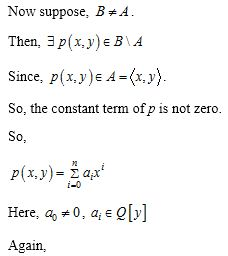
![LaxE ASB Again, = p(x,y)-Žaxs B =a, Е В ...20 € 0 [y] Here, p and a has the same constant term. So, both p and a has non-ze](http://img.homeworklib.com/questions/f2076c40-acf0-11ea-babb-ddb015ffa61a.png?x-oss-process=image/resize,w_560)
Add Answer to:
Consider the element y E Qx, y]. Argue that +y is irreducible (so (ry) is maximal...
Could you please solve this problem with the clear hands writing to read it please PLEACE? Also the good explanation to understand the solution is by step by step the subject is Modern algebra Commut...
 Could you please solve
this problem with the clear hands writing to read it please PLEACE?
Also the good explanation to understand the solution is by step by
step
the subject is Modern
algebra
Commutative rings and modules 1. (10 points) Let R be a commutative ring with identity. The Jacobson radical of R is defined to be the intersection of all maximal ideals of R: J(R) m. m is maximal in R Show that for any x E J(R)...
Could you please solve
this problem with the clear hands writing to read it please PLEACE?
Also the good explanation to understand the solution is by step by
step
the subject is Modern
algebra
Commutative rings and modules 1. (10 points) Let R be a commutative ring with identity. The Jacobson radical of R is defined to be the intersection of all maximal ideals of R: J(R) m. m is maximal in R Show that for any x E J(R)...
Consider the following stress state in plane stress: Qx = 120 MPa Qy = -30 MPa...
Consider the following stress state in plane stress: Qx = 120 MPa Qy = -30 MPa Txy = 70 MPa a) Calculate the two in-plane principal stresses and show the principal stress state on a properly oriented stress element. b) Calculate the maximum in-plane shear stress. c) Calculate the maximum out-of-plane shear stress. On what plane (x-z or y-z) does this shear stress occur?
10. [12 Points) Properties of relations Consider the relation R defined on R by «Ry x2...
 10. [12 Points) Properties of relations Consider the relation R defined on R by «Ry x2 - y2 = x - y (a) Show that R is reflexive. (b) Show that R is symmetric. (c) Show that R is transitive. (d) You have thus verified that R is an equivalence relation. What is the equivalence class of 3? (e) More generally, what is the equivalence class of an element x? Use the listing method. (f) Instead of proving the three...
Consider the statement: "Let r, y e Z. If ry is even, then r is even...
 Consider the statement: "Let r, y e Z. If ry is even, then r is even or y is even.” (1) Write down the converse of the implication. (2) Write down the contrapositive of the implication. (3) Prove the statement by contrapositve.
Algebraic structures 1. Consider the ring M = {Ia al: a, b, c, d e Z2}...
 Algebraic structures
1. Consider the ring M = {Ia al: a, b, c, d e Z2} under entry-wise addition and standard matrix multiplication. a. What are the units of this ring? b. Determine whether or not it is an integral domain. 2. Consider the ring Z * ZZ under component-wise addition and multiplication. a. What are the units of this ring? b. Let I = ( (2,1,1)) and J = ( (1,3,1)) be principal ideals. Show that their intersection is...
Algebraic structures
1. Consider the ring M = {Ia al: a, b, c, d e Z2} under entry-wise addition and standard matrix multiplication. a. What are the units of this ring? b. Determine whether or not it is an integral domain. 2. Consider the ring Z * ZZ under component-wise addition and multiplication. a. What are the units of this ring? b. Let I = ( (2,1,1)) and J = ( (1,3,1)) be principal ideals. Show that their intersection is...
Let R be a UFD, and let So be a set of irreducibles in R. Let...
 Let R be a UFD, and let So be a set of irreducibles in R. Let S := {ufi.fr: k > 0,[1,...,SE E So, u € R*} (we use the convention that the product fifk is 1 when k=0). (a) Show that S is multiplicatively closed. (b) Suppose / ER, GES. Show that is a unit in S-R if and only if SES. (c) Show that res-'R is irreducible if and only if x is associates with y = {es-R,...
Can you please provide clear and step by step solution for both 3 and 4. Thanks...
 Can you please provide clear
and step by step solution for both 3 and 4. Thanks :)
Exercise 5. [A-M Ch 3 Ex 7] Let R#0 be a ring. A multiplicatively closed subset S of R is said to be saturated if XY ES #xe S and y E S. 1. Let I be the collection of all multiplicatively closed subsets of R such that 0 € S. Show that I has maximal elements, and that Se & is maximal...
Can you please provide clear
and step by step solution for both 3 and 4. Thanks :)
Exercise 5. [A-M Ch 3 Ex 7] Let R#0 be a ring. A multiplicatively closed subset S of R is said to be saturated if XY ES #xe S and y E S. 1. Let I be the collection of all multiplicatively closed subsets of R such that 0 € S. Show that I has maximal elements, and that Se & is maximal...
* Let φ : R3-+ R be a continuous function. The level sets of φ are the sets 4:-{(z, y, z) e R3 Id(z, y, z) =c); where c is a real constant (c) Use the setup in this problem to argue that a seq...
 * Let φ : R3-+ R be a continuous function. The level sets of φ are the sets 4:-{(z, y, z) e R3 Id(z, y, z) =c); where c is a real constant (c) Use the setup in this problem to argue that a sequence on the unit sphere x E R31 (- is the standard Euclidean norm) cannot converge to a point that is not an element of the unit sphere.
* Let φ : R3-+ R be a...
* Let φ : R3-+ R be a continuous function. The level sets of φ are the sets 4:-{(z, y, z) e R3 Id(z, y, z) =c); where c is a real constant (c) Use the setup in this problem to argue that a sequence on the unit sphere x E R31 (- is the standard Euclidean norm) cannot converge to a point that is not an element of the unit sphere.
* Let φ : R3-+ R be a...
a eshee some @) consider the polynomial frac)=232 feed for all constructible numbers VER, show that...
 a eshee some @) consider the polynomial frac)=232 feed for all constructible numbers VER, show that fox) is irreducible over 418) (6) Let g(x) E a[x] be irreducible polynomial and assume g (2) splits in IR Let VER be a of Erede gox) Prove that 3/2 + 8 is a primitive element of Q (8, 32)/R root this is gamma not 8!
Please show that in any monoid (semigroup with neutral element e) if some element a has...
Please show that in any monoid (semigroup with neutral element e) if some element a has inverse a^-1, this inverse is unique. This means no element can have more than one inverse. [Hint: Start from writing the definition of the inverse for element a. Consider an element a which has two inverses (a1)^-1 and (a2)^-1. Then think about the value of (a1)^-1a(a2)^-1]. Comment: This is about any monoid which has inverses for some elements, but not necessarily for all elements....
 Could you please solve
this problem with the clear hands writing to read it please PLEACE?
Also the good explanation to understand the solution is by step by
step
the subject is Modern
algebra
Commutative rings and modules 1. (10 points) Let R be a commutative ring with identity. The Jacobson radical of R is defined to be the intersection of all maximal ideals of R: J(R) m. m is maximal in R Show that for any x E J(R)...
Could you please solve
this problem with the clear hands writing to read it please PLEACE?
Also the good explanation to understand the solution is by step by
step
the subject is Modern
algebra
Commutative rings and modules 1. (10 points) Let R be a commutative ring with identity. The Jacobson radical of R is defined to be the intersection of all maximal ideals of R: J(R) m. m is maximal in R Show that for any x E J(R)...
 10. [12 Points) Properties of relations Consider the relation R defined on R by «Ry x2 - y2 = x - y (a) Show that R is reflexive. (b) Show that R is symmetric. (c) Show that R is transitive. (d) You have thus verified that R is an equivalence relation. What is the equivalence class of 3? (e) More generally, what is the equivalence class of an element x? Use the listing method. (f) Instead of proving the three...
 Consider the statement: "Let r, y e Z. If ry is even, then r is even or y is even.” (1) Write down the converse of the implication. (2) Write down the contrapositive of the implication. (3) Prove the statement by contrapositve.
 Algebraic structures
1. Consider the ring M = {Ia al: a, b, c, d e Z2} under entry-wise addition and standard matrix multiplication. a. What are the units of this ring? b. Determine whether or not it is an integral domain. 2. Consider the ring Z * ZZ under component-wise addition and multiplication. a. What are the units of this ring? b. Let I = ( (2,1,1)) and J = ( (1,3,1)) be principal ideals. Show that their intersection is...
Algebraic structures
1. Consider the ring M = {Ia al: a, b, c, d e Z2} under entry-wise addition and standard matrix multiplication. a. What are the units of this ring? b. Determine whether or not it is an integral domain. 2. Consider the ring Z * ZZ under component-wise addition and multiplication. a. What are the units of this ring? b. Let I = ( (2,1,1)) and J = ( (1,3,1)) be principal ideals. Show that their intersection is...
 Let R be a UFD, and let So be a set of irreducibles in R. Let S := {ufi.fr: k > 0,[1,...,SE E So, u € R*} (we use the convention that the product fifk is 1 when k=0). (a) Show that S is multiplicatively closed. (b) Suppose / ER, GES. Show that is a unit in S-R if and only if SES. (c) Show that res-'R is irreducible if and only if x is associates with y = {es-R,...
 Can you please provide clear
and step by step solution for both 3 and 4. Thanks :)
Exercise 5. [A-M Ch 3 Ex 7] Let R#0 be a ring. A multiplicatively closed subset S of R is said to be saturated if XY ES #xe S and y E S. 1. Let I be the collection of all multiplicatively closed subsets of R such that 0 € S. Show that I has maximal elements, and that Se & is maximal...
Can you please provide clear
and step by step solution for both 3 and 4. Thanks :)
Exercise 5. [A-M Ch 3 Ex 7] Let R#0 be a ring. A multiplicatively closed subset S of R is said to be saturated if XY ES #xe S and y E S. 1. Let I be the collection of all multiplicatively closed subsets of R such that 0 € S. Show that I has maximal elements, and that Se & is maximal...
 * Let φ : R3-+ R be a continuous function. The level sets of φ are the sets 4:-{(z, y, z) e R3 Id(z, y, z) =c); where c is a real constant (c) Use the setup in this problem to argue that a sequence on the unit sphere x E R31 (- is the standard Euclidean norm) cannot converge to a point that is not an element of the unit sphere.
* Let φ : R3-+ R be a...
* Let φ : R3-+ R be a continuous function. The level sets of φ are the sets 4:-{(z, y, z) e R3 Id(z, y, z) =c); where c is a real constant (c) Use the setup in this problem to argue that a sequence on the unit sphere x E R31 (- is the standard Euclidean norm) cannot converge to a point that is not an element of the unit sphere.
* Let φ : R3-+ R be a...
 a eshee some @) consider the polynomial frac)=232 feed for all constructible numbers VER, show that fox) is irreducible over 418) (6) Let g(x) E a[x] be irreducible polynomial and assume g (2) splits in IR Let VER be a of Erede gox) Prove that 3/2 + 8 is a primitive element of Q (8, 32)/R root this is gamma not 8!
Most questions answered within 3 hours.
-
Where is the error in this code sequence?
String s1 = "Hello";
String s2 = "ello";...
asked 10 months ago -
Financial data for Joel de Paris, Inc., for last year
follow:
Joel de Paris, Inc.
Balance...
asked 10 months ago -
Consider this reaction:
Al2(SO4)3 (aq)+ BaCl3
(aq) Al2Cl6 (aq)- +
3BaSO4(s) . What is the...
asked 10 months ago -
Suppose that Savneet is considering increasing her
recent random sample from 20 car rentals to 40...
asked 10 months ago -
Trucks arrive at an unloading terminal at an average rate of 120
per hour.
Trucks arrive...
asked 10 months ago -
Why are methanol and ethanol completely soluble in water while
octanol is not very little soluble....
asked 10 months ago -
A facilities manager at a university reads in a research report
that the mean amount of...
asked 10 months ago -
When the CuSO4 is rehydrated by adding water to the anhydrous
compound, is this an endothermic...
asked 10 months ago -
A ray of sunlight is passing from diamond into crown glass; the
angle of incidence is...
asked 10 months ago -
A block of mass 0.249 kg is placed on top of a light, vertical
spring of...
asked 10 months ago -
how do the kidneys compensate in the presences of acidosis
a) trigger hyperventilate
b) reserve acid...
asked 10 months ago -
Question 501 pts
The rental rate of capital to the firm increases. Which of the
following...
asked 10 months ago