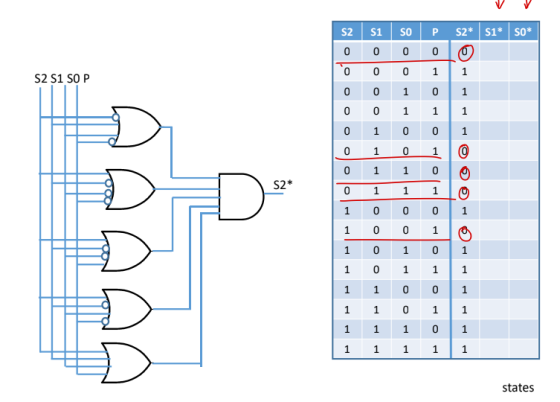
help in how to proceed with the next state, please explain. thanks
Homework Answers
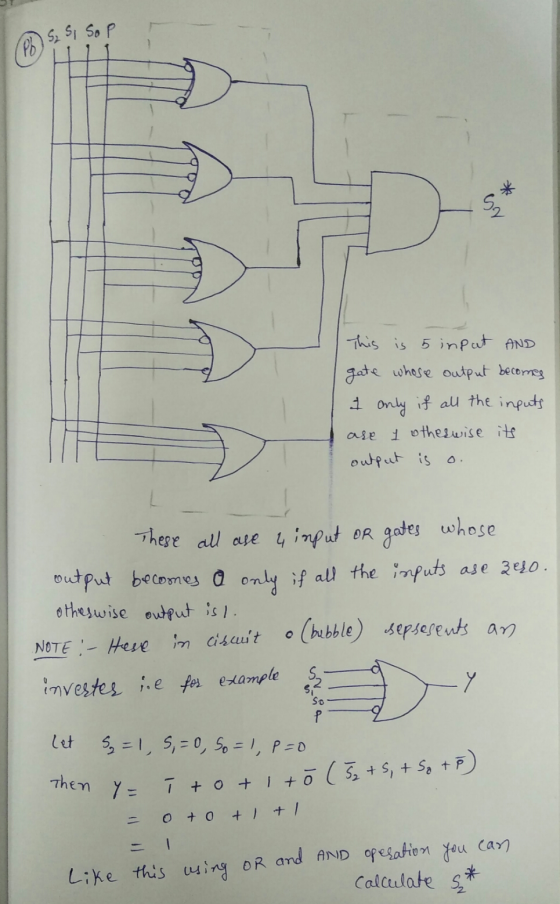
Add Answer to:
help in how to proceed with the next state, please explain.
thanks
P S2 S1 SOP...
Not just fill the next states with 0 and 1. Please show and explain how to...
 Not just fill the next states with 0 and 1. Please show and
explain how to get to the next state encoder from the diagram.
Thanks!
12. (a) (8 points) Given the state diagram below, create a truth table for the next state encoder. Start AB 01 AB (b) (6 points) Use the truth table you built to produce SOP logic expressions for the two state variables SiSo 00 01 11 10 S1So 00 01 11 10 N, AB 01...
Not just fill the next states with 0 and 1. Please show and
explain how to get to the next state encoder from the diagram.
Thanks!
12. (a) (8 points) Given the state diagram below, create a truth table for the next state encoder. Start AB 01 AB (b) (6 points) Use the truth table you built to produce SOP logic expressions for the two state variables SiSo 00 01 11 10 S1So 00 01 11 10 N, AB 01...
3. Minimize the number of states for the state table below. Provide a reduced state table Next St...
 3. Minimize the number of states for the state table below. Provide a reduced state table Next State Present State 00 01 10 Output So 1 S20 S1 S2 82 S3I S2 83 83 S0 so S1 84 855 S6 85 6 6 87 86 7 S7 So0 S4 S6
3. Minimize the number of states for the state table below. Provide a reduced state table Next State Present State 00 01 10 Output So 1 S20 S1 S2 82...
3. Minimize the number of states for the state table below. Provide a reduced state table Next State Present State 00 01 10 Output So 1 S20 S1 S2 82 S3I S2 83 83 S0 so S1 84 855 S6 85 6 6 87 86 7 S7 So0 S4 S6
3. Minimize the number of states for the state table below. Provide a reduced state table Next State Present State 00 01 10 Output So 1 S20 S1 S2 82...
please explain steps. I know U(f,P)-L(f,P)= something that *16. Let S = {S1, S2, ..., Sk}...
 please explain steps. I know U(f,P)-L(f,P)=
something
that *16. Let S = {S1, S2, ..., Sk} be a finite subset of [a,b]. Suppose that f is a bounded function on [a, b] such that f(x) = 0 if x € S. Show that f is integrable and that sa f = 0.
please explain steps. I know U(f,P)-L(f,P)=
something
that *16. Let S = {S1, S2, ..., Sk} be a finite subset of [a,b]. Suppose that f is a bounded function on [a, b] such that f(x) = 0 if x € S. Show that f is integrable and that sa f = 0.
The following payoff table shows the profit for a decision problem with two states of nature and two decision alternatives: State of Nature Decision Alternative s1 10 4 S2 d1 d2 (a) Suppose P(S1)-0.2...
 The following payoff table shows the profit for a decision problem with two states of nature and two decision alternatives: State of Nature Decision Alternative s1 10 4 S2 d1 d2 (a) Suppose P(S1)-0.2 ad P(s2)-0.8. What is the best decision using the expected value approach? Round your answer in one decimal place The best decision is decision alternative d2 , with an expected value of 3.2 (b) Perform sensitivity analysis on the payoffs for decision alternative d1. Assume the...
please trace this is sort program and base address s0, number of element s1 please also complete the program(..) explai...
 please trace this is sort program and base address s0, number
of element s1
please also complete the program(..)
explain the program too thanks
sit $t4, $t1, $to beq $t4, $zero, Skip sll $s1, $s1, 2 add $s2, $s0, $s1 addi $t2, $so, 0 Skip: oopl: addi $t3, $t2, 0 oopJ: addi $t3, $t3, 4 beq $t3, $s2, NextI Iw $to, 0($t2) lw NextI: addi $t2, $t2, 4 End: 配列の昇順ソートベースアドレス$50, 空欄を埋めてプログラムを完成させよ。 要素数$51
sit $t4, $t1, $to beq $t4, $zero, Skip...
please trace this is sort program and base address s0, number
of element s1
please also complete the program(..)
explain the program too thanks
sit $t4, $t1, $to beq $t4, $zero, Skip sll $s1, $s1, 2 add $s2, $s0, $s1 addi $t2, $so, 0 Skip: oopl: addi $t3, $t2, 0 oopJ: addi $t3, $t3, 4 beq $t3, $s2, NextI Iw $to, 0($t2) lw NextI: addi $t2, $t2, 4 End: 配列の昇順ソートベースアドレス$50, 空欄を埋めてプログラムを完成させよ。 要素数$51
sit $t4, $t1, $to beq $t4, $zero, Skip...
The following payoff table shows the profit for a decision problem with two states of nature and two decision alternatives: State of Nature Decision Alternative s1 S2 101 4 (a) Suppose P(si)-0.2 and...
 The following payoff table shows the profit for a decision problem with two states of nature and two decision alternatives: State of Nature Decision Alternative s1 S2 101 4 (a) Suppose P(si)-0.2 and P(s2)-0.8. What is the best decision using the expected value approach? Round your answer in one decimal place. The best decision is decision alternative d2 v , with an expected value of 3.2 (b) Perform sensitivity analysis on the payoffs for decision alternative di. Assume the probabilities...
Consider the following state diagram, which items on the state table is correct for the switch...
 Consider the following state diagram, which items on the state table is correct for the switch between states and output values. (Fig. 30) So S7 Food S Sz SS l%0 S2 Sc 70 %0 So Next state Z2Z1 Current state A. B. C. D. SO S1 S2 S3 X=0 S3 S4 S3 S3 X=1 X=0 S1 00 S1 01 10 S4 00 Fig. 30 X=1 00 00 10 00 S2 A. Line A on the table Line B on the...
The following payoff table shows the profit for a decision problem with two states of nature and two decision alternatives: State of Nature Decision Alternative s1 s2 d1 10 1 d2 4 3 (a...
The following payoff table shows the profit for a decision problem with two states of nature and two decision alternatives: State of Nature Decision Alternative s1 s2 d1 10 1 d2 4 3 (a) Suppose P(s1)=0.2 and P(s2)=0.8. What is the best decision using the expected value approach? Round your answer in one decimal place. The best decision is decision alternative - Select your answer -d1d2Item 1 , with an expected value of . (b) Perform sensitivity analysis on the...
Given the following Mealy finite state machine (FSM): Reset State State Encoding A/O B/O SO S1...
 Given the following Mealy finite state machine (FSM): Reset State State Encoding A/O B/O SO S1 S2 001 Bio AB/1 AIO Ā+BO a. Suppose one hot encoding is used to encode the states as given in ad- jacent table. Complete the state transition table and output table. (10 pts) b. Write Boolean equations for the next state and the output logic units. (10 pts) c. Sketch a schematic of the FSM. (10 pts)
Please help me... 5. (a) Consider the deterministic finite automaton M with states S := {80,...
 Please help me...
5. (a) Consider the deterministic finite automaton M with states S := {80, 81, 82, 83}, start state so, single accepting state $3, and alphabet E = {0,1}. The following table describes the transition function T:S xHS. State 0 1 So So S1 So S1 S2 So $1 82 S3 S3 82 Draw the transition diagram for M. Let U = {01110,011100}. For each u EU describe the run for input u to M. Does M accept...
Please help me...
5. (a) Consider the deterministic finite automaton M with states S := {80, 81, 82, 83}, start state so, single accepting state $3, and alphabet E = {0,1}. The following table describes the transition function T:S xHS. State 0 1 So So S1 So S1 S2 So $1 82 S3 S3 82 Draw the transition diagram for M. Let U = {01110,011100}. For each u EU describe the run for input u to M. Does M accept...
 Not just fill the next states with 0 and 1. Please show and
explain how to get to the next state encoder from the diagram.
Thanks!
12. (a) (8 points) Given the state diagram below, create a truth table for the next state encoder. Start AB 01 AB (b) (6 points) Use the truth table you built to produce SOP logic expressions for the two state variables SiSo 00 01 11 10 S1So 00 01 11 10 N, AB 01...
Not just fill the next states with 0 and 1. Please show and
explain how to get to the next state encoder from the diagram.
Thanks!
12. (a) (8 points) Given the state diagram below, create a truth table for the next state encoder. Start AB 01 AB (b) (6 points) Use the truth table you built to produce SOP logic expressions for the two state variables SiSo 00 01 11 10 S1So 00 01 11 10 N, AB 01...
 3. Minimize the number of states for the state table below. Provide a reduced state table Next State Present State 00 01 10 Output So 1 S20 S1 S2 82 S3I S2 83 83 S0 so S1 84 855 S6 85 6 6 87 86 7 S7 So0 S4 S6
3. Minimize the number of states for the state table below. Provide a reduced state table Next State Present State 00 01 10 Output So 1 S20 S1 S2 82...
3. Minimize the number of states for the state table below. Provide a reduced state table Next State Present State 00 01 10 Output So 1 S20 S1 S2 82 S3I S2 83 83 S0 so S1 84 855 S6 85 6 6 87 86 7 S7 So0 S4 S6
3. Minimize the number of states for the state table below. Provide a reduced state table Next State Present State 00 01 10 Output So 1 S20 S1 S2 82...
 please explain steps. I know U(f,P)-L(f,P)=
something
that *16. Let S = {S1, S2, ..., Sk} be a finite subset of [a,b]. Suppose that f is a bounded function on [a, b] such that f(x) = 0 if x € S. Show that f is integrable and that sa f = 0.
please explain steps. I know U(f,P)-L(f,P)=
something
that *16. Let S = {S1, S2, ..., Sk} be a finite subset of [a,b]. Suppose that f is a bounded function on [a, b] such that f(x) = 0 if x € S. Show that f is integrable and that sa f = 0.
 The following payoff table shows the profit for a decision problem with two states of nature and two decision alternatives: State of Nature Decision Alternative s1 10 4 S2 d1 d2 (a) Suppose P(S1)-0.2 ad P(s2)-0.8. What is the best decision using the expected value approach? Round your answer in one decimal place The best decision is decision alternative d2 , with an expected value of 3.2 (b) Perform sensitivity analysis on the payoffs for decision alternative d1. Assume the...
 please trace this is sort program and base address s0, number
of element s1
please also complete the program(..)
explain the program too thanks
sit $t4, $t1, $to beq $t4, $zero, Skip sll $s1, $s1, 2 add $s2, $s0, $s1 addi $t2, $so, 0 Skip: oopl: addi $t3, $t2, 0 oopJ: addi $t3, $t3, 4 beq $t3, $s2, NextI Iw $to, 0($t2) lw NextI: addi $t2, $t2, 4 End: 配列の昇順ソートベースアドレス$50, 空欄を埋めてプログラムを完成させよ。 要素数$51
sit $t4, $t1, $to beq $t4, $zero, Skip...
please trace this is sort program and base address s0, number
of element s1
please also complete the program(..)
explain the program too thanks
sit $t4, $t1, $to beq $t4, $zero, Skip sll $s1, $s1, 2 add $s2, $s0, $s1 addi $t2, $so, 0 Skip: oopl: addi $t3, $t2, 0 oopJ: addi $t3, $t3, 4 beq $t3, $s2, NextI Iw $to, 0($t2) lw NextI: addi $t2, $t2, 4 End: 配列の昇順ソートベースアドレス$50, 空欄を埋めてプログラムを完成させよ。 要素数$51
sit $t4, $t1, $to beq $t4, $zero, Skip...
 The following payoff table shows the profit for a decision problem with two states of nature and two decision alternatives: State of Nature Decision Alternative s1 S2 101 4 (a) Suppose P(si)-0.2 and P(s2)-0.8. What is the best decision using the expected value approach? Round your answer in one decimal place. The best decision is decision alternative d2 v , with an expected value of 3.2 (b) Perform sensitivity analysis on the payoffs for decision alternative di. Assume the probabilities...
 Consider the following state diagram, which items on the state table is correct for the switch between states and output values. (Fig. 30) So S7 Food S Sz SS l%0 S2 Sc 70 %0 So Next state Z2Z1 Current state A. B. C. D. SO S1 S2 S3 X=0 S3 S4 S3 S3 X=1 X=0 S1 00 S1 01 10 S4 00 Fig. 30 X=1 00 00 10 00 S2 A. Line A on the table Line B on the...
 Given the following Mealy finite state machine (FSM): Reset State State Encoding A/O B/O SO S1 S2 001 Bio AB/1 AIO Ā+BO a. Suppose one hot encoding is used to encode the states as given in ad- jacent table. Complete the state transition table and output table. (10 pts) b. Write Boolean equations for the next state and the output logic units. (10 pts) c. Sketch a schematic of the FSM. (10 pts)
 Please help me...
5. (a) Consider the deterministic finite automaton M with states S := {80, 81, 82, 83}, start state so, single accepting state $3, and alphabet E = {0,1}. The following table describes the transition function T:S xHS. State 0 1 So So S1 So S1 S2 So $1 82 S3 S3 82 Draw the transition diagram for M. Let U = {01110,011100}. For each u EU describe the run for input u to M. Does M accept...
Please help me...
5. (a) Consider the deterministic finite automaton M with states S := {80, 81, 82, 83}, start state so, single accepting state $3, and alphabet E = {0,1}. The following table describes the transition function T:S xHS. State 0 1 So So S1 So S1 S2 So $1 82 S3 S3 82 Draw the transition diagram for M. Let U = {01110,011100}. For each u EU describe the run for input u to M. Does M accept...
Most questions answered within 3 hours.
-
Where is the error in this code sequence?
String s1 = "Hello";
String s2 = "ello";...
asked 10 months ago -
Financial data for Joel de Paris, Inc., for last year
follow:
Joel de Paris, Inc.
Balance...
asked 10 months ago -
Consider this reaction:
Al2(SO4)3 (aq)+ BaCl3
(aq) Al2Cl6 (aq)- +
3BaSO4(s) . What is the...
asked 10 months ago -
Suppose that Savneet is considering increasing her
recent random sample from 20 car rentals to 40...
asked 10 months ago -
Trucks arrive at an unloading terminal at an average rate of 120
per hour.
Trucks arrive...
asked 10 months ago -
Why are methanol and ethanol completely soluble in water while
octanol is not very little soluble....
asked 10 months ago -
A facilities manager at a university reads in a research report
that the mean amount of...
asked 10 months ago -
When the CuSO4 is rehydrated by adding water to the anhydrous
compound, is this an endothermic...
asked 10 months ago -
A ray of sunlight is passing from diamond into crown glass; the
angle of incidence is...
asked 10 months ago -
A block of mass 0.249 kg is placed on top of a light, vertical
spring of...
asked 10 months ago -
how do the kidneys compensate in the presences of acidosis
a) trigger hyperventilate
b) reserve acid...
asked 10 months ago -
Question 501 pts
The rental rate of capital to the firm increases. Which of the
following...
asked 10 months ago