
Homework Answers
Add Answer to:
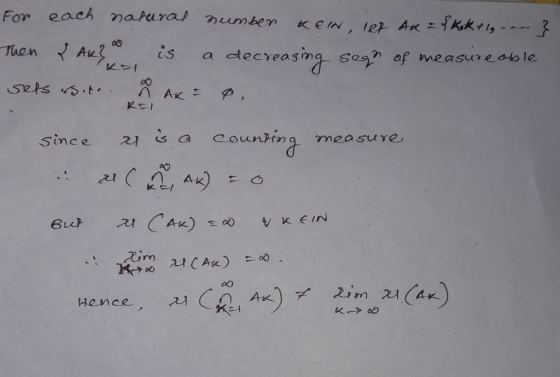
1. Let u be the counting measure on P(N). Find a decreasing sequence of sets Ak...
6. In this problem, u is Lebesgue measure on R, while v is counting measure on...
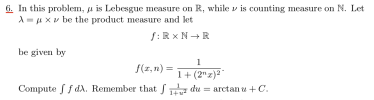 6. In this problem, u is Lebesgue measure on R, while v is counting measure on N. Let =u X v be the product measure and let f: R *N → R be given by f(x, n) = 1 + (21 x)? Compute S f d). Remember that S itu du = arctan u + C.
3.) Let ak E R with ak > 0 for all k E N. Suppose Σ㎞iak...
 3.) Let ak E R with ak > 0 for all k E N. Suppose Σ㎞iak converges. Show that Σί1bk (By definition, for a sequence (ck), we say liCkoo if, for all M ER with Hint: Show that there exists (Ni))ไ1 with N > Nj for all j E N, such that bk there exists a sequence (bk)k of real numbers such that lim converges = oo and M >0, there exists N E N such that ck > M...
(Exercise 4.13, reordered) Given a series ΣΧί ak, let 8,-Ση-i ak. Σχί ak is Cesaro summable if S1 + 82 +... +Sn lim n-+...
 (Exercise 4.13, reordered) Given a series ΣΧί ak, let 8,-Ση-i ak. Σχί ak is Cesaro summable if S1 + 82 +... +Sn lim n-+o converges. (a) Give an example of a series Σ00i ak that is Cesaro sum mable but not convergent (b) Prove that if 1 ak converges, then it is Cèsaro summable. Hint: Say the sequence of partial sums sn → L. Try to prove that =1 8k → L by showing and then splitting the latter sum...
(2) Let (X, 2, ) be a measure space and let (.). be a sequence of...
 (2) Let (X, 2, ) be a measure space and let (.). be a sequence of (E, BR)-measurable functions from X to R. Suppose that 'n pointwise and lim. S du SI du < 0. Prove that for all E E lim,- Jef du = sef du < 0.
(6) Let (2,A, /i) be a measure space. Let fn: N -» R* be a sequence of measurable functions. Let g, h : 2 -> R* be a...
 (6) Let (2,A, /i) be a measure space. Let fn: N -» R* be a sequence of measurable functions. Let g, h : 2 -> R* be a integrable pair of measurable functions such that both are on a set AE A and g(x) < fn(x) < h(x), for all x E A and n e N. Prove that / / fn du lim sup fn d lim sup lim inf fn d< lim inf fn du п00 n oo...
Let (an) be a sequence such that lim an = 0. Define the sequence (AR) Exercise...
 Let (an) be a sequence such that lim an = 0. Define the sequence (AR) Exercise 21: by A =ļa, and An = zou-a + ax=a + zam for k21. Prove that an converges to some S if and only if Ax converges to S. N=0 k=0 Exercise 22: (Cauchy condensation test) Let (an) be a sequence such that 0 < antı san a) Show n=0 n=1 Hint: Recall the proof of convergence of for p > 1. Ren for...
Let {h} be a sequence ofRiemann integrable functions on [a,b], such that for each x, {h(x)) is a decreasing sequence. Suppose n) converges pointwise to a Riemann integrable function f Prove that f(x)...
 Let {h} be a sequence ofRiemann integrable functions on [a,b], such that for each x, {h(x)) is a decreasing sequence. Suppose n) converges pointwise to a Riemann integrable function f Prove that f(x)dxf(x)dx. lim n00
Let {h} be a sequence ofRiemann integrable functions on [a,b], such that for each x, {h(x)) is a decreasing sequence. Suppose n) converges pointwise to a Riemann integrable function f Prove that f(x)dxf(x)dx. lim n00
Let {h} be a sequence ofRiemann integrable functions on [a,b], such that for each x, {h(x)) is a decreasing sequence. Suppose n) converges pointwise to a Riemann integrable function f Prove that f(x)dxf(x)dx. lim n00
1.Let Ai, A2,. . , Ak be collection of sets that partitions the sample space S....
 1.Let Ai, A2,. . , Ak be collection of sets that partitions the sample space S. Which of the following are properties of the partition? B. Ain A2nnAk S. C. The sets A, A are mutually exclusive D. The sets A1, A2,... Ak are independent. E. Only A. and B. F. Only A. and C. G. Only A. and D. H. Only B. and C. I. Only B. and D. J. Only C. and D. K. Only A., B., and...
(3) Let (2,A, /i) be a measure space. Let f : N > R* be a nonnegative measurable function. Define the sequence fn(x)...
 (3) Let (2,A, /i) be a measure space. Let f : N > R* be a nonnegative measurable function. Define the sequence fn(x) = min{f(x), n}, n E N. Prove that for any A E A f du lim fn du A 4 (You must show that the integrals exist.)
(3) Let (2,A, /i) be a measure space. Let f : N > R* be a nonnegative measurable function. Define the sequence fn(x) = min{f(x), n}, n E N. Prove...
(3) Let (2,A, /i) be a measure space. Let f : N > R* be a nonnegative measurable function. Define the sequence fn(x) = min{f(x), n}, n E N. Prove that for any A E A f du lim fn du A 4 (You must show that the integrals exist.)
(3) Let (2,A, /i) be a measure space. Let f : N > R* be a nonnegative measurable function. Define the sequence fn(x) = min{f(x), n}, n E N. Prove...
3. Let Ei 2 E2 ? ... ? Ek ? ... be a decreasing sequence of...
 3. Let Ei 2 E2 ? ... ? Ek ? ... be a decreasing sequence of nonempty, closed subsets of R”. (a) Prove that if Ej is compact, then n En +0. n=1 n= 1 (b) Find an example of a sequence as above with the property that n En = D. (Hint: In light of (a), none of the E; can be compact sets. Since each E; is closed by assumption, each of the E; must be unbounded. Also,...
 6. In this problem, u is Lebesgue measure on R, while v is counting measure on N. Let =u X v be the product measure and let f: R *N → R be given by f(x, n) = 1 + (21 x)? Compute S f d). Remember that S itu du = arctan u + C.
 3.) Let ak E R with ak > 0 for all k E N. Suppose Σ㎞iak converges. Show that Σί1bk (By definition, for a sequence (ck), we say liCkoo if, for all M ER with Hint: Show that there exists (Ni))ไ1 with N > Nj for all j E N, such that bk there exists a sequence (bk)k of real numbers such that lim converges = oo and M >0, there exists N E N such that ck > M...
 (Exercise 4.13, reordered) Given a series ΣΧί ak, let 8,-Ση-i ak. Σχί ak is Cesaro summable if S1 + 82 +... +Sn lim n-+o converges. (a) Give an example of a series Σ00i ak that is Cesaro sum mable but not convergent (b) Prove that if 1 ak converges, then it is Cèsaro summable. Hint: Say the sequence of partial sums sn → L. Try to prove that =1 8k → L by showing and then splitting the latter sum...
 (2) Let (X, 2, ) be a measure space and let (.). be a sequence of (E, BR)-measurable functions from X to R. Suppose that 'n pointwise and lim. S du SI du < 0. Prove that for all E E lim,- Jef du = sef du < 0.
 (6) Let (2,A, /i) be a measure space. Let fn: N -» R* be a sequence of measurable functions. Let g, h : 2 -> R* be a integrable pair of measurable functions such that both are on a set AE A and g(x) < fn(x) < h(x), for all x E A and n e N. Prove that / / fn du lim sup fn d lim sup lim inf fn d< lim inf fn du п00 n oo...
 Let (an) be a sequence such that lim an = 0. Define the sequence (AR) Exercise 21: by A =ļa, and An = zou-a + ax=a + zam for k21. Prove that an converges to some S if and only if Ax converges to S. N=0 k=0 Exercise 22: (Cauchy condensation test) Let (an) be a sequence such that 0 < antı san a) Show n=0 n=1 Hint: Recall the proof of convergence of for p > 1. Ren for...
 Let {h} be a sequence ofRiemann integrable functions on [a,b], such that for each x, {h(x)) is a decreasing sequence. Suppose n) converges pointwise to a Riemann integrable function f Prove that f(x)dxf(x)dx. lim n00
Let {h} be a sequence ofRiemann integrable functions on [a,b], such that for each x, {h(x)) is a decreasing sequence. Suppose n) converges pointwise to a Riemann integrable function f Prove that f(x)dxf(x)dx. lim n00
Let {h} be a sequence ofRiemann integrable functions on [a,b], such that for each x, {h(x)) is a decreasing sequence. Suppose n) converges pointwise to a Riemann integrable function f Prove that f(x)dxf(x)dx. lim n00
 1.Let Ai, A2,. . , Ak be collection of sets that partitions the sample space S. Which of the following are properties of the partition? B. Ain A2nnAk S. C. The sets A, A are mutually exclusive D. The sets A1, A2,... Ak are independent. E. Only A. and B. F. Only A. and C. G. Only A. and D. H. Only B. and C. I. Only B. and D. J. Only C. and D. K. Only A., B., and...
 (3) Let (2,A, /i) be a measure space. Let f : N > R* be a nonnegative measurable function. Define the sequence fn(x) = min{f(x), n}, n E N. Prove that for any A E A f du lim fn du A 4 (You must show that the integrals exist.)
(3) Let (2,A, /i) be a measure space. Let f : N > R* be a nonnegative measurable function. Define the sequence fn(x) = min{f(x), n}, n E N. Prove...
(3) Let (2,A, /i) be a measure space. Let f : N > R* be a nonnegative measurable function. Define the sequence fn(x) = min{f(x), n}, n E N. Prove that for any A E A f du lim fn du A 4 (You must show that the integrals exist.)
(3) Let (2,A, /i) be a measure space. Let f : N > R* be a nonnegative measurable function. Define the sequence fn(x) = min{f(x), n}, n E N. Prove...
 3. Let Ei 2 E2 ? ... ? Ek ? ... be a decreasing sequence of nonempty, closed subsets of R”. (a) Prove that if Ej is compact, then n En +0. n=1 n= 1 (b) Find an example of a sequence as above with the property that n En = D. (Hint: In light of (a), none of the E; can be compact sets. Since each E; is closed by assumption, each of the E; must be unbounded. Also,...
Most questions answered within 3 hours.
-
Where is the error in this code sequence?
String s1 = "Hello";
String s2 = "ello";...
asked 10 months ago -
Financial data for Joel de Paris, Inc., for last year
follow:
Joel de Paris, Inc.
Balance...
asked 10 months ago -
Consider this reaction:
Al2(SO4)3 (aq)+ BaCl3
(aq) Al2Cl6 (aq)- +
3BaSO4(s) . What is the...
asked 10 months ago -
Suppose that Savneet is considering increasing her
recent random sample from 20 car rentals to 40...
asked 10 months ago -
Trucks arrive at an unloading terminal at an average rate of 120
per hour.
Trucks arrive...
asked 10 months ago -
Why are methanol and ethanol completely soluble in water while
octanol is not very little soluble....
asked 10 months ago -
A facilities manager at a university reads in a research report
that the mean amount of...
asked 10 months ago -
When the CuSO4 is rehydrated by adding water to the anhydrous
compound, is this an endothermic...
asked 10 months ago -
A ray of sunlight is passing from diamond into crown glass; the
angle of incidence is...
asked 10 months ago -
A block of mass 0.249 kg is placed on top of a light, vertical
spring of...
asked 10 months ago -
how do the kidneys compensate in the presences of acidosis
a) trigger hyperventilate
b) reserve acid...
asked 10 months ago -
Question 501 pts
The rental rate of capital to the firm increases. Which of the
following...
asked 10 months ago