Discrete Math: Please help with all parts of question 5. I have included problem 3 to help answer part (a) but I only need help with question 5!
5.

3.
Homework Answers
K-Colorable Graph : A graph G is said to be K-Colorable if G has K-coloring of a graph.
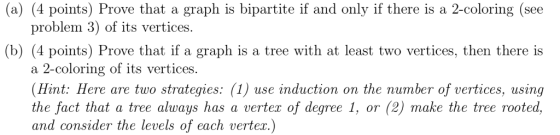
5) (a) Prove that a graph G is bipartite if and only if there is a 2-coloring of its vertices.
Answer of 5 (a):
Suppose G is 2-Colorable.
First to prove that G is bipartite.
i.e. we have to partition the vertex set into two sets
and
such that
and
Let and
be
two colors used to color graph G.
Let be the set of
all the vertices of G which receives the color
and
be the set of
all the vertices of G which receives the color
.
and
is a
bi-partition of the vertex set of G also there is no edge between
any two vertices of
and
since they are of same color.
and
also
and
G is
bipartite graph.
Now conversely suppose G is bipartite graph.
Let and
be
the vertex set of G such that
and
also
and
Now assign the color to all the
vertices of the set
and color
to all the
vertices of set
Thus all the vertices of graph G are colored using only two colors.
G is
2-colorable.
Thus a graph G is bipartite if and only if there is a 2-coloring of its vertices.
5) (b) Prove that if a graph is a tree with at least two vertices, then there is a 2-coloring of its vertices.
Answer of 5 (b):
I will prove this using the 2nd Hint given in the problem.
We will make the tree as rooted tree.
Let T(V,E) be tree with at least two vertices.
V be the vertex as V = {v1, v2, v3, . . . vp} and E be the set of edges as E ={e1, e2, e3, . . . eq}
The image of the rooted tree as follows:
 Let v1 be the root
of the tree which is at the level 0. This vertex v1 can
be coloured by using color C1. Now in the next level,
vertices are adjacent to vertex v1. Hence we cannot color them
using color C1. But the vertices at level 1 are not
adjacent to themselves. Hence we can color them using a single
color say C2. So suppose all the vertices at level 1 are
colored using color C2.
Let v1 be the root
of the tree which is at the level 0. This vertex v1 can
be coloured by using color C1. Now in the next level,
vertices are adjacent to vertex v1. Hence we cannot color them
using color C1. But the vertices at level 1 are not
adjacent to themselves. Hence we can color them using a single
color say C2. So suppose all the vertices at level 1 are
colored using color C2.
Similarly the vertices at the level 2 are adjacent to vertices at level 1. Thus they cannot be coloured using colour C2. But those are not adjacent with the vertices at level 2 and also with the vertices at level 0. Thus the vertices at level 2 can be colored using the color C1.
Thus alternatively we can color the vertices of a tree by color C1 or color C2.
Thus if a graph is a tree with at least two vertices, then there is a 2-coloring of its vertices.
5) (c) Parts (a) and (b) together imply that every tree is bipartite. Show that the converse is false. i.e. draw a bipartite graph that is not a tree.
Answer of 5 (c):
Yes parts (a) and (b) together imply that every tree is bipartite graph. To show that the converse is false we have to give an example of a bipartite graph which is not a tree.
The example is as follows.
 Graph G is bipartite graph
because we can bipartite its vertex set V = {v1,
v2, v3, v4} in two sets
Graph G is bipartite graph
because we can bipartite its vertex set V = {v1,
v2, v3, v4} in two sets and
as follows.
and
also
and
but it is not a tree because it contains a cycle.
Add Answer to:
Discrete Math: Please help with all parts of question
5. I have included problem 3 to...
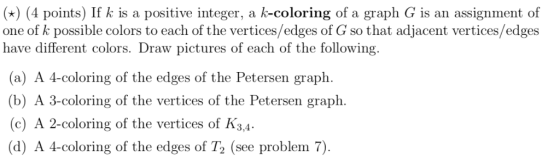
X) (4 points) If k is a positive integer, a k-coloring of a graph G is an assignment of one of k ...
 COMP Discrete Structures: Please answer completely and
clearly.
(3).
(5).
x) (4 points) If k is a positive integer, a k-coloring of a graph G is an assignment of one of k possible colors to each of the vertices/edges of G so that adjacent vertices/edges have different colors. Draw pictures of each of the following (a) A 4-coloring of the edges of the Petersen graph. (b) A 3-coloring of the vertices of the Petersen graph. (e) A 2-coloring (d) A...
COMP Discrete Structures: Please answer completely and
clearly.
(3).
(5).
x) (4 points) If k is a positive integer, a k-coloring of a graph G is an assignment of one of k possible colors to each of the vertices/edges of G so that adjacent vertices/edges have different colors. Draw pictures of each of the following (a) A 4-coloring of the edges of the Petersen graph. (b) A 3-coloring of the vertices of the Petersen graph. (e) A 2-coloring (d) A...
Show all work for full credit. PART A Graph Theorv). 01.a. Model the following problem into a graph coloring problem A local zoo wants to take visitors on animal feeding tours, and is consider...
 Show all work for full credit. PART A Graph Theorv). 01.a. Model the following problem into a graph coloring problem A local zoo wants to take visitors on animal feeding tours, and is considering the following tours: Tour 1 visits the monkeys, birds, and deer Tour 2 visits the elephants, deer and giraffes; Tour 3 visits the birds, reptiles and bears Tour 4 visits the kangaroos, monkeys and bears Tour 5 visits birds, kangaroos and pandas; Monday, Wednesday and Friday...
Problem 8. (2+4+4 points each) A bipartite graph G = (V. E) is a graph whose...
 Problem 8. (2+4+4 points each) A bipartite graph G = (V. E) is a graph whose vertices can be partitioned into two (disjoint) sets V1 and V2, such that every edge joins a vertex in V1 with a vertex in V2. This means no edges are within V1 or V2 (or symbolically: Vu, v E V1. {u, u} &E and Vu, v E V2.{u,v} &E). 8(a) Show that the complete graph K, is a bipartite graph. 8(b) Prove that no...
Problem E: For each of the following parts, state True or False. If true, give a short proof. If ...
 Problem E: For each of the following parts, state True or False. If true, give a short proof. If false, givera counterexample: (1). Using Kruskal's algorithm, edges are (always) inserted into the MST in the same order as using Prim's (2). If an edge e is part of a TSP tour found by the quick TSP method then it must also be part of the (3). If an edge e is part of a Shortest Path Tree rooted at A...
Suppose that we have a graph with vertices 1, 2, 3, 4, 5, 6, 7 and...
 Suppose that we have a graph with vertices 1, 2, 3, 4, 5, 6, 7 and edges (1, 5), (2, 5), (3, 4), (3, 5), (6, 2), (7, 1), (7, 4). Draw this graph and execute the function mexset1) to find the number of vertices in the largest independent set of the graph. What is the best way to choose v' for executing this function? Must draw a tree structure to show how you come up with the answer.
014) Draw a dual graph G for the following planar map, and find a coloring for the vertices of G that uses x(G) number of colors o cean Q15. Solve the following TSP problem 3 4 55305 302 320 C Usi...
 014) Draw a dual graph G for the following planar map, and find a coloring for the vertices of G that uses x(G) number of colors o cean Q15. Solve the following TSP problem 3 4 55305 302 320 C Using the nearest neighbor algorithm., if A is the home city. Shade the edges used. Find the distance travelled. E x piaun the qlgor tam a) 340 305 30 D 320 С Using the sorted edge algorithm. Show work (...
please help me make this into a contradiction or a direct proof please. i put the question, my answer, and the textbook i used. thank you also please write neatly proof 2.5 Prove har a Sim...
 please help me make this into a contradiction or a direct
proof please.
i put the question, my answer, and the textbook i used.
thank you
also please write neatly
proof 2.5 Prove har a Simple sraph and 13 cdges cannot be bipartite CHint ercattne gr apn in to ertex Sets and Court tne忤of edges Claim Splitting the graph into two vertex, Sets ves you a 8 Ver ices So if we Change tne书 apn and an A bipartite graph...
please help me make this into a contradiction or a direct
proof please.
i put the question, my answer, and the textbook i used.
thank you
also please write neatly
proof 2.5 Prove har a Simple sraph and 13 cdges cannot be bipartite CHint ercattne gr apn in to ertex Sets and Court tne忤of edges Claim Splitting the graph into two vertex, Sets ves you a 8 Ver ices So if we Change tne书 apn and an A bipartite graph...
math 270A quiz 10 discrete structures Name: Spring 2020 Math 270A Quiz 10 (MFCS 5.1-6.1) Directions:...
 math 270A quiz 10 discrete structures
Name: Spring 2020 Math 270A Quiz 10 (MFCS 5.1-6.1) Directions: Please complete each question to the best of your ability. Show work to get full credit. Partially correct work will receive partial credit. Lastly please box your answer. 1. (2 points) Are the following graphs isomorphic? Explain why or why not. 2. (3 points) Find a minimum weight spanning tree of the graph below (either highlight the edges that make up the MST, or...
math 270A quiz 10 discrete structures
Name: Spring 2020 Math 270A Quiz 10 (MFCS 5.1-6.1) Directions: Please complete each question to the best of your ability. Show work to get full credit. Partially correct work will receive partial credit. Lastly please box your answer. 1. (2 points) Are the following graphs isomorphic? Explain why or why not. 2. (3 points) Find a minimum weight spanning tree of the graph below (either highlight the edges that make up the MST, or...
2 (a) Draw the graphs K5,2 and K5,3 using the standard arrangement. For example, K5,2 should have a row of 5 vertices above a row of 2 vertices, and the edges connect each vertex in the top row to ea...
 2 (a) Draw the graphs K5,2 and K5,3 using the standard
arrangement.
For example, K5,2 should have a row of 5 vertices above a row of
2 vertices, and the edges connect each vertex in the top row to
each vertex in the bottom row.
(b) Draw K5,2 as a plane graph, i.e., with no edges
crossing.
(c) Complete the following table, recalling E is the number of
edges in a graph and V is the number of vertices. (Strictly...
2 (a) Draw the graphs K5,2 and K5,3 using the standard
arrangement.
For example, K5,2 should have a row of 5 vertices above a row of
2 vertices, and the edges connect each vertex in the top row to
each vertex in the bottom row.
(b) Draw K5,2 as a plane graph, i.e., with no edges
crossing.
(c) Complete the following table, recalling E is the number of
edges in a graph and V is the number of vertices. (Strictly...
Answer each question in the space provided below. 1. Draw all non-isomorphic free trees with five...
 Answer each question in the space provided below. 1. Draw all non-isomorphic free trees with five vertices. You should not include two trees that are isomorphic. 2. If a tree has n vertices, what is the maximum possible number of leaves? (Your answer should be an expression depending on the variable n. 3. Find a graph with the given set of properties or explain why no such graph can exist. The graphs do not need to be trees unless explicitly...
 COMP Discrete Structures: Please answer completely and
clearly.
(3).
(5).
x) (4 points) If k is a positive integer, a k-coloring of a graph G is an assignment of one of k possible colors to each of the vertices/edges of G so that adjacent vertices/edges have different colors. Draw pictures of each of the following (a) A 4-coloring of the edges of the Petersen graph. (b) A 3-coloring of the vertices of the Petersen graph. (e) A 2-coloring (d) A...
COMP Discrete Structures: Please answer completely and
clearly.
(3).
(5).
x) (4 points) If k is a positive integer, a k-coloring of a graph G is an assignment of one of k possible colors to each of the vertices/edges of G so that adjacent vertices/edges have different colors. Draw pictures of each of the following (a) A 4-coloring of the edges of the Petersen graph. (b) A 3-coloring of the vertices of the Petersen graph. (e) A 2-coloring (d) A...
 Show all work for full credit. PART A Graph Theorv). 01.a. Model the following problem into a graph coloring problem A local zoo wants to take visitors on animal feeding tours, and is considering the following tours: Tour 1 visits the monkeys, birds, and deer Tour 2 visits the elephants, deer and giraffes; Tour 3 visits the birds, reptiles and bears Tour 4 visits the kangaroos, monkeys and bears Tour 5 visits birds, kangaroos and pandas; Monday, Wednesday and Friday...
 Problem 8. (2+4+4 points each) A bipartite graph G = (V. E) is a graph whose vertices can be partitioned into two (disjoint) sets V1 and V2, such that every edge joins a vertex in V1 with a vertex in V2. This means no edges are within V1 or V2 (or symbolically: Vu, v E V1. {u, u} &E and Vu, v E V2.{u,v} &E). 8(a) Show that the complete graph K, is a bipartite graph. 8(b) Prove that no...
 Problem E: For each of the following parts, state True or False. If true, give a short proof. If false, givera counterexample: (1). Using Kruskal's algorithm, edges are (always) inserted into the MST in the same order as using Prim's (2). If an edge e is part of a TSP tour found by the quick TSP method then it must also be part of the (3). If an edge e is part of a Shortest Path Tree rooted at A...
 Suppose that we have a graph with vertices 1, 2, 3, 4, 5, 6, 7 and edges (1, 5), (2, 5), (3, 4), (3, 5), (6, 2), (7, 1), (7, 4). Draw this graph and execute the function mexset1) to find the number of vertices in the largest independent set of the graph. What is the best way to choose v' for executing this function? Must draw a tree structure to show how you come up with the answer.
 014) Draw a dual graph G for the following planar map, and find a coloring for the vertices of G that uses x(G) number of colors o cean Q15. Solve the following TSP problem 3 4 55305 302 320 C Using the nearest neighbor algorithm., if A is the home city. Shade the edges used. Find the distance travelled. E x piaun the qlgor tam a) 340 305 30 D 320 С Using the sorted edge algorithm. Show work (...
 please help me make this into a contradiction or a direct
proof please.
i put the question, my answer, and the textbook i used.
thank you
also please write neatly
proof 2.5 Prove har a Simple sraph and 13 cdges cannot be bipartite CHint ercattne gr apn in to ertex Sets and Court tne忤of edges Claim Splitting the graph into two vertex, Sets ves you a 8 Ver ices So if we Change tne书 apn and an A bipartite graph...
please help me make this into a contradiction or a direct
proof please.
i put the question, my answer, and the textbook i used.
thank you
also please write neatly
proof 2.5 Prove har a Simple sraph and 13 cdges cannot be bipartite CHint ercattne gr apn in to ertex Sets and Court tne忤of edges Claim Splitting the graph into two vertex, Sets ves you a 8 Ver ices So if we Change tne书 apn and an A bipartite graph...
 math 270A quiz 10 discrete structures
Name: Spring 2020 Math 270A Quiz 10 (MFCS 5.1-6.1) Directions: Please complete each question to the best of your ability. Show work to get full credit. Partially correct work will receive partial credit. Lastly please box your answer. 1. (2 points) Are the following graphs isomorphic? Explain why or why not. 2. (3 points) Find a minimum weight spanning tree of the graph below (either highlight the edges that make up the MST, or...
math 270A quiz 10 discrete structures
Name: Spring 2020 Math 270A Quiz 10 (MFCS 5.1-6.1) Directions: Please complete each question to the best of your ability. Show work to get full credit. Partially correct work will receive partial credit. Lastly please box your answer. 1. (2 points) Are the following graphs isomorphic? Explain why or why not. 2. (3 points) Find a minimum weight spanning tree of the graph below (either highlight the edges that make up the MST, or...
 2 (a) Draw the graphs K5,2 and K5,3 using the standard
arrangement.
For example, K5,2 should have a row of 5 vertices above a row of
2 vertices, and the edges connect each vertex in the top row to
each vertex in the bottom row.
(b) Draw K5,2 as a plane graph, i.e., with no edges
crossing.
(c) Complete the following table, recalling E is the number of
edges in a graph and V is the number of vertices. (Strictly...
2 (a) Draw the graphs K5,2 and K5,3 using the standard
arrangement.
For example, K5,2 should have a row of 5 vertices above a row of
2 vertices, and the edges connect each vertex in the top row to
each vertex in the bottom row.
(b) Draw K5,2 as a plane graph, i.e., with no edges
crossing.
(c) Complete the following table, recalling E is the number of
edges in a graph and V is the number of vertices. (Strictly...
 Answer each question in the space provided below. 1. Draw all non-isomorphic free trees with five vertices. You should not include two trees that are isomorphic. 2. If a tree has n vertices, what is the maximum possible number of leaves? (Your answer should be an expression depending on the variable n. 3. Find a graph with the given set of properties or explain why no such graph can exist. The graphs do not need to be trees unless explicitly...
Most questions answered within 3 hours.
-
Where is the error in this code sequence?
String s1 = "Hello";
String s2 = "ello";...
asked 10 months ago -
Financial data for Joel de Paris, Inc., for last year
follow:
Joel de Paris, Inc.
Balance...
asked 10 months ago -
Consider this reaction:
Al2(SO4)3 (aq)+ BaCl3
(aq) Al2Cl6 (aq)- +
3BaSO4(s) . What is the...
asked 10 months ago -
Suppose that Savneet is considering increasing her
recent random sample from 20 car rentals to 40...
asked 10 months ago -
Trucks arrive at an unloading terminal at an average rate of 120
per hour.
Trucks arrive...
asked 10 months ago -
Why are methanol and ethanol completely soluble in water while
octanol is not very little soluble....
asked 10 months ago -
A facilities manager at a university reads in a research report
that the mean amount of...
asked 10 months ago -
When the CuSO4 is rehydrated by adding water to the anhydrous
compound, is this an endothermic...
asked 10 months ago -
A ray of sunlight is passing from diamond into crown glass; the
angle of incidence is...
asked 10 months ago -
A block of mass 0.249 kg is placed on top of a light, vertical
spring of...
asked 10 months ago -
how do the kidneys compensate in the presences of acidosis
a) trigger hyperventilate
b) reserve acid...
asked 10 months ago -
Question 501 pts
The rental rate of capital to the firm increases. Which of the
following...
asked 10 months ago