
Homework Answers
Add Answer to:
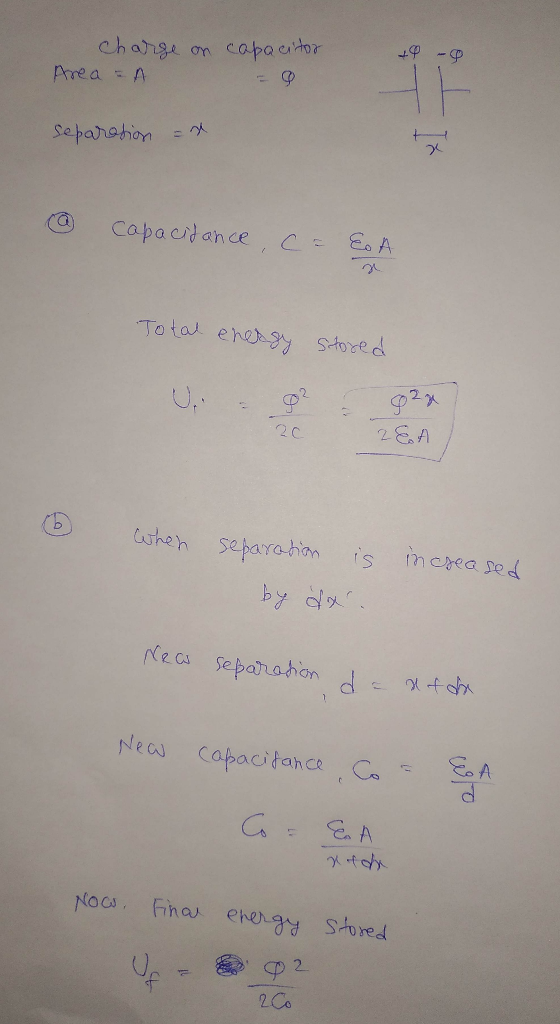
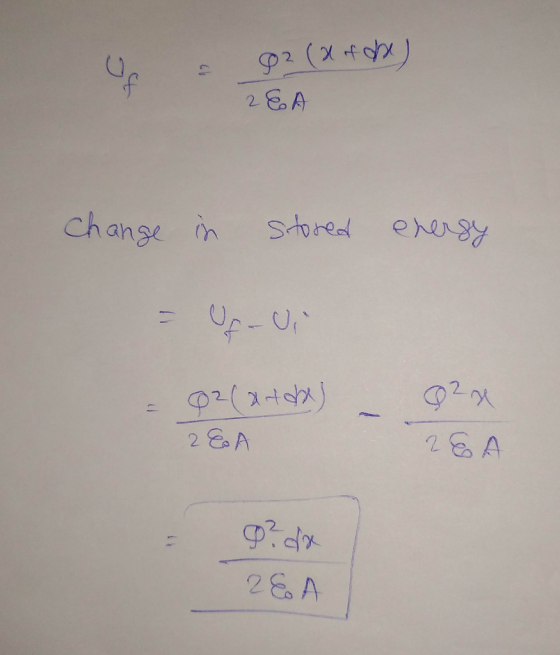
3. A parallel-plate capacitor with plate separation x and area A has charges +Q and -Q...
A parallel plate capacitor of capacitance Co has plates of area A with separation d between...
A parallel plate capacitor of capacitance Co has plates of area A with separation d between them. When it is connected to a battery of voltage Vo, it has charge of magnitude Qo on its plates. It is then disconnected from the battery and the plates are pulled apart to a separation 2d without discharging them. After the plates are 2d apart, by what factor does the capacitance change? By what factor does the potential difference between the plates change?
An air-filled parallel-plate capacitor has plate area A andplate separation d. The capacitor is connected...
An air-filled parallel-plate capacitor has plate area A and plate separation d. The capacitor is connected to a battery that creates a constant voltage V.A) Find the energy U_0 stored in the capacitor. Express your answer in terms of A, d, V, and ϵ_0.B) The capacitor is now disconnected from the battery, and the plates of the capacitor are then slowly pulled apart until the separation reaches 3d. Find the new energy U_1 of the capacitor after this process. Express...
A parallel plate capacitor, with a plate area of 8.5 x10 (-4)m^2 and an air filled...
A parallel plate capacitor, with a plate area of 8.5 x10 (-4)m^2 and an air filled separation of 3 x 10 (-3)m, are charged by a 6 Volt battery. They are then disconnected from the battery and pulled apart to the separation of 8 x10 (-3 )m. (a) find the potential difference between the plates (b) initial stored energy (c) final stored energy (d) work required to pull the plates apart
Please draw pictures!! 56. (I) A parallel-plate capacitor has fixed charges+Q and -Q. The separation of...
 Please draw pictures!!
56. (I) A parallel-plate capacitor has fixed charges+Q and -Q. The separation of the plates is then halved. (a) By what factor does the energy stored in the electric field change? (b) How much work must be done to reduce the plate separation from d to Jd? The area of each plate is A
Please draw pictures!!
56. (I) A parallel-plate capacitor has fixed charges+Q and -Q. The separation of the plates is then halved. (a) By what factor does the energy stored in the electric field change? (b) How much work must be done to reduce the plate separation from d to Jd? The area of each plate is A
A parallel-plate capacitor in air has a plate separation of 1.35 cm and a plate area...
 A parallel-plate capacitor in air has a plate separation of 1.35 cm and a plate area of 25.0 cm². The plates are charged to a potential difference of 270 V and disconnected from the source. The capacitor is then immersed in distilled water. Assume the liquid is an insulator. (a) Determine the charge on the plates before and after immersion before pC after pC (b) Determine the capacitance and potential difference after immersion F V AV, (c) Determine the change...
The parallel plates in a capacitor, with a plate area of 9.90 cm2 and an air-filled...
 The parallel plates in a capacitor, with a plate area of 9.90 cm2 and an air-filled separation of 2.30 mm, are charged by a 4.10 V battery. They are then disconnected from the battery and pulled apart (without discharge) to a separation of 6.50 mm. Neglecting fringing, find (a) the potential difference between the plates, (b) the initial stored energy, (c) the final stored energy, and (d) the work required to separate the plates.
The parallel plates in a capacitor, with a plate area of 9.00 cm2 and an air-filled...
 The parallel plates in a capacitor, with a plate area of 9.00 cm2 and an air-filled separation of 3.30 mm, are charged by a 5.40 V battery. They are then disconnected from the battery and pulled apart (without discharge) to a separation of 8.10 mm. Neglecting fringing, find (a) the potential difference between the plates, (b) the initial stored energy, (c) the final stored energy, and (d) the work required to separate the plates
The parallel plates in a capacitor, with a plate area of 9.00 cm2 and an air-filled...
The parallel plates in a capacitor, with a plate area of 9.00 cm2 and an air-filled separation of 3.30 mm, are charged by a 5.40 V battery. They are then disconnected from the battery and pulled apart (without discharge) to a separation of 8.10 mm. Neglecting fringing, find (a) the potential difference between the plates, (b) the initial stored energy, (c) the final stored energy, and (d) the work required to separate the plates.
The parallel plates in a capacitor, with a plate area of 5.30 cm2 and an air-filled...
The parallel plates in a capacitor, with a plate area of 5.30 cm2 and an air-filled separation of 4.60 mm, are charged by a 3.60 V battery. They are then disconnected from the battery and pulled apart (without discharge) to a separation of 6.00 mm. Neglecting fringing, find (a) the potential difference between the plates, (b) the initial stored energy, (c) the final stored energy, and (d) the work required to separate the plates.
A parallel plate capacitor has a charge Q, plates of area A and separation d, where...
A parallel plate capacitor has a charge Q, plates of area A and separation d, where , so that we can disregard the fringe field. Show that the magnitude of the force exerted on each plate by the other is F = Q2/(2e0A).You may use (with care!) the expression F = QE, or consider the change in potential energy of the capacitor as you change the separation of the plates. Or you may do both.
 Please draw pictures!!
56. (I) A parallel-plate capacitor has fixed charges+Q and -Q. The separation of the plates is then halved. (a) By what factor does the energy stored in the electric field change? (b) How much work must be done to reduce the plate separation from d to Jd? The area of each plate is A
Please draw pictures!!
56. (I) A parallel-plate capacitor has fixed charges+Q and -Q. The separation of the plates is then halved. (a) By what factor does the energy stored in the electric field change? (b) How much work must be done to reduce the plate separation from d to Jd? The area of each plate is A
 A parallel-plate capacitor in air has a plate separation of 1.35 cm and a plate area of 25.0 cm². The plates are charged to a potential difference of 270 V and disconnected from the source. The capacitor is then immersed in distilled water. Assume the liquid is an insulator. (a) Determine the charge on the plates before and after immersion before pC after pC (b) Determine the capacitance and potential difference after immersion F V AV, (c) Determine the change...
 The parallel plates in a capacitor, with a plate area of 9.90 cm2 and an air-filled separation of 2.30 mm, are charged by a 4.10 V battery. They are then disconnected from the battery and pulled apart (without discharge) to a separation of 6.50 mm. Neglecting fringing, find (a) the potential difference between the plates, (b) the initial stored energy, (c) the final stored energy, and (d) the work required to separate the plates.
 The parallel plates in a capacitor, with a plate area of 9.00 cm2 and an air-filled separation of 3.30 mm, are charged by a 5.40 V battery. They are then disconnected from the battery and pulled apart (without discharge) to a separation of 8.10 mm. Neglecting fringing, find (a) the potential difference between the plates, (b) the initial stored energy, (c) the final stored energy, and (d) the work required to separate the plates
Most questions answered within 3 hours.
-
Where is the error in this code sequence?
String s1 = "Hello";
String s2 = "ello";...
asked 10 months ago -
Financial data for Joel de Paris, Inc., for last year
follow:
Joel de Paris, Inc.
Balance...
asked 10 months ago -
Consider this reaction:
Al2(SO4)3 (aq)+ BaCl3
(aq) Al2Cl6 (aq)- +
3BaSO4(s) . What is the...
asked 10 months ago -
Suppose that Savneet is considering increasing her
recent random sample from 20 car rentals to 40...
asked 10 months ago -
Trucks arrive at an unloading terminal at an average rate of 120
per hour.
Trucks arrive...
asked 10 months ago -
Why are methanol and ethanol completely soluble in water while
octanol is not very little soluble....
asked 10 months ago -
A facilities manager at a university reads in a research report
that the mean amount of...
asked 10 months ago -
When the CuSO4 is rehydrated by adding water to the anhydrous
compound, is this an endothermic...
asked 10 months ago -
A ray of sunlight is passing from diamond into crown glass; the
angle of incidence is...
asked 10 months ago -
A block of mass 0.249 kg is placed on top of a light, vertical
spring of...
asked 10 months ago -
how do the kidneys compensate in the presences of acidosis
a) trigger hyperventilate
b) reserve acid...
asked 10 months ago -
Question 501 pts
The rental rate of capital to the firm increases. Which of the
following...
asked 10 months ago