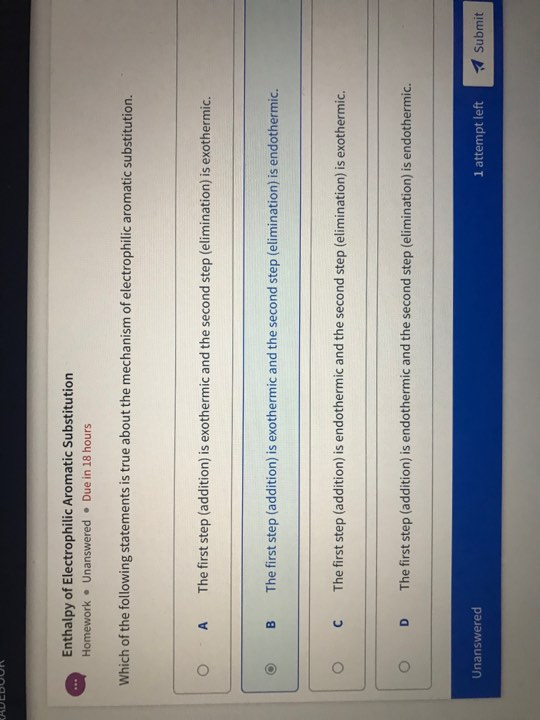
I think it’s B. Please let me know if it’s B or C?
Homework Answers
Option C
Addition of Electrophile is endothermic reaction since it lost aromaticity
While Elimination step is exothermic since it retains aromaticity.
Add Answer to:
I think it’s B. Please let me know if it’s B or C?
ADEDUUR Enthalpy of...
Help me pleaseeeee! Identify the mechanism by which each of the reactions above proceeds from among...
 Help me pleaseeeee! Identify the mechanism by which each of the
reactions above proceeds from among the mechanisms listed. Use the
letters a - j for your answers.
Chapter 16: Mastery [Review Topics] [References] 1. Identifying Unknown Aromatic Com... 1 pts M 2. Electrophilic Aromatic Substitution: ... 1 pts M 3. Electrophilic Aromatic Substitution: ... 1 pts M 4. Electrophilic Aromatic Substitution: ... 1 pts M CH3 _CH3 CH3 FeCl3 = 2. I T + Cl2 - + HCI 5....
Help me pleaseeeee! Identify the mechanism by which each of the
reactions above proceeds from among the mechanisms listed. Use the
letters a - j for your answers.
Chapter 16: Mastery [Review Topics] [References] 1. Identifying Unknown Aromatic Com... 1 pts M 2. Electrophilic Aromatic Substitution: ... 1 pts M 3. Electrophilic Aromatic Substitution: ... 1 pts M 4. Electrophilic Aromatic Substitution: ... 1 pts M CH3 _CH3 CH3 FeCl3 = 2. I T + Cl2 - + HCI 5....
Please list the correct letter choice for both 1 and 2. I tried the choices shown in the picture,...
 Please list the correct letter choice for both 1 and 2. I tried
the choices shown in the picture, but the homework system said
there was an error in my response. I am not sure which/if both are
wrong. Please help. :)
Na CI 1. NaC reflux 6M HCI reflux 2, Ph Ph он он NH3 CI NHs CI NH -Electrophilic addition dSy2 Nucleophilic substitution e-Electrophilic aromatic substitution Carbonyl nucleophilic addn g = Nucleophilic subs at carbonyl(acyl Xfer) h -...
Please list the correct letter choice for both 1 and 2. I tried
the choices shown in the picture, but the homework system said
there was an error in my response. I am not sure which/if both are
wrong. Please help. :)
Na CI 1. NaC reflux 6M HCI reflux 2, Ph Ph он он NH3 CI NHs CI NH -Electrophilic addition dSy2 Nucleophilic substitution e-Electrophilic aromatic substitution Carbonyl nucleophilic addn g = Nucleophilic subs at carbonyl(acyl Xfer) h -...
O H2N-OH 2. нса a Electrophilic addition b-E2 Elimination d- Sy2 Nucleophilic substitution-Nucleophilic subs at carbonyl(acyl...
 O H2N-OH 2. нса a Electrophilic addition b-E2 Elimination d- Sy2 Nucleophilic substitution-Nucleophilic subs at carbonyl(acyl Xfer) e-Electrophilic aromatic substitution h -Conjugate (nucleophilic) addn SNI Nucleophilic substitution r-Carbonyl nucleophilic addn Identify the mechanism by which each of the reactions above proceeds from among the mechanisms listed. Use the letters a -i for your answers. 2. Submit Answor Retry Entire Group 9 more group attempts remaining
10. What is a major problem with Friedel-Crafts alkylation? A) It requires high temperatures. B) The...
 10. What is a major problem with Friedel-Crafts alkylation? A) It requires high temperatures. B) The conditions are too acidic. C) The starting material is frequently over-alkylated. D) The products coordinate with the aluminum chloride. 11. Which of the following statements about the mechanism of electrophilic aromatic substitution is not true? A) All electrophilic aromatic substitution reactions occur via a two-step mechanism. B) The transition state of the first step is lower in energy. C) The first step is the...
help me to answer question b please.. 6.51 Consider the conversion of alkyl halide A to...
 help me to answer question b please..
6.51 Consider the conversion of alkyl halide A to ether B. -Bra O OCH3 + CH2OH + HB a. Classify the conversion of A to B as substitution, elimination, or addition. b. The reaction rate depends on the concentration of A only. Write the rate equation for the reaction, and explain why the reaction mechanism must involve more than one step.
help me to answer question b please..
6.51 Consider the conversion of alkyl halide A to ether B. -Bra O OCH3 + CH2OH + HB a. Classify the conversion of A to B as substitution, elimination, or addition. b. The reaction rate depends on the concentration of A only. Write the rate equation for the reaction, and explain why the reaction mechanism must involve more than one step.
Below are two mechanisms, please identify by which mechanisms these reactions are following (a-i mechanisms listed...
 Below are two mechanisms, please identify by which mechanisms
these reactions are following (a-i mechanisms listed
below).
Identify the mechanism by which each of the reactions above
proceeds from among the mechanisms listed. Use the letters
a - i for your answers
[Review Topics] [References) 1 HỌCho , L – H3C-o-Li 2. OX + HCI + H2O a = Proton transfer b = Lewis acid base c= Radical chain substitution d = Radical chain addition e = Electrophilic addition f=E1...
Below are two mechanisms, please identify by which mechanisms
these reactions are following (a-i mechanisms listed
below).
Identify the mechanism by which each of the reactions above
proceeds from among the mechanisms listed. Use the letters
a - i for your answers
[Review Topics] [References) 1 HỌCho , L – H3C-o-Li 2. OX + HCI + H2O a = Proton transfer b = Lewis acid base c= Radical chain substitution d = Radical chain addition e = Electrophilic addition f=E1...
Please help me with all 4 questions please. I'm struggling with 2,3 and 4. I think...
 Please help me with all 4 questions please. I'm struggling with
2,3 and 4. I think 1 is B
1. How many ones are in the adjacency matrix of the following compound? a. 10 b. 8 C. 6 d. 4 e. not a.-d. 2. Which structure is has S and Z stereochemistry? e. not a.-d a. b. d. 3. Which picture best represents the Pi-energy diagram of the arenium ion intermediate of electrophilic a substitution of benzene? Hint: The arenium...
Please help me with all 4 questions please. I'm struggling with
2,3 and 4. I think 1 is B
1. How many ones are in the adjacency matrix of the following compound? a. 10 b. 8 C. 6 d. 4 e. not a.-d. 2. Which structure is has S and Z stereochemistry? e. not a.-d a. b. d. 3. Which picture best represents the Pi-energy diagram of the arenium ion intermediate of electrophilic a substitution of benzene? Hint: The arenium...
ASAP need help with 1 to 10 please and thank you 1. Multiple choice questions (20)...
 ASAP need help with 1 to 10 please and thank you
1. Multiple choice questions (20) 1.Which of the followings is the most reactive one in electrophilic aromatic substitution? NO; D. A. B 2. If a proton resonance at 200 MHz in a spectrometer with a magnetic field of 4.7 T, what will be its resonance frequency in a spectrometer with a magnetic field of 9.4 T? A. 200 MHz B. 400 MHz C. 800 MHz D. 100 MHz )...
ASAP need help with 1 to 10 please and thank you
1. Multiple choice questions (20) 1.Which of the followings is the most reactive one in electrophilic aromatic substitution? NO; D. A. B 2. If a proton resonance at 200 MHz in a spectrometer with a magnetic field of 4.7 T, what will be its resonance frequency in a spectrometer with a magnetic field of 9.4 T? A. 200 MHz B. 400 MHz C. 800 MHz D. 100 MHz )...
I think I may have also done some of the oxidation states wrong. Please let me know the oxidation states and if it is o...
 I think I may have also done some of the oxidation states wrong.
Please let me know the oxidation states and if it is oxidation or
reduction. Thank you!
Element Chemical 1 Chemical 2 Oxidation state #1 Oxidation state #1 Left to right is Oxidation or Reduction Chemical 2 is aerobic or anaerobic C6H1206 CO2 +4 NO2 -1 NO; N2 NH3 Fe+3 (ferric) Fe 2 (ferrous) 0* H2O + 2020
I think I may have also done some of the oxidation states wrong.
Please let me know the oxidation states and if it is oxidation or
reduction. Thank you!
Element Chemical 1 Chemical 2 Oxidation state #1 Oxidation state #1 Left to right is Oxidation or Reduction Chemical 2 is aerobic or anaerobic C6H1206 CO2 +4 NO2 -1 NO; N2 NH3 Fe+3 (ferric) Fe 2 (ferrous) 0* H2O + 2020
250 ChemActivity 29 Electrophilic Aromatic Substitution no ChemActivity 29 Part A: Electrophilic Aromatic Substitution (What products...
 250 ChemActivity 29 Electrophilic Aromatic Substitution no ChemActivity 29 Part A: Electrophilic Aromatic Substitution (What products are formed when a strong electrophile is added to benzene?) Model 1: (review) Electrophilic Addition of HCI Rani o g cyclohexene carbocation intermediate Run 2 U X benzene This product carbocation intermediate DOES NOT Critical Thinking Questions 1 For Rxn I (above) draw curved arrows showing the mechanism of electrophilic addition of HCl. Include an appropriate carbocation intermediate in the box above. Figure 1:...
 Help me pleaseeeee! Identify the mechanism by which each of the
reactions above proceeds from among the mechanisms listed. Use the
letters a - j for your answers.
Chapter 16: Mastery [Review Topics] [References] 1. Identifying Unknown Aromatic Com... 1 pts M 2. Electrophilic Aromatic Substitution: ... 1 pts M 3. Electrophilic Aromatic Substitution: ... 1 pts M 4. Electrophilic Aromatic Substitution: ... 1 pts M CH3 _CH3 CH3 FeCl3 = 2. I T + Cl2 - + HCI 5....
Help me pleaseeeee! Identify the mechanism by which each of the
reactions above proceeds from among the mechanisms listed. Use the
letters a - j for your answers.
Chapter 16: Mastery [Review Topics] [References] 1. Identifying Unknown Aromatic Com... 1 pts M 2. Electrophilic Aromatic Substitution: ... 1 pts M 3. Electrophilic Aromatic Substitution: ... 1 pts M 4. Electrophilic Aromatic Substitution: ... 1 pts M CH3 _CH3 CH3 FeCl3 = 2. I T + Cl2 - + HCI 5....
 Please list the correct letter choice for both 1 and 2. I tried
the choices shown in the picture, but the homework system said
there was an error in my response. I am not sure which/if both are
wrong. Please help. :)
Na CI 1. NaC reflux 6M HCI reflux 2, Ph Ph он он NH3 CI NHs CI NH -Electrophilic addition dSy2 Nucleophilic substitution e-Electrophilic aromatic substitution Carbonyl nucleophilic addn g = Nucleophilic subs at carbonyl(acyl Xfer) h -...
Please list the correct letter choice for both 1 and 2. I tried
the choices shown in the picture, but the homework system said
there was an error in my response. I am not sure which/if both are
wrong. Please help. :)
Na CI 1. NaC reflux 6M HCI reflux 2, Ph Ph он он NH3 CI NHs CI NH -Electrophilic addition dSy2 Nucleophilic substitution e-Electrophilic aromatic substitution Carbonyl nucleophilic addn g = Nucleophilic subs at carbonyl(acyl Xfer) h -...
 O H2N-OH 2. нса a Electrophilic addition b-E2 Elimination d- Sy2 Nucleophilic substitution-Nucleophilic subs at carbonyl(acyl Xfer) e-Electrophilic aromatic substitution h -Conjugate (nucleophilic) addn SNI Nucleophilic substitution r-Carbonyl nucleophilic addn Identify the mechanism by which each of the reactions above proceeds from among the mechanisms listed. Use the letters a -i for your answers. 2. Submit Answor Retry Entire Group 9 more group attempts remaining
 10. What is a major problem with Friedel-Crafts alkylation? A) It requires high temperatures. B) The conditions are too acidic. C) The starting material is frequently over-alkylated. D) The products coordinate with the aluminum chloride. 11. Which of the following statements about the mechanism of electrophilic aromatic substitution is not true? A) All electrophilic aromatic substitution reactions occur via a two-step mechanism. B) The transition state of the first step is lower in energy. C) The first step is the...
 help me to answer question b please..
6.51 Consider the conversion of alkyl halide A to ether B. -Bra O OCH3 + CH2OH + HB a. Classify the conversion of A to B as substitution, elimination, or addition. b. The reaction rate depends on the concentration of A only. Write the rate equation for the reaction, and explain why the reaction mechanism must involve more than one step.
help me to answer question b please..
6.51 Consider the conversion of alkyl halide A to ether B. -Bra O OCH3 + CH2OH + HB a. Classify the conversion of A to B as substitution, elimination, or addition. b. The reaction rate depends on the concentration of A only. Write the rate equation for the reaction, and explain why the reaction mechanism must involve more than one step.
 Below are two mechanisms, please identify by which mechanisms
these reactions are following (a-i mechanisms listed
below).
Identify the mechanism by which each of the reactions above
proceeds from among the mechanisms listed. Use the letters
a - i for your answers
[Review Topics] [References) 1 HỌCho , L – H3C-o-Li 2. OX + HCI + H2O a = Proton transfer b = Lewis acid base c= Radical chain substitution d = Radical chain addition e = Electrophilic addition f=E1...
Below are two mechanisms, please identify by which mechanisms
these reactions are following (a-i mechanisms listed
below).
Identify the mechanism by which each of the reactions above
proceeds from among the mechanisms listed. Use the letters
a - i for your answers
[Review Topics] [References) 1 HỌCho , L – H3C-o-Li 2. OX + HCI + H2O a = Proton transfer b = Lewis acid base c= Radical chain substitution d = Radical chain addition e = Electrophilic addition f=E1...
 Please help me with all 4 questions please. I'm struggling with
2,3 and 4. I think 1 is B
1. How many ones are in the adjacency matrix of the following compound? a. 10 b. 8 C. 6 d. 4 e. not a.-d. 2. Which structure is has S and Z stereochemistry? e. not a.-d a. b. d. 3. Which picture best represents the Pi-energy diagram of the arenium ion intermediate of electrophilic a substitution of benzene? Hint: The arenium...
Please help me with all 4 questions please. I'm struggling with
2,3 and 4. I think 1 is B
1. How many ones are in the adjacency matrix of the following compound? a. 10 b. 8 C. 6 d. 4 e. not a.-d. 2. Which structure is has S and Z stereochemistry? e. not a.-d a. b. d. 3. Which picture best represents the Pi-energy diagram of the arenium ion intermediate of electrophilic a substitution of benzene? Hint: The arenium...
 ASAP need help with 1 to 10 please and thank you
1. Multiple choice questions (20) 1.Which of the followings is the most reactive one in electrophilic aromatic substitution? NO; D. A. B 2. If a proton resonance at 200 MHz in a spectrometer with a magnetic field of 4.7 T, what will be its resonance frequency in a spectrometer with a magnetic field of 9.4 T? A. 200 MHz B. 400 MHz C. 800 MHz D. 100 MHz )...
ASAP need help with 1 to 10 please and thank you
1. Multiple choice questions (20) 1.Which of the followings is the most reactive one in electrophilic aromatic substitution? NO; D. A. B 2. If a proton resonance at 200 MHz in a spectrometer with a magnetic field of 4.7 T, what will be its resonance frequency in a spectrometer with a magnetic field of 9.4 T? A. 200 MHz B. 400 MHz C. 800 MHz D. 100 MHz )...
 I think I may have also done some of the oxidation states wrong.
Please let me know the oxidation states and if it is oxidation or
reduction. Thank you!
Element Chemical 1 Chemical 2 Oxidation state #1 Oxidation state #1 Left to right is Oxidation or Reduction Chemical 2 is aerobic or anaerobic C6H1206 CO2 +4 NO2 -1 NO; N2 NH3 Fe+3 (ferric) Fe 2 (ferrous) 0* H2O + 2020
I think I may have also done some of the oxidation states wrong.
Please let me know the oxidation states and if it is oxidation or
reduction. Thank you!
Element Chemical 1 Chemical 2 Oxidation state #1 Oxidation state #1 Left to right is Oxidation or Reduction Chemical 2 is aerobic or anaerobic C6H1206 CO2 +4 NO2 -1 NO; N2 NH3 Fe+3 (ferric) Fe 2 (ferrous) 0* H2O + 2020
 250 ChemActivity 29 Electrophilic Aromatic Substitution no ChemActivity 29 Part A: Electrophilic Aromatic Substitution (What products are formed when a strong electrophile is added to benzene?) Model 1: (review) Electrophilic Addition of HCI Rani o g cyclohexene carbocation intermediate Run 2 U X benzene This product carbocation intermediate DOES NOT Critical Thinking Questions 1 For Rxn I (above) draw curved arrows showing the mechanism of electrophilic addition of HCl. Include an appropriate carbocation intermediate in the box above. Figure 1:...
Most questions answered within 3 hours.
-
Where is the error in this code sequence?
String s1 = "Hello";
String s2 = "ello";...
asked 10 months ago -
Financial data for Joel de Paris, Inc., for last year
follow:
Joel de Paris, Inc.
Balance...
asked 10 months ago -
Consider this reaction:
Al2(SO4)3 (aq)+ BaCl3
(aq) Al2Cl6 (aq)- +
3BaSO4(s) . What is the...
asked 10 months ago -
Suppose that Savneet is considering increasing her
recent random sample from 20 car rentals to 40...
asked 10 months ago -
Trucks arrive at an unloading terminal at an average rate of 120
per hour.
Trucks arrive...
asked 10 months ago -
Why are methanol and ethanol completely soluble in water while
octanol is not very little soluble....
asked 10 months ago -
A facilities manager at a university reads in a research report
that the mean amount of...
asked 10 months ago -
When the CuSO4 is rehydrated by adding water to the anhydrous
compound, is this an endothermic...
asked 10 months ago -
A ray of sunlight is passing from diamond into crown glass; the
angle of incidence is...
asked 10 months ago -
A block of mass 0.249 kg is placed on top of a light, vertical
spring of...
asked 10 months ago -
how do the kidneys compensate in the presences of acidosis
a) trigger hyperventilate
b) reserve acid...
asked 10 months ago -
Question 501 pts
The rental rate of capital to the firm increases. Which of the
following...
asked 10 months ago