
Homework Answers
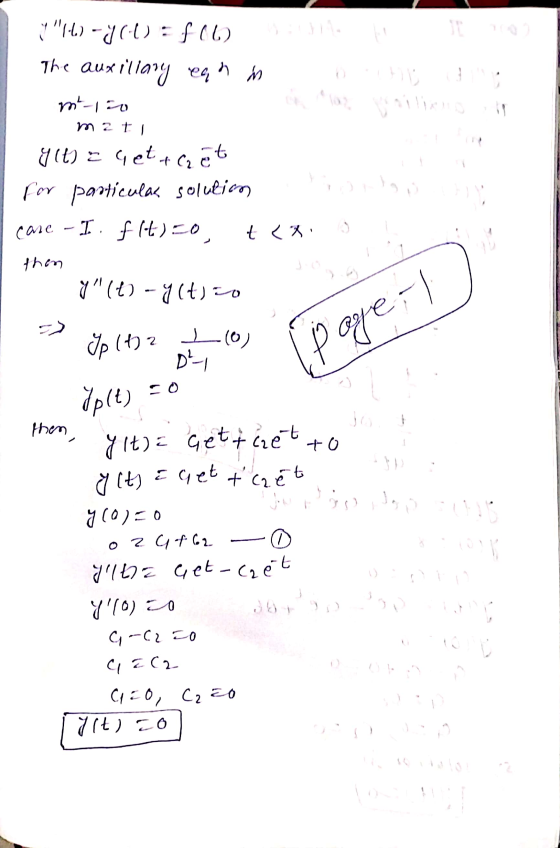
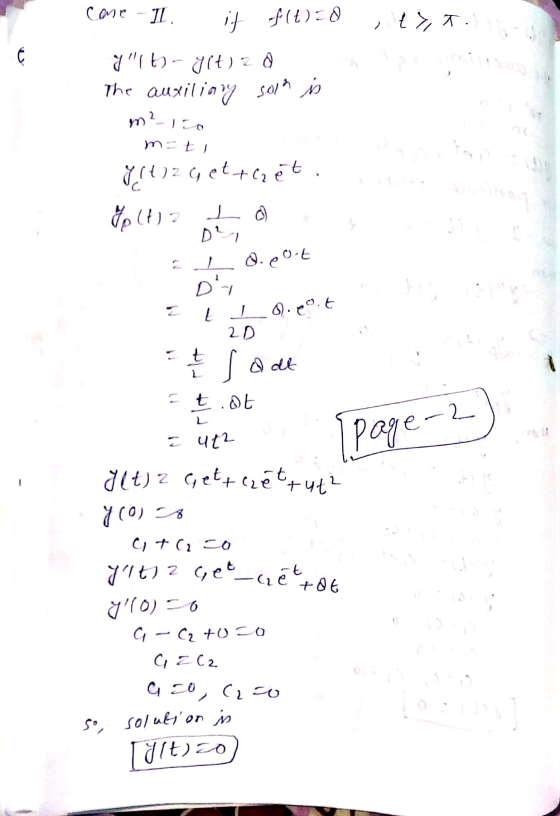
Solve the IVP y' + y = f(t), y(0) = 0, where f is the 27-periodic...
 Solve the IVP y' + y = f(t), y(0) = 0, where f is the 27-periodic function given by f(t) -1, 0<t<T, <t<21, f(t) = f(t + 27).
Use the Laplace transform to solve the given initial-value problem. 0 st<1 t 1 y' y f(t), y(0) 0, where f(t) (4,...
 Use the Laplace transform to solve the given initial-value problem. 0 st<1 t 1 y' y f(t), y(0) 0, where f(t) (4, ae-1 -(1-1) 4 y(t) X
Use the Laplace transform to solve the given initial-value problem. 0 st
Use the Laplace transform to solve the given initial-value problem. 0 st<1 t 1 y' y f(t), y(0) 0, where f(t) (4, ae-1 -(1-1) 4 y(t) X
Use the Laplace transform to solve the given initial-value problem. 0 st
IVP Use the Laplace Transform to solve the y"+y = f(t) y'ld-o, y(0)=0 where f(t) =...
 IVP Use the Laplace Transform to solve the y"+y = f(t) y'ld-o, y(0)=0 where f(t) = { 1 Oste/ sint tz /
3) Solve the following initial value problem. ( 1; 0 <t y" + y = f(t),...
 3) Solve the following initial value problem. ( 1; 0 <t y" + y = f(t), y(0) = 2, y'(0) = -1, where f(t) = } nere -1; En VI t
10. Use the Laplace transform to solve y" - 3y' +2y f(t), y(0)-0,'(0) 0, where (t)-(0...
 10. Use the Laplace transform to solve y" - 3y' +2y f(t), y(0)-0,'(0) 0, where (t)-(0 for 0 st < 4; for t 2 4 No credit will be given for any other method. (10 marks)
solve using Laplace transforms (f) y"+y=f(t – 37) cos(t), y(0) = 0, y'(0) = 1. (g)...
 solve using Laplace transforms
(f) y"+y=f(t – 37) cos(t), y(0) = 0, y'(0) = 1. (g) y" + 2y = U(t – 7) +38(t – 37/2) – Ut – 27), y(0) = y'(0) = 0.
solve using Laplace transforms
(f) y"+y=f(t – 37) cos(t), y(0) = 0, y'(0) = 1. (g) y" + 2y = U(t – 7) +38(t – 37/2) – Ut – 27), y(0) = y'(0) = 0.
Solve the differential equation below using Laplacian Transformations: Y' – 3y = f(t); y(0) = 0,...
 Solve the differential equation below using Laplacian Transformations: Y' – 3y = f(t); y(0) = 0, y (0) = 1 where f(t) = 2, 0 < t <3 13, t > 3 {
cos 4t 1:[0,) 3. Solve for y(t): y” +16y = f(t) = { with y(0) =...
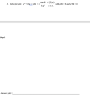 cos 4t 1:[0,) 3. Solve for y(t): y” +16y = f(t) = { with y(0) = 0 and y'(0) = 0. 0,if tn. Saleserstos se va posar este mai 90 -m70-e Stepl. Answer: y(t) =
Solve the following ode using Laplace transform: y' - 5y = f(t); y(0) - 1 t;...
 Solve the following ode using Laplace transform: y' - 5y = f(t); y(0) - 1 t; Ost<1 f(t) = 0; t21
5.Solve the initial value problem y" +5y' +6y-g(t), y(0) 0,(0) 2, where (t)-t 1<t<5,. 1, 5...
 5.Solve the initial value problem y" +5y' +6y-g(t), y(0) 0,(0) 2, where (t)-t 1<t<5,. 1, 5 < t. Then sketch the graph of the solution. (Use technologies. Be sure the graph is neat.) Sec. 7.6.39]
 Solve the IVP y' + y = f(t), y(0) = 0, where f is the 27-periodic function given by f(t) -1, 0<t<T, <t<21, f(t) = f(t + 27).
 Use the Laplace transform to solve the given initial-value problem. 0 st<1 t 1 y' y f(t), y(0) 0, where f(t) (4, ae-1 -(1-1) 4 y(t) X
Use the Laplace transform to solve the given initial-value problem. 0 st
Use the Laplace transform to solve the given initial-value problem. 0 st<1 t 1 y' y f(t), y(0) 0, where f(t) (4, ae-1 -(1-1) 4 y(t) X
Use the Laplace transform to solve the given initial-value problem. 0 st
 IVP Use the Laplace Transform to solve the y"+y = f(t) y'ld-o, y(0)=0 where f(t) = { 1 Oste/ sint tz /
 3) Solve the following initial value problem. ( 1; 0 <t y" + y = f(t), y(0) = 2, y'(0) = -1, where f(t) = } nere -1; En VI t
 10. Use the Laplace transform to solve y" - 3y' +2y f(t), y(0)-0,'(0) 0, where (t)-(0 for 0 st < 4; for t 2 4 No credit will be given for any other method. (10 marks)
 solve using Laplace transforms
(f) y"+y=f(t – 37) cos(t), y(0) = 0, y'(0) = 1. (g) y" + 2y = U(t – 7) +38(t – 37/2) – Ut – 27), y(0) = y'(0) = 0.
solve using Laplace transforms
(f) y"+y=f(t – 37) cos(t), y(0) = 0, y'(0) = 1. (g) y" + 2y = U(t – 7) +38(t – 37/2) – Ut – 27), y(0) = y'(0) = 0.
 Solve the differential equation below using Laplacian Transformations: Y' – 3y = f(t); y(0) = 0, y (0) = 1 where f(t) = 2, 0 < t <3 13, t > 3 {
 cos 4t 1:[0,) 3. Solve for y(t): y” +16y = f(t) = { with y(0) = 0 and y'(0) = 0. 0,if tn. Saleserstos se va posar este mai 90 -m70-e Stepl. Answer: y(t) =
 Solve the following ode using Laplace transform: y' - 5y = f(t); y(0) - 1 t; Ost<1 f(t) = 0; t21
 5.Solve the initial value problem y" +5y' +6y-g(t), y(0) 0,(0) 2, where (t)-t 1<t<5,. 1, 5 < t. Then sketch the graph of the solution. (Use technologies. Be sure the graph is neat.) Sec. 7.6.39]
Most questions answered within 3 hours.
-
Where is the error in this code sequence?
String s1 = "Hello";
String s2 = "ello";...
asked 10 months ago -
Financial data for Joel de Paris, Inc., for last year
follow:
Joel de Paris, Inc.
Balance...
asked 10 months ago -
Consider this reaction:
Al2(SO4)3 (aq)+ BaCl3
(aq) Al2Cl6 (aq)- +
3BaSO4(s) . What is the...
asked 10 months ago -
Suppose that Savneet is considering increasing her
recent random sample from 20 car rentals to 40...
asked 10 months ago -
Trucks arrive at an unloading terminal at an average rate of 120
per hour.
Trucks arrive...
asked 10 months ago -
Why are methanol and ethanol completely soluble in water while
octanol is not very little soluble....
asked 10 months ago -
A facilities manager at a university reads in a research report
that the mean amount of...
asked 10 months ago -
When the CuSO4 is rehydrated by adding water to the anhydrous
compound, is this an endothermic...
asked 10 months ago -
A ray of sunlight is passing from diamond into crown glass; the
angle of incidence is...
asked 10 months ago -
A block of mass 0.249 kg is placed on top of a light, vertical
spring of...
asked 10 months ago -
how do the kidneys compensate in the presences of acidosis
a) trigger hyperventilate
b) reserve acid...
asked 10 months ago -
Question 501 pts
The rental rate of capital to the firm increases. Which of the
following...
asked 10 months ago