The sequence of triangle numbers is generated by adding the natural numbers. So the 7th triangle...
The sequence of triangle numbers is generated by adding the natural numbers. So the 7th triangle number would be 1 + 2 + 3 + 4 + 5 + 6 + 7 = 28. The first ten terms would be:
1, 3, 6, 10, 15, 21, 28, 36, 45, 55, ...
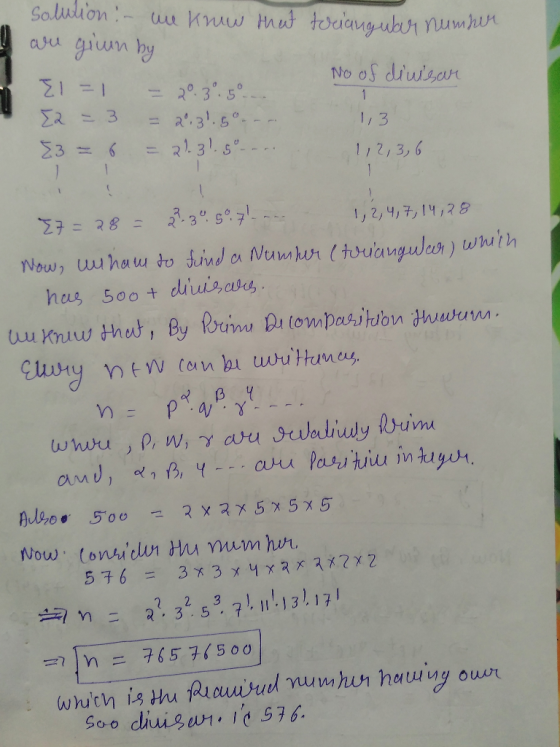
Let us list the factors of the first seven triangle numbers:
1: 1
3: 1,3
6: 1,2,3,6
10: 1,2,5,10
15: 1,3,5,15
21: 1,3,7,21
28: 1,2,4,7,14,28
We can see that 28 is the first triangle number to have over five divisors.What is the value of the first triangle number to have over five hundred divisors? Solve using only math.
Homework Answers
Add Answer to:
The sequence of triangle numbers is generated by adding the
natural numbers. So the 7th triangle...
ANSWER USING JAVA CODE (1)The sum of the squares of the first ten natural numbers is,...
ANSWER USING JAVA CODE (1)The sum of the squares of the first ten natural numbers is, 12 + 22 + ... + 102 = 385 The square of the sum of the first ten natural numbers is, (1 + 2 + ... + 10)2 = 552 = 3025 Hence the difference between the sum of the squares of the first ten natural numbers and the square of the sum is 3025 − 385 = 2640. Find the difference between the...
6 Generate Triangle Numbers: You must use Python 3 Write a function called generateTriangleNumbers(). This function...
6 Generate Triangle Numbers: You must use Python 3 Write a function called generateTriangleNumbers(). This function will take in an integer x and will return a list of integers containing the first x triangle numbers. The nth triangle number is the sum of 1 + 2 + 3 + 4...(n − 1) + n. Some example input-output pairs: 3 -> [1, 3, 6] 1 -> [1] 7 -> [1, 3, 6, 10, 15, 21, 28]
Problem 1: Follow the instructions below: Use an ArrayList to store randomly generated circle or Triangle object...
 Problem 1: Follow the instructions below: Use an ArrayList to store randomly generated circle or Triangle objects. 1. 2. While generating these objects, assign radius with a random number between 0 and 1 for Circle objects and three sides with random numbers between and 2 for Triangle objects. 3. While adding the objects into the ArrayList, you should reject those with area less than the existing obiects in the ArrayList and only add those with area greater than the existing...
The Fibonacci sequence is the sequence of numbers: 0, 1, 1, 2, 3, 5, 8, 13,...
The Fibonacci sequence is the sequence of numbers: 0, 1, 1, 2, 3, 5, 8, 13, 21, 34, … The next number is found by adding up the two numbers before it. For example, the 2 is found by adding the two numbers before it (1+1). The 3 is found by adding the two numbers before it (1+2). The 5 is found by adding the two numbers before it (2+3), and so on! Each number in the sequence is called...
numbers 21,23,25 Objective 2: Solve a Triangle Using the Law of Sines (SSA) Ambiguous Case For...
 numbers 21,23,25
Objective 2: Solve a Triangle Using the Law of Sines (SSA) Ambiguous Case For Exercises 21-28. information is given about AABC. Determine if the information gives one triangle, two triangles, or no triangle. Solve the resulting triangle(s). Round the lengths of sides and measures of the angles to 1 decimal place if necessary. (See Examples 3-5) 21. b = 33, c = 25, B = 38° 22. b = 5.c = 12, C = 73° 23. a =...
numbers 21,23,25
Objective 2: Solve a Triangle Using the Law of Sines (SSA) Ambiguous Case For Exercises 21-28. information is given about AABC. Determine if the information gives one triangle, two triangles, or no triangle. Solve the resulting triangle(s). Round the lengths of sides and measures of the angles to 1 decimal place if necessary. (See Examples 3-5) 21. b = 33, c = 25, B = 38° 22. b = 5.c = 12, C = 73° 23. a =...
Each new term in the Fibonacci sequence is generated by adding the previous two terms. By startin...
Each new term in the Fibonacci sequence is generated by adding the previous two terms. By starting with 1 and 2, the first 10 terms will be: 1, 2, 3, 5, 8, 13, 21, 34, 55, 89, ... By considering the terms in the Fibonacci sequence whose values do not exceed four million, find the sum of the even-valued terms.Place your answer in R0 at the end of your program. Can you tell me what is the reason when done...
Fibonacci Sequence The Fibonacci Sequence is the series of numbers: 0, 1, 1, 2, 3, 5,...
Fibonacci Sequence The Fibonacci Sequence is the series of numbers: 0, 1, 1, 2, 3, 5, 8, 13, 21, 34, ... The next number is found by adding up the two numbers before it. The 2 is found by adding the two numbers before it (1+1) The 3 is found by adding the two numbers before it (1+2), And the 5 is (2+3), and so on! Example: the next number in the sequence above is 21+34 = 55 Source:...
Please help me with understandable solutions for question 6(a), 7, 8 and 10. ( Use Chinese...
 Please help me with understandable solutions for question 6(a), 7,
8 and 10. ( Use Chinese remainder theorem where applicable).
78 CHAPTER 5. THE CHINESE REMAINDER THEOREM 6. (a) Let m mi,m2 Then r a (mod mi), ag (mod m2) can be solved if and only if (m, m2) | a1-a2. The solution, when it exists, is unique modulo m. (b) Using part (a) prove the Chinese remainder theorem by induction. 7. There is a number. It has no remainder...
Please help me with understandable solutions for question 6(a), 7,
8 and 10. ( Use Chinese remainder theorem where applicable).
78 CHAPTER 5. THE CHINESE REMAINDER THEOREM 6. (a) Let m mi,m2 Then r a (mod mi), ag (mod m2) can be solved if and only if (m, m2) | a1-a2. The solution, when it exists, is unique modulo m. (b) Using part (a) prove the Chinese remainder theorem by induction. 7. There is a number. It has no remainder...
A Fibonacci sequence is a series of numbers where the next number in the series is...
A Fibonacci sequence is a series of numbers where the next number in the series is the sum of the previous two numbers. The sequence starts with the numbers 0 and 1. Here are the first ten numbers of the Fibonacci sequence: 0 1 1 2 3 5 8 13 21 34 Write a Java program to print out the first fifteen numbers of the Fibonacci sequence using a loop. You will need three variables previous, current, and next...
Write a C program to assign natural numbers 1 to 100 into a one-dimensional integer array....
Write a C program to assign natural numbers 1 to 100 into a one-dimensional integer array. Display all the values in the array on the screen. For each number in the array, determine if the number contains digit 7 or is divisible by 7. Display all those numbers on the screen. Original array: 1 2 3 4 5 6 7 8 9 10 11 12 13 14 15 16 17 18 19 20 21 22 23 24 25 26 27...
 Problem 1: Follow the instructions below: Use an ArrayList to store randomly generated circle or Triangle objects. 1. 2. While generating these objects, assign radius with a random number between 0 and 1 for Circle objects and three sides with random numbers between and 2 for Triangle objects. 3. While adding the objects into the ArrayList, you should reject those with area less than the existing obiects in the ArrayList and only add those with area greater than the existing...
 numbers 21,23,25
Objective 2: Solve a Triangle Using the Law of Sines (SSA) Ambiguous Case For Exercises 21-28. information is given about AABC. Determine if the information gives one triangle, two triangles, or no triangle. Solve the resulting triangle(s). Round the lengths of sides and measures of the angles to 1 decimal place if necessary. (See Examples 3-5) 21. b = 33, c = 25, B = 38° 22. b = 5.c = 12, C = 73° 23. a =...
numbers 21,23,25
Objective 2: Solve a Triangle Using the Law of Sines (SSA) Ambiguous Case For Exercises 21-28. information is given about AABC. Determine if the information gives one triangle, two triangles, or no triangle. Solve the resulting triangle(s). Round the lengths of sides and measures of the angles to 1 decimal place if necessary. (See Examples 3-5) 21. b = 33, c = 25, B = 38° 22. b = 5.c = 12, C = 73° 23. a =...
 Please help me with understandable solutions for question 6(a), 7,
8 and 10. ( Use Chinese remainder theorem where applicable).
78 CHAPTER 5. THE CHINESE REMAINDER THEOREM 6. (a) Let m mi,m2 Then r a (mod mi), ag (mod m2) can be solved if and only if (m, m2) | a1-a2. The solution, when it exists, is unique modulo m. (b) Using part (a) prove the Chinese remainder theorem by induction. 7. There is a number. It has no remainder...
Please help me with understandable solutions for question 6(a), 7,
8 and 10. ( Use Chinese remainder theorem where applicable).
78 CHAPTER 5. THE CHINESE REMAINDER THEOREM 6. (a) Let m mi,m2 Then r a (mod mi), ag (mod m2) can be solved if and only if (m, m2) | a1-a2. The solution, when it exists, is unique modulo m. (b) Using part (a) prove the Chinese remainder theorem by induction. 7. There is a number. It has no remainder...
Most questions answered within 3 hours.
-
Where is the error in this code sequence?
String s1 = "Hello";
String s2 = "ello";...
asked 10 months ago -
Financial data for Joel de Paris, Inc., for last year
follow:
Joel de Paris, Inc.
Balance...
asked 10 months ago -
Consider this reaction:
Al2(SO4)3 (aq)+ BaCl3
(aq) Al2Cl6 (aq)- +
3BaSO4(s) . What is the...
asked 10 months ago -
Suppose that Savneet is considering increasing her
recent random sample from 20 car rentals to 40...
asked 10 months ago -
Trucks arrive at an unloading terminal at an average rate of 120
per hour.
Trucks arrive...
asked 10 months ago -
Why are methanol and ethanol completely soluble in water while
octanol is not very little soluble....
asked 10 months ago -
A facilities manager at a university reads in a research report
that the mean amount of...
asked 10 months ago -
When the CuSO4 is rehydrated by adding water to the anhydrous
compound, is this an endothermic...
asked 10 months ago -
A ray of sunlight is passing from diamond into crown glass; the
angle of incidence is...
asked 10 months ago -
A block of mass 0.249 kg is placed on top of a light, vertical
spring of...
asked 10 months ago -
how do the kidneys compensate in the presences of acidosis
a) trigger hyperventilate
b) reserve acid...
asked 10 months ago -
Question 501 pts
The rental rate of capital to the firm increases. Which of the
following...
asked 10 months ago