![0-0 = -a)|(-0). 3. Prove that for all a, b € 2,00 (-a)0 A 4. Show that for all n e Z, 6]n(n + 1)(2n + 1). 1. 1)) fono](http://img.homeworklib.com/questions/40f80250-9c47-11ea-a77e-496dde45bd57.png?x-oss-process=image/resize,w_560)
Homework Answers
Prove by Induction 24.) Prove that for all natural numbers n 2 5, (n+1)! 2n+3 b.)...
 Prove by Induction
24.) Prove that for all natural numbers n 2 5, (n+1)! 2n+3 b.) Prove that for all integers n (Hint: First prove the following lemma: If n E Z, n2 6 then then proceed with your proof.
Prove by Induction
24.) Prove that for all natural numbers n 2 5, (n+1)! 2n+3 b.) Prove that for all integers n (Hint: First prove the following lemma: If n E Z, n2 6 then then proceed with your proof.
13 please 8. b. -2 3 0 0 0 0 -1 2 0 0-4 0 3...
 13 please
8. b. -2 3 0 0 0 0 -1 2 0 0-4 0 3 0-2 0 3 0 0 -2 0 3 0 4 o0-1 6 0 0 1 o 2 6 0 0 -1 6 10. For any positive integer k, prove that det(4t) - de(A)*. 11. Prove that if A is invertible, then den(A-1)- I/der(A) - det(4)- 12. We know in general that A-B丰B-A for two n x n matrices. However, prove that: det(A . B)-det(B...
13 please
8. b. -2 3 0 0 0 0 -1 2 0 0-4 0 3 0-2 0 3 0 0 -2 0 3 0 4 o0-1 6 0 0 1 o 2 6 0 0 -1 6 10. For any positive integer k, prove that det(4t) - de(A)*. 11. Prove that if A is invertible, then den(A-1)- I/der(A) - det(4)- 12. We know in general that A-B丰B-A for two n x n matrices. However, prove that: det(A . B)-det(B...
. 1. Prove by induction that for all integers n≥1, 4+8+12+...+4n = 2n^2+2n 2. A number...
. 1. Prove by induction that for all integers n≥1, 4+8+12+...+4n = 2n^2+2n 2. A number a is divisible by b if the remainder of dividing a by b is zero. For example 10 is divisible by 5 but 11 is not divisible by 5. Prove by induction that for all integers n≥1,11^n - 6 is divisible by 5. 3. Prove by induction that for all integers n ≥ 1, 3^n ≥ 2^n+n^2
(a) Prove that, for all natural numbers n, 2 + 2 · 2 2 + 3...
(a) Prove that, for all natural numbers n, 2 + 2 · 2 2 + 3 · 2 3 + ... + n · 2 n = (n − 1)2n+1 + 2. (b) Prove that, for all natural numbers n, 3 + 2 · 3 2 + 3 · 3 3 + ... + n · 3 n = (2n − 1)3n+1 + 3 4 . (c) Prove that, for all natural numbers n, 1 2 + 42 + 72...
5. Prove that for n e Z, n is even, if and only if n2 is...
 5. Prove that for n e Z, n is even, if and only if n2 is even. 6. Verify by induction that 3" > 2n? n>0.
Problem 3. Prove that if bn + B and B < 0, there is an N...
 Problem 3. Prove that if bn + B and B < 0, there is an N E N such that for all n > N, bn < B/2.
Prove that for each natural number n 26 we have 2n 3 3 2" Use the above to prove that for each na...
 Prove that for each natural number n 26 we have 2n 3 3 2" Use the above to prove that for each natural number n 2 6 we have (n +1)2 Hint: n24n +4-(n2 +2n +1) + (2n+3).] 2"
Prove that for each natural number n 26 we have 2n 3 3 2" Use the above to prove that for each natural number n 2 6 we have (n +1)2 Hint: n24n +4-(n2 +2n +1) + (2n+3).] 2"
Prove that for each natural number n 26 we have 2n 3 3 2" Use the above to prove that for each natural number n 2 6 we have (n +1)2 Hint: n24n +4-(n2 +2n +1) + (2n+3).] 2"
2. Prove that lim (-1)"+1 0. 72-00 n 2n 3. Prove that lim noon + 1...
 2. Prove that lim (-1)"+1 0. 72-00 n 2n 3. Prove that lim noon + 1 2. 80 4. Prove that lim n-+v5n 0. -7 9 - in 5. Prove that lim n0 8 + 13n 13
(2) Prove that if j-0 i-0 with k, 1 e N u {0), and bo, . . . , be , do, . . . , dl e { 0, . . . ,...
 (2) Prove that if j-0 i-0 with k, 1 e N u {0), and bo, . . . , be , do, . . . , dl e { 0, . . . , 9), such that be, de # 0, then k = 1 and bi- di fori 0,.. , k. (I recommend using strong induction and uniqueness of the expression n=10 . a + r with a e Z and re(0, 1, ,9).) (3) Prove that for all...
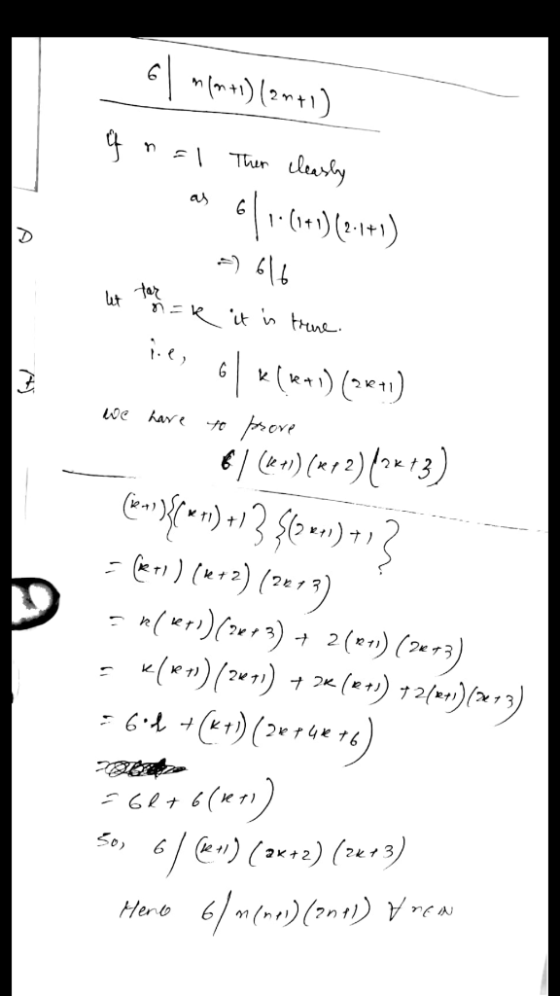
3. Use the Division Algorithm (Theorem 6.1.1) to prove that for all n ez+ 6 I n(n +1) (2n +1).
 3. Use the Division Algorithm (Theorem 6.1.1) to prove that for all n ez+ 6 I n(n +1) (2n +1).
3. Use the Division Algorithm (Theorem 6.1.1) to prove that for all n ez+ 6 I n(n +1) (2n +1).
3. Use the Division Algorithm (Theorem 6.1.1) to prove that for all n ez+ 6 I n(n +1) (2n +1).
 Prove by Induction
24.) Prove that for all natural numbers n 2 5, (n+1)! 2n+3 b.) Prove that for all integers n (Hint: First prove the following lemma: If n E Z, n2 6 then then proceed with your proof.
Prove by Induction
24.) Prove that for all natural numbers n 2 5, (n+1)! 2n+3 b.) Prove that for all integers n (Hint: First prove the following lemma: If n E Z, n2 6 then then proceed with your proof.
 13 please
8. b. -2 3 0 0 0 0 -1 2 0 0-4 0 3 0-2 0 3 0 0 -2 0 3 0 4 o0-1 6 0 0 1 o 2 6 0 0 -1 6 10. For any positive integer k, prove that det(4t) - de(A)*. 11. Prove that if A is invertible, then den(A-1)- I/der(A) - det(4)- 12. We know in general that A-B丰B-A for two n x n matrices. However, prove that: det(A . B)-det(B...
13 please
8. b. -2 3 0 0 0 0 -1 2 0 0-4 0 3 0-2 0 3 0 0 -2 0 3 0 4 o0-1 6 0 0 1 o 2 6 0 0 -1 6 10. For any positive integer k, prove that det(4t) - de(A)*. 11. Prove that if A is invertible, then den(A-1)- I/der(A) - det(4)- 12. We know in general that A-B丰B-A for two n x n matrices. However, prove that: det(A . B)-det(B...
 5. Prove that for n e Z, n is even, if and only if n2 is even. 6. Verify by induction that 3" > 2n? n>0.
 Problem 3. Prove that if bn + B and B < 0, there is an N E N such that for all n > N, bn < B/2.
 Prove that for each natural number n 26 we have 2n 3 3 2" Use the above to prove that for each natural number n 2 6 we have (n +1)2 Hint: n24n +4-(n2 +2n +1) + (2n+3).] 2"
Prove that for each natural number n 26 we have 2n 3 3 2" Use the above to prove that for each natural number n 2 6 we have (n +1)2 Hint: n24n +4-(n2 +2n +1) + (2n+3).] 2"
Prove that for each natural number n 26 we have 2n 3 3 2" Use the above to prove that for each natural number n 2 6 we have (n +1)2 Hint: n24n +4-(n2 +2n +1) + (2n+3).] 2"
 2. Prove that lim (-1)"+1 0. 72-00 n 2n 3. Prove that lim noon + 1 2. 80 4. Prove that lim n-+v5n 0. -7 9 - in 5. Prove that lim n0 8 + 13n 13
 (2) Prove that if j-0 i-0 with k, 1 e N u {0), and bo, . . . , be , do, . . . , dl e { 0, . . . , 9), such that be, de # 0, then k = 1 and bi- di fori 0,.. , k. (I recommend using strong induction and uniqueness of the expression n=10 . a + r with a e Z and re(0, 1, ,9).) (3) Prove that for all...
 3. Use the Division Algorithm (Theorem 6.1.1) to prove that for all n ez+ 6 I n(n +1) (2n +1).
3. Use the Division Algorithm (Theorem 6.1.1) to prove that for all n ez+ 6 I n(n +1) (2n +1).
3. Use the Division Algorithm (Theorem 6.1.1) to prove that for all n ez+ 6 I n(n +1) (2n +1).
Most questions answered within 3 hours.
-
Where is the error in this code sequence?
String s1 = "Hello";
String s2 = "ello";...
asked 11 months ago -
Financial data for Joel de Paris, Inc., for last year
follow:
Joel de Paris, Inc.
Balance...
asked 11 months ago -
Consider this reaction:
Al2(SO4)3 (aq)+ BaCl3
(aq) Al2Cl6 (aq)- +
3BaSO4(s) . What is the...
asked 11 months ago -
Suppose that Savneet is considering increasing her
recent random sample from 20 car rentals to 40...
asked 11 months ago -
Trucks arrive at an unloading terminal at an average rate of 120
per hour.
Trucks arrive...
asked 11 months ago -
Why are methanol and ethanol completely soluble in water while
octanol is not very little soluble....
asked 11 months ago -
A facilities manager at a university reads in a research report
that the mean amount of...
asked 11 months ago -
When the CuSO4 is rehydrated by adding water to the anhydrous
compound, is this an endothermic...
asked 11 months ago -
A ray of sunlight is passing from diamond into crown glass; the
angle of incidence is...
asked 11 months ago -
A block of mass 0.249 kg is placed on top of a light, vertical
spring of...
asked 11 months ago -
how do the kidneys compensate in the presences of acidosis
a) trigger hyperventilate
b) reserve acid...
asked 11 months ago -
Question 501 pts
The rental rate of capital to the firm increases. Which of the
following...
asked 11 months ago