
Homework Answers
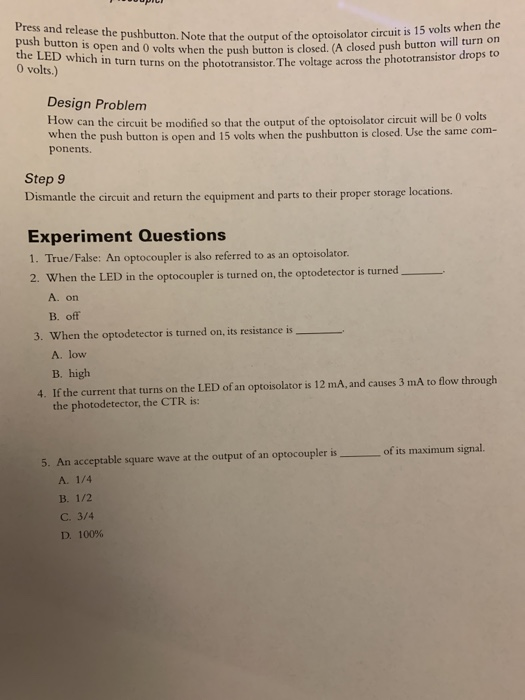
The answer to the design problem is given below:
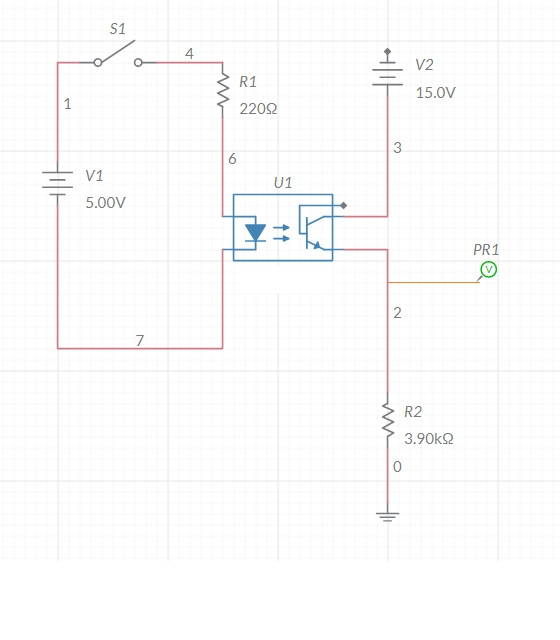
Theory: The probe and resistor should be connected as shown below to get 0 V when push-button is pressed and to get 15 V when push-button is not pressed.
Explanation: When push-button is pressed, Optocoupler is activated and the resistance between Emitter and Collector is very less, so 15 V gets applied to 3.9 Kohm resistance. The probe reads 15 V.
When push-button is released, High resistance appears across Emitter & Collector. No current flows. So, the probe reads 0 V.
Add Answer to:
Could you please show me how I can drw those circuits.
please using (NI Multisim 14)...
can you show where to measure, the quantity listed in the pic? like what two points...
 can you show where to measure, the quantity listed in the
pic?
like what two points to get the answer
for
all of them, please.
In this step, you will add a second transistor, causing the switching action to improve dramatically. The circuit is shown in Figure 10-2. Notice that the 1.0 k resistor is now the collector resistor for Q. The circuit works as follows. When Vw is very low, Q, is off since it does not have sufficient...
can you show where to measure, the quantity listed in the
pic?
like what two points to get the answer
for
all of them, please.
In this step, you will add a second transistor, causing the switching action to improve dramatically. The circuit is shown in Figure 10-2. Notice that the 1.0 k resistor is now the collector resistor for Q. The circuit works as follows. When Vw is very low, Q, is off since it does not have sufficient...
Question 3. Unregulated supply Rz IL Vin IR Ib (a) The circuit on the right shows...
 Question 3. Unregulated supply Rz IL Vin IR Ib (a) The circuit on the right shows a series regulator connected to the output of an unregulated power supply. The transistor has B =50, and a 6 volt Zener diode is used. When the load current, Il, is 1 amp the de input voltage from the unregulated supply, Vin, is 11 volt, VBE = 1 volt and the Zener diode current, Iz, is 20 mA. For these conditions, calculate Iz (i)...
using NI multisim please Part 1: 1. Simulate the circuit as shown below: 2- Set the...
 using NI multisim please
Part 1: 1. Simulate the circuit as shown below: 2- Set the sensitivity of the Yl channel of the scope to 2 Vicm 3. Set the Y2 sensitivity to 50 mVlcm. 4. Set the time base to 500 ms or to the slowest rate available on your instrument 5. Sct power supply to 10 V then switch on the power supply switch 6- Switch the toggle switch of point (A) to the left and observe the...
using NI multisim please
Part 1: 1. Simulate the circuit as shown below: 2- Set the sensitivity of the Yl channel of the scope to 2 Vicm 3. Set the Y2 sensitivity to 50 mVlcm. 4. Set the time base to 500 ms or to the slowest rate available on your instrument 5. Sct power supply to 10 V then switch on the power supply switch 6- Switch the toggle switch of point (A) to the left and observe the...
1.Design a Schmidt Trigger circuit using the LM311N comparator IC that will illuminate an LED (your...
1.Design a Schmidt Trigger circuit using the LM311N comparator IC that will illuminate an LED (your choice of color) when the input voltage Vin goes above 3 VDC and shuts off when the input voltage drops below 3 VDC (+/- 5 %). 2.The circuit will run on 5V regulated and that is the only power source available. The LED resistor R1 will be chosen such that the current through the LED will be 20 mA +/- 20% 3.You can design...
Laboratory 2: Transistor circuit characteristics A. Objectives: 1. To study the basic characteris...
 Laboratory 2: Transistor circuit characteristics A. Objectives: 1. To study the basic characteristics of a transistor circuit. 2. To study the bias circuit of a transistor circuit. B. Apparatus: 1. DC Power supply 2. Experimental boards and corresponding components 3. Electronic calculator (prepared by students) 4. Digital camera (prepared by students for photo taking of the experimental results) 5. Laptop computer with the software PicoScope 6 and Microsoft Word installed. 6. PicoScope PC Oscilloscope and its accessories. 7. Digital multi-meter....
Please answer 2,3 and 4 VCC Rb Rs C1 Wwth VS Re Ce RL VO w...
 Please answer 2,3 and 4
VCC Rb Rs C1 Wwth VS Re Ce RL VO w + Figure 1 For the circuit of Figure 1 the following parameters are given with Vec = 15 volts DC: Rs = 0 ohm ra = 1000 ohm Rb = 1750 ohms CI = 10 microfarads gm = 30ms RL = 50 ohms Ce=0.3 microfarads Re = 145 ohms C2 may be considered very large vs is a sinusoidal voltage source of 1 volt...
Please answer 2,3 and 4
VCC Rb Rs C1 Wwth VS Re Ce RL VO w + Figure 1 For the circuit of Figure 1 the following parameters are given with Vec = 15 volts DC: Rs = 0 ohm ra = 1000 ohm Rb = 1750 ohms CI = 10 microfarads gm = 30ms RL = 50 ohms Ce=0.3 microfarads Re = 145 ohms C2 may be considered very large vs is a sinusoidal voltage source of 1 volt...
Student Assessment 1. The complementary PNP/NPN emitter follower circuit is intended as a: a small signal...
 Student Assessment 1. The complementary PNP/NPN emitter follower circuit is intended as a: a small signal voltage amplifier 6 high frequency amplifier. C high output impedance amplifier. d current/power amplifier 2. If a complementary PNP/NPN output pair is driven with dual polarity power () supplies then the input and output terminals will be at: a half of the positive supply voltage 6 0V (ground). C half of the negative supply voltage. a +0.6V. The Transfer Characteristic of a complementary PNP/NPN...
Objectives: To learn transient behavior of series RC circuits To observe of time constant and its...
 Objectives: To learn transient behavior of series RC circuits To observe of time constant and its effect on charging process of capacitor using pulse waveforms Equipment: Oscilloscope Function generator Resistors (1 k) Capacitors (1 uF) Breadboard Pre-Lab Questions A pulse is a voltage or current that changes from one level to the other and back again. If a waveform's high time equals its low time, it is called a square wave. The length of each cycle (one positive peak and...
Question 4. (a) A full-wave bridge rectifier power supply is powered from the secondary of a...
 Question 4. (a) A full-wave bridge rectifier power supply is powered from the secondary of a transformer which has a rms secondary voltage of 15.6V. The primary of the transformer is connected to a 50Hz, 230VRMS power supply. A 2700uF filter capacitor is used. A current of 1.5 Amp is drawn from the supply. (i) Sketch a schematic diagram of the setup. (ii) Calculate the mean de output voltage. Assume each power diode has a forward voltage drop of 1...
Circuit 1 Simulate the circuit of the Figure 1 and determine both the waveshape and amplitude...
 Circuit 1 Simulate the circuit of the Figure 1 and determine both the waveshape and amplitude of the signal measured by the oscilloscope at the output when connecting the AC input. The diodes are model 1N4001, each. The resistor's color code is Brown, Black, Orange, Silver. Lab questions: 1-the output will be a square wave. Will it be DC or AC? What is the Vpp (Voltage peak-to-peak)? 2- write a short explanation why it is not sinusoidal as the input?...
 can you show where to measure, the quantity listed in the
pic?
like what two points to get the answer
for
all of them, please.
In this step, you will add a second transistor, causing the switching action to improve dramatically. The circuit is shown in Figure 10-2. Notice that the 1.0 k resistor is now the collector resistor for Q. The circuit works as follows. When Vw is very low, Q, is off since it does not have sufficient...
can you show where to measure, the quantity listed in the
pic?
like what two points to get the answer
for
all of them, please.
In this step, you will add a second transistor, causing the switching action to improve dramatically. The circuit is shown in Figure 10-2. Notice that the 1.0 k resistor is now the collector resistor for Q. The circuit works as follows. When Vw is very low, Q, is off since it does not have sufficient...
 Question 3. Unregulated supply Rz IL Vin IR Ib (a) The circuit on the right shows a series regulator connected to the output of an unregulated power supply. The transistor has B =50, and a 6 volt Zener diode is used. When the load current, Il, is 1 amp the de input voltage from the unregulated supply, Vin, is 11 volt, VBE = 1 volt and the Zener diode current, Iz, is 20 mA. For these conditions, calculate Iz (i)...
 using NI multisim please
Part 1: 1. Simulate the circuit as shown below: 2- Set the sensitivity of the Yl channel of the scope to 2 Vicm 3. Set the Y2 sensitivity to 50 mVlcm. 4. Set the time base to 500 ms or to the slowest rate available on your instrument 5. Sct power supply to 10 V then switch on the power supply switch 6- Switch the toggle switch of point (A) to the left and observe the...
using NI multisim please
Part 1: 1. Simulate the circuit as shown below: 2- Set the sensitivity of the Yl channel of the scope to 2 Vicm 3. Set the Y2 sensitivity to 50 mVlcm. 4. Set the time base to 500 ms or to the slowest rate available on your instrument 5. Sct power supply to 10 V then switch on the power supply switch 6- Switch the toggle switch of point (A) to the left and observe the...
 Laboratory 2: Transistor circuit characteristics A. Objectives: 1. To study the basic characteristics of a transistor circuit. 2. To study the bias circuit of a transistor circuit. B. Apparatus: 1. DC Power supply 2. Experimental boards and corresponding components 3. Electronic calculator (prepared by students) 4. Digital camera (prepared by students for photo taking of the experimental results) 5. Laptop computer with the software PicoScope 6 and Microsoft Word installed. 6. PicoScope PC Oscilloscope and its accessories. 7. Digital multi-meter....
 Please answer 2,3 and 4
VCC Rb Rs C1 Wwth VS Re Ce RL VO w + Figure 1 For the circuit of Figure 1 the following parameters are given with Vec = 15 volts DC: Rs = 0 ohm ra = 1000 ohm Rb = 1750 ohms CI = 10 microfarads gm = 30ms RL = 50 ohms Ce=0.3 microfarads Re = 145 ohms C2 may be considered very large vs is a sinusoidal voltage source of 1 volt...
Please answer 2,3 and 4
VCC Rb Rs C1 Wwth VS Re Ce RL VO w + Figure 1 For the circuit of Figure 1 the following parameters are given with Vec = 15 volts DC: Rs = 0 ohm ra = 1000 ohm Rb = 1750 ohms CI = 10 microfarads gm = 30ms RL = 50 ohms Ce=0.3 microfarads Re = 145 ohms C2 may be considered very large vs is a sinusoidal voltage source of 1 volt...
 Student Assessment 1. The complementary PNP/NPN emitter follower circuit is intended as a: a small signal voltage amplifier 6 high frequency amplifier. C high output impedance amplifier. d current/power amplifier 2. If a complementary PNP/NPN output pair is driven with dual polarity power () supplies then the input and output terminals will be at: a half of the positive supply voltage 6 0V (ground). C half of the negative supply voltage. a +0.6V. The Transfer Characteristic of a complementary PNP/NPN...
 Objectives: To learn transient behavior of series RC circuits To observe of time constant and its effect on charging process of capacitor using pulse waveforms Equipment: Oscilloscope Function generator Resistors (1 k) Capacitors (1 uF) Breadboard Pre-Lab Questions A pulse is a voltage or current that changes from one level to the other and back again. If a waveform's high time equals its low time, it is called a square wave. The length of each cycle (one positive peak and...
 Question 4. (a) A full-wave bridge rectifier power supply is powered from the secondary of a transformer which has a rms secondary voltage of 15.6V. The primary of the transformer is connected to a 50Hz, 230VRMS power supply. A 2700uF filter capacitor is used. A current of 1.5 Amp is drawn from the supply. (i) Sketch a schematic diagram of the setup. (ii) Calculate the mean de output voltage. Assume each power diode has a forward voltage drop of 1...
 Circuit 1 Simulate the circuit of the Figure 1 and determine both the waveshape and amplitude of the signal measured by the oscilloscope at the output when connecting the AC input. The diodes are model 1N4001, each. The resistor's color code is Brown, Black, Orange, Silver. Lab questions: 1-the output will be a square wave. Will it be DC or AC? What is the Vpp (Voltage peak-to-peak)? 2- write a short explanation why it is not sinusoidal as the input?...
Most questions answered within 3 hours.
-
Where is the error in this code sequence?
String s1 = "Hello";
String s2 = "ello";...
asked 10 months ago -
Financial data for Joel de Paris, Inc., for last year
follow:
Joel de Paris, Inc.
Balance...
asked 10 months ago -
Consider this reaction:
Al2(SO4)3 (aq)+ BaCl3
(aq) Al2Cl6 (aq)- +
3BaSO4(s) . What is the...
asked 10 months ago -
Suppose that Savneet is considering increasing her
recent random sample from 20 car rentals to 40...
asked 10 months ago -
Trucks arrive at an unloading terminal at an average rate of 120
per hour.
Trucks arrive...
asked 10 months ago -
Why are methanol and ethanol completely soluble in water while
octanol is not very little soluble....
asked 10 months ago -
A facilities manager at a university reads in a research report
that the mean amount of...
asked 10 months ago -
When the CuSO4 is rehydrated by adding water to the anhydrous
compound, is this an endothermic...
asked 10 months ago -
A ray of sunlight is passing from diamond into crown glass; the
angle of incidence is...
asked 10 months ago -
A block of mass 0.249 kg is placed on top of a light, vertical
spring of...
asked 10 months ago -
how do the kidneys compensate in the presences of acidosis
a) trigger hyperventilate
b) reserve acid...
asked 10 months ago -
Question 501 pts
The rental rate of capital to the firm increases. Which of the
following...
asked 10 months ago