
Homework Answers

Add Answer to:
16. (10 points) Bipolar pulse signals, s(t) (i -1,2), of amplitude +1 V are received in...
4.9. A system using matched filter detection of cqually likely BPSK signals, s(t) V2E Tcos o...
 4.9. A system using matched filter detection of cqually likely BPSK signals, s(t) V2E Tcos o rand s2(1)-V2 E/T cos (oo t + π), operates in AwGN with a received E,N, of 6.8 dB. Assume that E{z(T) = ± VE (a) Find the minimum probability of bit error, PB, for this signal set and E,/No (b) If the decision threshold is γ= 0.1 VE, find PB. (c) The threshold of γ = 0.1 VE is optimum for a particular set...
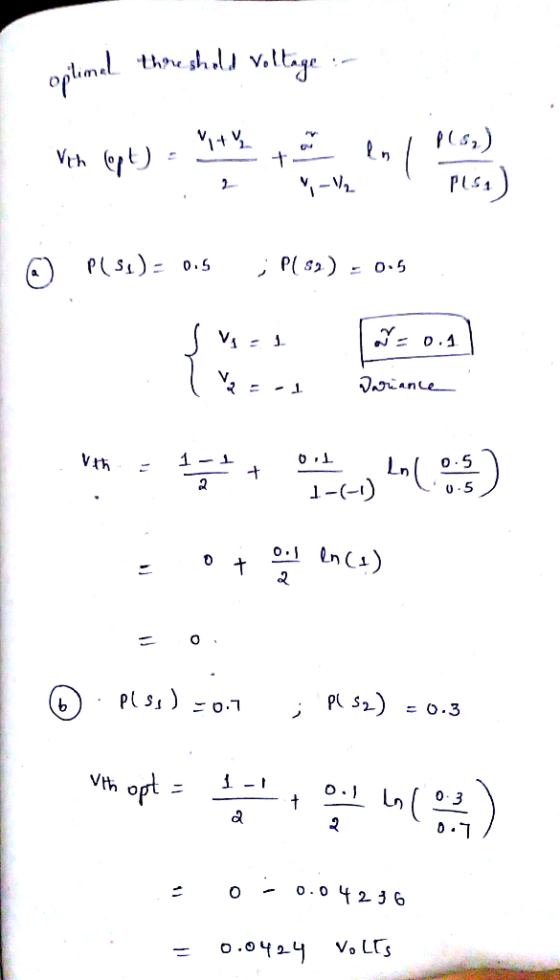
A bipolar binary signal, si(t), is a +1- or -1- V pulse during the interval (0, T). AWGN having two-sided power spectra...
 A bipolar binary signal, si(t), is a +1- or -1- V pulse during the interval (0, T). AWGN having two-sided power spectral density of 0.005 W/Hz is added to the signal. If the received signal is detected with a matched filter, determine the maximum bit rate that can be sent with a bit error probability ofPB< 10
A bipolar binary signal, si(t), is a +1- or -1- V pulse during the interval (0, T). AWGN having two-sided power spectral density...
A bipolar binary signal, si(t), is a +1- or -1- V pulse during the interval (0, T). AWGN having two-sided power spectral density of 0.005 W/Hz is added to the signal. If the received signal is detected with a matched filter, determine the maximum bit rate that can be sent with a bit error probability ofPB< 10
A bipolar binary signal, si(t), is a +1- or -1- V pulse during the interval (0, T). AWGN having two-sided power spectral density...
Consider a binary modulation scheme in which the transmitted signals are 81-0 and s2=A with prior...
 Consider a binary modulation scheme in which the transmitted signals are 81-0 and s2=A with prior probabilities P the received signal is p and P2 1-p. These signals are sent over an AWGN channel and r=si + n for i = 1,2 where n is a Gaussian noise with zero mean and variance No/2. a) Determine the MAP decision regions for this signaling b) Express the error probability in terms of Q-functions.
Consider a binary modulation scheme in which the...
Consider a binary modulation scheme in which the transmitted signals are 81-0 and s2=A with prior probabilities P the received signal is p and P2 1-p. These signals are sent over an AWGN channel and r=si + n for i = 1,2 where n is a Gaussian noise with zero mean and variance No/2. a) Determine the MAP decision regions for this signaling b) Express the error probability in terms of Q-functions.
Consider a binary modulation scheme in which the...
Problem 2 Consider a general QAM scheme with transmitted symbol s(t) R { pulse shape p()71(7,/2)....
 Problem 2 Consider a general QAM scheme with transmitted symbol s(t) R { pulse shape p()71(7,/2). a(n) Apr(t - nT) exp (j2 fet)}, where the t-T./2 Let the constellation be a(n)e {2,-2,2j,-2j,0. 1. What is the appropriate matched filter to apply for this signal. Draw the optimum receiver 2. What is the average energy of the constellation, i.., E,? 3. Assume the the received signal is r(t)= s(t) +n(t), where n(t) is AWGN with variance 1. Find the error probability...
1) Handout problem 7.7. (Hint: Write down the expression for the average probability of error P,,...
 1) Handout problem 7.7. (Hint: Write down the expression for the average probability of error P,, which will involve Po,P1,fo 1),。。), and the threshold λ, and then minimize P, by setting dP/άλ-O. Use the Fundamental Theorem of Calculus to compute dP/d.) Problem 7.7 In a binary PCM system, symbols 0 and 1 have a priori probabilities Po and p1, respectively. The conditional probability density function of the ran- dom variable Y (with sample value y) obtained by sampling the matched...
A digital communication system uses the signals si(t) and s2(t) shown in Fig. 1 to t equally like...
 A digital communication system uses the signals si(t) and s2(t) shown in Fig. 1 to t equally likely bits '0' and '1', respectively. The signaling duration is 4 seconds. The receiver uses a filter h(t) shown in Fig. 2 s1 (t) s2(t) 0 Figure 1: Set of signals in Problem 1 h(t) 0 Figure 2: h(t) in Problem 1 (a) Determine the parameter ri for this system. HINT: Remember that ri is equal to this convolution 81(t) * h(t) evaluated...
3. (30 points) A binary communication system transmits signals s(t) (i 1,2). The receiver samples the received signal r(t) s(t) + n(t) at T and obtain the decision statistic r(T) S (T) n(T) a + n...
 3. (30 points) A binary communication system transmits signals s(t) (i 1,2). The receiver samples the received signal r(t) s(t) + n(t) at T and obtain the decision statistic r(T) S (T) n(T) a + n, where the signal component is either an +A or a2-A with A >0 and n is the noise component. Assume that s1 (t) and s2(t) are equally likely to be transmitted and the decision threshold is chosen as zero. If A 1 and the...
 4.9. A system using matched filter detection of cqually likely BPSK signals, s(t) V2E Tcos o rand s2(1)-V2 E/T cos (oo t + π), operates in AwGN with a received E,N, of 6.8 dB. Assume that E{z(T) = ± VE (a) Find the minimum probability of bit error, PB, for this signal set and E,/No (b) If the decision threshold is γ= 0.1 VE, find PB. (c) The threshold of γ = 0.1 VE is optimum for a particular set...
 A bipolar binary signal, si(t), is a +1- or -1- V pulse during the interval (0, T). AWGN having two-sided power spectral density of 0.005 W/Hz is added to the signal. If the received signal is detected with a matched filter, determine the maximum bit rate that can be sent with a bit error probability ofPB< 10
A bipolar binary signal, si(t), is a +1- or -1- V pulse during the interval (0, T). AWGN having two-sided power spectral density...
A bipolar binary signal, si(t), is a +1- or -1- V pulse during the interval (0, T). AWGN having two-sided power spectral density of 0.005 W/Hz is added to the signal. If the received signal is detected with a matched filter, determine the maximum bit rate that can be sent with a bit error probability ofPB< 10
A bipolar binary signal, si(t), is a +1- or -1- V pulse during the interval (0, T). AWGN having two-sided power spectral density...
 Consider a binary modulation scheme in which the transmitted signals are 81-0 and s2=A with prior probabilities P the received signal is p and P2 1-p. These signals are sent over an AWGN channel and r=si + n for i = 1,2 where n is a Gaussian noise with zero mean and variance No/2. a) Determine the MAP decision regions for this signaling b) Express the error probability in terms of Q-functions.
Consider a binary modulation scheme in which the...
Consider a binary modulation scheme in which the transmitted signals are 81-0 and s2=A with prior probabilities P the received signal is p and P2 1-p. These signals are sent over an AWGN channel and r=si + n for i = 1,2 where n is a Gaussian noise with zero mean and variance No/2. a) Determine the MAP decision regions for this signaling b) Express the error probability in terms of Q-functions.
Consider a binary modulation scheme in which the...
 Problem 2 Consider a general QAM scheme with transmitted symbol s(t) R { pulse shape p()71(7,/2). a(n) Apr(t - nT) exp (j2 fet)}, where the t-T./2 Let the constellation be a(n)e {2,-2,2j,-2j,0. 1. What is the appropriate matched filter to apply for this signal. Draw the optimum receiver 2. What is the average energy of the constellation, i.., E,? 3. Assume the the received signal is r(t)= s(t) +n(t), where n(t) is AWGN with variance 1. Find the error probability...
 1) Handout problem 7.7. (Hint: Write down the expression for the average probability of error P,, which will involve Po,P1,fo 1),。。), and the threshold λ, and then minimize P, by setting dP/άλ-O. Use the Fundamental Theorem of Calculus to compute dP/d.) Problem 7.7 In a binary PCM system, symbols 0 and 1 have a priori probabilities Po and p1, respectively. The conditional probability density function of the ran- dom variable Y (with sample value y) obtained by sampling the matched...
 A digital communication system uses the signals si(t) and s2(t) shown in Fig. 1 to t equally likely bits '0' and '1', respectively. The signaling duration is 4 seconds. The receiver uses a filter h(t) shown in Fig. 2 s1 (t) s2(t) 0 Figure 1: Set of signals in Problem 1 h(t) 0 Figure 2: h(t) in Problem 1 (a) Determine the parameter ri for this system. HINT: Remember that ri is equal to this convolution 81(t) * h(t) evaluated...
 3. (30 points) A binary communication system transmits signals s(t) (i 1,2). The receiver samples the received signal r(t) s(t) + n(t) at T and obtain the decision statistic r(T) S (T) n(T) a + n, where the signal component is either an +A or a2-A with A >0 and n is the noise component. Assume that s1 (t) and s2(t) are equally likely to be transmitted and the decision threshold is chosen as zero. If A 1 and the...
Most questions answered within 3 hours.
-
Where is the error in this code sequence?
String s1 = "Hello";
String s2 = "ello";...
asked 11 months ago -
Financial data for Joel de Paris, Inc., for last year
follow:
Joel de Paris, Inc.
Balance...
asked 11 months ago -
Consider this reaction:
Al2(SO4)3 (aq)+ BaCl3
(aq) Al2Cl6 (aq)- +
3BaSO4(s) . What is the...
asked 11 months ago -
Suppose that Savneet is considering increasing her
recent random sample from 20 car rentals to 40...
asked 11 months ago -
Trucks arrive at an unloading terminal at an average rate of 120
per hour.
Trucks arrive...
asked 11 months ago -
Why are methanol and ethanol completely soluble in water while
octanol is not very little soluble....
asked 11 months ago -
A facilities manager at a university reads in a research report
that the mean amount of...
asked 11 months ago -
When the CuSO4 is rehydrated by adding water to the anhydrous
compound, is this an endothermic...
asked 11 months ago -
A ray of sunlight is passing from diamond into crown glass; the
angle of incidence is...
asked 11 months ago -
A block of mass 0.249 kg is placed on top of a light, vertical
spring of...
asked 11 months ago -
how do the kidneys compensate in the presences of acidosis
a) trigger hyperventilate
b) reserve acid...
asked 11 months ago -
Question 501 pts
The rental rate of capital to the firm increases. Which of the
following...
asked 11 months ago