
Homework Answers

10. Find the ROC of the Z-transform of x[n] (a) [:l> (6) 31 (0)1> (a) not...
 10. Find the ROC of the Z-transform of x[n] (a) [:l> (6) 31 (0)1> (a) not (a), not (b) and not () 11. Calculate the DFT of the following discrete-time signal with: x[0] = 2, x[1] = -1, x[2] = 3, x[3] = -2. The value of the DFT required for this question is X(0). (a) 2 + j3. (b) 2-4, (c) 6, (d) not (a), not (b) and not e
2. Let f(z) be the principal branch of i.е., f(z) exp@ Log(z)}. Co mpute (e)dz where...
 2. Let f(z) be the principal branch of i.е., f(z) exp@ Log(z)}. Co mpute (e)dz where C is the semicircle {et : 0 < θ < π
Nomenclature Coordinate Complexes | <Br< SCN < Cl< O=N-0 <F <OH <C:0-(oxalato) < 0,2-<H2O <SCN <NH;...
 Nomenclature Coordinate Complexes | <Br< SCN < Cl< O=N-0 <F <OH <C:0-(oxalato) < 0,2-<H2O <SCN <NH; <en (H2NCH2CH2NH2) NO2 <CN <CO Formula Name # of lone de [Cr. (NH3)3 (+20)})( triamminetriaquachromium(III) chloride [Fe(NH3).](NO2) hexaammineiron (111) nitrate [pt leng (12232 dithicyanodi(ethylenediamine)platinum(IV) chloride [Co(C204)(CO)]* Owlbunyoleation contu) lon ammonium tetraiodicuprate(II) INHO), [LUIGI Ke[Fe(ONO).] [ Fel NH3)6] hexaammineiron(III) hexahydroxochromate(III) [Co(H2NCH2CH2NH3)4](SO4)3 | +r15 4+ hy • he ºlfa wine) ¢e bal} (1) v10a4e pentaaquahydroxoiron(III) ion [Fe(H2E), GH) +2. (NH4)[Ni(O2)2(H2O)2] ammunium cinquabiscova lato) nickelate CI) AN...
3 Q 3 homogeneous y(x -y) =0, z>0
 3
Q 3 homogeneous y(x -y) =0, z>0
3
Q 3 homogeneous y(x -y) =0, z>0
5.30. UITULU eur 5.39. Evaluate z dz when : >0 and C is the circle Izl...
 5.30. UITULU eur 5.39. Evaluate z dz when : >0 and C is the circle Izl = 3. 2 Ti I (z2 + 1)
Problem 5. Let a < b and c > 0 and let f be integrable on...
 Problem 5. Let a < b and c > 0 and let f be integrable on [ca, cb]. Show that f c Ca where g(a) f(ex)
For s > 0 define the gamma function I (s) by T () = [co-dt. Show...
 For s > 0 define the gamma function I (s) by T () = [co-dt. Show that I (8) extends to an analytic function in the half-plane 20 = {ZEC: Rez >0}, and that the above formula continues to hold there. Hint: Show that S T. (s) ds = 0 for every triangle T in C where I (8) = le-+48-1dt for S E C and 0 <€ < 1.
e-g please e. 4-HC-C6H4-NH-C(O)-CH3 + Cl2/HC-COH H30* f. 4-nitro-1-chlorobenzene + NaOH ------> H20 g. Ph-CH2-CH2-CH2-CO2H +...
 e-g please
e. 4-HC-C6H4-NH-C(O)-CH3 + Cl2/HC-COH H30* f. 4-nitro-1-chlorobenzene + NaOH ------> H20 g. Ph-CH2-CH2-CH2-CO2H + AICI: -------
e-g please
e. 4-HC-C6H4-NH-C(O)-CH3 + Cl2/HC-COH H30* f. 4-nitro-1-chlorobenzene + NaOH ------> H20 g. Ph-CH2-CH2-CH2-CO2H + AICI: -------
If zo E C is a constant complex number, and r> 0 is constant, consider the...
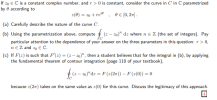 If zo E C is a constant complex number, and r> 0 is constant, consider the curve in C in C parametrized by 0 according to z(0) = 20 +reio 0 € (0,27] (a) Carefully describe the nature of the curve C. (b) Using the parametrization above, compute particular attention to the dependence of your answer on the three parameters in this question: r >0, ne Z and zo E C. (c) If F(z) is such that F"(z) = (2-zo)",...
Let f, g E H(C) be such that |f(z)| < \g(z)| for any z e C....
 Let f, g E H(C) be such that |f(z)| < \g(z)| for any z e C. Show that there exists a E D(0,1) such that f(z) = ag(z) for any z E C. (Hint: consider f/g and be careful with the zeros of g.)
 10. Find the ROC of the Z-transform of x[n] (a) [:l> (6) 31 (0)1> (a) not (a), not (b) and not () 11. Calculate the DFT of the following discrete-time signal with: x[0] = 2, x[1] = -1, x[2] = 3, x[3] = -2. The value of the DFT required for this question is X(0). (a) 2 + j3. (b) 2-4, (c) 6, (d) not (a), not (b) and not e
 2. Let f(z) be the principal branch of i.е., f(z) exp@ Log(z)}. Co mpute (e)dz where C is the semicircle {et : 0 < θ < π
 Nomenclature Coordinate Complexes | <Br< SCN < Cl< O=N-0 <F <OH <C:0-(oxalato) < 0,2-<H2O <SCN <NH; <en (H2NCH2CH2NH2) NO2 <CN <CO Formula Name # of lone de [Cr. (NH3)3 (+20)})( triamminetriaquachromium(III) chloride [Fe(NH3).](NO2) hexaammineiron (111) nitrate [pt leng (12232 dithicyanodi(ethylenediamine)platinum(IV) chloride [Co(C204)(CO)]* Owlbunyoleation contu) lon ammonium tetraiodicuprate(II) INHO), [LUIGI Ke[Fe(ONO).] [ Fel NH3)6] hexaammineiron(III) hexahydroxochromate(III) [Co(H2NCH2CH2NH3)4](SO4)3 | +r15 4+ hy • he ºlfa wine) ¢e bal} (1) v10a4e pentaaquahydroxoiron(III) ion [Fe(H2E), GH) +2. (NH4)[Ni(O2)2(H2O)2] ammunium cinquabiscova lato) nickelate CI) AN...
 3
Q 3 homogeneous y(x -y) =0, z>0
3
Q 3 homogeneous y(x -y) =0, z>0
 5.30. UITULU eur 5.39. Evaluate z dz when : >0 and C is the circle Izl = 3. 2 Ti I (z2 + 1)
 Problem 5. Let a < b and c > 0 and let f be integrable on [ca, cb]. Show that f c Ca where g(a) f(ex)
 For s > 0 define the gamma function I (s) by T () = [co-dt. Show that I (8) extends to an analytic function in the half-plane 20 = {ZEC: Rez >0}, and that the above formula continues to hold there. Hint: Show that S T. (s) ds = 0 for every triangle T in C where I (8) = le-+48-1dt for S E C and 0 <€ < 1.
 e-g please
e. 4-HC-C6H4-NH-C(O)-CH3 + Cl2/HC-COH H30* f. 4-nitro-1-chlorobenzene + NaOH ------> H20 g. Ph-CH2-CH2-CH2-CO2H + AICI: -------
e-g please
e. 4-HC-C6H4-NH-C(O)-CH3 + Cl2/HC-COH H30* f. 4-nitro-1-chlorobenzene + NaOH ------> H20 g. Ph-CH2-CH2-CH2-CO2H + AICI: -------
 If zo E C is a constant complex number, and r> 0 is constant, consider the curve in C in C parametrized by 0 according to z(0) = 20 +reio 0 € (0,27] (a) Carefully describe the nature of the curve C. (b) Using the parametrization above, compute particular attention to the dependence of your answer on the three parameters in this question: r >0, ne Z and zo E C. (c) If F(z) is such that F"(z) = (2-zo)",...
 Let f, g E H(C) be such that |f(z)| < \g(z)| for any z e C. Show that there exists a E D(0,1) such that f(z) = ag(z) for any z E C. (Hint: consider f/g and be careful with the zeros of g.)
Most questions answered within 3 hours.
-
Where is the error in this code sequence?
String s1 = "Hello";
String s2 = "ello";...
asked 10 months ago -
Financial data for Joel de Paris, Inc., for last year
follow:
Joel de Paris, Inc.
Balance...
asked 10 months ago -
Consider this reaction:
Al2(SO4)3 (aq)+ BaCl3
(aq) Al2Cl6 (aq)- +
3BaSO4(s) . What is the...
asked 10 months ago -
Suppose that Savneet is considering increasing her
recent random sample from 20 car rentals to 40...
asked 10 months ago -
Trucks arrive at an unloading terminal at an average rate of 120
per hour.
Trucks arrive...
asked 10 months ago -
Why are methanol and ethanol completely soluble in water while
octanol is not very little soluble....
asked 10 months ago -
A facilities manager at a university reads in a research report
that the mean amount of...
asked 10 months ago -
When the CuSO4 is rehydrated by adding water to the anhydrous
compound, is this an endothermic...
asked 10 months ago -
A ray of sunlight is passing from diamond into crown glass; the
angle of incidence is...
asked 10 months ago -
A block of mass 0.249 kg is placed on top of a light, vertical
spring of...
asked 10 months ago -
how do the kidneys compensate in the presences of acidosis
a) trigger hyperventilate
b) reserve acid...
asked 10 months ago -
Question 501 pts
The rental rate of capital to the firm increases. Which of the
following...
asked 10 months ago