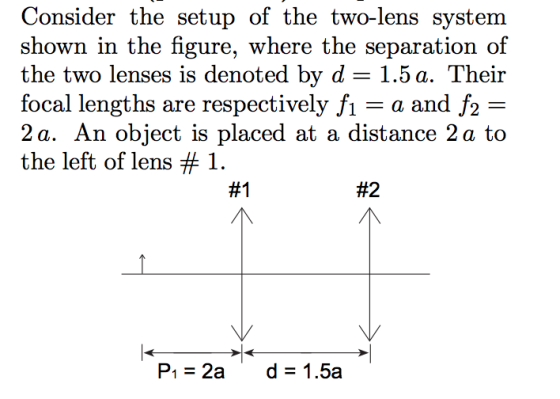
Determine the magnification if lens #2 were absent; i.e., the magnification of lens #1.
1. M1 = 1.5
2. M1 = 0.5
3. M1 = 2.5
4. M1 = −0.5
5. M1 = −2.5
6. M1 = 1
7. M1 = −2
8. M1 = −1.5
9. M1 = 2
10. M1 = −1
Determine the properties of the final image for the present two-lens problem.
1. real, enlarged and inverted
2. virtual, enlarged and upright
3. virtual, reduced and inverted
4. virtual, enlarged and inverted
5. real, reduced and upright
6. real, enlarged and upright
7. real, reduced and inverted
8. virtual, reduced and upright
Homework Answers
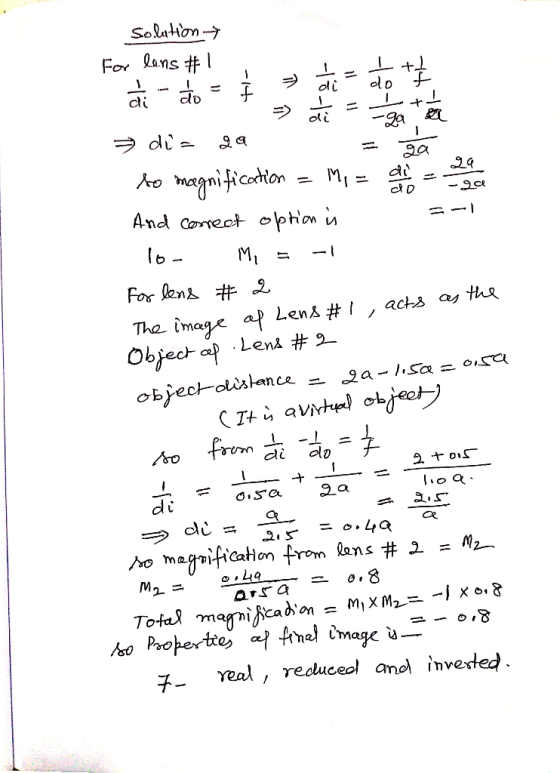
Add Answer to:
Determine the magnification if lens #2 were absent; i.e., the
magnification of lens #1.
1. M1...
2) (20 pts) A lens of focal length +20cm is placed 50cm to the left of...
 2) (20 pts) A lens of focal length +20cm is placed 50cm to the left of a mirror of focal length 40cm. An object is located 60cm to the left of the lens (follow sign conventions). A) (10 pts) for the intermediate image: i) What is the image distance (relative to the lens)? ii) What is the magnification? iii) For each of the following, circle the answer that describes the quality of the image: Real / Virtual Upright / Inverted...
2. An object is placed in front of two thin symmetrical convex lenses with focal lengths...
 2. An object is placed in front of two thin symmetrical convex lenses with focal lengths of F1 +10 cm and F25 cm, with a lens separation of D-42 cm. The object is 15.0 cm from lens 1. Where is the final image of the object and what is its magnification? (10 points) [Please use reverse side if you need more room. Circle the correct descriptors: real virtual enlarged reduced erect inverted Answer: X final = ML =
Now, a diverging lens with focal length having a magnitude of 20 cm is placed 10...
Now, a diverging lens with focal length having a magnitude of 20 cm is placed 10 cm to the right of the converging lens in problem that has a 2 cm tall object placed 12 cm to the left of a converging lens with focal length of magnitude 15 cm. Determine the location of the final image formed by both lenses (in relation to the diverging lens) and the magnification of the final image. State whether the final image is...
Could you please show all of the steps taken in solving the problem and explain the process fully...
 Could you please show all of the steps taken in solving the
problem and explain the process fully, using sentences/phrases (if
possible) to understand why those steps were taken and
why you got that answer.
Also could you please draw a diagram with any applicable
variables/values to help visualize the problem better.
Thank you in advance for all the help!
A 1.20-cm-tall object is 50.0 cm to the left of a diverging lens (lens 1) of focal length of magnitude...
Could you please show all of the steps taken in solving the
problem and explain the process fully, using sentences/phrases (if
possible) to understand why those steps were taken and
why you got that answer.
Also could you please draw a diagram with any applicable
variables/values to help visualize the problem better.
Thank you in advance for all the help!
A 1.20-cm-tall object is 50.0 cm to the left of a diverging lens (lens 1) of focal length of magnitude...
9. -15 points KatzPSE1 38.P.076 My Notes Ask Your The figure below shows an object placed a distance doi from one of two converging lenses separated by s 1.00 m. The first lens has focal length fi 23...
 9. -15 points KatzPSE1 38.P.076 My Notes Ask Your The figure below shows an object placed a distance doi from one of two converging lenses separated by s 1.00 m. The first lens has focal length fi 23.0 cm, and the second lens has focal length 2 47.0 cm. An image is formed by light passing through both lenses at a distance = 12.0 cm to the left of the second lens. Include the sign of the value in your...
Choose true or false for each statement regarding a converging lens. true false If an object is...
Choose true or false for each statement regarding a converging lens. true false If an object is placed 7.9 cm from a converging lens with f = 4 cm, then its image will be reduced and real. true false If an object is placed 3.9 cm from a converging lens with f = 4 cm, then its image will be reduced and virtual. true false A converging lens produces an enlarged virtual image when the object is placed between the lens and its...
What statement below best expresses the lens placement for a microscope? The object Is just Inside...
 What statement below best expresses the lens placement for a microscope? The object Is just Inside the focal length of the objective, the Image from the objective is just inside the focal length of the eyepiece. The object is just outside the focal length of the objective, the Image from the objective is just inside the focal length of the eyepiece. The object is just outside the focal length of the objective, the Image from the objective is just outside...
1.) An object is placed in front of a diverging lens with a focal length of...
1.) An object is placed in front of a diverging lens with a focal length of 17.7 cm. For each object distance, find the image distance and the magnification. Describe each image. (a) 35.4 cm location _____cm magnification _____ nature real virtual upright inverted (b) 17.7 cm location _____ cm magnification _____ nature real virtual upright inverted (c) 8.85 cm location _____ cm magnification _____ nature real virtual upright inverted 2.) An object is placed in front of a converging lens...
A lens produces a real image of a real object. a) Is the image inverted or upright? b) Is the lens diverging or conver...
A lens produces a real image of a real object. a) Is the image inverted or upright? b) Is the lens diverging or converging? c) Is the image enlarged or reduced in size? d) If two convex lenses identical in size and shape aremanufactured from glass with two different indices of refraction,would the focal length of the lens with the greater index ofrefraction (lens 1) be larger or smaller than that of the otherlens (lens 2)?
1. You have a converging lens with a focal length of 1.5 cm and a diverging...
1. You have a converging lens with a focal length of 1.5 cm and a diverging lens with a focal length of 2.5 cm. You also have a binder clip with a height of 1.6 cm. A. Sketch the ray tracing if the binder clip is 4.1 cm from the converging lens. B. Use the thin lens equation to calculate the location and size of the image if the binder clip is 4.1 cm from the converging lens. C. What...
 2) (20 pts) A lens of focal length +20cm is placed 50cm to the left of a mirror of focal length 40cm. An object is located 60cm to the left of the lens (follow sign conventions). A) (10 pts) for the intermediate image: i) What is the image distance (relative to the lens)? ii) What is the magnification? iii) For each of the following, circle the answer that describes the quality of the image: Real / Virtual Upright / Inverted...
 2. An object is placed in front of two thin symmetrical convex lenses with focal lengths of F1 +10 cm and F25 cm, with a lens separation of D-42 cm. The object is 15.0 cm from lens 1. Where is the final image of the object and what is its magnification? (10 points) [Please use reverse side if you need more room. Circle the correct descriptors: real virtual enlarged reduced erect inverted Answer: X final = ML =
 Could you please show all of the steps taken in solving the
problem and explain the process fully, using sentences/phrases (if
possible) to understand why those steps were taken and
why you got that answer.
Also could you please draw a diagram with any applicable
variables/values to help visualize the problem better.
Thank you in advance for all the help!
A 1.20-cm-tall object is 50.0 cm to the left of a diverging lens (lens 1) of focal length of magnitude...
Could you please show all of the steps taken in solving the
problem and explain the process fully, using sentences/phrases (if
possible) to understand why those steps were taken and
why you got that answer.
Also could you please draw a diagram with any applicable
variables/values to help visualize the problem better.
Thank you in advance for all the help!
A 1.20-cm-tall object is 50.0 cm to the left of a diverging lens (lens 1) of focal length of magnitude...
 9. -15 points KatzPSE1 38.P.076 My Notes Ask Your The figure below shows an object placed a distance doi from one of two converging lenses separated by s 1.00 m. The first lens has focal length fi 23.0 cm, and the second lens has focal length 2 47.0 cm. An image is formed by light passing through both lenses at a distance = 12.0 cm to the left of the second lens. Include the sign of the value in your...
 What statement below best expresses the lens placement for a microscope? The object Is just Inside the focal length of the objective, the Image from the objective is just inside the focal length of the eyepiece. The object is just outside the focal length of the objective, the Image from the objective is just inside the focal length of the eyepiece. The object is just outside the focal length of the objective, the Image from the objective is just outside...
Most questions answered within 3 hours.
-
Where is the error in this code sequence?
String s1 = "Hello";
String s2 = "ello";...
asked 10 months ago -
Financial data for Joel de Paris, Inc., for last year
follow:
Joel de Paris, Inc.
Balance...
asked 10 months ago -
Consider this reaction:
Al2(SO4)3 (aq)+ BaCl3
(aq) Al2Cl6 (aq)- +
3BaSO4(s) . What is the...
asked 10 months ago -
Suppose that Savneet is considering increasing her
recent random sample from 20 car rentals to 40...
asked 10 months ago -
Trucks arrive at an unloading terminal at an average rate of 120
per hour.
Trucks arrive...
asked 10 months ago -
Why are methanol and ethanol completely soluble in water while
octanol is not very little soluble....
asked 10 months ago -
A facilities manager at a university reads in a research report
that the mean amount of...
asked 10 months ago -
When the CuSO4 is rehydrated by adding water to the anhydrous
compound, is this an endothermic...
asked 10 months ago -
A ray of sunlight is passing from diamond into crown glass; the
angle of incidence is...
asked 10 months ago -
A block of mass 0.249 kg is placed on top of a light, vertical
spring of...
asked 10 months ago -
how do the kidneys compensate in the presences of acidosis
a) trigger hyperventilate
b) reserve acid...
asked 10 months ago -
Question 501 pts
The rental rate of capital to the firm increases. Which of the
following...
asked 10 months ago