
Homework Answers
![Taking ial No L) L) 0-4幺 ttwid 2 16 192 2Y3) 16.192- 539 G 「0.96 Tek[s] [c] 192](http://img.homeworklib.com/questions/2af43b20-af2c-11ea-b758-c551cbabf221.png?x-oss-process=image/resize,w_560)

Add Answer to:
Which mechanism best fits the data?
Consider the following reaction. 5A+B+3C5D E The following data was...
please help Consider the following reaction. 4A+B+ 4C 4D + E The following data was collected...
 please help
Consider the following reaction. 4A+B+ 4C 4D + E The following data was collected on the reaction. Trial Alo [B], (ClO Rate (M/s) 0.32 0.62 0.32 6.861 0.64 0.62 0.32 13.722 0.32 0.32 13.722 4 0.32 0.62 0.64 6.861 2 1.24 Rate law = K[A142[8]1[C]" O Knowing the rate which of the two mechanisms are proposed would be accurate: Mechanism 1: Mechanism 1 Mechanism 2 A+B DY AC Y+C YoBoc X+A+C Z+A Which mechanism best fits the data?...
please help
Consider the following reaction. 4A+B+ 4C 4D + E The following data was collected on the reaction. Trial Alo [B], (ClO Rate (M/s) 0.32 0.62 0.32 6.861 0.64 0.62 0.32 13.722 0.32 0.32 13.722 4 0.32 0.62 0.64 6.861 2 1.24 Rate law = K[A142[8]1[C]" O Knowing the rate which of the two mechanisms are proposed would be accurate: Mechanism 1: Mechanism 1 Mechanism 2 A+B DY AC Y+C YoBoc X+A+C Z+A Which mechanism best fits the data?...
please help Consider the following reaction. 4A+B+40 + 4D +E ents (C) The following data was...
 please help
Consider the following reaction. 4A+B+40 + 4D +E ents (C) The following data was collected on the reaction. Trial [A], [B]. Rate (M/s) 0.32 0.62 0.32 6.861 0.64 0.62 0.32 27.444 3 1.24 0.32 13.722 0.32 0.62 0.64 6.861 Rate law 0.32 Knowing the rate which of the two mechanisms are proposed would be accurate: Mechanism 1 Mechanism 2 1 AB D+Y D-Y 12 Y+C Y+B+C X +A+C 3 X+A+C + D+Z+2C A 2+A E Which mechanism best...
please help
Consider the following reaction. 4A+B+40 + 4D +E ents (C) The following data was collected on the reaction. Trial [A], [B]. Rate (M/s) 0.32 0.62 0.32 6.861 0.64 0.62 0.32 27.444 3 1.24 0.32 13.722 0.32 0.62 0.64 6.861 Rate law 0.32 Knowing the rate which of the two mechanisms are proposed would be accurate: Mechanism 1 Mechanism 2 1 AB D+Y D-Y 12 Y+C Y+B+C X +A+C 3 X+A+C + D+Z+2C A 2+A E Which mechanism best...
Consider the following reaction. 5 A + B + 4 C →→ 5 D + E...
Consider the following reaction. 5 A + B + 4 C →→ 5 D + E The following data was collected on the reaction. Trial [A]0 [B]0 [C]0 Rate (M/s) 1 0.65 0.13 0.65 4.064 2 1.3 0.13 0.65 16.256 3 0.65 0.26 0.65 8.128 4 0.65 0.13 1.3 4.064 Two mechanisms are proposed: Mechanism 1: A + C →→ D + Y Y + C →→ X X +2 A + B →→ D + Z Z + A...
Consider the following reaction. 4 A + B + 2 C →→ 4 D + E...
Consider the following reaction. 4 A + B + 2 C →→ 4 D + E The following data was collected on the reaction. Trial [A]0 [B]0 [C]0 Rate (M/s) 1 0.22 0.75 0.22 9.506 2 0.44 0.75 0.22 19.012 3 0.22 1.5 0.22 19.012 4 0.22 0.75 0.44 9.506 Two mechanisms are proposed: Mechanism 1: A + B →→ D + Y Y + C →→ X X + A + C →→ D + Z Z + A...
y courses CHEM 1C-A-M20 Week 6 Cumulative Exa ered 5.00 Consider the following reaction mechanism: 2...
 y courses CHEM 1C-A-M20 Week 6 Cumulative Exa ered 5.00 Consider the following reaction mechanism: 2 NO,CI = clo, + N2O + Clo fast N20 + clo, = NO2 + NOCI fast NOCI + ClO – NO, + Cl2 slow tion What is the rate law for this reaction mechanism? Select one: a. rate = k [N,0] [C10,] (CIO) [No,j' b. rate = k [Noci) [NO_ch? (cio,' [N,01" c. none of the listed answer choices d. rate = k [NO_ch?(no,j?...
Three kinetics questions. Consider the following reaction and experimental data: X+Y-XY Trial [X] (mol/L) [Y] (mol/L)...
 Three kinetics questions.
Consider the following reaction and experimental data: X+Y-XY Trial [X] (mol/L) [Y] (mol/L) Rate (moll's) 0.180 0.0250 0.0640 0.0450 0.0250 0.0160 0.0450 0.0750 0.0480 Using the information above, determine the rate of this reaction when [X] = 1.15 mol/L and [Y] = 0.667 mol/L. Rate = _mollis 2 Given the following reaction and experimental data: A+B+C Trial [A] (mol/L) [B] (mol/L) Rate (moll's) 0.40 0.20 0.038 0.80 0.20 0.077 0.80 0.40 0.31 What is the rate constant...
Three kinetics questions.
Consider the following reaction and experimental data: X+Y-XY Trial [X] (mol/L) [Y] (mol/L) Rate (moll's) 0.180 0.0250 0.0640 0.0450 0.0250 0.0160 0.0450 0.0750 0.0480 Using the information above, determine the rate of this reaction when [X] = 1.15 mol/L and [Y] = 0.667 mol/L. Rate = _mollis 2 Given the following reaction and experimental data: A+B+C Trial [A] (mol/L) [B] (mol/L) Rate (moll's) 0.40 0.20 0.038 0.80 0.20 0.077 0.80 0.40 0.31 What is the rate constant...
3. Use the proposed reaction mechanism to answer the following questions; Elementary 1: 2NO2Cl <---> ClO2...
3. Use the proposed reaction mechanism to answer the following questions; Elementary 1: 2NO2Cl <---> ClO2 + N2O + ClO Elementary 2: N2O + ClO2 <---> NO2 + NOCl Elementary 3: NOCl + ClO ---> NO2 + Cl2 a) What is the overall (reduced) reaction? b) Identify any intermediates. c) Determine the rate law expression for each elementary reaction. (fast) (fast) (slow)
Pari A The following table lists concentrations (A) versus time for a certain reaction in which...
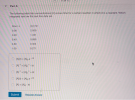 Pari A The following table lists concentrations (A) versus time for a certain reaction in which A is a reactant. Which integrated rate law fits best this data time /s 0.00 0.20 0.40 (AJIM 2.000 0.699 1.00 [Al(t) = [A]o e [A] = [A]o" - kt fal' = [Alo * + [Al(t) = [Aloe [A] = [A]o - kt Submit Request Answer
Consider the following pair of reactions. Predict the type of elimination mechanism, predict which reaction of...
 Consider the following pair of reactions. Predict the type of
elimination mechanism, predict which reaction of the pair will
occur at the fastest rate, and draw the correct organic
product.
Consider the following pair of reactions. Predict the type of elimination mechanism, predict which reaction of the pair will occur at the fastest rate, and draw the correct organic product. methanol 11111ll + =ÖCH3 heat Select answer Cl: methanol + CH3- heat Select answer
Consider the following pair of reactions. Predict the type of
elimination mechanism, predict which reaction of the pair will
occur at the fastest rate, and draw the correct organic
product.
Consider the following pair of reactions. Predict the type of elimination mechanism, predict which reaction of the pair will occur at the fastest rate, and draw the correct organic product. methanol 11111ll + =ÖCH3 heat Select answer Cl: methanol + CH3- heat Select answer
Compute the error of each approximation, and then determine which form fits the data the best 3. ...
 Compute the error of each approximation, and then determine which form fits the data the best 3. (20 pts) Consider the nonlinear system 6x1 2 cos(3)-1-0 9r2 + Vr| + sin(za) + 1.06 + 0.9 = 0, Solve this system by i) Newton's method, (ii) Broyden's method. For both methods, use the initial approximation x() = [0,0,0], and the stopping criteria llx(k) X(k 1) I < tol = 10-9. Here 1-1 is the Euclidian 2-norm Display the results for each...
 please help
Consider the following reaction. 4A+B+ 4C 4D + E The following data was collected on the reaction. Trial Alo [B], (ClO Rate (M/s) 0.32 0.62 0.32 6.861 0.64 0.62 0.32 13.722 0.32 0.32 13.722 4 0.32 0.62 0.64 6.861 2 1.24 Rate law = K[A142[8]1[C]" O Knowing the rate which of the two mechanisms are proposed would be accurate: Mechanism 1: Mechanism 1 Mechanism 2 A+B DY AC Y+C YoBoc X+A+C Z+A Which mechanism best fits the data?...
please help
Consider the following reaction. 4A+B+ 4C 4D + E The following data was collected on the reaction. Trial Alo [B], (ClO Rate (M/s) 0.32 0.62 0.32 6.861 0.64 0.62 0.32 13.722 0.32 0.32 13.722 4 0.32 0.62 0.64 6.861 2 1.24 Rate law = K[A142[8]1[C]" O Knowing the rate which of the two mechanisms are proposed would be accurate: Mechanism 1: Mechanism 1 Mechanism 2 A+B DY AC Y+C YoBoc X+A+C Z+A Which mechanism best fits the data?...
 please help
Consider the following reaction. 4A+B+40 + 4D +E ents (C) The following data was collected on the reaction. Trial [A], [B]. Rate (M/s) 0.32 0.62 0.32 6.861 0.64 0.62 0.32 27.444 3 1.24 0.32 13.722 0.32 0.62 0.64 6.861 Rate law 0.32 Knowing the rate which of the two mechanisms are proposed would be accurate: Mechanism 1 Mechanism 2 1 AB D+Y D-Y 12 Y+C Y+B+C X +A+C 3 X+A+C + D+Z+2C A 2+A E Which mechanism best...
please help
Consider the following reaction. 4A+B+40 + 4D +E ents (C) The following data was collected on the reaction. Trial [A], [B]. Rate (M/s) 0.32 0.62 0.32 6.861 0.64 0.62 0.32 27.444 3 1.24 0.32 13.722 0.32 0.62 0.64 6.861 Rate law 0.32 Knowing the rate which of the two mechanisms are proposed would be accurate: Mechanism 1 Mechanism 2 1 AB D+Y D-Y 12 Y+C Y+B+C X +A+C 3 X+A+C + D+Z+2C A 2+A E Which mechanism best...
 y courses CHEM 1C-A-M20 Week 6 Cumulative Exa ered 5.00 Consider the following reaction mechanism: 2 NO,CI = clo, + N2O + Clo fast N20 + clo, = NO2 + NOCI fast NOCI + ClO – NO, + Cl2 slow tion What is the rate law for this reaction mechanism? Select one: a. rate = k [N,0] [C10,] (CIO) [No,j' b. rate = k [Noci) [NO_ch? (cio,' [N,01" c. none of the listed answer choices d. rate = k [NO_ch?(no,j?...
 Three kinetics questions.
Consider the following reaction and experimental data: X+Y-XY Trial [X] (mol/L) [Y] (mol/L) Rate (moll's) 0.180 0.0250 0.0640 0.0450 0.0250 0.0160 0.0450 0.0750 0.0480 Using the information above, determine the rate of this reaction when [X] = 1.15 mol/L and [Y] = 0.667 mol/L. Rate = _mollis 2 Given the following reaction and experimental data: A+B+C Trial [A] (mol/L) [B] (mol/L) Rate (moll's) 0.40 0.20 0.038 0.80 0.20 0.077 0.80 0.40 0.31 What is the rate constant...
Three kinetics questions.
Consider the following reaction and experimental data: X+Y-XY Trial [X] (mol/L) [Y] (mol/L) Rate (moll's) 0.180 0.0250 0.0640 0.0450 0.0250 0.0160 0.0450 0.0750 0.0480 Using the information above, determine the rate of this reaction when [X] = 1.15 mol/L and [Y] = 0.667 mol/L. Rate = _mollis 2 Given the following reaction and experimental data: A+B+C Trial [A] (mol/L) [B] (mol/L) Rate (moll's) 0.40 0.20 0.038 0.80 0.20 0.077 0.80 0.40 0.31 What is the rate constant...
 Pari A The following table lists concentrations (A) versus time for a certain reaction in which A is a reactant. Which integrated rate law fits best this data time /s 0.00 0.20 0.40 (AJIM 2.000 0.699 1.00 [Al(t) = [A]o e [A] = [A]o" - kt fal' = [Alo * + [Al(t) = [Aloe [A] = [A]o - kt Submit Request Answer
 Consider the following pair of reactions. Predict the type of
elimination mechanism, predict which reaction of the pair will
occur at the fastest rate, and draw the correct organic
product.
Consider the following pair of reactions. Predict the type of elimination mechanism, predict which reaction of the pair will occur at the fastest rate, and draw the correct organic product. methanol 11111ll + =ÖCH3 heat Select answer Cl: methanol + CH3- heat Select answer
Consider the following pair of reactions. Predict the type of
elimination mechanism, predict which reaction of the pair will
occur at the fastest rate, and draw the correct organic
product.
Consider the following pair of reactions. Predict the type of elimination mechanism, predict which reaction of the pair will occur at the fastest rate, and draw the correct organic product. methanol 11111ll + =ÖCH3 heat Select answer Cl: methanol + CH3- heat Select answer
 Compute the error of each approximation, and then determine which form fits the data the best 3. (20 pts) Consider the nonlinear system 6x1 2 cos(3)-1-0 9r2 + Vr| + sin(za) + 1.06 + 0.9 = 0, Solve this system by i) Newton's method, (ii) Broyden's method. For both methods, use the initial approximation x() = [0,0,0], and the stopping criteria llx(k) X(k 1) I < tol = 10-9. Here 1-1 is the Euclidian 2-norm Display the results for each...
Most questions answered within 3 hours.
-
Where is the error in this code sequence?
String s1 = "Hello";
String s2 = "ello";...
asked 10 months ago -
Financial data for Joel de Paris, Inc., for last year
follow:
Joel de Paris, Inc.
Balance...
asked 10 months ago -
Consider this reaction:
Al2(SO4)3 (aq)+ BaCl3
(aq) Al2Cl6 (aq)- +
3BaSO4(s) . What is the...
asked 10 months ago -
Suppose that Savneet is considering increasing her
recent random sample from 20 car rentals to 40...
asked 10 months ago -
Trucks arrive at an unloading terminal at an average rate of 120
per hour.
Trucks arrive...
asked 10 months ago -
Why are methanol and ethanol completely soluble in water while
octanol is not very little soluble....
asked 10 months ago -
A facilities manager at a university reads in a research report
that the mean amount of...
asked 10 months ago -
When the CuSO4 is rehydrated by adding water to the anhydrous
compound, is this an endothermic...
asked 10 months ago -
A ray of sunlight is passing from diamond into crown glass; the
angle of incidence is...
asked 10 months ago -
A block of mass 0.249 kg is placed on top of a light, vertical
spring of...
asked 10 months ago -
how do the kidneys compensate in the presences of acidosis
a) trigger hyperventilate
b) reserve acid...
asked 10 months ago -
Question 501 pts
The rental rate of capital to the firm increases. Which of the
following...
asked 10 months ago