Find N-point DFT of x[n]= n=0,1,…,N-1 X[n] = Using the periodicity of the complex exponentials,...
Find N-point DFT of x[n]=  n=0,1,…,N-1
X[n] = 
Using the periodicity of the complex exponentials, we can write x[n] follows:
X[n] = 
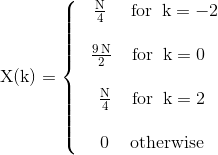
The DFT coefficients are
9N/2 k=0
X[k]= N/4 k=2 and k=-2
0 else
Homework Answers
![2nn Given x[n] = 4 + cos? , and n = 0,1,2,....., N - 1 N](http://img.homeworklib.com/questions/045578c0-a811-11ea-832c-0b7b5495488e.png?x-oss-process=image/resize,w_560)

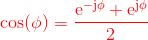

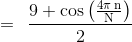
![+ 6 + Na #3 +0] *](http://img.homeworklib.com/questions/0605de60-a811-11ea-b640-a78f47217ac7.png?x-oss-process=image/resize,w_560)
![\mathrm{=\frac{9}{2}+\left [ \frac{e^{-j\frac{4\pi \,n}{N} }+e^{j\frac{4\pi \,n}{N} }}{4} \right ] }](http://img.homeworklib.com/questions/065f6330-a811-11ea-bea7-f59421cf726a.png?x-oss-process=image/resize,w_560)



![IDFT of X(k) is defined as x[n] - 12 2X(k) Nk](http://img.homeworklib.com/questions/07adc420-a811-11ea-9244-255098ede086.png?x-oss-process=image/resize,w_560)


Add Answer to:
Find N-point DFT of x[n]=
n=0,1,…,N-1
X[n] =
Using the periodicity of the complex exponentials,...
Using the 4-point DFT/IFFT in matrix form, determine: (a) The DFT of x[n] = [1, 2,...
Using the 4-point DFT/IFFT in matrix form, determine: (a) The DFT of x[n] = [1, 2, 1, 2]. (b) The IDFT of X[k] = [0, 4, 0, 4];
Problem #5 The 4-point DFT of a certain 4-point signal, x[n], is X[k] = DFT(x[n])-[ 0...
 Problem #5 The 4-point DFT of a certain 4-point signal, x[n], is X[k] = DFT(x[n])-[ 0 Find the signal xIn] and write in terms of delayed unit samples. Answer: X[n] = 0 12 0]
Proposition 7.7. (a) Exponentials beat polynomials: for any polynomial p(n) (with complex coeffic...
 please help proving prop 7.7
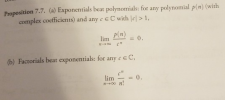
Proposition 7.7. (a) Exponentials beat polynomials: for any polynomial p(n) (with complex coefficients) and any c e C with lel> 1, P(n)0 72 (b) Factorials beat exponentials: for any c EC, lim--= 0.
Proposition 7.7. (a) Exponentials beat polynomials: for any polynomial p(n) (with complex coefficients) and any c e C with lel> 1, P(n)0 72 (b) Factorials beat exponentials: for any c EC, lim--= 0.
please help proving prop 7.7
Proposition 7.7. (a) Exponentials beat polynomials: for any polynomial p(n) (with complex coefficients) and any c e C with lel> 1, P(n)0 72 (b) Factorials beat exponentials: for any c EC, lim--= 0.
Proposition 7.7. (a) Exponentials beat polynomials: for any polynomial p(n) (with complex coefficients) and any c e C with lel> 1, P(n)0 72 (b) Factorials beat exponentials: for any c EC, lim--= 0.
please answer it in detail (a) Find the 10 point DFT of the sequence r(n) -1,1,1,1,1,0,0,0,0,0],...
 please answer it in detail
(a) Find the 10 point DFT of the sequence r(n) -1,1,1,1,1,0,0,0,0,0], for n- 0,..,9. X(k)-4,1-j*2.414,0,1-j 0.414,0,1+j 0.414,0,1+j 2.414 help (formulas) Hint: You can use the formula used in example 7.1.2 in page 457 Compute the DFT of the following sequences in terms of X(k). Do not copy the entire formula of X(k) from part (a). (b) ri(n) - [0,0,0,1,1,1, 1, 1,0,0], for n-0,...,9. Xi(k)4,1+j 2.413,0,1+j0.414,0,1- 0.414,1-j2.413 You may use X(k) to denote the DFT of...
please answer it in detail
(a) Find the 10 point DFT of the sequence r(n) -1,1,1,1,1,0,0,0,0,0], for n- 0,..,9. X(k)-4,1-j*2.414,0,1-j 0.414,0,1+j 0.414,0,1+j 2.414 help (formulas) Hint: You can use the formula used in example 7.1.2 in page 457 Compute the DFT of the following sequences in terms of X(k). Do not copy the entire formula of X(k) from part (a). (b) ri(n) - [0,0,0,1,1,1, 1, 1,0,0], for n-0,...,9. Xi(k)4,1+j 2.413,0,1+j0.414,0,1- 0.414,1-j2.413 You may use X(k) to denote the DFT of...
Question 4 (a) Find the DFT of the series x[n)-(0.2,1,1,0.2), and sketch the magnitude of the resulting spectral components [10 marks] (b) For a discrete impulse response, h[n], that is symmetric...
 Question 4 (a) Find the DFT of the series x[n)-(0.2,1,1,0.2), and sketch the magnitude of the resulting spectral components [10 marks] (b) For a discrete impulse response, h[n], that is symmetric about the origin, the spectral coefficients of the signal, H(k), can be obtained by use of the DFT He- H(k)- H-(N-1)/2 Conversely, if the spectral coefficients, H(k), are known (and are even and symmetrical about k-0), the original signal, h[n], can be reconstituted using the inverse DFT 1 (N-D/2...
1. Let [n] = 6 cos(0.8nn). Note that [n] is periodic. (a) Find the period N...
 1. Let [n] = 6 cos(0.8nn). Note that [n] is periodic. (a) Find the period N of 1 [n). (b) Let y[n] = [n(u[n] – z[n-N]). Find Y [k] = DFT(y[n]), k=0,1,..., N-1. Hint: x[n] = 3e08an + 3e-j0.8an (e) Find X(W) = DTFT (2[12]). How does it compare with part (b)? (a) Sketch 1 [n],y[n], X(w), Y [k]. 2. (a) Sketches in the 2D complex plane for n = 0,1,...,8. (b) Let i[n] = +2e ", n=0,1,...,8. Find X[k]...
-Σ rinkin + ml. Sequence c[n] is defined as c[n] x(n] = { 1,-1, 1 } as x[k] and 5-point DFT of c[...
 -Σ rinkin + ml. Sequence c[n] is defined as c[n] x(n] = { 1,-1, 1 } as x[k] and 5-point DFT of c[n] as c[k]. (i) Calculate C[1]? 「[I] = 1-e^(-%72%pi/5)+6 alculate the 4-point DFT of sequence Your last answer was interpreted as follows: I-e + e- Incorrect answer. ii) Calculate i [] is the conjugate operator) -96 Your last answer was interpreted as follows:-i Incorrect answer.
-Σ rinkin + ml. Sequence c[n] is defined as c[n] x(n] = {...
-Σ rinkin + ml. Sequence c[n] is defined as c[n] x(n] = { 1,-1, 1 } as x[k] and 5-point DFT of c[n] as c[k]. (i) Calculate C[1]? 「[I] = 1-e^(-%72%pi/5)+6 alculate the 4-point DFT of sequence Your last answer was interpreted as follows: I-e + e- Incorrect answer. ii) Calculate i [] is the conjugate operator) -96 Your last answer was interpreted as follows:-i Incorrect answer.
-Σ rinkin + ml. Sequence c[n] is defined as c[n] x(n] = {...
1. Let {X[k]}K=o be the N = 8-point DFT of the real-valued sequence x[n] = [1,...
 1. Let {X[k]}K=o be the N = 8-point DFT of the real-valued sequence x[n] = [1, 2, 3, 4]. (a) Let Y[k] = X[k]ejak + X[<k – 4 >8] be the N = 8-point DFT of a sequence y[n]. Compute y[n]. Note: Do NOT compute X[k]. (b) Let Y[k] = X*[k] be the DFT of the sequence y[n], where * denotes the conjugate. Compute the sequence y[n]. Note: Do NOT compute X[k].
M-file dft.m function Xk = dft(x) [N,M] = size(x); if M ~=1, % makes sure that...
 M-file
dft.m
function Xk = dft(x)
[N,M] = size(x);
if M ~=1, % makes sure that x is a column vector
x = x';
N = M;
end
Xk=zeros(N,1);
n = 0:N-1;
for k=0:N-1
Xk(k+1) = exp(-j*2*pi*k*n/N)*x;
end
Using the MATLAB M-file dft, compute the 32-point DFT of rn cos(₩), 0 〈 n < 10, x[n] 0 for all other n. COS
M-file
dft.m
function Xk = dft(x)
[N,M] = size(x);
if M ~=1, % makes sure that x is a column vector
x = x';
N = M;
end
Xk=zeros(N,1);
n = 0:N-1;
for k=0:N-1
Xk(k+1) = exp(-j*2*pi*k*n/N)*x;
end
Using the MATLAB M-file dft, compute the 32-point DFT of rn cos(₩), 0 〈 n < 10, x[n] 0 for all other n. COS
It is suggested that if you have an FFT subroutine for computing a length-N DFT, the...
 It is suggested that if you have an FFT subroutine for computing a length-N DFT, the inverse DFT of an N-point sequence X[k] can be implemented using this subroutine as follows: 1. Swap the real and imaginary parts of each DFT coefficient X[k]. 2. Apply the FFT routine to this input sequence. 3. Swap the real and imaginary parts of the output sequence. 4. Scale the resulting sequence by 1/N to obtain the sequence x[n], corresponding to the inverse DFT...
 Problem #5 The 4-point DFT of a certain 4-point signal, x[n], is X[k] = DFT(x[n])-[ 0 Find the signal xIn] and write in terms of delayed unit samples. Answer: X[n] = 0 12 0]
 please help proving prop 7.7
Proposition 7.7. (a) Exponentials beat polynomials: for any polynomial p(n) (with complex coefficients) and any c e C with lel> 1, P(n)0 72 (b) Factorials beat exponentials: for any c EC, lim--= 0.
Proposition 7.7. (a) Exponentials beat polynomials: for any polynomial p(n) (with complex coefficients) and any c e C with lel> 1, P(n)0 72 (b) Factorials beat exponentials: for any c EC, lim--= 0.
please help proving prop 7.7
Proposition 7.7. (a) Exponentials beat polynomials: for any polynomial p(n) (with complex coefficients) and any c e C with lel> 1, P(n)0 72 (b) Factorials beat exponentials: for any c EC, lim--= 0.
Proposition 7.7. (a) Exponentials beat polynomials: for any polynomial p(n) (with complex coefficients) and any c e C with lel> 1, P(n)0 72 (b) Factorials beat exponentials: for any c EC, lim--= 0.
 please answer it in detail
(a) Find the 10 point DFT of the sequence r(n) -1,1,1,1,1,0,0,0,0,0], for n- 0,..,9. X(k)-4,1-j*2.414,0,1-j 0.414,0,1+j 0.414,0,1+j 2.414 help (formulas) Hint: You can use the formula used in example 7.1.2 in page 457 Compute the DFT of the following sequences in terms of X(k). Do not copy the entire formula of X(k) from part (a). (b) ri(n) - [0,0,0,1,1,1, 1, 1,0,0], for n-0,...,9. Xi(k)4,1+j 2.413,0,1+j0.414,0,1- 0.414,1-j2.413 You may use X(k) to denote the DFT of...
please answer it in detail
(a) Find the 10 point DFT of the sequence r(n) -1,1,1,1,1,0,0,0,0,0], for n- 0,..,9. X(k)-4,1-j*2.414,0,1-j 0.414,0,1+j 0.414,0,1+j 2.414 help (formulas) Hint: You can use the formula used in example 7.1.2 in page 457 Compute the DFT of the following sequences in terms of X(k). Do not copy the entire formula of X(k) from part (a). (b) ri(n) - [0,0,0,1,1,1, 1, 1,0,0], for n-0,...,9. Xi(k)4,1+j 2.413,0,1+j0.414,0,1- 0.414,1-j2.413 You may use X(k) to denote the DFT of...
 Question 4 (a) Find the DFT of the series x[n)-(0.2,1,1,0.2), and sketch the magnitude of the resulting spectral components [10 marks] (b) For a discrete impulse response, h[n], that is symmetric about the origin, the spectral coefficients of the signal, H(k), can be obtained by use of the DFT He- H(k)- H-(N-1)/2 Conversely, if the spectral coefficients, H(k), are known (and are even and symmetrical about k-0), the original signal, h[n], can be reconstituted using the inverse DFT 1 (N-D/2...
 1. Let [n] = 6 cos(0.8nn). Note that [n] is periodic. (a) Find the period N of 1 [n). (b) Let y[n] = [n(u[n] – z[n-N]). Find Y [k] = DFT(y[n]), k=0,1,..., N-1. Hint: x[n] = 3e08an + 3e-j0.8an (e) Find X(W) = DTFT (2[12]). How does it compare with part (b)? (a) Sketch 1 [n],y[n], X(w), Y [k]. 2. (a) Sketches in the 2D complex plane for n = 0,1,...,8. (b) Let i[n] = +2e ", n=0,1,...,8. Find X[k]...
 -Σ rinkin + ml. Sequence c[n] is defined as c[n] x(n] = { 1,-1, 1 } as x[k] and 5-point DFT of c[n] as c[k]. (i) Calculate C[1]? 「[I] = 1-e^(-%72%pi/5)+6 alculate the 4-point DFT of sequence Your last answer was interpreted as follows: I-e + e- Incorrect answer. ii) Calculate i [] is the conjugate operator) -96 Your last answer was interpreted as follows:-i Incorrect answer.
-Σ rinkin + ml. Sequence c[n] is defined as c[n] x(n] = {...
-Σ rinkin + ml. Sequence c[n] is defined as c[n] x(n] = { 1,-1, 1 } as x[k] and 5-point DFT of c[n] as c[k]. (i) Calculate C[1]? 「[I] = 1-e^(-%72%pi/5)+6 alculate the 4-point DFT of sequence Your last answer was interpreted as follows: I-e + e- Incorrect answer. ii) Calculate i [] is the conjugate operator) -96 Your last answer was interpreted as follows:-i Incorrect answer.
-Σ rinkin + ml. Sequence c[n] is defined as c[n] x(n] = {...
 1. Let {X[k]}K=o be the N = 8-point DFT of the real-valued sequence x[n] = [1, 2, 3, 4]. (a) Let Y[k] = X[k]ejak + X[<k – 4 >8] be the N = 8-point DFT of a sequence y[n]. Compute y[n]. Note: Do NOT compute X[k]. (b) Let Y[k] = X*[k] be the DFT of the sequence y[n], where * denotes the conjugate. Compute the sequence y[n]. Note: Do NOT compute X[k].
 M-file
dft.m
function Xk = dft(x)
[N,M] = size(x);
if M ~=1, % makes sure that x is a column vector
x = x';
N = M;
end
Xk=zeros(N,1);
n = 0:N-1;
for k=0:N-1
Xk(k+1) = exp(-j*2*pi*k*n/N)*x;
end
Using the MATLAB M-file dft, compute the 32-point DFT of rn cos(₩), 0 〈 n < 10, x[n] 0 for all other n. COS
M-file
dft.m
function Xk = dft(x)
[N,M] = size(x);
if M ~=1, % makes sure that x is a column vector
x = x';
N = M;
end
Xk=zeros(N,1);
n = 0:N-1;
for k=0:N-1
Xk(k+1) = exp(-j*2*pi*k*n/N)*x;
end
Using the MATLAB M-file dft, compute the 32-point DFT of rn cos(₩), 0 〈 n < 10, x[n] 0 for all other n. COS
 It is suggested that if you have an FFT subroutine for computing a length-N DFT, the inverse DFT of an N-point sequence X[k] can be implemented using this subroutine as follows: 1. Swap the real and imaginary parts of each DFT coefficient X[k]. 2. Apply the FFT routine to this input sequence. 3. Swap the real and imaginary parts of the output sequence. 4. Scale the resulting sequence by 1/N to obtain the sequence x[n], corresponding to the inverse DFT...
Most questions answered within 3 hours.
-
Where is the error in this code sequence?
String s1 = "Hello";
String s2 = "ello";...
asked 11 months ago -
Financial data for Joel de Paris, Inc., for last year
follow:
Joel de Paris, Inc.
Balance...
asked 11 months ago -
Consider this reaction:
Al2(SO4)3 (aq)+ BaCl3
(aq) Al2Cl6 (aq)- +
3BaSO4(s) . What is the...
asked 11 months ago -
Suppose that Savneet is considering increasing her
recent random sample from 20 car rentals to 40...
asked 11 months ago -
Trucks arrive at an unloading terminal at an average rate of 120
per hour.
Trucks arrive...
asked 11 months ago -
Why are methanol and ethanol completely soluble in water while
octanol is not very little soluble....
asked 11 months ago -
A facilities manager at a university reads in a research report
that the mean amount of...
asked 11 months ago -
When the CuSO4 is rehydrated by adding water to the anhydrous
compound, is this an endothermic...
asked 11 months ago -
A ray of sunlight is passing from diamond into crown glass; the
angle of incidence is...
asked 11 months ago -
A block of mass 0.249 kg is placed on top of a light, vertical
spring of...
asked 11 months ago -
how do the kidneys compensate in the presences of acidosis
a) trigger hyperventilate
b) reserve acid...
asked 11 months ago -
Question 501 pts
The rental rate of capital to the firm increases. Which of the
following...
asked 11 months ago