Homework Answers
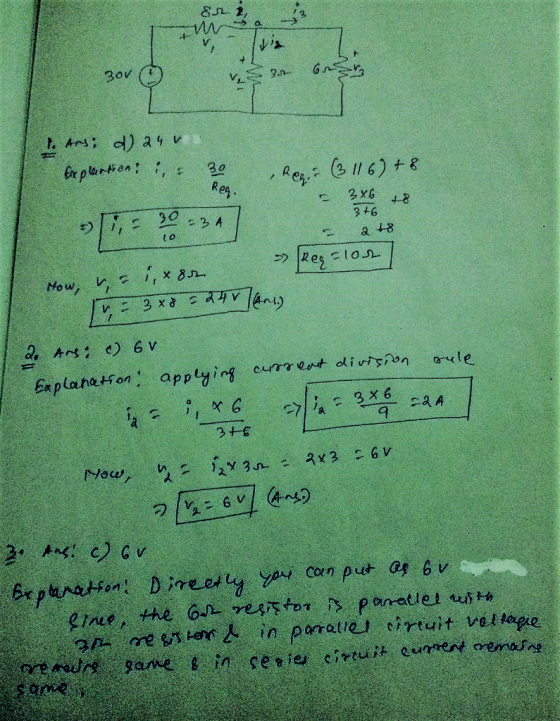
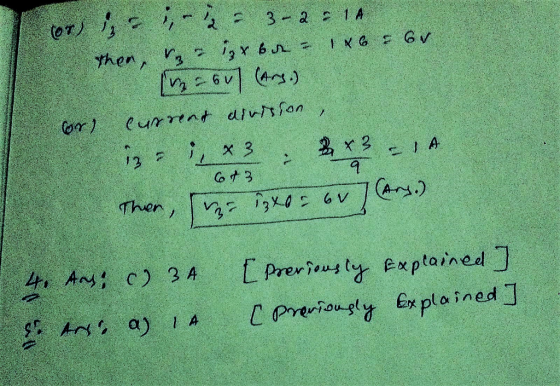
Add Answer to:
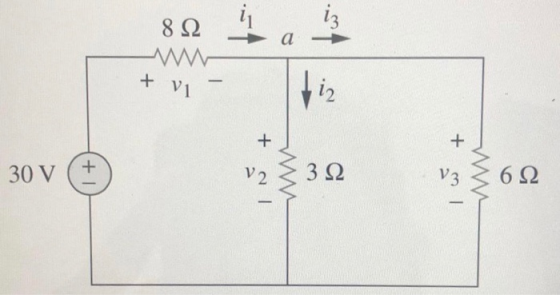
Use the following figure to answer questions 1 through
5:
1. Find V1
a) 2V
b)...
For the circuit below, determine the MAGNITUDE of the CURRENT passing through each resistor. V1 =...
 For the circuit below, determine the MAGNITUDE of the
CURRENT passing through each resistor. V1 = 7 V,
V2 = 12 V, V3 = 4 V, R1 = 19 Ω,
R2 = 3 Ω, R3 = 6 Ω.
For the circuit below, determine the MAGNITUDE of the CURRENT passing through each resistor. V1-7 V, V2 = 12 V, V3 = 4 V, R1 = 19 Ω, R2-3 Ω, R3 = 6 Ω. R1 V I3-
For the circuit below, determine the MAGNITUDE of the
CURRENT passing through each resistor. V1 = 7 V,
V2 = 12 V, V3 = 4 V, R1 = 19 Ω,
R2 = 3 Ω, R3 = 6 Ω.
For the circuit below, determine the MAGNITUDE of the CURRENT passing through each resistor. V1-7 V, V2 = 12 V, V3 = 4 V, R1 = 19 Ω, R2-3 Ω, R3 = 6 Ω. R1 V I3-
Use Nodal Analysis Exercise 3.7 Find V1, V2, and V3 in the circuit shown in Figure...
 Use Nodal Analysis
Exercise 3.7 Find V1, V2, and V3 in the circuit shown in Figure 3.20. FIGURE 3.20 The circuit for EXERCISE 3.7. 3 k12 R2 3 k2 Is 4 mA R3 15k12 Z RA 9k12 3 R5 6 k12 Answer: Vi = 15 V, V2 = 9V, V3 = 12 V.
Use Nodal Analysis
Exercise 3.7 Find V1, V2, and V3 in the circuit shown in Figure 3.20. FIGURE 3.20 The circuit for EXERCISE 3.7. 3 k12 R2 3 k2 Is 4 mA R3 15k12 Z RA 9k12 3 R5 6 k12 Answer: Vi = 15 V, V2 = 9V, V3 = 12 V.
Hello can assist me with this questions! Thanks! Practice questions - Linear Algebra/ Advanced Math Let...
 Hello can assist me with this questions! Thanks!
Practice questions - Linear Algebra/ Advanced Math Let v = (5, 2, 6,-4), v2 = (-12, -3, -12,6), and vz = (2a + 3, 8a + 3,-3a + 6, 2a - 6), where a is some unknown real number. Let V = span {V1, V2, V3}. (a) Transform {V1, V2, V3} into an orthonormal basis for V by applying the Gram-Schmidt Process. Orthonormal bases obtained using a method different from the Gram-Schmidt...
Hello can assist me with this questions! Thanks!
Practice questions - Linear Algebra/ Advanced Math Let v = (5, 2, 6,-4), v2 = (-12, -3, -12,6), and vz = (2a + 3, 8a + 3,-3a + 6, 2a - 6), where a is some unknown real number. Let V = span {V1, V2, V3}. (a) Transform {V1, V2, V3} into an orthonormal basis for V by applying the Gram-Schmidt Process. Orthonormal bases obtained using a method different from the Gram-Schmidt...
(1 point) For the circuit below, V1 = 13 V, V2 = 8 V, V3 =...
 (1 point) For the circuit below, V1 = 13 V, V2 = 8 V, V3 = -2 V. L1 = 22 mH, L2 = 18 mH, L3 = 46 mH. R1 = 22 12, R2 = 26 12, R3 = 25 12, R4 = 8 12, R5 = 47 12, R6 = 22 12, Find (a) i1, (b) i2, (C) v. 1+ RG V2 min to-rööviz w ell + V3 Zamo 2013 Paul Hummel BY NC SA (A) 11 =...
Can I get help with questions 2,3,4,6? be the (2) Determine if the following sequences of vectors vi, V2, V3 are linear...
 Can I get help with questions 2,3,4,6?
be the (2) Determine if the following sequences of vectors vi, V2, V3 are linearly de- pendent or linearly independent (a) ces of V 0 0 V1= V2 = V3 = w. It (b) contains @0 (S) V1= Vo= Va (c) inations (CE) n m. -2 VI = V2= V3 (3) Consider the vectors 6) () Vo = V3 = in R2. Compute scalars ,2, E3 not all 0 such that I1V1+2V2 +r3V3...
Can I get help with questions 2,3,4,6?
be the (2) Determine if the following sequences of vectors vi, V2, V3 are linearly de- pendent or linearly independent (a) ces of V 0 0 V1= V2 = V3 = w. It (b) contains @0 (S) V1= Vo= Va (c) inations (CE) n m. -2 VI = V2= V3 (3) Consider the vectors 6) () Vo = V3 = in R2. Compute scalars ,2, E3 not all 0 such that I1V1+2V2 +r3V3...
In the following circuit: Vg=24V,ix=2A,β=1.5,V1=12V,V3=3V,V4=4V Find V: Find Vx: Find the power consumed in element 1:...
 In the following circuit:
Vg=24V,ix=2A,β=1.5,V1=12V,V3=3V,V4=4V
Find V:
Find Vx:
Find the power consumed in element 1:
Find the power consumed in element 2:
Find the power consumed in element 3:
Find the power consumed in element 4:
Find the power consumed in the independent voltage source:
Find the power consumed in the not independent current
source:
1 + 1 V4 + . + I + L V1 1
In the following circuit:
Vg=24V,ix=2A,β=1.5,V1=12V,V3=3V,V4=4V
Find V:
Find Vx:
Find the power consumed in element 1:
Find the power consumed in element 2:
Find the power consumed in element 3:
Find the power consumed in element 4:
Find the power consumed in the independent voltage source:
Find the power consumed in the not independent current
source:
1 + 1 V4 + . + I + L V1 1
15 points) Consider the following vectors in R3 0 0 2 V1 = 1 ; V2...
 15 points) Consider the following vectors in R3 0 0 2 V1 = 1 ; V2 = 3 ; V3 = 1] ; V4 = -1;V5 = 4 1 2 3 = a) Are V1, V2, V3, V4, V5 linearly independent? Explain. b) Let H (V1, V2, V3, V4, V5) be a 3 x 5 matrix, find (i) a basis of N(H) (ii) a basis of R(H) (iii) a basis of C(H) (iv) the rank of H (v) the nullity...
2A/A 2. Calculate the power of the current controlled current sou rce I1, and the current...
 2A/A
2. Calculate the power of the current controlled current sou rce I1, and the current through R3 in the circuit below. Then answer the following questions, (15 points) Note: Save the circuit source file as "2.ms10" I I1 4 R1 3 2 A/A 1000 R2 32000 V1 14 V R3 3000 5 2 R4 31000 V2 2V 0 The power of the current controlled current source is 10 ,and the direction is The magnitude of the current is
2....
2A/A
2. Calculate the power of the current controlled current sou rce I1, and the current through R3 in the circuit below. Then answer the following questions, (15 points) Note: Save the circuit source file as "2.ms10" I I1 4 R1 3 2 A/A 1000 R2 32000 V1 14 V R3 3000 5 2 R4 31000 V2 2V 0 The power of the current controlled current source is 10 ,and the direction is The magnitude of the current is
2....
Using mesh analysis, solve the following circuit and calculate the current through Ri and the voltage...
 Using mesh analysis, solve the following circuit and calculate the current through Ri and the voltage at V relative to ground, given: Vi = 10 V, V2 = 6V, V3 = 2V, R1 = 1k02, R2 = 2 k2, R3 = 3kQ, R = 4k, and Rs = 5k12 V3 7 Ri Rs AN Using mesh analysis, solve the following circuit and calculate the current through R1 and the voltage at V relative to ground, given: V1 = 10 V,...
1. Find the Voltages at Nodes V1 and V2 2. Find Current through R1 3. Find...
 1. Find the Voltages at Nodes V1 and V2
2. Find Current through R1
3. Find The Power Delivered/Sunk by I1
4. Find the current with direction through R2
R2 W 90 15A R3 Dron 10A 30 3120
1. Find the Voltages at Nodes V1 and V2
2. Find Current through R1
3. Find The Power Delivered/Sunk by I1
4. Find the current with direction through R2
R2 W 90 15A R3 Dron 10A 30 3120
 For the circuit below, determine the MAGNITUDE of the
CURRENT passing through each resistor. V1 = 7 V,
V2 = 12 V, V3 = 4 V, R1 = 19 Ω,
R2 = 3 Ω, R3 = 6 Ω.
For the circuit below, determine the MAGNITUDE of the CURRENT passing through each resistor. V1-7 V, V2 = 12 V, V3 = 4 V, R1 = 19 Ω, R2-3 Ω, R3 = 6 Ω. R1 V I3-
For the circuit below, determine the MAGNITUDE of the
CURRENT passing through each resistor. V1 = 7 V,
V2 = 12 V, V3 = 4 V, R1 = 19 Ω,
R2 = 3 Ω, R3 = 6 Ω.
For the circuit below, determine the MAGNITUDE of the CURRENT passing through each resistor. V1-7 V, V2 = 12 V, V3 = 4 V, R1 = 19 Ω, R2-3 Ω, R3 = 6 Ω. R1 V I3-
 Use Nodal Analysis
Exercise 3.7 Find V1, V2, and V3 in the circuit shown in Figure 3.20. FIGURE 3.20 The circuit for EXERCISE 3.7. 3 k12 R2 3 k2 Is 4 mA R3 15k12 Z RA 9k12 3 R5 6 k12 Answer: Vi = 15 V, V2 = 9V, V3 = 12 V.
Use Nodal Analysis
Exercise 3.7 Find V1, V2, and V3 in the circuit shown in Figure 3.20. FIGURE 3.20 The circuit for EXERCISE 3.7. 3 k12 R2 3 k2 Is 4 mA R3 15k12 Z RA 9k12 3 R5 6 k12 Answer: Vi = 15 V, V2 = 9V, V3 = 12 V.
 Hello can assist me with this questions! Thanks!
Practice questions - Linear Algebra/ Advanced Math Let v = (5, 2, 6,-4), v2 = (-12, -3, -12,6), and vz = (2a + 3, 8a + 3,-3a + 6, 2a - 6), where a is some unknown real number. Let V = span {V1, V2, V3}. (a) Transform {V1, V2, V3} into an orthonormal basis for V by applying the Gram-Schmidt Process. Orthonormal bases obtained using a method different from the Gram-Schmidt...
Hello can assist me with this questions! Thanks!
Practice questions - Linear Algebra/ Advanced Math Let v = (5, 2, 6,-4), v2 = (-12, -3, -12,6), and vz = (2a + 3, 8a + 3,-3a + 6, 2a - 6), where a is some unknown real number. Let V = span {V1, V2, V3}. (a) Transform {V1, V2, V3} into an orthonormal basis for V by applying the Gram-Schmidt Process. Orthonormal bases obtained using a method different from the Gram-Schmidt...
 (1 point) For the circuit below, V1 = 13 V, V2 = 8 V, V3 = -2 V. L1 = 22 mH, L2 = 18 mH, L3 = 46 mH. R1 = 22 12, R2 = 26 12, R3 = 25 12, R4 = 8 12, R5 = 47 12, R6 = 22 12, Find (a) i1, (b) i2, (C) v. 1+ RG V2 min to-rööviz w ell + V3 Zamo 2013 Paul Hummel BY NC SA (A) 11 =...
 Can I get help with questions 2,3,4,6?
be the (2) Determine if the following sequences of vectors vi, V2, V3 are linearly de- pendent or linearly independent (a) ces of V 0 0 V1= V2 = V3 = w. It (b) contains @0 (S) V1= Vo= Va (c) inations (CE) n m. -2 VI = V2= V3 (3) Consider the vectors 6) () Vo = V3 = in R2. Compute scalars ,2, E3 not all 0 such that I1V1+2V2 +r3V3...
Can I get help with questions 2,3,4,6?
be the (2) Determine if the following sequences of vectors vi, V2, V3 are linearly de- pendent or linearly independent (a) ces of V 0 0 V1= V2 = V3 = w. It (b) contains @0 (S) V1= Vo= Va (c) inations (CE) n m. -2 VI = V2= V3 (3) Consider the vectors 6) () Vo = V3 = in R2. Compute scalars ,2, E3 not all 0 such that I1V1+2V2 +r3V3...
 In the following circuit:
Vg=24V,ix=2A,β=1.5,V1=12V,V3=3V,V4=4V
Find V:
Find Vx:
Find the power consumed in element 1:
Find the power consumed in element 2:
Find the power consumed in element 3:
Find the power consumed in element 4:
Find the power consumed in the independent voltage source:
Find the power consumed in the not independent current
source:
1 + 1 V4 + . + I + L V1 1
In the following circuit:
Vg=24V,ix=2A,β=1.5,V1=12V,V3=3V,V4=4V
Find V:
Find Vx:
Find the power consumed in element 1:
Find the power consumed in element 2:
Find the power consumed in element 3:
Find the power consumed in element 4:
Find the power consumed in the independent voltage source:
Find the power consumed in the not independent current
source:
1 + 1 V4 + . + I + L V1 1
 15 points) Consider the following vectors in R3 0 0 2 V1 = 1 ; V2 = 3 ; V3 = 1] ; V4 = -1;V5 = 4 1 2 3 = a) Are V1, V2, V3, V4, V5 linearly independent? Explain. b) Let H (V1, V2, V3, V4, V5) be a 3 x 5 matrix, find (i) a basis of N(H) (ii) a basis of R(H) (iii) a basis of C(H) (iv) the rank of H (v) the nullity...
 2A/A
2. Calculate the power of the current controlled current sou rce I1, and the current through R3 in the circuit below. Then answer the following questions, (15 points) Note: Save the circuit source file as "2.ms10" I I1 4 R1 3 2 A/A 1000 R2 32000 V1 14 V R3 3000 5 2 R4 31000 V2 2V 0 The power of the current controlled current source is 10 ,and the direction is The magnitude of the current is
2....
2A/A
2. Calculate the power of the current controlled current sou rce I1, and the current through R3 in the circuit below. Then answer the following questions, (15 points) Note: Save the circuit source file as "2.ms10" I I1 4 R1 3 2 A/A 1000 R2 32000 V1 14 V R3 3000 5 2 R4 31000 V2 2V 0 The power of the current controlled current source is 10 ,and the direction is The magnitude of the current is
2....
 Using mesh analysis, solve the following circuit and calculate the current through Ri and the voltage at V relative to ground, given: Vi = 10 V, V2 = 6V, V3 = 2V, R1 = 1k02, R2 = 2 k2, R3 = 3kQ, R = 4k, and Rs = 5k12 V3 7 Ri Rs AN Using mesh analysis, solve the following circuit and calculate the current through R1 and the voltage at V relative to ground, given: V1 = 10 V,...
 1. Find the Voltages at Nodes V1 and V2
2. Find Current through R1
3. Find The Power Delivered/Sunk by I1
4. Find the current with direction through R2
R2 W 90 15A R3 Dron 10A 30 3120
1. Find the Voltages at Nodes V1 and V2
2. Find Current through R1
3. Find The Power Delivered/Sunk by I1
4. Find the current with direction through R2
R2 W 90 15A R3 Dron 10A 30 3120
Most questions answered within 3 hours.
-
Where is the error in this code sequence?
String s1 = "Hello";
String s2 = "ello";...
asked 10 months ago -
Financial data for Joel de Paris, Inc., for last year
follow:
Joel de Paris, Inc.
Balance...
asked 10 months ago -
Consider this reaction:
Al2(SO4)3 (aq)+ BaCl3
(aq) Al2Cl6 (aq)- +
3BaSO4(s) . What is the...
asked 10 months ago -
Suppose that Savneet is considering increasing her
recent random sample from 20 car rentals to 40...
asked 10 months ago -
Trucks arrive at an unloading terminal at an average rate of 120
per hour.
Trucks arrive...
asked 10 months ago -
Why are methanol and ethanol completely soluble in water while
octanol is not very little soluble....
asked 10 months ago -
A facilities manager at a university reads in a research report
that the mean amount of...
asked 10 months ago -
When the CuSO4 is rehydrated by adding water to the anhydrous
compound, is this an endothermic...
asked 10 months ago -
A ray of sunlight is passing from diamond into crown glass; the
angle of incidence is...
asked 10 months ago -
A block of mass 0.249 kg is placed on top of a light, vertical
spring of...
asked 10 months ago -
how do the kidneys compensate in the presences of acidosis
a) trigger hyperventilate
b) reserve acid...
asked 10 months ago -
Question 501 pts
The rental rate of capital to the firm increases. Which of the
following...
asked 10 months ago