
Homework Answers
Add Answer to:
The pressure, volume, and temperature of a mole of an ideal gas are related by the...
The pressure, volume, and temperature of a mole of an ideal gas are related by the...
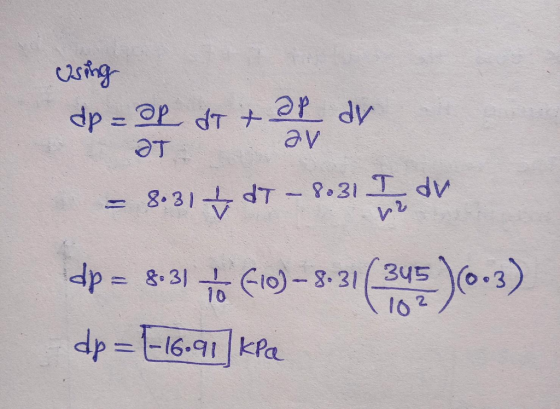
The pressure, volume, and temperature of a mole of an ideal gas are related by the equation PV = 8.31T, where P is measured in kilopascals, V in liters, and T in kelvins. Use differentials to find the approximate change in the pressure if the volume increases from 10 L to 10.3 L and the temperature decreases from 375 K to 370 K. (Note whether the change is positive or negative in your answer. Round your answer to two decimal...
deal gases obey the equation PV nRT, where P is the pressure of the gas, V is its volume, n is the number of moles of gas, T is its temperature, and the constant R-8.314 KPa-liters-mol-1 kelvin-1...
 deal gases obey the equation PV nRT, where P is the pressure of the gas, V is its volume, n is the number of moles of gas, T is its temperature, and the constant R-8.314 KPa-liters-mol-1 kelvin-1 (a) Find the exac t change in volume of O, gas as the pressure increases from 12.00 to 12.01 KPa, the temperature decreases from 300.0 to 299.9 degrees kelvin, and the number of moles of 0, gas changes from 1.03 to 1.01 moles....
deal gases obey the equation PV - nRT where P is the pressure of he gas, volum, sthe sunbet of moles of gas, T is its temperature, and the constant R-8.314 KPa-liters mol1 kelvin (a) Find the exa...
 deal gases obey the equation PV - nRT where P is the pressure of he gas, volum, sthe sunbet of moles of gas, T is its temperature, and the constant R-8.314 KPa-liters mol1 kelvin (a) Find the exact change in volume of o, gas as the pressure increases from 12.00 to 12.01 KPa, decreases from 300.0 to 299.9 degrees kelvin, and the number of moles of 0, gas changes the temperature moles. Round the final answer to three decimal places....
The pressure of 1 mole of an ideal gas is increasing at a rate of 0.06...
The pressure of 1 mole of an ideal gas is increasing at a rate of 0.06 kPa/s and the temperature is increasing at a rate of 0.21 K/s. Use the equation PV = 8.31T to find the rate of change of the volume when the pressure is 13 kPa and the temperature is 320 K. (Round your answer to two decimal places.)
Learning Goal: To apply the ideal gas law to problems involving temperature, pressure, volume, and moles...
 Learning Goal: To apply the ideal gas law to problems involving
temperature, pressure, volume, and moles of a gas. The four
properties of gases (pressure P, volume V, temperature T, and moles
of gas n) are related by a single expression known as the ideal gas
law: PV=nRT The variable R is known as the universal gas constant
and has the value R=0.0821 L⋅atm/(mole⋅K). The units of R dictate
the units for all other quantities, so when using this value...
Learning Goal: To apply the ideal gas law to problems involving
temperature, pressure, volume, and moles of a gas. The four
properties of gases (pressure P, volume V, temperature T, and moles
of gas n) are related by a single expression known as the ideal gas
law: PV=nRT The variable R is known as the universal gas constant
and has the value R=0.0821 L⋅atm/(mole⋅K). The units of R dictate
the units for all other quantities, so when using this value...
The Pressure of an Ideal gas, measured in kPa, is related to its volume, V, and...
 The Pressure of an Ideal gas,
measured in kPa, is related to its volume, V, and temperature, T,
by the equation:
PV=0.23T.
The temperature is measured with an error of 8 kelvin and the
volume is measured with an error of 0.6m^3. If it is known that the
actual values are T=234 kelvin and V=4m^3, what is the estimated
maximum error in the measurement of the pressure? Round your answer
to 4 decimal places.
The pressure of an ideal gas,...
The Pressure of an Ideal gas,
measured in kPa, is related to its volume, V, and temperature, T,
by the equation:
PV=0.23T.
The temperature is measured with an error of 8 kelvin and the
volume is measured with an error of 0.6m^3. If it is known that the
actual values are T=234 kelvin and V=4m^3, what is the estimated
maximum error in the measurement of the pressure? Round your answer
to 4 decimal places.
The pressure of an ideal gas,...
Using the Ideal Gas Law, what volume in L would 1 mole of an ideal gas occupy at standard temperature and pressure? Reme...
Using the Ideal Gas Law, what volume in L would 1 mole of an ideal gas occupy at standard temperature and pressure? Remember: STP is 273.15 K and 101.325 kPa.
The pressure, P in atmospheres (atm), of an ideal gas can be expressed as a function...
 The pressure, P in atmospheres (atm), of an ideal gas can be expressed as a function of volume, V in liters (L), and temperature, T in kelvin (K), is P(V, T) = nRT/V where n = 1 mol and R 0.08 are constants. Suppose the current volume and temperature of a gas behaving according to the ideal gas law are: V = 5 L and T = 300 K. (a) Compute the differential (or, equivalently, approximate DeltaP) for the given...
Hi, Really struggling to get my head around this question Could you please provide an explanation...
 Hi,
Really struggling to get my head around this question Could you
please provide an explanation with your working. Trying to better
understand what's being asked. Would really appreciate it if you
could explain your working. I am happy with my answer to part a),
but can't understand where to start in part b) Many thanks!
Question 2 The ideal gas law relates the temperatueresure, and the temperature, pressure, and volume of an ideal gas. For n moles of gas,...
Hi,
Really struggling to get my head around this question Could you
please provide an explanation with your working. Trying to better
understand what's being asked. Would really appreciate it if you
could explain your working. I am happy with my answer to part a),
but can't understand where to start in part b) Many thanks!
Question 2 The ideal gas law relates the temperatueresure, and the temperature, pressure, and volume of an ideal gas. For n moles of gas,...
a)Rewrite ideal gas law as volume being a function of pressure and temperature. b) What is...
a)Rewrite ideal gas law as volume being a function of pressure and temperature. b) What is the expression for the total derivative dV as a function of pressure and temperature? c) At a pressure of 1.08 atm and 350 K for one mole of ideal gas, what is the predicted change in volume if the pressure changes by 0.10 atm (dp = 0.10 atm) and the temperature changes is 10.0 K?
 deal gases obey the equation PV nRT, where P is the pressure of the gas, V is its volume, n is the number of moles of gas, T is its temperature, and the constant R-8.314 KPa-liters-mol-1 kelvin-1 (a) Find the exac t change in volume of O, gas as the pressure increases from 12.00 to 12.01 KPa, the temperature decreases from 300.0 to 299.9 degrees kelvin, and the number of moles of 0, gas changes from 1.03 to 1.01 moles....
 deal gases obey the equation PV - nRT where P is the pressure of he gas, volum, sthe sunbet of moles of gas, T is its temperature, and the constant R-8.314 KPa-liters mol1 kelvin (a) Find the exact change in volume of o, gas as the pressure increases from 12.00 to 12.01 KPa, decreases from 300.0 to 299.9 degrees kelvin, and the number of moles of 0, gas changes the temperature moles. Round the final answer to three decimal places....
 Learning Goal: To apply the ideal gas law to problems involving
temperature, pressure, volume, and moles of a gas. The four
properties of gases (pressure P, volume V, temperature T, and moles
of gas n) are related by a single expression known as the ideal gas
law: PV=nRT The variable R is known as the universal gas constant
and has the value R=0.0821 L⋅atm/(mole⋅K). The units of R dictate
the units for all other quantities, so when using this value...
Learning Goal: To apply the ideal gas law to problems involving
temperature, pressure, volume, and moles of a gas. The four
properties of gases (pressure P, volume V, temperature T, and moles
of gas n) are related by a single expression known as the ideal gas
law: PV=nRT The variable R is known as the universal gas constant
and has the value R=0.0821 L⋅atm/(mole⋅K). The units of R dictate
the units for all other quantities, so when using this value...
 The Pressure of an Ideal gas,
measured in kPa, is related to its volume, V, and temperature, T,
by the equation:
PV=0.23T.
The temperature is measured with an error of 8 kelvin and the
volume is measured with an error of 0.6m^3. If it is known that the
actual values are T=234 kelvin and V=4m^3, what is the estimated
maximum error in the measurement of the pressure? Round your answer
to 4 decimal places.
The pressure of an ideal gas,...
The Pressure of an Ideal gas,
measured in kPa, is related to its volume, V, and temperature, T,
by the equation:
PV=0.23T.
The temperature is measured with an error of 8 kelvin and the
volume is measured with an error of 0.6m^3. If it is known that the
actual values are T=234 kelvin and V=4m^3, what is the estimated
maximum error in the measurement of the pressure? Round your answer
to 4 decimal places.
The pressure of an ideal gas,...
 The pressure, P in atmospheres (atm), of an ideal gas can be expressed as a function of volume, V in liters (L), and temperature, T in kelvin (K), is P(V, T) = nRT/V where n = 1 mol and R 0.08 are constants. Suppose the current volume and temperature of a gas behaving according to the ideal gas law are: V = 5 L and T = 300 K. (a) Compute the differential (or, equivalently, approximate DeltaP) for the given...
 Hi,
Really struggling to get my head around this question Could you
please provide an explanation with your working. Trying to better
understand what's being asked. Would really appreciate it if you
could explain your working. I am happy with my answer to part a),
but can't understand where to start in part b) Many thanks!
Question 2 The ideal gas law relates the temperatueresure, and the temperature, pressure, and volume of an ideal gas. For n moles of gas,...
Hi,
Really struggling to get my head around this question Could you
please provide an explanation with your working. Trying to better
understand what's being asked. Would really appreciate it if you
could explain your working. I am happy with my answer to part a),
but can't understand where to start in part b) Many thanks!
Question 2 The ideal gas law relates the temperatueresure, and the temperature, pressure, and volume of an ideal gas. For n moles of gas,...
Most questions answered within 3 hours.
-
Where is the error in this code sequence?
String s1 = "Hello";
String s2 = "ello";...
asked 11 months ago -
Financial data for Joel de Paris, Inc., for last year
follow:
Joel de Paris, Inc.
Balance...
asked 11 months ago -
Consider this reaction:
Al2(SO4)3 (aq)+ BaCl3
(aq) Al2Cl6 (aq)- +
3BaSO4(s) . What is the...
asked 11 months ago -
Suppose that Savneet is considering increasing her
recent random sample from 20 car rentals to 40...
asked 11 months ago -
Trucks arrive at an unloading terminal at an average rate of 120
per hour.
Trucks arrive...
asked 11 months ago -
Why are methanol and ethanol completely soluble in water while
octanol is not very little soluble....
asked 11 months ago -
A facilities manager at a university reads in a research report
that the mean amount of...
asked 11 months ago -
When the CuSO4 is rehydrated by adding water to the anhydrous
compound, is this an endothermic...
asked 11 months ago -
A ray of sunlight is passing from diamond into crown glass; the
angle of incidence is...
asked 11 months ago -
A block of mass 0.249 kg is placed on top of a light, vertical
spring of...
asked 11 months ago -
how do the kidneys compensate in the presences of acidosis
a) trigger hyperventilate
b) reserve acid...
asked 11 months ago -
Question 501 pts
The rental rate of capital to the firm increases. Which of the
following...
asked 11 months ago