
Homework Answers
Request Answer!
We need at least 10 more requests to produce the answer.
0 / 10 have requested this problem solution
The more requests, the faster the answer.
Add Answer to:
Use the References to access important values if For te socord oder mact on below the...
Use the References to access important values if needed for this question. The gas phase decomposition...
Use the References to access important values if needed for this question. The gas phase decomposition of hydrogen iodide at 700 K HI(g)-----> ½ H2(g) + ½ I2(g) is second order in HI. In one experiment, when the initial concentration of HI was 1.57 M, the concentration of HIdropped to 0.237 M after 1.93×10³ seconds had passed. Based on these data, the rate constant for the reaction is_____ M-1 s-1.
[References) Use the References to access important values if needed for this question. What is the...
 [References) Use the References to access important values if needed for this question. What is the calculated value of the cell potential at 298K for an electrochemical cell with the following reaction, when the Pb2+ concentration is 8.30x10⁴ M and the Mg2+ concentration is 1.39 M ? Pb2+ (aq) + Mg(s) —— Pb(s) + Mg2+ (aq) Answer: V The cell reaction as written above is spontaneous for the concentrations given: Submit Answer Retry Entire Group 4 more group attempts remaining
Use the References to access important values if needed for this question. In a study of...
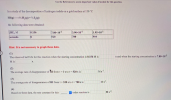 Use the References to access important values if needed for this question. In a study of the decomposition of hydrogen iodide on a gold surface at 150 °C HI(g)— % H2(g) + % 12() the following data were obtained: 0.156 3.90x10- [HI], M seconds 7.80x10² 520 1.95x10⁻² 910 780 Hint: It is not necessary to graph these data. (1) The observed half life for this reaction when the starting concentration is 0.156 M is Mis and when the starting concentration...
[References) Use the References to access important values if needed for this question. When the Pb2+...
 [References) Use the References to access important values if needed for this question. When the Pb2+ concentration is 3.17X10⁴ M, the observed cell potential at 298K for an electrochemical cell with the following reaction is 0.530V. What is the Zn2+ concentration? Pb2+(aq) + Zn(s)— Pb(9) + Zn2+(aq) Answer: M Submit Answer Retry Entire Group 4 more grouppattempts remaining
References Use the References to access important values if needed for this question Write the cell...
 References Use the References to access important values if needed for this question Write the cell notation for an electrochemical cell consisting of an anode where Cd (s) is axidized to Cd (aq) and a cathode where Ag' (aq) is reduced to Ag (s). Assume all aqueous solutions have a concentration of 1 mol/L Submit Answer
(References) Use the References to access important values if needed for this question. When the Agt...
 (References) Use the References to access important values if needed for this question. When the Agt concentration is 8.16x10 + M, the observed cell potential at 298K for an electrochemical cell with the following reaction is 1.353V. What is the Cr3+ concentration? 3Ag" (aq) + Cr(s)—+3A98) + Cr3+ (aq) Answer: M ed Submit Answer Retry Entire Group 3 more group attempts remaining 3
Use the References to access important values if needed for this question. = 8A = 3A...
 Use the References to access important values if needed for this question. = 8A = 3A 4A 5A 6A 7A He Na Mg 3B 4B 5B 6B 7B 8B 1B 2B K Ca Sc Ti V Cr Mn Fe Co Ni Cu Zn Ga Ge As Se Br Kr | Rb s v 2r No Mo To Ru Ra Pa ng ca In án su Te | Xe Cs Ba La" Hf Ta W Re Os Ir Pt Au Hg...
(Reference Use the References to access important values if needed for this question A sample of...
 (Reference Use the References to access important values if needed for this question A sample of oxygen gas collected at a pressure of 1.25 atm and a temperature of 301 K is found to occupy a volume of 851 milliliters. How many moles of O, gas are in the sample? mol Submit Answer Submit Answer Try Another Version Frey Another Version 2 tom ate 2 item attempts remaining
NOVO Use the References to access important values if needed for this question In a study...
 NOVO Use the References to access important values if needed for this question In a study of the decomposition of hydrogen iodide on a gold surface at 150 °C HI(g) + H2(g) + / 12() the following data were obtained: P 0.215 (HIM seconds 0.108 518 5.40x10² 780 2.70x10⁻² 911 0 Hint: It is not necessary to graph these data. (1) The observed half life for this reaction when the starting concentration is 0.215 M is Mis and when the...
Use the References to access important values if needed for this question. NO2 reacts with F2...
 Use the References to access important values if needed for this question. NO2 reacts with F2 in the gas phase according to the following chemical equation: 2NO2(g)F2(g) 2NO Fg) It is observed that, when the concentration of F2 is reduced to 1/3 o its initial value, the rate of the reaction is also reduced to 1/3 of its nitial value. When the concentration of NO2 is multiplied by 4.48, the rate of the reaction also increases by a factor of...
 [References) Use the References to access important values if needed for this question. What is the calculated value of the cell potential at 298K for an electrochemical cell with the following reaction, when the Pb2+ concentration is 8.30x10⁴ M and the Mg2+ concentration is 1.39 M ? Pb2+ (aq) + Mg(s) —— Pb(s) + Mg2+ (aq) Answer: V The cell reaction as written above is spontaneous for the concentrations given: Submit Answer Retry Entire Group 4 more group attempts remaining
 Use the References to access important values if needed for this question. In a study of the decomposition of hydrogen iodide on a gold surface at 150 °C HI(g)— % H2(g) + % 12() the following data were obtained: 0.156 3.90x10- [HI], M seconds 7.80x10² 520 1.95x10⁻² 910 780 Hint: It is not necessary to graph these data. (1) The observed half life for this reaction when the starting concentration is 0.156 M is Mis and when the starting concentration...
 [References) Use the References to access important values if needed for this question. When the Pb2+ concentration is 3.17X10⁴ M, the observed cell potential at 298K for an electrochemical cell with the following reaction is 0.530V. What is the Zn2+ concentration? Pb2+(aq) + Zn(s)— Pb(9) + Zn2+(aq) Answer: M Submit Answer Retry Entire Group 4 more grouppattempts remaining
 References Use the References to access important values if needed for this question Write the cell notation for an electrochemical cell consisting of an anode where Cd (s) is axidized to Cd (aq) and a cathode where Ag' (aq) is reduced to Ag (s). Assume all aqueous solutions have a concentration of 1 mol/L Submit Answer
 (References) Use the References to access important values if needed for this question. When the Agt concentration is 8.16x10 + M, the observed cell potential at 298K for an electrochemical cell with the following reaction is 1.353V. What is the Cr3+ concentration? 3Ag" (aq) + Cr(s)—+3A98) + Cr3+ (aq) Answer: M ed Submit Answer Retry Entire Group 3 more group attempts remaining 3
 Use the References to access important values if needed for this question. = 8A = 3A 4A 5A 6A 7A He Na Mg 3B 4B 5B 6B 7B 8B 1B 2B K Ca Sc Ti V Cr Mn Fe Co Ni Cu Zn Ga Ge As Se Br Kr | Rb s v 2r No Mo To Ru Ra Pa ng ca In án su Te | Xe Cs Ba La" Hf Ta W Re Os Ir Pt Au Hg...
 (Reference Use the References to access important values if needed for this question A sample of oxygen gas collected at a pressure of 1.25 atm and a temperature of 301 K is found to occupy a volume of 851 milliliters. How many moles of O, gas are in the sample? mol Submit Answer Submit Answer Try Another Version Frey Another Version 2 tom ate 2 item attempts remaining
 NOVO Use the References to access important values if needed for this question In a study of the decomposition of hydrogen iodide on a gold surface at 150 °C HI(g) + H2(g) + / 12() the following data were obtained: P 0.215 (HIM seconds 0.108 518 5.40x10² 780 2.70x10⁻² 911 0 Hint: It is not necessary to graph these data. (1) The observed half life for this reaction when the starting concentration is 0.215 M is Mis and when the...
 Use the References to access important values if needed for this question. NO2 reacts with F2 in the gas phase according to the following chemical equation: 2NO2(g)F2(g) 2NO Fg) It is observed that, when the concentration of F2 is reduced to 1/3 o its initial value, the rate of the reaction is also reduced to 1/3 of its nitial value. When the concentration of NO2 is multiplied by 4.48, the rate of the reaction also increases by a factor of...
Most questions answered within 3 hours.
-
Where is the error in this code sequence?
String s1 = "Hello";
String s2 = "ello";...
asked 10 months ago -
Financial data for Joel de Paris, Inc., for last year
follow:
Joel de Paris, Inc.
Balance...
asked 10 months ago -
Consider this reaction:
Al2(SO4)3 (aq)+ BaCl3
(aq) Al2Cl6 (aq)- +
3BaSO4(s) . What is the...
asked 10 months ago -
Suppose that Savneet is considering increasing her
recent random sample from 20 car rentals to 40...
asked 10 months ago -
Trucks arrive at an unloading terminal at an average rate of 120
per hour.
Trucks arrive...
asked 10 months ago -
Why are methanol and ethanol completely soluble in water while
octanol is not very little soluble....
asked 10 months ago -
A facilities manager at a university reads in a research report
that the mean amount of...
asked 10 months ago -
When the CuSO4 is rehydrated by adding water to the anhydrous
compound, is this an endothermic...
asked 10 months ago -
A ray of sunlight is passing from diamond into crown glass; the
angle of incidence is...
asked 10 months ago -
A block of mass 0.249 kg is placed on top of a light, vertical
spring of...
asked 10 months ago -
how do the kidneys compensate in the presences of acidosis
a) trigger hyperventilate
b) reserve acid...
asked 10 months ago -
Question 501 pts
The rental rate of capital to the firm increases. Which of the
following...
asked 10 months ago