Show the calculation for the serial dilutions to obtain 0.01mg/L, 0.05mg/L, 0.10mg/L, and 0.5mg/L solutions 25mL...
Show the calculation for the serial dilutions to obtain 0.01mg/L, 0.05mg/L, 0.10mg/L, and 0.5mg/L solutions
25mL of nitrite standard solution to 100mL volumetric flask and dilute to volume with deionized water
Homework Answers

Add Answer to:
Show the calculation for the serial dilutions to obtain
0.01mg/L, 0.05mg/L, 0.10mg/L, and 0.5mg/L solutions
25mL...
You prepared a set of standard solutions by serial dilutions. You started with a stock solution...
 You prepared a set of standard solutions by serial dilutions. You started with a stock solution of bromocresol green with a concentration of 0.213 M. The following standard solutions were prepared as described below. Solution A: Stock solution of bromocresol green at a concentration of 0.213 M. Solution B: 25 mL of solution A was diluted to 50 mL in a volumetric flask. Solution C: 25 mL of solution B was diluted to 50 mL in a volumetric flask. Solution...
You prepared four standard solutions by serial dilutions that contained decreasing concentrations of bromocresol green, but...
 You prepared four standard solutions by serial dilutions that contained decreasing concentrations of bromocresol green, but constant HCl concentration. You also prepared four additional standard solutions by serial dilutions that contained decreasing concentrations of bromocresol green, but constant NaOH concentration. You then measured the absorbances of these solutions at their respective lamba max wavelengths (AX1 & A2). These absorbances were plotted versus Hin and In molar concentrations respecti vely to produce linear calibration curves with linear equations shown below. AX1...
how do I prepare the 100mg/L of asprin acetaminophen and caffeine solution and dilute that solution...
 how do I prepare the 100mg/L of asprin acetaminophen and
caffeine solution
and dilute that solution with 1a% acetic acid to creat 50, 10
and 5mg/L solutions
Preparation of Standards: Using a 100ML volumetric flask and 1 % acetic acid solution (prepared in hood from glacial acetic acid using a 1000mL beaker and 10mL graduated cylinder), prepare and label a stock solution of 100 mg/L each of aspirin, acetaminophen, and caffeine combined together in a single volumetric flask. Using appropriate...
how do I prepare the 100mg/L of asprin acetaminophen and
caffeine solution
and dilute that solution with 1a% acetic acid to creat 50, 10
and 5mg/L solutions
Preparation of Standards: Using a 100ML volumetric flask and 1 % acetic acid solution (prepared in hood from glacial acetic acid using a 1000mL beaker and 10mL graduated cylinder), prepare and label a stock solution of 100 mg/L each of aspirin, acetaminophen, and caffeine combined together in a single volumetric flask. Using appropriate...
Calculate the mass of Fe2+ in the tablet by taking the dilutions and volumes of solutions...
 Calculate the mass of Fe2+ in the tablet by taking the
dilutions and volumes of solutions used into account. The
concentration of the unknown is 2.325x10^-5M.
V. PROCEDURE Zou will be working with a partner for this experiment Part A. Initial preparation of the unknown (vitamin tablet) 1. Weigh the vitamin tablet on the Analytical Balance Then grind it to a powder with a mortar and pestle. mL beaker using 25 mL of 6 M HCI. Cover with a wa...
Calculate the mass of Fe2+ in the tablet by taking the
dilutions and volumes of solutions used into account. The
concentration of the unknown is 2.325x10^-5M.
V. PROCEDURE Zou will be working with a partner for this experiment Part A. Initial preparation of the unknown (vitamin tablet) 1. Weigh the vitamin tablet on the Analytical Balance Then grind it to a powder with a mortar and pestle. mL beaker using 25 mL of 6 M HCI. Cover with a wa...
Please explain how to go from 15 drops/L to 15 drops/mL. And show all work and...
 Please explain how to go from 15 drops/L to 15 drops/mL. And
show all work and show how the final answer has to be in drops/mL
thank you
4. A student prepared a set of solutions using the serial dilution method. The stock solution had a concentration of 15 drops/L. The solutions were prepared according the following procedure. Calculation the concentrations of solutions A-D. Show the calculation for each solution, complete with equations, units, and the correct number of significant...
Please explain how to go from 15 drops/L to 15 drops/mL. And
show all work and show how the final answer has to be in drops/mL
thank you
4. A student prepared a set of solutions using the serial dilution method. The stock solution had a concentration of 15 drops/L. The solutions were prepared according the following procedure. Calculation the concentrations of solutions A-D. Show the calculation for each solution, complete with equations, units, and the correct number of significant...
1. Calculate the serial dilutions using the following diagrams. 1mL 25mL 5mL 5mL 99mL 75mL 45mL 5...
 1. Calculate the serial dilutions using the following diagrams. 1mL 25mL 5mL 5mL 99mL 75mL 45mL 5mL Dilution: 0.1mL .01mL 0.1mL 1.0mL 1.9mL 9.99m 99.9mL 2mL Dilution: - when transferring 0.1mL from the corresponding tube? Show all your work in scientifie notation. Hint: Observe the diagram carefully 2.. Caleulate the dilutions for each tube; then calculate the dilutions for the four plates 1 mL or 1g sample 1 mL 1mL 1mL 1mL 1mL 1mL 1 mL ml 99 mL 0.1mL...
A chemist needs to create a series of standard Cu- (aq) solutions for an absorbance experiment....
 A chemist needs to create a series of standard Cu- (aq) solutions for an absorbance experiment. For the first standard, he uses a pipet to transfer 20.00 mL of a 2.64 M Cup (aq) stock solution to a 500.0 mL volumetric flask, and he adds enough water to dilute to the mark. He then uses a second pipet to transfer 25.00 mL of the second solution to a 100.0 mL volumetric flask, and he adds enough water to dilute to...
A chemist needs to create a series of standard Cu" (aq) solutions for an absorbance experiment....
 A chemist needs to create a series of standard Cu" (aq) solutions for an absorbance experiment. For the first standard, he uses a pipet to transfer 20.00 mL of a 2.52 M Cu" (aq) stock solution to a 500.0 mL volumetric flask, and he adds enough water to dilute to the mark. He then uses a second pipet to transfer 10.00 mL of the second solution to a 100.0 mL volumetric flask, and he adds enough water to dilute to...
A chemist needs to create a series of standard Cu2+ (aq) solutions for an absorbance experiment....
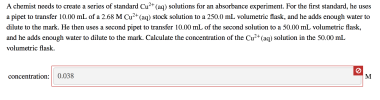 A chemist needs to create a series of standard Cu2+ (aq) solutions for an absorbance experiment. For the first standard, he uses a pipet to transfer 10.00 mL of a 2.68 M Cu2+ (aq) stock solution to a 250.0 mL volumetric flask, and he adds enough water to dilute to the mark. He then uses a second pipet to transfer 10.00 mL of the second solution to a 50.00 mL volumetric flask, and he adds enough water to dilute to...
A chemist needs to create a series of standard Cu²+ (aq) solutions for an absorbance experiment....
 A chemist needs to create a series of standard Cu²+ (aq) solutions for an absorbance experiment. For the first standard, he uses a pipet to transfer 25.00 mL of a 2.20 M Cu2+ (aq) stock solution to a 250.0 mL volumetric flask, and he adds enough water to dilute to the mark. He then uses a second pipet to transfer 5.00 mL of the second solution to a 50.00 ml. volumetric flask, and he adds enough water to dilute to...
 You prepared a set of standard solutions by serial dilutions. You started with a stock solution of bromocresol green with a concentration of 0.213 M. The following standard solutions were prepared as described below. Solution A: Stock solution of bromocresol green at a concentration of 0.213 M. Solution B: 25 mL of solution A was diluted to 50 mL in a volumetric flask. Solution C: 25 mL of solution B was diluted to 50 mL in a volumetric flask. Solution...
 You prepared four standard solutions by serial dilutions that contained decreasing concentrations of bromocresol green, but constant HCl concentration. You also prepared four additional standard solutions by serial dilutions that contained decreasing concentrations of bromocresol green, but constant NaOH concentration. You then measured the absorbances of these solutions at their respective lamba max wavelengths (AX1 & A2). These absorbances were plotted versus Hin and In molar concentrations respecti vely to produce linear calibration curves with linear equations shown below. AX1...
 how do I prepare the 100mg/L of asprin acetaminophen and
caffeine solution
and dilute that solution with 1a% acetic acid to creat 50, 10
and 5mg/L solutions
Preparation of Standards: Using a 100ML volumetric flask and 1 % acetic acid solution (prepared in hood from glacial acetic acid using a 1000mL beaker and 10mL graduated cylinder), prepare and label a stock solution of 100 mg/L each of aspirin, acetaminophen, and caffeine combined together in a single volumetric flask. Using appropriate...
how do I prepare the 100mg/L of asprin acetaminophen and
caffeine solution
and dilute that solution with 1a% acetic acid to creat 50, 10
and 5mg/L solutions
Preparation of Standards: Using a 100ML volumetric flask and 1 % acetic acid solution (prepared in hood from glacial acetic acid using a 1000mL beaker and 10mL graduated cylinder), prepare and label a stock solution of 100 mg/L each of aspirin, acetaminophen, and caffeine combined together in a single volumetric flask. Using appropriate...
 Calculate the mass of Fe2+ in the tablet by taking the
dilutions and volumes of solutions used into account. The
concentration of the unknown is 2.325x10^-5M.
V. PROCEDURE Zou will be working with a partner for this experiment Part A. Initial preparation of the unknown (vitamin tablet) 1. Weigh the vitamin tablet on the Analytical Balance Then grind it to a powder with a mortar and pestle. mL beaker using 25 mL of 6 M HCI. Cover with a wa...
Calculate the mass of Fe2+ in the tablet by taking the
dilutions and volumes of solutions used into account. The
concentration of the unknown is 2.325x10^-5M.
V. PROCEDURE Zou will be working with a partner for this experiment Part A. Initial preparation of the unknown (vitamin tablet) 1. Weigh the vitamin tablet on the Analytical Balance Then grind it to a powder with a mortar and pestle. mL beaker using 25 mL of 6 M HCI. Cover with a wa...
 Please explain how to go from 15 drops/L to 15 drops/mL. And
show all work and show how the final answer has to be in drops/mL
thank you
4. A student prepared a set of solutions using the serial dilution method. The stock solution had a concentration of 15 drops/L. The solutions were prepared according the following procedure. Calculation the concentrations of solutions A-D. Show the calculation for each solution, complete with equations, units, and the correct number of significant...
Please explain how to go from 15 drops/L to 15 drops/mL. And
show all work and show how the final answer has to be in drops/mL
thank you
4. A student prepared a set of solutions using the serial dilution method. The stock solution had a concentration of 15 drops/L. The solutions were prepared according the following procedure. Calculation the concentrations of solutions A-D. Show the calculation for each solution, complete with equations, units, and the correct number of significant...
 1. Calculate the serial dilutions using the following diagrams. 1mL 25mL 5mL 5mL 99mL 75mL 45mL 5mL Dilution: 0.1mL .01mL 0.1mL 1.0mL 1.9mL 9.99m 99.9mL 2mL Dilution: - when transferring 0.1mL from the corresponding tube? Show all your work in scientifie notation. Hint: Observe the diagram carefully 2.. Caleulate the dilutions for each tube; then calculate the dilutions for the four plates 1 mL or 1g sample 1 mL 1mL 1mL 1mL 1mL 1mL 1 mL ml 99 mL 0.1mL...
 A chemist needs to create a series of standard Cu- (aq) solutions for an absorbance experiment. For the first standard, he uses a pipet to transfer 20.00 mL of a 2.64 M Cup (aq) stock solution to a 500.0 mL volumetric flask, and he adds enough water to dilute to the mark. He then uses a second pipet to transfer 25.00 mL of the second solution to a 100.0 mL volumetric flask, and he adds enough water to dilute to...
 A chemist needs to create a series of standard Cu" (aq) solutions for an absorbance experiment. For the first standard, he uses a pipet to transfer 20.00 mL of a 2.52 M Cu" (aq) stock solution to a 500.0 mL volumetric flask, and he adds enough water to dilute to the mark. He then uses a second pipet to transfer 10.00 mL of the second solution to a 100.0 mL volumetric flask, and he adds enough water to dilute to...
 A chemist needs to create a series of standard Cu2+ (aq) solutions for an absorbance experiment. For the first standard, he uses a pipet to transfer 10.00 mL of a 2.68 M Cu2+ (aq) stock solution to a 250.0 mL volumetric flask, and he adds enough water to dilute to the mark. He then uses a second pipet to transfer 10.00 mL of the second solution to a 50.00 mL volumetric flask, and he adds enough water to dilute to...
 A chemist needs to create a series of standard Cu²+ (aq) solutions for an absorbance experiment. For the first standard, he uses a pipet to transfer 25.00 mL of a 2.20 M Cu2+ (aq) stock solution to a 250.0 mL volumetric flask, and he adds enough water to dilute to the mark. He then uses a second pipet to transfer 5.00 mL of the second solution to a 50.00 ml. volumetric flask, and he adds enough water to dilute to...
Most questions answered within 3 hours.
-
Where is the error in this code sequence?
String s1 = "Hello";
String s2 = "ello";...
asked 10 months ago -
Financial data for Joel de Paris, Inc., for last year
follow:
Joel de Paris, Inc.
Balance...
asked 10 months ago -
Consider this reaction:
Al2(SO4)3 (aq)+ BaCl3
(aq) Al2Cl6 (aq)- +
3BaSO4(s) . What is the...
asked 10 months ago -
Suppose that Savneet is considering increasing her
recent random sample from 20 car rentals to 40...
asked 10 months ago -
Trucks arrive at an unloading terminal at an average rate of 120
per hour.
Trucks arrive...
asked 10 months ago -
Why are methanol and ethanol completely soluble in water while
octanol is not very little soluble....
asked 10 months ago -
A facilities manager at a university reads in a research report
that the mean amount of...
asked 10 months ago -
When the CuSO4 is rehydrated by adding water to the anhydrous
compound, is this an endothermic...
asked 10 months ago -
A ray of sunlight is passing from diamond into crown glass; the
angle of incidence is...
asked 10 months ago -
A block of mass 0.249 kg is placed on top of a light, vertical
spring of...
asked 10 months ago -
how do the kidneys compensate in the presences of acidosis
a) trigger hyperventilate
b) reserve acid...
asked 10 months ago -
Question 501 pts
The rental rate of capital to the firm increases. Which of the
following...
asked 10 months ago