 Can
someone explain this? And tell me what is sumk function,and how
relate to recursion
Can
someone explain this? And tell me what is sumk function,and how
relate to recursion
Homework Answers
`Hey,
Note: Brother in case of any queries, just comment in box I would be very happy to assist all your queries
sumk is an iterative function to find the sum of first k integers where k is passed as parameter and it is then returned from the function
It can be related to recursion by changing the function as
def sumk(k):
if(k==0):
return 0;
else:
return k+sumk(k-1);
Kindly revert for any queries
Thanks.
Add Answer to:
Can
someone explain this? And tell me what is sumk function,and how
relate to recursion
import...
Can someone explain to me how I can determine the functional group and how to tell...
 Can someone explain to me how I can determine the functional
group and how to tell what the numbers for the different stretching
have to do with determining it?
$5) What functional groups are represented in the following IR spectrum 00T SD 4D00 3000 20DB 1000 a0 AVENUMEERI
Can someone explain to me how I can determine the functional
group and how to tell what the numbers for the different stretching
have to do with determining it?
$5) What functional groups are represented in the following IR spectrum 00T SD 4D00 3000 20DB 1000 a0 AVENUMEERI
Using Python3, How can I aggregate the output from each iteration to one single list? Because...
 Using Python3,
How can I aggregate the output from each iteration to one single
list? Because from the program I have right now, it gives me the
result of every iteration and gives me something like this as
individual results and not one large list:
None
None
...
None
130.0
None
...
1764
1765
None
To clarify, I have this program where it calculates the sum of
bytes sent within each incrementation of every 1 second, but there
are instances...
Using Python3,
How can I aggregate the output from each iteration to one single
list? Because from the program I have right now, it gives me the
result of every iteration and gives me something like this as
individual results and not one large list:
None
None
...
None
130.0
None
...
1764
1765
None
To clarify, I have this program where it calculates the sum of
bytes sent within each incrementation of every 1 second, but there
are instances...
PLEASE HELP ASAP! in Python, I am supposed to create a program that compares insertion sorting...
PLEASE HELP ASAP! in Python, I am supposed to create a program that compares insertion sorting and selection sorting. My program only compares insertion and selection once. It is supposed to compare increasing, decreasing and an array of random values for each at 5 different lengths (without looping). Please help me. I have included my code below. import time import random def insertion_sort(arr): for i in range(1, len(arr)): key = arr[i] j = i - 1 while j >= 0...
PYTHON. Continues off another code. I don't understand this. Someone please help! Comment the lines please...
PYTHON. Continues off another code. I don't understand this. Someone please help! Comment the lines please so I can understand LinkedList ADT: class myLinkedList: def __init__(self): self.__head = None self.__tail = None self.__size = 0 def insert(self, i, data): if self.isEmpty(): self.__head = listNode(data) self.__tail = self.__head elif i <= 0: self.__head = listNode(data, self.__head) elif i >= self.__size: self.__tail.setNext(listNode(data)) self.__tail = self.__tail.getNext() else: current = self.__getIthNode(i - 1) current.setNext(listNode(data,...
can someone please tell me where did I do wrong and how I can fix this...
 can someone please tell me where did I do wrong and how I can
fix this
TU. . IVIL main.py Load default template... 1 # Read a list of strings from the user' 3 def square(x): return x*x nmin on input_string = input() 7 numbers= 11 8 for i in (str(input_string): numbers.append(i*2) 10 # Use list comprehension to cast them to ints 11 numbers = [int(i) for i in input_string.split()] 12 result = list (map(lambda x: x*x, numbers)) 13 for...
can someone please tell me where did I do wrong and how I can
fix this
TU. . IVIL main.py Load default template... 1 # Read a list of strings from the user' 3 def square(x): return x*x nmin on input_string = input() 7 numbers= 11 8 for i in (str(input_string): numbers.append(i*2) 10 # Use list comprehension to cast them to ints 11 numbers = [int(i) for i in input_string.split()] 12 result = list (map(lambda x: x*x, numbers)) 13 for...
CAN SOMEONE PLEASE EXPLAN FO ME WHATS WRONG WITH MY CODE WHEN EVEN I RUN IT...
CAN SOMEONE PLEASE EXPLAN FO ME WHATS WRONG WITH MY CODE WHEN EVEN I RUN IT IT GIVE ME THIS MASSAGE IM USING python BTW Traceback (most recent call last): File "../resource/asnlib/public/RUN.py", line 20, in <module> exec(source_code, dict()) File "<string>", line 60, in <module> NameError: name 'total_rough_sod' is not defined ) from math import pi length = float(input('Enter Course Length:')) width = float(input('Enter Course Width:')) def calculate_smooth_sod(width): grean_area_raduis= (width/2)/2 total_smooth_sod=2*pi*(grean_area_raduis**2) return total_smooth_sod def calculate_sand_trap_area(width): sand_trap_radius=(width/3)/2 sand_trap_area=pi*(sand_trap_radius**2) return sand_trap_area def calculate_rough_sod(length,...
Can someone please use layman's terms to explain to me the relationship between the notion of mathematical induction and recursion in computer science? I am struggling to understand the relationsh...
Can someone please use layman's terms to explain to me the relationship between the notion of mathematical induction and recursion in computer science? I am struggling to understand the relationship
Practice: • function • loops • if condition • random Roll a dice many times, you...
 Practice: • function • loops • if condition • random Roll a dice many times, you will see that each face value will count of roughly 1/6 • write a function • roll a dice once, return value will be 1-6, • use your functin I call your function 6000 times • count how many times of face 1 • count how many times of face 2 • print out the numbers of total face 1, 2, ..., 6 you...
Can someone explain this mathematical step? How was the unit step function u[n-k-2] incorporated in the...
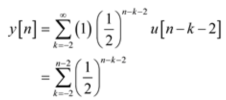 Can someone explain this mathematical step? How was the unit
step function u[n-k-2] incorporated in the sum? I'm having trouble
seeing how this unit step function can be visualized and why it
becomes the upper limit of the sum.
n-k-2
Can someone explain this mathematical step? How was the unit
step function u[n-k-2] incorporated in the sum? I'm having trouble
seeing how this unit step function can be visualized and why it
becomes the upper limit of the sum.
n-k-2
Can someone please tell me what this means and how to do it? This is a...
Can someone please tell me what this means and how to do it? This is a requirement for one of the classes I'm taking, it deals with the PYTHON programming language. The requirement is: "It must automatically copy the result to the operating system clipboard." The thing is that we aren't allowed to make the user download anything such as Pyperclip or Tkinter, so what am I supposed to do? Does it automatically get copied to the clipboard and this...
 Can someone explain to me how I can determine the functional
group and how to tell what the numbers for the different stretching
have to do with determining it?
$5) What functional groups are represented in the following IR spectrum 00T SD 4D00 3000 20DB 1000 a0 AVENUMEERI
Can someone explain to me how I can determine the functional
group and how to tell what the numbers for the different stretching
have to do with determining it?
$5) What functional groups are represented in the following IR spectrum 00T SD 4D00 3000 20DB 1000 a0 AVENUMEERI
 Using Python3,
How can I aggregate the output from each iteration to one single
list? Because from the program I have right now, it gives me the
result of every iteration and gives me something like this as
individual results and not one large list:
None
None
...
None
130.0
None
...
1764
1765
None
To clarify, I have this program where it calculates the sum of
bytes sent within each incrementation of every 1 second, but there
are instances...
Using Python3,
How can I aggregate the output from each iteration to one single
list? Because from the program I have right now, it gives me the
result of every iteration and gives me something like this as
individual results and not one large list:
None
None
...
None
130.0
None
...
1764
1765
None
To clarify, I have this program where it calculates the sum of
bytes sent within each incrementation of every 1 second, but there
are instances...
 can someone please tell me where did I do wrong and how I can
fix this
TU. . IVIL main.py Load default template... 1 # Read a list of strings from the user' 3 def square(x): return x*x nmin on input_string = input() 7 numbers= 11 8 for i in (str(input_string): numbers.append(i*2) 10 # Use list comprehension to cast them to ints 11 numbers = [int(i) for i in input_string.split()] 12 result = list (map(lambda x: x*x, numbers)) 13 for...
can someone please tell me where did I do wrong and how I can
fix this
TU. . IVIL main.py Load default template... 1 # Read a list of strings from the user' 3 def square(x): return x*x nmin on input_string = input() 7 numbers= 11 8 for i in (str(input_string): numbers.append(i*2) 10 # Use list comprehension to cast them to ints 11 numbers = [int(i) for i in input_string.split()] 12 result = list (map(lambda x: x*x, numbers)) 13 for...
 Practice: • function • loops • if condition • random Roll a dice many times, you will see that each face value will count of roughly 1/6 • write a function • roll a dice once, return value will be 1-6, • use your functin I call your function 6000 times • count how many times of face 1 • count how many times of face 2 • print out the numbers of total face 1, 2, ..., 6 you...
 Can someone explain this mathematical step? How was the unit
step function u[n-k-2] incorporated in the sum? I'm having trouble
seeing how this unit step function can be visualized and why it
becomes the upper limit of the sum.
n-k-2
Can someone explain this mathematical step? How was the unit
step function u[n-k-2] incorporated in the sum? I'm having trouble
seeing how this unit step function can be visualized and why it
becomes the upper limit of the sum.
n-k-2
Most questions answered within 3 hours.
-
Where is the error in this code sequence?
String s1 = "Hello";
String s2 = "ello";...
asked 10 months ago -
Financial data for Joel de Paris, Inc., for last year
follow:
Joel de Paris, Inc.
Balance...
asked 10 months ago -
Consider this reaction:
Al2(SO4)3 (aq)+ BaCl3
(aq) Al2Cl6 (aq)- +
3BaSO4(s) . What is the...
asked 10 months ago -
Suppose that Savneet is considering increasing her
recent random sample from 20 car rentals to 40...
asked 10 months ago -
Trucks arrive at an unloading terminal at an average rate of 120
per hour.
Trucks arrive...
asked 10 months ago -
Why are methanol and ethanol completely soluble in water while
octanol is not very little soluble....
asked 10 months ago -
A facilities manager at a university reads in a research report
that the mean amount of...
asked 10 months ago -
When the CuSO4 is rehydrated by adding water to the anhydrous
compound, is this an endothermic...
asked 10 months ago -
A ray of sunlight is passing from diamond into crown glass; the
angle of incidence is...
asked 10 months ago -
A block of mass 0.249 kg is placed on top of a light, vertical
spring of...
asked 10 months ago -
how do the kidneys compensate in the presences of acidosis
a) trigger hyperventilate
b) reserve acid...
asked 10 months ago -
Question 501 pts
The rental rate of capital to the firm increases. Which of the
following...
asked 10 months ago