A motorist traveling with a constant speed of 15 m/s passes a school -crossing corner, where...
A motorist traveling with a constant speed of 15 m/s passes a school -crossing corner, where the speed limit is 10 m/s. Just the motor ist passes, a police officer on a motorcycle stopped at
the corner start off in pursuit with constant acceleration of 3.0 m/s2
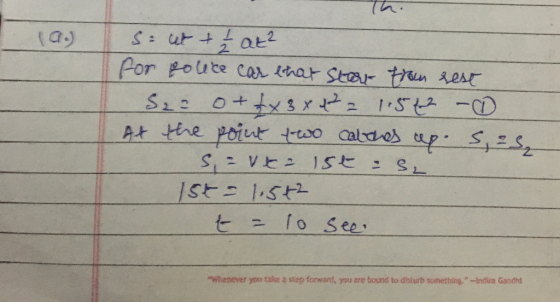
(a) How much time elapses before the officer catches up with the motorist?
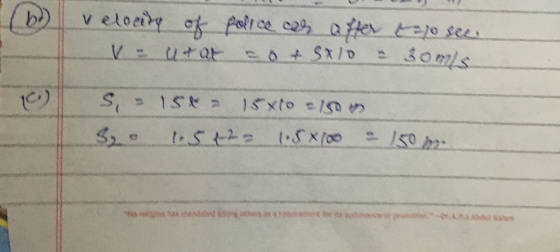
(b) What is the officer’s speed at that point?
(c) Wh at is the total distance each vehicle has traveled at that point?
Homework Answers
Add Answer to:
A motorist traveling with a constant speed of 15 m/s passes a
school -crossing corner, where...
A motorist traveling with a constant speed of 15m/s passes a school-crossing corner, where the speed limit is 10m/s
A motorist traveling with a constant speed of 15m/s passes a school-crossing corner, where the speed limit is 10m/s. Just as the motorist passes, a police officer on a motorcycle at the corner starts off in pursuit with constant acceleration of 3m/s^2. (a)How much time elapses before the police catches up the motorist? (b)What is the officer's speed limit at that point? (c)What is the total distance each vehicle has traveled at that point?
Suppose that instead of moving at a constant speed, the car in VP 2.9.1 begins to...
 Suppose that instead of moving at a constant speed, the car in
VP 2.9.1 begins to accelerate at 1 m/s2 at the
moment it passes the school crossing. How much time elapses before
the officer catches up to the car?
What is the position of the car when the officer catches up to
it?
PART D AND PART E. THANK YOU
VP 2.9.1 Part A A motorist is traveling at a constant velocity of v = 13.0 m/s and passes...
Suppose that instead of moving at a constant speed, the car in
VP 2.9.1 begins to accelerate at 1 m/s2 at the
moment it passes the school crossing. How much time elapses before
the officer catches up to the car?
What is the position of the car when the officer catches up to
it?
PART D AND PART E. THANK YOU
VP 2.9.1 Part A A motorist is traveling at a constant velocity of v = 13.0 m/s and passes...
5. A car traveling at 15 m/s passes a police car. At that instant, the police...
 5. A car traveling at 15 m/s passes a police car. At that instant, the police car accelerates at a constant rate of 3 m/s in pursuit. We wish to find how much time elapses before the officer catches the car. Choose a coordinate system for this problem and identify the initial states starting when the car passes the police. a. b sr ei eion
Please show work 3. A car traveling at a constant 39 m/s (-87 mph) passes a...
 Please show work
3. A car traveling at a constant 39 m/s (-87 mph) passes a police car that is initially traveling at 25 m/s (55 mph). At the instant of the pass, the police car accelerates at a constant rate of 3.3 m/s in pursuit. We wish to find how much time elapses before the officer catches the car. (a) Identify the initial states when the car passes the police. (b) Define the final state or conditions which enable...
Please show work
3. A car traveling at a constant 39 m/s (-87 mph) passes a police car that is initially traveling at 25 m/s (55 mph). At the instant of the pass, the police car accelerates at a constant rate of 3.3 m/s in pursuit. We wish to find how much time elapses before the officer catches the car. (a) Identify the initial states when the car passes the police. (b) Define the final state or conditions which enable...
Physics with Calc I A motorist drives along a straight road at a constant speed of...
Physics with Calc I A motorist drives along a straight road at a constant speed of 15.5 m/s. Just as she passes a parked motorcycle police officer, the officer starts to accelerate at 3.00 m/s2 to overtake her. Assume that the officer maintains this acceleration. (a) Determine the time it takes the police officer to reach the motorist. (b) Find the speed of the officer as he overtakes the motorist. (c) Find the total displacement of the officer as he...
Please show work 3. A car traveling at a constant 39 m/s (-87 mph) passes a...
 Please show work
3. A car traveling at a constant 39 m/s (-87 mph) passes a police car that is initially traveling at 25 m/s (55 mph). At the instant of the pass, the police car accelerates at a constant rate of 3.3 m/s in pursuit. We wish to find how much time elapses before the officer catches the car. (a) Identify the initial states when the car passes the police. (b) Define the final state or conditions which enable...
Please show work
3. A car traveling at a constant 39 m/s (-87 mph) passes a police car that is initially traveling at 25 m/s (55 mph). At the instant of the pass, the police car accelerates at a constant rate of 3.3 m/s in pursuit. We wish to find how much time elapses before the officer catches the car. (a) Identify the initial states when the car passes the police. (b) Define the final state or conditions which enable...
you are given 4 vectors with equal magnitudes. under what conditions will their sum be zero?...
you are given 4 vectors with equal magnitudes. under what conditions will their sum be zero? if a vector has an equal, positive x and y components, what are the angles it makes with the axes? A superhero jumped horizontally from a 31 m high rooftop to the ground immediately after he spotted a child walking towards a busy street all alone. Fortunately, he lands on the street just next to the child in 2.5s and the child is rescued!...
A speeder traveling at a constant 25 m/s passes a parked officer. The officer immediately begins...
A speeder traveling at a constant 25 m/s passes a parked officer. The officer immediately begins to accelerate at 3.0 m/s. How long until the officer overtakes the car? How far do they travel in that time? What is the speed of the officer when they catch the speeder?
A motorist with an expired license tag travels at a constant speed of 11.4 m/s down...
A motorist with an expired license tag travels at a constant speed of 11.4 m/s down a street, and a policeman on a motorcycle, taking another 4.19 s to finish his donut, gives chase at an acceleration of 2.65 m/s2. (b) Find the distance the trooper travels while overtaking the motorist.
A motorist with an expired license tag travels at a constant speed of 11.8 m/s down...
A motorist with an expired license tag travels at a constant speed of 11.8 m/s down a street, and a policeman on a motorcycle, taking another 4.26 s to finish his donut, gives chase at an acceleration of 2.81 m/s2. (a) Find the time required to catch the car. (b) Find the distance the trooper travels while overtaking the motorist.
 Suppose that instead of moving at a constant speed, the car in
VP 2.9.1 begins to accelerate at 1 m/s2 at the
moment it passes the school crossing. How much time elapses before
the officer catches up to the car?
What is the position of the car when the officer catches up to
it?
PART D AND PART E. THANK YOU
VP 2.9.1 Part A A motorist is traveling at a constant velocity of v = 13.0 m/s and passes...
Suppose that instead of moving at a constant speed, the car in
VP 2.9.1 begins to accelerate at 1 m/s2 at the
moment it passes the school crossing. How much time elapses before
the officer catches up to the car?
What is the position of the car when the officer catches up to
it?
PART D AND PART E. THANK YOU
VP 2.9.1 Part A A motorist is traveling at a constant velocity of v = 13.0 m/s and passes...
 5. A car traveling at 15 m/s passes a police car. At that instant, the police car accelerates at a constant rate of 3 m/s in pursuit. We wish to find how much time elapses before the officer catches the car. Choose a coordinate system for this problem and identify the initial states starting when the car passes the police. a. b sr ei eion
 Please show work
3. A car traveling at a constant 39 m/s (-87 mph) passes a police car that is initially traveling at 25 m/s (55 mph). At the instant of the pass, the police car accelerates at a constant rate of 3.3 m/s in pursuit. We wish to find how much time elapses before the officer catches the car. (a) Identify the initial states when the car passes the police. (b) Define the final state or conditions which enable...
Please show work
3. A car traveling at a constant 39 m/s (-87 mph) passes a police car that is initially traveling at 25 m/s (55 mph). At the instant of the pass, the police car accelerates at a constant rate of 3.3 m/s in pursuit. We wish to find how much time elapses before the officer catches the car. (a) Identify the initial states when the car passes the police. (b) Define the final state or conditions which enable...
 Please show work
3. A car traveling at a constant 39 m/s (-87 mph) passes a police car that is initially traveling at 25 m/s (55 mph). At the instant of the pass, the police car accelerates at a constant rate of 3.3 m/s in pursuit. We wish to find how much time elapses before the officer catches the car. (a) Identify the initial states when the car passes the police. (b) Define the final state or conditions which enable...
Please show work
3. A car traveling at a constant 39 m/s (-87 mph) passes a police car that is initially traveling at 25 m/s (55 mph). At the instant of the pass, the police car accelerates at a constant rate of 3.3 m/s in pursuit. We wish to find how much time elapses before the officer catches the car. (a) Identify the initial states when the car passes the police. (b) Define the final state or conditions which enable...
Most questions answered within 3 hours.
-
Where is the error in this code sequence?
String s1 = "Hello";
String s2 = "ello";...
asked 11 months ago -
Financial data for Joel de Paris, Inc., for last year
follow:
Joel de Paris, Inc.
Balance...
asked 11 months ago -
Consider this reaction:
Al2(SO4)3 (aq)+ BaCl3
(aq) Al2Cl6 (aq)- +
3BaSO4(s) . What is the...
asked 11 months ago -
Suppose that Savneet is considering increasing her
recent random sample from 20 car rentals to 40...
asked 11 months ago -
Trucks arrive at an unloading terminal at an average rate of 120
per hour.
Trucks arrive...
asked 11 months ago -
Why are methanol and ethanol completely soluble in water while
octanol is not very little soluble....
asked 11 months ago -
A facilities manager at a university reads in a research report
that the mean amount of...
asked 11 months ago -
When the CuSO4 is rehydrated by adding water to the anhydrous
compound, is this an endothermic...
asked 11 months ago -
A ray of sunlight is passing from diamond into crown glass; the
angle of incidence is...
asked 11 months ago -
A block of mass 0.249 kg is placed on top of a light, vertical
spring of...
asked 11 months ago -
how do the kidneys compensate in the presences of acidosis
a) trigger hyperventilate
b) reserve acid...
asked 11 months ago -
Question 501 pts
The rental rate of capital to the firm increases. Which of the
following...
asked 11 months ago