
Homework Answers
1.
Calculate P(X 1,
Y
1,
Y 1)
1)
X1
: X=0, X=1
Y1
: Y=1, Y=2

From the table
P(X=0,Y=1) = 20/66 ; P(X=0,Y=2) = 6/66 ; P(X=1,Y=1) = 12/66 ; P(X=1,Y=2) = 0


2.
Marginal probability mass function fX(x) of the random Variable X
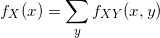
For X=0



| x | 0 | 1 | 2 |
| fX(x) | 36/66 | 27/66 | 3/66 |
or
| x | 0 | 1 | 2 |
| fX(x) | 12/22 | 9/22 | 1/22 |
Mean : E(X)

Mean = 1/2 =0.5
Add Answer to:
Part 1 Suppose that 2 batteries are randomly chosen without replacement from a group of 12...
2. Two chips are chosen randomly with replacement from an urn containing 2 red, 3 black...
 2. Two chips are chosen randomly with replacement from an urn containing 2 red, 3 black chips, and 5 gray chips. Let X denote the number of red chips chosen and let Y denote the number of black chips chosen. a. Find the joint probability mass function of X and Y , p(x,y) = P(X = 2, Y = y). b. Use the joint PMF to find the probability mass function, px(2), of X. c. Use the joint PMF to...
5 numbers chosen randomly without replacement. "B" represents number of even numbers, this random variable has...
5 numbers chosen randomly without replacement. "B" represents number of even numbers, this random variable has this probability: x 0 1 2 3 4 5 p(B=x) 0.02693 0.15989 .33858 .31977 .13464 .02020 number of odd #s chosen would then be 5-x, if x is even #s chosen. "C" represents difference b/w # of even and # of odd chosen, --> C= 2B-5 a. probability that exactly 1 even # chosen? b. probability at most 1 even # chosen? c. prob....
1. The joint probability density function (pdf) of X and Y is given by fxy(x, y)...
 1. The joint probability density function (pdf) of X and Y is given by fxy(x, y) = A (1 – xey, 0<x<1,0 < y < 0 (a) Find the constant A. (b) Find the marginal pdfs of X and Y. (c) Find E(X) and E(Y). (d) Find E(XY). 2. Let X denote the number of times (1, 2, or 3 times) a certain machine malfunctions on any given day. Let Y denote the number of times (1, 2, or 3...
Two balls are drawn in succession without replacement from a bag containing 2 red balls, 1...
Two balls are drawn in succession without replacement from a bag containing 2 red balls, 1 green balls and 3 green balls. Let X and Y denote the number of red and green balls respectively. Find a) f(x,y) the expression for the joint p.d.f of X and Y [5 Marks] b) f(x) the expression for the marginal pdf of X [5 Marks] c) f(y) the expression for the marginal pdf of Y [5 Marks] d) f(y/x), the expression for the...
1. In a box there are three numbered tickets. The numbers are 0, 1 and 2. You have to select (blindfolded) two tickets one after the other, without replacement. Define the random variable X as the...
 1. In a box there are three numbered tickets. The numbers are 0, 1 and 2. You have to select (blindfolded) two tickets one after the other, without replacement. Define the random variable X as the number on the first ticket and the random variable Y as the sum of the numbers on your selected two tickets. E.g. if you selected first the 2 and second time the 1 , then X = 2 and Y-1 +2 = 3. a./...
Problem 2 - Three Continuous Random Variables Suppose X,Y,Z have joint pdf given by fx,YZ(xgz) = k xyz if 0 S$ 1,0 rS 1,0 25 1 ) and fxyZ(x,y,z) = 0, otherwise. (a) Find k so that fxyz(x.yz) is a gen...
 Problem 2 - Three Continuous Random Variables Suppose X,Y,Z have joint pdf given by fx,YZ(xgz) = k xyz if 0 S$ 1,0 rS 1,0 25 1 ) and fxyZ(x,y,z) = 0, otherwise. (a) Find k so that fxyz(x.yz) is a genuine probability density function. (b) Are X,Y,Z independent? (c) Find PXs 1/2, Y s 1/3, Z s1/4). (d) Find the marginal pdf fxy(x.y). (e) Find the marginal pdf fx(x).
Problem 2 - Three Continuous Random Variables Suppose X,Y,Z have joint...
Problem 2 - Three Continuous Random Variables Suppose X,Y,Z have joint pdf given by fx,YZ(xgz) = k xyz if 0 S$ 1,0 rS 1,0 25 1 ) and fxyZ(x,y,z) = 0, otherwise. (a) Find k so that fxyz(x.yz) is a genuine probability density function. (b) Are X,Y,Z independent? (c) Find PXs 1/2, Y s 1/3, Z s1/4). (d) Find the marginal pdf fxy(x.y). (e) Find the marginal pdf fx(x).
Problem 2 - Three Continuous Random Variables Suppose X,Y,Z have joint...
Please answer the question clearly 10. If two cards are randomly drawn (without replacement) from an...
 Please answer the question clearly
10. If two cards are randomly drawn (without replacement) from an ordinary deck of 52 playing cards, let Z be the number of Kings obtained from the first draw and let W be the total number of Kings obtained from both draws. The table below provides values for f(z, w), the joint distribution (PMF) of Z and W. 188 221 16 221 16 221 221 (a) Find the marginal distribution (PMF) of Z (b) Find...
Please answer the question clearly
10. If two cards are randomly drawn (without replacement) from an ordinary deck of 52 playing cards, let Z be the number of Kings obtained from the first draw and let W be the total number of Kings obtained from both draws. The table below provides values for f(z, w), the joint distribution (PMF) of Z and W. 188 221 16 221 16 221 221 (a) Find the marginal distribution (PMF) of Z (b) Find...
1. We draw randomly without replacement 3 balls from an urn that contains 3 red and...
 1. We draw randomly without replacement 3 balls from an urn that contains 3 red and 5 white balls. Denote by X the number of red balls drawn. Find the probability distribution of X, its expected value, and its standard deviation.
4. Let X and Y be independent exponential random variables with pa- rameter ? 1. Given...
 4. Let X and Y be independent exponential random variables with pa- rameter ? 1. Given that X and Y are independent, their joint pdf is given by the product of the individual pdfs of X and Y, that is, fxy(x,y) = fx(x)fy(y) The joint pdf is defined over the same set of r-values and y-values that the individual pdfs were defined for. Using this information, calculate P(X - Y < t) where you can assume t is a positive...
Two individuals were asked to pick a number from 1 to 3 S = {1, 2,...
Two individuals were asked to pick a number from 1 to 3 S = {1, 2, 3] (with replacement). Let X be the sum of the two numbers chosen and let Y be the product of the two numbers chosen (5 marks) a) Construct the joint probability distribution table for (X, Y). b) Calculate ??(??=4|??=4). c) Are X and Y independent? Explain!
 2. Two chips are chosen randomly with replacement from an urn containing 2 red, 3 black chips, and 5 gray chips. Let X denote the number of red chips chosen and let Y denote the number of black chips chosen. a. Find the joint probability mass function of X and Y , p(x,y) = P(X = 2, Y = y). b. Use the joint PMF to find the probability mass function, px(2), of X. c. Use the joint PMF to...
 1. The joint probability density function (pdf) of X and Y is given by fxy(x, y) = A (1 – xey, 0<x<1,0 < y < 0 (a) Find the constant A. (b) Find the marginal pdfs of X and Y. (c) Find E(X) and E(Y). (d) Find E(XY). 2. Let X denote the number of times (1, 2, or 3 times) a certain machine malfunctions on any given day. Let Y denote the number of times (1, 2, or 3...
 1. In a box there are three numbered tickets. The numbers are 0, 1 and 2. You have to select (blindfolded) two tickets one after the other, without replacement. Define the random variable X as the number on the first ticket and the random variable Y as the sum of the numbers on your selected two tickets. E.g. if you selected first the 2 and second time the 1 , then X = 2 and Y-1 +2 = 3. a./...
 Problem 2 - Three Continuous Random Variables Suppose X,Y,Z have joint pdf given by fx,YZ(xgz) = k xyz if 0 S$ 1,0 rS 1,0 25 1 ) and fxyZ(x,y,z) = 0, otherwise. (a) Find k so that fxyz(x.yz) is a genuine probability density function. (b) Are X,Y,Z independent? (c) Find PXs 1/2, Y s 1/3, Z s1/4). (d) Find the marginal pdf fxy(x.y). (e) Find the marginal pdf fx(x).
Problem 2 - Three Continuous Random Variables Suppose X,Y,Z have joint...
Problem 2 - Three Continuous Random Variables Suppose X,Y,Z have joint pdf given by fx,YZ(xgz) = k xyz if 0 S$ 1,0 rS 1,0 25 1 ) and fxyZ(x,y,z) = 0, otherwise. (a) Find k so that fxyz(x.yz) is a genuine probability density function. (b) Are X,Y,Z independent? (c) Find PXs 1/2, Y s 1/3, Z s1/4). (d) Find the marginal pdf fxy(x.y). (e) Find the marginal pdf fx(x).
Problem 2 - Three Continuous Random Variables Suppose X,Y,Z have joint...
 Please answer the question clearly
10. If two cards are randomly drawn (without replacement) from an ordinary deck of 52 playing cards, let Z be the number of Kings obtained from the first draw and let W be the total number of Kings obtained from both draws. The table below provides values for f(z, w), the joint distribution (PMF) of Z and W. 188 221 16 221 16 221 221 (a) Find the marginal distribution (PMF) of Z (b) Find...
Please answer the question clearly
10. If two cards are randomly drawn (without replacement) from an ordinary deck of 52 playing cards, let Z be the number of Kings obtained from the first draw and let W be the total number of Kings obtained from both draws. The table below provides values for f(z, w), the joint distribution (PMF) of Z and W. 188 221 16 221 16 221 221 (a) Find the marginal distribution (PMF) of Z (b) Find...
 1. We draw randomly without replacement 3 balls from an urn that contains 3 red and 5 white balls. Denote by X the number of red balls drawn. Find the probability distribution of X, its expected value, and its standard deviation.
 4. Let X and Y be independent exponential random variables with pa- rameter ? 1. Given that X and Y are independent, their joint pdf is given by the product of the individual pdfs of X and Y, that is, fxy(x,y) = fx(x)fy(y) The joint pdf is defined over the same set of r-values and y-values that the individual pdfs were defined for. Using this information, calculate P(X - Y < t) where you can assume t is a positive...
Most questions answered within 3 hours.
-
Where is the error in this code sequence?
String s1 = "Hello";
String s2 = "ello";...
asked 10 months ago -
Financial data for Joel de Paris, Inc., for last year
follow:
Joel de Paris, Inc.
Balance...
asked 10 months ago -
Consider this reaction:
Al2(SO4)3 (aq)+ BaCl3
(aq) Al2Cl6 (aq)- +
3BaSO4(s) . What is the...
asked 10 months ago -
Suppose that Savneet is considering increasing her
recent random sample from 20 car rentals to 40...
asked 10 months ago -
Trucks arrive at an unloading terminal at an average rate of 120
per hour.
Trucks arrive...
asked 10 months ago -
Why are methanol and ethanol completely soluble in water while
octanol is not very little soluble....
asked 10 months ago -
A facilities manager at a university reads in a research report
that the mean amount of...
asked 10 months ago -
When the CuSO4 is rehydrated by adding water to the anhydrous
compound, is this an endothermic...
asked 10 months ago -
A ray of sunlight is passing from diamond into crown glass; the
angle of incidence is...
asked 10 months ago -
A block of mass 0.249 kg is placed on top of a light, vertical
spring of...
asked 10 months ago -
how do the kidneys compensate in the presences of acidosis
a) trigger hyperventilate
b) reserve acid...
asked 10 months ago -
Question 501 pts
The rental rate of capital to the firm increases. Which of the
following...
asked 10 months ago