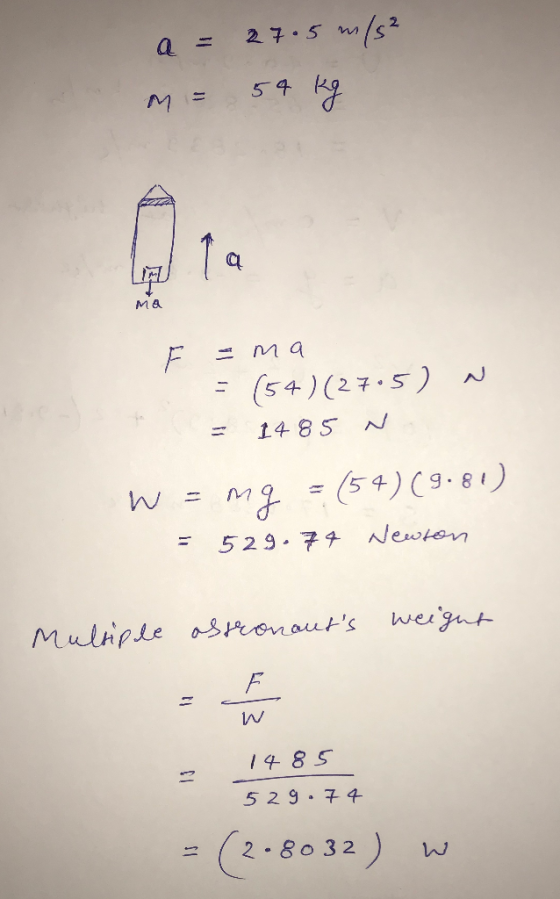
A spaceship takes off vertically from rest with an acceleration of 27.5 m/s2.27.5 m/s2. What magnitude...
A spaceship takes off vertically from rest with an acceleration of 27.5 m/s2.27.5 m/s2. What magnitude of force FF is exerted on a 54.0 kg54.0 kg astronaut during takeoff? Express FF as a multiple of the astronaut's weight ww on Earth.
Homework Answers
Add Answer to:
A spaceship takes off vertically from rest with an acceleration
of 27.5 m/s2.27.5 m/s2. What magnitude...
A rocket blasts off from rest and attains a speed of 38.1 m/s in 15.8 s....
A rocket blasts off from rest and attains a speed of 38.1 m/s in 15.8 s. An astronaut has a mass of 64.4 kg. What is the astronaut's apparent weight during takeoff?
The acceleration of the spacecraft in which the Apollo astronauts took off from the moon was...
The acceleration of the spacecraft in which the Apollo astronauts took off from the moon was 3.4 m/s2. On the moon, g = 1.6 m/s2. Part A What was the apparent weight of a 75 kg astronaut during takeoff? Express your answer with the appropriate units. Show work.
A spaceship starts from Earth and accelerates with a constant acceleration of 9.8 m/s2. This is...
A spaceship starts from Earth and accelerates with a constant acceleration of 9.8 m/s2. This is very convenient because crew and passengers on the spaceship will feel the same weight as on Earth when traveling in outer space. After how many days will an observer on Earth see the spaceship move with 15 percent of lightspeed? (Note that at this speed relativistic effects can be ignored.) A: 1.1 B: 16 C: 32 D: 53
Question 30 1 out of 1 points Assuming a constant acceleration of ax 4.3 m/s2 starting from rest, what is the airpl...
 Question 30 1 out of 1 points Assuming a constant acceleration of ax 4.3 m/s2 starting from rest, what is the airplane's takeoff velocity after 18.4 s? How far down the runway has the plane moved by the time it takes off?
Question 30 1 out of 1 points Assuming a constant acceleration of ax 4.3 m/s2 starting from rest, what is the airplane's takeoff velocity after 18.4 s? How far down the runway has the plane moved by the...
Question 30 1 out of 1 points Assuming a constant acceleration of ax 4.3 m/s2 starting from rest, what is the airplane's takeoff velocity after 18.4 s? How far down the runway has the plane moved by the time it takes off?
Question 30 1 out of 1 points Assuming a constant acceleration of ax 4.3 m/s2 starting from rest, what is the airplane's takeoff velocity after 18.4 s? How far down the runway has the plane moved by the...
Astronauts use a centrifuge to simulate the acceleration of a rocket launch. The centrifuge takes 30.0...
Astronauts use a centrifuge to simulate the acceleration of a rocket launch. The centrifuge takes 30.0 s to speed up from rest to its top speed of 1 rotation every 1.40 s . The astronaut is strapped into a seat 4.50 m from the axis. What is the astronaut's tangential acceleration during the first 30.0 s ? How many g's of acceleration does the astronaut experience when the device is rotating at top speed? Each 9.80 m/s2 of acceleration is...
A rocket rises vertically, from rest, with an acceleration of 4.0 m/s2 until it runs out...
A rocket rises vertically, from rest, with an acceleration of 4.0 m/s2 until it runs out of fuel at an altitude of 1500 m . After this point, its acceleration is that of gravity, downward. With what velocity does the rocket strike the Earth? How long (total) is it in the air?
Astronauts use a centrifuge to simulate the acceleration of a rocket launch. The centrifuge takes 40.0...
Astronauts use a centrifuge to simulate the acceleration of a rocket launch. The centrifuge takes 40.0 s to speed up from rest to its top speed of 1 rotation every 1.50 s . The astronaut is strapped into a seat 7.60 m from the axis. a.What is the astronaut's tangential acceleration during the first 40.0 s ? b. How many g's of acceleration does the astronaut experience when the device is rotating at top speed? Each 9.80 m/s2 of acceleration...
A rocket is fired vertically and ascends with a constant vertical acceleration of 25 m/s2 for...
A rocket is fired vertically and ascends with a constant vertical acceleration of 25 m/s2 for 1.5 min. Its fuel is then all used and it continues as a free-fall particle. A) What is the maximum altitude reached? B) What is the total time elapsed from takeoff until the rocket strikes the earth?
Astronauts use a centrifuge to simulate the acceleration of a rocket launch. The centrifuge takes 40.0...
 Astronauts use a centrifuge to simulate the acceleration of a
rocket launch. The centrifuge takes 40.0 s to speed up from rest to
its top speed of 1 rotation every 1.20 s . The astronaut is
strapped into a seat 4.90 m from the axis.
please show work. need help with both
questions.
Problem 4.59 Part A Astronauts use a centrifuge to simulate the acceleration of a rocket launch. The centrifuge takes 40.0 s to speed up from rest to...
Astronauts use a centrifuge to simulate the acceleration of a
rocket launch. The centrifuge takes 40.0 s to speed up from rest to
its top speed of 1 rotation every 1.20 s . The astronaut is
strapped into a seat 4.90 m from the axis.
please show work. need help with both
questions.
Problem 4.59 Part A Astronauts use a centrifuge to simulate the acceleration of a rocket launch. The centrifuge takes 40.0 s to speed up from rest to...
If the astronaut throws the 3.20 kg tool with an acceleration of 7.50 m/s2 , what...
If the astronaut throws the 3.20 kg tool with an acceleration of 7.50 m/s2 , what is the magnitude of the acceleration a of the astronaut during the throw? Assume that the total inertia of the astronaut is 88.0 kg .
 Question 30 1 out of 1 points Assuming a constant acceleration of ax 4.3 m/s2 starting from rest, what is the airplane's takeoff velocity after 18.4 s? How far down the runway has the plane moved by the time it takes off?
Question 30 1 out of 1 points Assuming a constant acceleration of ax 4.3 m/s2 starting from rest, what is the airplane's takeoff velocity after 18.4 s? How far down the runway has the plane moved by the...
Question 30 1 out of 1 points Assuming a constant acceleration of ax 4.3 m/s2 starting from rest, what is the airplane's takeoff velocity after 18.4 s? How far down the runway has the plane moved by the time it takes off?
Question 30 1 out of 1 points Assuming a constant acceleration of ax 4.3 m/s2 starting from rest, what is the airplane's takeoff velocity after 18.4 s? How far down the runway has the plane moved by the...
 Astronauts use a centrifuge to simulate the acceleration of a
rocket launch. The centrifuge takes 40.0 s to speed up from rest to
its top speed of 1 rotation every 1.20 s . The astronaut is
strapped into a seat 4.90 m from the axis.
please show work. need help with both
questions.
Problem 4.59 Part A Astronauts use a centrifuge to simulate the acceleration of a rocket launch. The centrifuge takes 40.0 s to speed up from rest to...
Astronauts use a centrifuge to simulate the acceleration of a
rocket launch. The centrifuge takes 40.0 s to speed up from rest to
its top speed of 1 rotation every 1.20 s . The astronaut is
strapped into a seat 4.90 m from the axis.
please show work. need help with both
questions.
Problem 4.59 Part A Astronauts use a centrifuge to simulate the acceleration of a rocket launch. The centrifuge takes 40.0 s to speed up from rest to...
Most questions answered within 3 hours.
-
Where is the error in this code sequence?
String s1 = "Hello";
String s2 = "ello";...
asked 10 months ago -
Financial data for Joel de Paris, Inc., for last year
follow:
Joel de Paris, Inc.
Balance...
asked 10 months ago -
Consider this reaction:
Al2(SO4)3 (aq)+ BaCl3
(aq) Al2Cl6 (aq)- +
3BaSO4(s) . What is the...
asked 10 months ago -
Suppose that Savneet is considering increasing her
recent random sample from 20 car rentals to 40...
asked 10 months ago -
Trucks arrive at an unloading terminal at an average rate of 120
per hour.
Trucks arrive...
asked 10 months ago -
Why are methanol and ethanol completely soluble in water while
octanol is not very little soluble....
asked 10 months ago -
A facilities manager at a university reads in a research report
that the mean amount of...
asked 10 months ago -
When the CuSO4 is rehydrated by adding water to the anhydrous
compound, is this an endothermic...
asked 10 months ago -
A ray of sunlight is passing from diamond into crown glass; the
angle of incidence is...
asked 10 months ago -
A block of mass 0.249 kg is placed on top of a light, vertical
spring of...
asked 10 months ago -
how do the kidneys compensate in the presences of acidosis
a) trigger hyperventilate
b) reserve acid...
asked 10 months ago -
Question 501 pts
The rental rate of capital to the firm increases. Which of the
following...
asked 10 months ago