Assume that the equilibrium wage is lower than the socially optimal wage. Given this assumption, explain...
Homework Answers
When equilibrium wage is lower than socially optimal wage the vacancy rate is lower because of market dynamics and subdued financial health which brings lower vacancies and hence lower demand and lower salaries.
When wages are lower the demand is also less and hence unemployment rises causing inverse relationships curve or also known as Beveridge Curve which is inverse relation between unemployment rate and vacancy rate.
Add Answer to:
Assume that the equilibrium wage is lower than the socially optimal
wage. Given this assumption, explain...
The market equilibrium quantity: 9 Multiple Choice maximizes total economic surplus. is sometimes the socially optimal...
 The market equilibrium quantity: 9 Multiple Choice maximizes total economic surplus. is sometimes the socially optimal quantity. is the socially optimal quantity
Assume the following for a rare and valuable resource, Lithium. 1. The socially optimal quantity for...
Assume the following for a rare and valuable resource, Lithium. 1. The socially optimal quantity for every period is 42 tons. 2. There exist, in total, 150 tons of lithium in reserve. 3. There are 2-periods we like to consider in the allocation of this resource. Please answer the following questions in a clear and concise fashion: 1. What is the socially efficient quantity for the 2 periods? 2. At the socially efficient quantity, did the 1st period incur any...
A monopolist produces less than the socially optimal amount, resulting in a “deadweight” loss for the...
A monopolist produces less than the socially optimal amount, resulting in a “deadweight” loss for the society. Provide an intuitive explanation for the deadweight loss (i.e., what does it represent). Is it possible to achieve the socially optimal outcome if a monopolist is able to implement perfect price discrimination? Do the consumers prefer perfect price discrimination by a monopolist or perfect competition?
1. A monopolist produces less than the socially optimal amount, resulting in a "deadweight" loss for...
 1. A monopolist produces less than the socially optimal amount, resulting in a "deadweight" loss for the society. Provide an intuitive explanation for the deadweight loss (i.e., what does it represent). Is it possible to achieve the socially optimal outcome if a monopolist is able to implement perfect price discrimination? Do the consumers prefer perfect price discrimination by a monopolist or perfect competition?
1. Because of ______, the market will provide ______ the socially optimal level of information. A....
1. Because of ______, the market will provide ______ the socially optimal level of information. A. The credibility problem; more B. The problem of adverse selection; less C. moral hazard; more D. The free-rider problem; less 2. If technological developments increase the marginal product of labor, then the: A. Supply of labor will increase. B. Demand for labor will decrease. C. The equilibrium wage rate will decrease. D. Demand for labor will increase.
A monopolist produces less than the socially optimal amount, resulting in a “deadweight” loss for the society. Provide a...
A monopolist produces less than the socially optimal amount, resulting in a “deadweight” loss for the society. Provide an intuitive explanation for the deadweight loss (i.e., what does it represent). Is it possible to achieve the socially optimal outcome if a monopolist is able to implement perfect price discrimination? Do the consumers prefer perfect price discrimination by a monopolist or perfect competition?
Consider the market for private economics tutors in Davis. Assume it is perfectly compet itive. The market's inver...
 Consider the market for private economics tutors in Davis. Assume it is perfectly compet itive. The market's inverse demand curve is p = 1600 - 5Q, with Q being the number of students receiving tutor per quarter and p being price per quarter. Economics tutors' private marginal cost curve is MCP = 100+ 5Q. Also assume that, because economics professors curve their classes, when one student improves her grade, it causes every other student to have a lower grade. This...
5. Explain the difference between socially optimal and fair return pricing regulations. Use a graph.
5. Explain the difference between socially optimal and fair return pricing regulations. Use a graph.
58. The socially optimal level of pollution occurs when marginal damage is less than marginal abatement...
58. The socially optimal level of pollution occurs when marginal damage is less than marginal abatement costs. A) True B) False
the socially 3. A negative externality will result in an equilibrium quantity of an activity that is optimal quan...
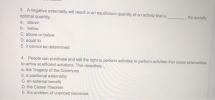 the socially 3. A negative externality will result in an equilibrium quantity of an activity that is optimal quantity a. above b. below C. above or below D. equal to E. it cannot be determined 4. People can purchase and sell the right to perform activities to perform activities that cause externalities to arrive at efficient solutions. This describes.... a. the Tragedy of the Commons b. a positional externality C. an external benefit D. the Coase Theorem E. the problem...
 The market equilibrium quantity: 9 Multiple Choice maximizes total economic surplus. is sometimes the socially optimal quantity. is the socially optimal quantity
 1. A monopolist produces less than the socially optimal amount, resulting in a "deadweight" loss for the society. Provide an intuitive explanation for the deadweight loss (i.e., what does it represent). Is it possible to achieve the socially optimal outcome if a monopolist is able to implement perfect price discrimination? Do the consumers prefer perfect price discrimination by a monopolist or perfect competition?
 Consider the market for private economics tutors in Davis. Assume it is perfectly compet itive. The market's inverse demand curve is p = 1600 - 5Q, with Q being the number of students receiving tutor per quarter and p being price per quarter. Economics tutors' private marginal cost curve is MCP = 100+ 5Q. Also assume that, because economics professors curve their classes, when one student improves her grade, it causes every other student to have a lower grade. This...
 the socially 3. A negative externality will result in an equilibrium quantity of an activity that is optimal quantity a. above b. below C. above or below D. equal to E. it cannot be determined 4. People can purchase and sell the right to perform activities to perform activities that cause externalities to arrive at efficient solutions. This describes.... a. the Tragedy of the Commons b. a positional externality C. an external benefit D. the Coase Theorem E. the problem...
Most questions answered within 3 hours.
-
Where is the error in this code sequence?
String s1 = "Hello";
String s2 = "ello";...
asked 10 months ago -
Financial data for Joel de Paris, Inc., for last year
follow:
Joel de Paris, Inc.
Balance...
asked 10 months ago -
Consider this reaction:
Al2(SO4)3 (aq)+ BaCl3
(aq) Al2Cl6 (aq)- +
3BaSO4(s) . What is the...
asked 10 months ago -
Suppose that Savneet is considering increasing her
recent random sample from 20 car rentals to 40...
asked 10 months ago -
Trucks arrive at an unloading terminal at an average rate of 120
per hour.
Trucks arrive...
asked 10 months ago -
Why are methanol and ethanol completely soluble in water while
octanol is not very little soluble....
asked 10 months ago -
A facilities manager at a university reads in a research report
that the mean amount of...
asked 10 months ago -
When the CuSO4 is rehydrated by adding water to the anhydrous
compound, is this an endothermic...
asked 10 months ago -
A ray of sunlight is passing from diamond into crown glass; the
angle of incidence is...
asked 10 months ago -
A block of mass 0.249 kg is placed on top of a light, vertical
spring of...
asked 10 months ago -
how do the kidneys compensate in the presences of acidosis
a) trigger hyperventilate
b) reserve acid...
asked 10 months ago -
Question 501 pts
The rental rate of capital to the firm increases. Which of the
following...
asked 10 months ago