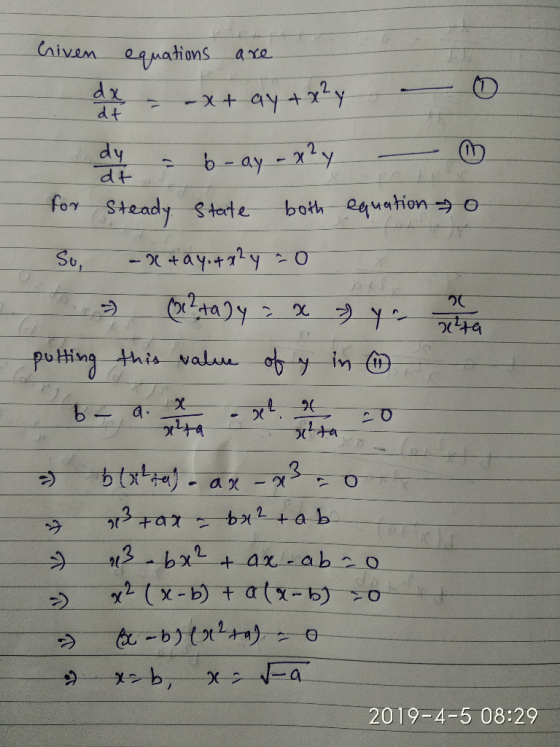
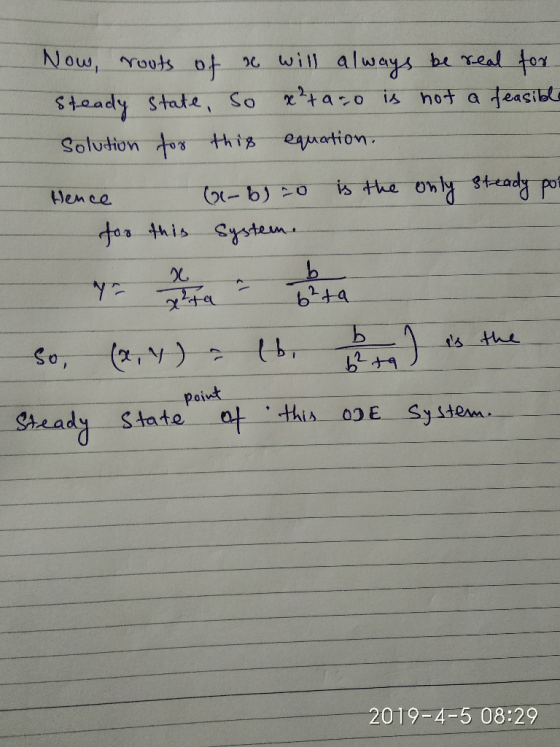
Determine the steady state of the following ODE system, where a and b are assumed constants allowed in the solution:
Please show all steps clearly.
Homework Answers
Add Answer to:
Determine the steady state of the following ODE system, where a
and b are assumed constants...
Please help solve this, using the equation to get through the problem. Additional information: where the...
 Please help solve this, using the equation
to get through the problem.
Additional information:
where the initial position
, the initial speed
The above differential equation can also be written as:
If
, there is light damping where the solution has the form ( where r
and w are two positive constants)
or
If
there is heavy damping where,
where
and
are two positive constants
If
there is critical damping where,
where r is a positive constant
d'y dy ma...
Please help solve this, using the equation
to get through the problem.
Additional information:
where the initial position
, the initial speed
The above differential equation can also be written as:
If
, there is light damping where the solution has the form ( where r
and w are two positive constants)
or
If
there is heavy damping where,
where
and
are two positive constants
If
there is critical damping where,
where r is a positive constant
d'y dy ma...
a) By direct substitution determine which of the following functions satisfy the wave equation. 1. g(x,...
a) By direct substitution determine which of the following functions satisfy the wave equation. 1. g(x, t) = Acos(kx − t) where A, k, are positive constants. 2. h(x, t) = Ae where A, k, are positive constants. 3. p(x, t) = Asinh(kx − t) where A, k, are positive constants. 4. q(x, t) = Ae where A, a, are positive constants. 5. An arbitrary function: f(x, t) = f(kx−t) where k and are positive constants. (Hint: Be careful with...
With a per-worker production function y = k1/2, the steady-state capital stock per worker (k*) as...
 With a per-worker production function y = k1/2, the steady-state
capital stock per worker (k*) as a function of the saving rate (s)
is given by:
A) k* = (s/
)2.
B) k* = (/s)2.
C) k* = s/.
D) k* =
/s.
Answer is A, I need to understand the process. Thanks
We were unable to transcribe this imageWe were unable to transcribe this imageWe were unable to transcribe this imageWe were unable to transcribe this image
With a per-worker production function y = k1/2, the steady-state
capital stock per worker (k*) as a function of the saving rate (s)
is given by:
A) k* = (s/
)2.
B) k* = (/s)2.
C) k* = s/.
D) k* =
/s.
Answer is A, I need to understand the process. Thanks
We were unable to transcribe this imageWe were unable to transcribe this imageWe were unable to transcribe this imageWe were unable to transcribe this image
Consider the following non-homogeneous system of differential equations. a. Write the system in matrix form. b....
 Consider the following non-homogeneous system of differential
equations.
a. Write the system in matrix form.
b. Find the homogeneous solution.
c. Find the particular solution.
d. Write down the general solution.
We were unable to transcribe this imageWe were unable to transcribe this image
Consider the following non-homogeneous system of differential
equations.
a. Write the system in matrix form.
b. Find the homogeneous solution.
c. Find the particular solution.
d. Write down the general solution.
We were unable to transcribe this imageWe were unable to transcribe this image
Find a polynomial p(x) of degree 2 that satisfies , , and where a, b, c...
Find a polynomial p(x) of degree 2 that satisfies , , and where a, b, c are given constants and are two different points. Thank you! We were unable to transcribe this imagep(m) = a We were unable to transcribe this imageWe were unable to transcribe this imageWe were unable to transcribe this image
consider the variation of constants formula where P(t)= a) show that solves the initial value problem x'+p(t)=(t) x()= when p and q are continuous functions of t on an interval I and tg p(s)d...
consider the variation of constants formula where P(t)= a) show that solves the initial value problem x'+p(t)=(t) x()= when p and q are continuous functions of t on an interval I and tg p(s)ds We were unable to transcribe this imageWe were unable to transcribe this imageWe were unable to transcribe this imageWe were unable to transcribe this imageWe were unable to transcribe this image tg p(s)ds
Write the following system of equations in the form AX = B, and calculate the solution...
 Write the following system of equations in the form AX = B, and
calculate the solution using the equation
x + y = -6
3x - y = -2
We were unable to transcribe this imageWe were unable to transcribe this image
Write the following system of equations in the form AX = B, and
calculate the solution using the equation
x + y = -6
3x - y = -2
We were unable to transcribe this imageWe were unable to transcribe this image
Explain the two terms in equation that comprise the flux, Js. Solve the ODE and show how the gen...
 Explain the two terms in equation that comprise the flux,
Js. Solve the ODE and show how the general solution is
given by
where
ac ax Cm 4(1 - W) + a2 exp( Pe We were unable to transcribe this image
ac ax
Cm 4(1 - W) + a2 exp( Pe
Explain the two terms in equation that comprise the flux,
Js. Solve the ODE and show how the general solution is
given by
where
ac ax Cm 4(1 - W) + a2 exp( Pe We were unable to transcribe this image
ac ax
Cm 4(1 - W) + a2 exp( Pe
Please answer all the parts to this question. Please show all steps. Please write a legible solut...
Please answer all the parts to this question. Please show all steps. Please write a legible solution. 3) Let be an matrix, and let be an invertible matrix. Does multiplying on the left by change the kernel of the associated linear transformation? Does it change the image? In other words, a) Is ? Explain. b) Is ? Explain. We were unable to transcribe this imageWe were unable to transcribe this imageWe were unable to transcribe this imagem X m We...
Let X be a banach space such that X= C([a,b]) where - ab+ with the sup...
 Let X be a banach space such that X= C([a,b]) where - ab+ with the sup
norm. Let x and f X. Show
that the non linear integral equation
u(x) = (sin
u(y) dy + f(x) ) has a solution u X. (the integral is
from a to b).
We were unable to transcribe this imageWe were unable to transcribe this imageWe were unable to transcribe this imageWe were unable to transcribe this imageWe were unable to transcribe this imageWe...
Let X be a banach space such that X= C([a,b]) where - ab+ with the sup
norm. Let x and f X. Show
that the non linear integral equation
u(x) = (sin
u(y) dy + f(x) ) has a solution u X. (the integral is
from a to b).
We were unable to transcribe this imageWe were unable to transcribe this imageWe were unable to transcribe this imageWe were unable to transcribe this imageWe were unable to transcribe this imageWe...
 Please help solve this, using the equation
to get through the problem.
Additional information:
where the initial position
, the initial speed
The above differential equation can also be written as:
If
, there is light damping where the solution has the form ( where r
and w are two positive constants)
or
If
there is heavy damping where,
where
and
are two positive constants
If
there is critical damping where,
where r is a positive constant
d'y dy ma...
Please help solve this, using the equation
to get through the problem.
Additional information:
where the initial position
, the initial speed
The above differential equation can also be written as:
If
, there is light damping where the solution has the form ( where r
and w are two positive constants)
or
If
there is heavy damping where,
where
and
are two positive constants
If
there is critical damping where,
where r is a positive constant
d'y dy ma...
 With a per-worker production function y = k1/2, the steady-state
capital stock per worker (k*) as a function of the saving rate (s)
is given by:
A) k* = (s/
)2.
B) k* = (/s)2.
C) k* = s/.
D) k* =
/s.
Answer is A, I need to understand the process. Thanks
We were unable to transcribe this imageWe were unable to transcribe this imageWe were unable to transcribe this imageWe were unable to transcribe this image
With a per-worker production function y = k1/2, the steady-state
capital stock per worker (k*) as a function of the saving rate (s)
is given by:
A) k* = (s/
)2.
B) k* = (/s)2.
C) k* = s/.
D) k* =
/s.
Answer is A, I need to understand the process. Thanks
We were unable to transcribe this imageWe were unable to transcribe this imageWe were unable to transcribe this imageWe were unable to transcribe this image
 Consider the following non-homogeneous system of differential
equations.
a. Write the system in matrix form.
b. Find the homogeneous solution.
c. Find the particular solution.
d. Write down the general solution.
We were unable to transcribe this imageWe were unable to transcribe this image
Consider the following non-homogeneous system of differential
equations.
a. Write the system in matrix form.
b. Find the homogeneous solution.
c. Find the particular solution.
d. Write down the general solution.
We were unable to transcribe this imageWe were unable to transcribe this image
 Write the following system of equations in the form AX = B, and
calculate the solution using the equation
x + y = -6
3x - y = -2
We were unable to transcribe this imageWe were unable to transcribe this image
Write the following system of equations in the form AX = B, and
calculate the solution using the equation
x + y = -6
3x - y = -2
We were unable to transcribe this imageWe were unable to transcribe this image
 Explain the two terms in equation that comprise the flux,
Js. Solve the ODE and show how the general solution is
given by
where
ac ax Cm 4(1 - W) + a2 exp( Pe We were unable to transcribe this image
ac ax
Cm 4(1 - W) + a2 exp( Pe
Explain the two terms in equation that comprise the flux,
Js. Solve the ODE and show how the general solution is
given by
where
ac ax Cm 4(1 - W) + a2 exp( Pe We were unable to transcribe this image
ac ax
Cm 4(1 - W) + a2 exp( Pe
 Let X be a banach space such that X= C([a,b]) where - ab+ with the sup
norm. Let x and f X. Show
that the non linear integral equation
u(x) = (sin
u(y) dy + f(x) ) has a solution u X. (the integral is
from a to b).
We were unable to transcribe this imageWe were unable to transcribe this imageWe were unable to transcribe this imageWe were unable to transcribe this imageWe were unable to transcribe this imageWe...
Let X be a banach space such that X= C([a,b]) where - ab+ with the sup
norm. Let x and f X. Show
that the non linear integral equation
u(x) = (sin
u(y) dy + f(x) ) has a solution u X. (the integral is
from a to b).
We were unable to transcribe this imageWe were unable to transcribe this imageWe were unable to transcribe this imageWe were unable to transcribe this imageWe were unable to transcribe this imageWe...
Most questions answered within 3 hours.
-
Where is the error in this code sequence?
String s1 = "Hello";
String s2 = "ello";...
asked 11 months ago -
Financial data for Joel de Paris, Inc., for last year
follow:
Joel de Paris, Inc.
Balance...
asked 11 months ago -
Consider this reaction:
Al2(SO4)3 (aq)+ BaCl3
(aq) Al2Cl6 (aq)- +
3BaSO4(s) . What is the...
asked 11 months ago -
Suppose that Savneet is considering increasing her
recent random sample from 20 car rentals to 40...
asked 11 months ago -
Trucks arrive at an unloading terminal at an average rate of 120
per hour.
Trucks arrive...
asked 11 months ago -
Why are methanol and ethanol completely soluble in water while
octanol is not very little soluble....
asked 11 months ago -
A facilities manager at a university reads in a research report
that the mean amount of...
asked 11 months ago -
When the CuSO4 is rehydrated by adding water to the anhydrous
compound, is this an endothermic...
asked 11 months ago -
A ray of sunlight is passing from diamond into crown glass; the
angle of incidence is...
asked 11 months ago -
A block of mass 0.249 kg is placed on top of a light, vertical
spring of...
asked 11 months ago -
how do the kidneys compensate in the presences of acidosis
a) trigger hyperventilate
b) reserve acid...
asked 11 months ago -
Question 501 pts
The rental rate of capital to the firm increases. Which of the
following...
asked 11 months ago