
Homework Answers
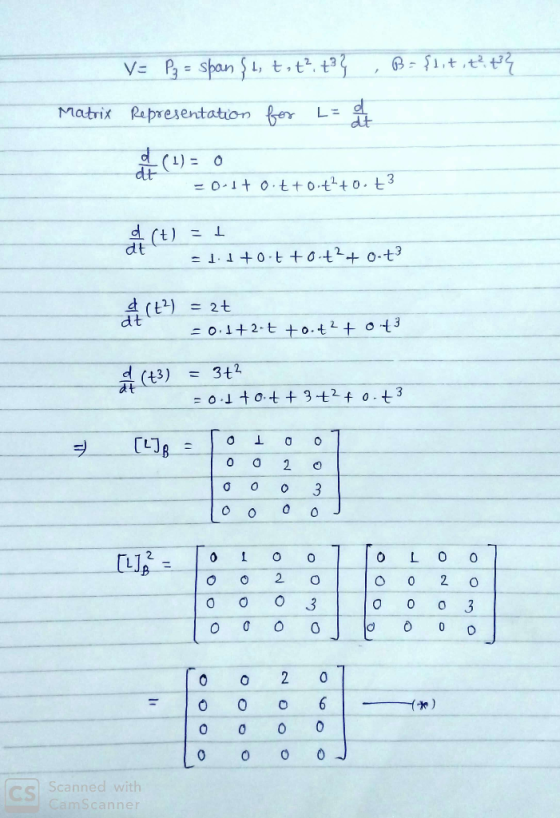
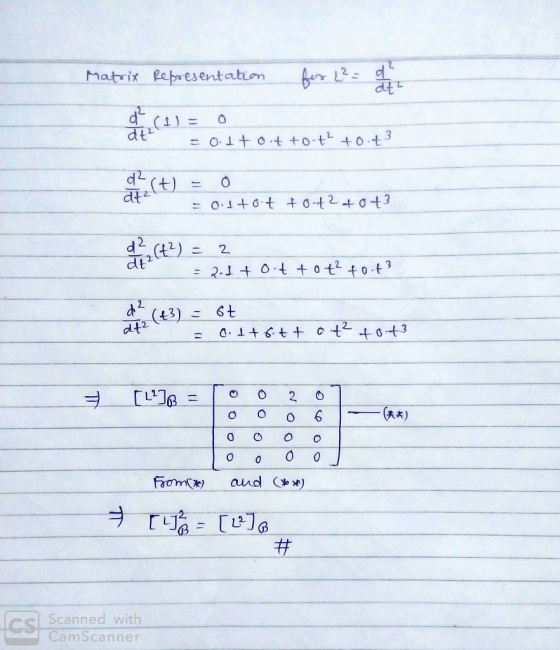
Matrix representation of a linear transformation...
Add Answer to:
3.2.1: Let V be a vector space with Basis B and let L be an operator...
7. Let V be the space generated by the basis B = {sin(t), cos(t), et}. i.e....
 7. Let V be the space generated by the basis B = {sin(t), cos(t), et}. i.e. V = span(B). Consider the linear transformation T:V + V defined by T(f(t)) = f"(t) – 2f'(t) – f(t). Find the standard matrix of the transformation. (Hint: Associate sin(t) with the vector (0), and so forth.) 8. Show that B = {t2 – 2, 3t2 +t, t+t+8} is a basis for P2, and find the change of coordinates matrix P which goes from B...
1. let V be a vector space and T an operator on V (i.e., a linear map T: V--> V). Suppose that T^2 - 5T +6I = 0, wher...
 1. let V be a vector space and T an operator on V (i.e., a
linear map T: V--> V). Suppose that T^2 - 5T +6I = 0, where I is
the identity operator and 0 stands for the zero operator
...
Read Section 3.E and 3.F V) 1. Let V be a vector space and T an operator on V (i.e., a linear map T: V -» Suppose that T2 - 5T + 61 = 0, where I is...
1. let V be a vector space and T an operator on V (i.e., a
linear map T: V--> V). Suppose that T^2 - 5T +6I = 0, where I is
the identity operator and 0 stands for the zero operator
...
Read Section 3.E and 3.F V) 1. Let V be a vector space and T an operator on V (i.e., a linear map T: V -» Suppose that T2 - 5T + 61 = 0, where I is...
Let V be a finite-dimensional vector space and let T L(V) be an operator. In this problem you sh...
Let V be a finite-dimensional vector space and let T L(V) be an operator. In this problem you show that there is a nonzero polynomial such that p(T) = 0. (a) What is 0 in this context? A polynomial? A linear map? An element of V? (b) Define by . Prove that is a linear map. (c) Prove that if where V is infinite-dimensional and W is finite-dimensional, then S cannot be injective. (d) Use the preceding parts to prove...
Prove the following: (a) Let V be a vector space of dimension 3 and let {v,U2,U3} be a basis for V. Show that u2, u2 -2+s and uvi also form a basis for V (b) Show that1-,1-2,1-- 2 is a basis for P2[r...
 Prove the following: (a) Let V be a vector space of dimension 3 and let {v,U2,U3} be a basis for V. Show that u2, u2 -2+s and uvi also form a basis for V (b) Show that1-,1-2,1-- 2 is a basis for P2[r], the set of all degree 2 or less polynomial functions. (c) Show that if A is invertible, then det A (Note: Show it for any det A-1 square matrix, showing it for a 2 x 2 matrix...
Problem 4 Let V be the vector space of functions of the form f(x) = e-xp(x), where p(x) is a polynomial of degree (a) Find the matrix of the derivative operator D = d/dx : V → V in the basis ek = e-x...
 Problem 4 Let V be the vector space of functions of the form f(x) = e-xp(x), where p(x) is a polynomial of degree (a) Find the matrix of the derivative operator D = d/dx : V → V in the basis ek = e-xXk/k!, k = 0, 1, . .. , n, of V. (b) Find the characteristic polynomial of D. (c) Find the minimal polynomial of D n.
Problem 4 Let V be the vector space of functions of...
Problem 4 Let V be the vector space of functions of the form f(x) = e-xp(x), where p(x) is a polynomial of degree (a) Find the matrix of the derivative operator D = d/dx : V → V in the basis ek = e-xXk/k!, k = 0, 1, . .. , n, of V. (b) Find the characteristic polynomial of D. (c) Find the minimal polynomial of D n.
Problem 4 Let V be the vector space of functions of...
Let V be a real vector space. Recall the following definition Definition 1. An operator L...
 Let V be a real vector space. Recall the following definition Definition 1. An operator L : V → V is linear if L(ax + by) = aLx + bLy, Va, b E R, and Vx, y E V. If (1) does not hold, L is called nonlinear. Let VC(-o0, 0o). Check directly using the Definition 1 above if L defined below are linear or nonlinear b) L-돐 +1n 1.1 (Note, this means Ly-y't in ly|.) c) L = a,...
1 point) Read 'Diagonalization Changing to a Basis of Eigenvectors' before attempting this problem. Suppose that V is a 5-dimensional vector space. Let S -(vi,... , vs) be some ordered basis...
 1 point) Read 'Diagonalization Changing to a Basis of Eigenvectors' before attempting this problem. Suppose that V is a 5-dimensional vector space. Let S -(vi,... , vs) be some ordered basis of V, and let T-(wi.... . ws) be some other ordered basis of V. Let L: V → V be a linear transformation. Let M be the matrix of L in the basis Sand et N be the matrix of L in the basis T. Decide whether each of...
Let B = {b1,b2, b3} be a basis for a vector space V. Let T be...
 Let B = {b1,b2, b3} be a basis for a vector space V. Let T be a linear transformation from V to V whose matrix relative to B is [ 1 -1 0 1 [T]B = 2 -2 -1 . 10 -1 -3 1 Find T(-3b1 – b2 - b3) in terms of bı, b2, b3 .
5. Consider a vector space V = {00 + 0 + ar? + 13. 1 40,,...
 5. Consider a vector space V = {00 + 0 + ar? + 13. 1 40,, 02, 03 € R} and a linear map D:V+V. P(1) - P(1) (a) Write down the matrix representation L of the linear map D under the basis B, = (b) Consider the new basis B2 = 31.5 +5.368.479 10 Find the matrix transformation T such that B, BT. (c) Let L, be the matrix representation of D under the new basis B. Prove L2...
Let V be a finite-dimensional vector space, and let B be a basis of V. Show...
Let V be a finite-dimensional vector space, and let B be a basis of V. Show that there is an inner product on V for which B is orthonormal.
 7. Let V be the space generated by the basis B = {sin(t), cos(t), et}. i.e. V = span(B). Consider the linear transformation T:V + V defined by T(f(t)) = f"(t) – 2f'(t) – f(t). Find the standard matrix of the transformation. (Hint: Associate sin(t) with the vector (0), and so forth.) 8. Show that B = {t2 – 2, 3t2 +t, t+t+8} is a basis for P2, and find the change of coordinates matrix P which goes from B...
 1. let V be a vector space and T an operator on V (i.e., a
linear map T: V--> V). Suppose that T^2 - 5T +6I = 0, where I is
the identity operator and 0 stands for the zero operator
...
Read Section 3.E and 3.F V) 1. Let V be a vector space and T an operator on V (i.e., a linear map T: V -» Suppose that T2 - 5T + 61 = 0, where I is...
1. let V be a vector space and T an operator on V (i.e., a
linear map T: V--> V). Suppose that T^2 - 5T +6I = 0, where I is
the identity operator and 0 stands for the zero operator
...
Read Section 3.E and 3.F V) 1. Let V be a vector space and T an operator on V (i.e., a linear map T: V -» Suppose that T2 - 5T + 61 = 0, where I is...
 Prove the following: (a) Let V be a vector space of dimension 3 and let {v,U2,U3} be a basis for V. Show that u2, u2 -2+s and uvi also form a basis for V (b) Show that1-,1-2,1-- 2 is a basis for P2[r], the set of all degree 2 or less polynomial functions. (c) Show that if A is invertible, then det A (Note: Show it for any det A-1 square matrix, showing it for a 2 x 2 matrix...
 Problem 4 Let V be the vector space of functions of the form f(x) = e-xp(x), where p(x) is a polynomial of degree (a) Find the matrix of the derivative operator D = d/dx : V → V in the basis ek = e-xXk/k!, k = 0, 1, . .. , n, of V. (b) Find the characteristic polynomial of D. (c) Find the minimal polynomial of D n.
Problem 4 Let V be the vector space of functions of...
Problem 4 Let V be the vector space of functions of the form f(x) = e-xp(x), where p(x) is a polynomial of degree (a) Find the matrix of the derivative operator D = d/dx : V → V in the basis ek = e-xXk/k!, k = 0, 1, . .. , n, of V. (b) Find the characteristic polynomial of D. (c) Find the minimal polynomial of D n.
Problem 4 Let V be the vector space of functions of...
 Let V be a real vector space. Recall the following definition Definition 1. An operator L : V → V is linear if L(ax + by) = aLx + bLy, Va, b E R, and Vx, y E V. If (1) does not hold, L is called nonlinear. Let VC(-o0, 0o). Check directly using the Definition 1 above if L defined below are linear or nonlinear b) L-돐 +1n 1.1 (Note, this means Ly-y't in ly|.) c) L = a,...
 1 point) Read 'Diagonalization Changing to a Basis of Eigenvectors' before attempting this problem. Suppose that V is a 5-dimensional vector space. Let S -(vi,... , vs) be some ordered basis of V, and let T-(wi.... . ws) be some other ordered basis of V. Let L: V → V be a linear transformation. Let M be the matrix of L in the basis Sand et N be the matrix of L in the basis T. Decide whether each of...
 Let B = {b1,b2, b3} be a basis for a vector space V. Let T be a linear transformation from V to V whose matrix relative to B is [ 1 -1 0 1 [T]B = 2 -2 -1 . 10 -1 -3 1 Find T(-3b1 – b2 - b3) in terms of bı, b2, b3 .
 5. Consider a vector space V = {00 + 0 + ar? + 13. 1 40,, 02, 03 € R} and a linear map D:V+V. P(1) - P(1) (a) Write down the matrix representation L of the linear map D under the basis B, = (b) Consider the new basis B2 = 31.5 +5.368.479 10 Find the matrix transformation T such that B, BT. (c) Let L, be the matrix representation of D under the new basis B. Prove L2...
Most questions answered within 3 hours.
-
Where is the error in this code sequence?
String s1 = "Hello";
String s2 = "ello";...
asked 10 months ago -
Financial data for Joel de Paris, Inc., for last year
follow:
Joel de Paris, Inc.
Balance...
asked 10 months ago -
Consider this reaction:
Al2(SO4)3 (aq)+ BaCl3
(aq) Al2Cl6 (aq)- +
3BaSO4(s) . What is the...
asked 10 months ago -
Suppose that Savneet is considering increasing her
recent random sample from 20 car rentals to 40...
asked 10 months ago -
Trucks arrive at an unloading terminal at an average rate of 120
per hour.
Trucks arrive...
asked 10 months ago -
Why are methanol and ethanol completely soluble in water while
octanol is not very little soluble....
asked 10 months ago -
A facilities manager at a university reads in a research report
that the mean amount of...
asked 10 months ago -
When the CuSO4 is rehydrated by adding water to the anhydrous
compound, is this an endothermic...
asked 10 months ago -
A ray of sunlight is passing from diamond into crown glass; the
angle of incidence is...
asked 10 months ago -
A block of mass 0.249 kg is placed on top of a light, vertical
spring of...
asked 10 months ago -
how do the kidneys compensate in the presences of acidosis
a) trigger hyperventilate
b) reserve acid...
asked 10 months ago -
Question 501 pts
The rental rate of capital to the firm increases. Which of the
following...
asked 10 months ago