
Homework Answers
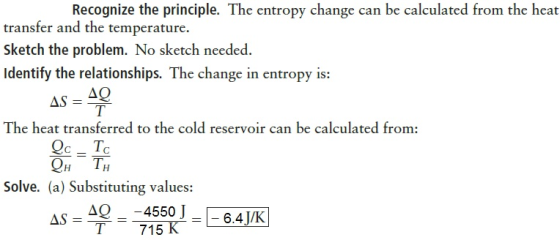
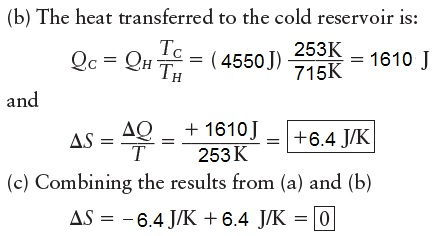
I hope you understood the problem and got your answers, If yes rate me!! or else comment for a better solutions
Add Answer to:
d Help? Read it 0-13 points 16.P.046 Consider a reversible heat engine that employs a hot...
Consider a reversible heat engine that employs a hot reservoir at a temperature of 660 K...
Consider a reversible heat engine that employs a hot reservoir at a temperature of 660 K and a cold reservoir at 230 K. (a) What is the entropy change of the hot reservoir during a period in which 4300 J is extracted from the hot reservoir? (b) What is the change in the entropy of the cold reservoir? (c) Find the change in the entropy of the engine itself during this time.
25. -15.17 points GioCP2 16.P.026. A reversible heat engine operates between thermal reservoirs at 864 K...
 25. -15.17 points GioCP2 16.P.026. A reversible heat engine operates between thermal reservoirs at 864 K and 188 K. If 8280 נ are extracted from the hot reservoir. how much works done by the heat eng e?
An engine absorbs 1.71 kJ from a hot reservoir at 277°C and expels 1.21 kJ to...
 An engine absorbs 1.71 kJ from a hot reservoir at 277°C and expels 1.21 kJ to a cold reservoir at 27°C in each cycle. (a) What is the engine's efficiency? (b) How much work is done by the engine in each cycle? (c) What is the power output of the engine if each cycle lasts 0.297 s? kW Need Help? Read it A Styrofoam cup holding 104 g of hot water at 1.00 x 10²°C cools to room temperature, 26.0°C....
The input heat of a Carnot engine is 3,000 J. The temperature of a hot reservoir...
The input heat of a Carnot engine is 3,000 J. The temperature of a hot reservoir is 600 K and that of a cold reservoir is 300 K. What is the work done? Hint: The efficiency e of a Carnot engine is defined as the ratio of the work done, W, by the engine to the input heat QH : e=W/QH. W=QH – QC, where Qc is the output heat. That is, e=1-Qc/QH =1-Tc/TH, where Tc for a temperature of...
Imagine you have a hot reservoir at a temperature of 89.0 °C, and cold reservoir at...
Imagine you have a hot reservoir at a temperature of 89.0 °C, and cold reservoir at a temperature of 15.0 °C. Given their vast size, it is reasonable to assume the reservoirs\' temperatures will not change significantly if heat flows into or out of them. These reservoirs are then brought into thermal contact, during which 39210 J of heat flows from the hot reservoir to the cold reservoir. As a result of this heat exchange, what is the total change...
Part A A Carnot engine has an efficiency e = 0.25. The temperature of the cold...
Part A A Carnot engine has an efficiency e = 0.25. The temperature of the cold reservoir is 250 K. What is the temperature of the hot reservoir? Express your answer in kelvins. Part B What is the change of entropy of the engine if it absorbs 160 J of heat energy during an isothermal expansion? Express your answer in joules per kelvin.
A hot reservoir at the temperature 650 K transfers 2000 J of heat irreversibly to a...
 A hot reservoir at the temperature 650 K transfers 2000 J of heat irreversibly to a cold reservoir at temperature 200 K. A) What is the change in entropy of the universe? B) Is entropy a conserved non-conserved quantity?
2. For a heat engine shown below, the low temperature in the cycle increases from 275...
 2. For a heat engine shown below, the low temperature in the cycle increases from 275 to 285 K, while other temperatures (including the low temperature reservoir) and QH stay the same. What happens to the entropy change of the low-temperature reservoir? Explain for full credit hot reservoirTh500 K 1250. ー S,--2.50 JIK A. decreases QH1250. J B. increases TH 500 K C. does not change 0.43 Ws-538.J Tc 285K AStotal 0.09 J/K Qc -713. J ASc 2.59 J/K cold...
+ -/24 points Complete Analysis of Heat Engine Goal Solve for the efficiency of a heat...
 + -/24 points Complete Analysis of Heat Engine Goal Solve for the efficiency of a heat engine using a five-step process the includes: 1. Making a state table. 2. Making a process table. 3. Calculating the totals for Work, Heat, and Internal-Energy-Change. 4. Identifying the heat input (hot reservoir) and output (cold reservoir). 5. Calculating the efficiency of the engine. isothermal Problem Shown in the figure to the right is a cyclic process undergone by a heat engine. Your heat...
Chemical Unive ChE Engineering Department 205: Given by Dr. M. K. Hadi-kali Time allowed: 2h This...
 Chemical Unive ChE Engineering Department 205: Given by Dr. M. K. Hadi-kali Time allowed: 2h This final esam is closed book. Answer problems showint all the necessary steps) 2.One kg of air ul.-20 giaci -21 J mer Krois adia atically and reversibly fro bars and 120 C to 20 bars. calculate the final temperature and the work on joule) required process. Assume that air is an ideal gas. l 3. Calculate the molar volume and the compressibility factor of ethylene...
 25. -15.17 points GioCP2 16.P.026. A reversible heat engine operates between thermal reservoirs at 864 K and 188 K. If 8280 נ are extracted from the hot reservoir. how much works done by the heat eng e?
 An engine absorbs 1.71 kJ from a hot reservoir at 277°C and expels 1.21 kJ to a cold reservoir at 27°C in each cycle. (a) What is the engine's efficiency? (b) How much work is done by the engine in each cycle? (c) What is the power output of the engine if each cycle lasts 0.297 s? kW Need Help? Read it A Styrofoam cup holding 104 g of hot water at 1.00 x 10²°C cools to room temperature, 26.0°C....
 A hot reservoir at the temperature 650 K transfers 2000 J of heat irreversibly to a cold reservoir at temperature 200 K. A) What is the change in entropy of the universe? B) Is entropy a conserved non-conserved quantity?
 2. For a heat engine shown below, the low temperature in the cycle increases from 275 to 285 K, while other temperatures (including the low temperature reservoir) and QH stay the same. What happens to the entropy change of the low-temperature reservoir? Explain for full credit hot reservoirTh500 K 1250. ー S,--2.50 JIK A. decreases QH1250. J B. increases TH 500 K C. does not change 0.43 Ws-538.J Tc 285K AStotal 0.09 J/K Qc -713. J ASc 2.59 J/K cold...
 + -/24 points Complete Analysis of Heat Engine Goal Solve for the efficiency of a heat engine using a five-step process the includes: 1. Making a state table. 2. Making a process table. 3. Calculating the totals for Work, Heat, and Internal-Energy-Change. 4. Identifying the heat input (hot reservoir) and output (cold reservoir). 5. Calculating the efficiency of the engine. isothermal Problem Shown in the figure to the right is a cyclic process undergone by a heat engine. Your heat...
 Chemical Unive ChE Engineering Department 205: Given by Dr. M. K. Hadi-kali Time allowed: 2h This final esam is closed book. Answer problems showint all the necessary steps) 2.One kg of air ul.-20 giaci -21 J mer Krois adia atically and reversibly fro bars and 120 C to 20 bars. calculate the final temperature and the work on joule) required process. Assume that air is an ideal gas. l 3. Calculate the molar volume and the compressibility factor of ethylene...
Most questions answered within 3 hours.
-
Where is the error in this code sequence?
String s1 = "Hello";
String s2 = "ello";...
asked 10 months ago -
Financial data for Joel de Paris, Inc., for last year
follow:
Joel de Paris, Inc.
Balance...
asked 10 months ago -
Consider this reaction:
Al2(SO4)3 (aq)+ BaCl3
(aq) Al2Cl6 (aq)- +
3BaSO4(s) . What is the...
asked 10 months ago -
Suppose that Savneet is considering increasing her
recent random sample from 20 car rentals to 40...
asked 10 months ago -
Trucks arrive at an unloading terminal at an average rate of 120
per hour.
Trucks arrive...
asked 10 months ago -
Why are methanol and ethanol completely soluble in water while
octanol is not very little soluble....
asked 10 months ago -
A facilities manager at a university reads in a research report
that the mean amount of...
asked 10 months ago -
When the CuSO4 is rehydrated by adding water to the anhydrous
compound, is this an endothermic...
asked 10 months ago -
A ray of sunlight is passing from diamond into crown glass; the
angle of incidence is...
asked 10 months ago -
A block of mass 0.249 kg is placed on top of a light, vertical
spring of...
asked 10 months ago -
how do the kidneys compensate in the presences of acidosis
a) trigger hyperventilate
b) reserve acid...
asked 10 months ago -
Question 501 pts
The rental rate of capital to the firm increases. Which of the
following...
asked 10 months ago