
Homework Answers
Ans 1 :
The organisms such as yeast produce alcohol in the absence of oxygen. These organisms can metabolise glucose anaerobically due to which they can survive and proliferate successfully in the oxygen limited environments.
The energy yield is certainly less than the aerobic metabolism but helps such organisms to thrive.
C6H12O6 = 2C2H2OH + 2CO2
Add Answer to:
What is u principu Yuon rnduce alcohol ? Wh is piWake not oxdized Condituns Descrie t...
please do part b lenterel t 2. For the signal u(-t-2) wh (a) graph the signal...
 please do part b
lenterel t 2. For the signal u(-t-2) wh (a) graph the signal and provide y-axis values on the graph (t+1) T T -10 -5 -4 3 -2 -1 1 2 3 6 4 5 7 10 (b) calculate the signal energy or power, as appropriate LC
please do part b
lenterel t 2. For the signal u(-t-2) wh (a) graph the signal and provide y-axis values on the graph (t+1) T T -10 -5 -4 3 -2 -1 1 2 3 6 4 5 7 10 (b) calculate the signal energy or power, as appropriate LC
please solve all parts Problem #3 Knowing G(S) 2+2anS+wh Drive the Second Order System's response y(t) and Stea...
 please solve all parts
Problem #3 Knowing G(S) 2+2anS+wh Drive the Second Order System's response y(t) and Steady State Response yss to the Ramp Input u(t) t, for each one of these cases. A. Not Damped B. Critically Damped C. Over Damped D. Under Damped Partial fraction expansion for sections C and D is the same and is provided in the lecture notes
Problem #3 Knowing G(S) 2+2anS+wh Drive the Second Order System's response y(t) and Steady State Response yss...
please solve all parts
Problem #3 Knowing G(S) 2+2anS+wh Drive the Second Order System's response y(t) and Steady State Response yss to the Ramp Input u(t) t, for each one of these cases. A. Not Damped B. Critically Damped C. Over Damped D. Under Damped Partial fraction expansion for sections C and D is the same and is provided in the lecture notes
Problem #3 Knowing G(S) 2+2anS+wh Drive the Second Order System's response y(t) and Steady State Response yss...
a) Calculate the moles of t-penthl alcohol where 1.00 mL of t-pentyl alcohol (0.805 g/mol) is...
a) Calculate the moles of t-penthl alcohol where 1.00 mL of t-pentyl alcohol (0.805 g/mol) is used. b) Calculate the moles of 12 M HCl where 2.50 mL of 12 M HCL is used. c) What is the limiting agent for the synthsis of t-pentyl chloride (by the reaxtion of t-pentyl alcohol woth concentrated hydrochloric acid) d) Calculate the theoretical yield of t-pentyl chloride. Thanks! e) Calculate the percent yield of t-pentyl chloride. Density: 0.805 g/cm−3 Mass of final product...
Wh chi a t the cial task of avoid interior d Acknowledge accomplishments.
 Wh chi a t the cial task of avoid interior d Acknowledge accomplishments.
1. Let x(t)-u(t-1) _ u(t-3) + δ(t-2) and h(t)-u(t) _ u(t-1) + u(t-3)-u(t-5) a. Find and...
 1. Let x(t)-u(t-1) _ u(t-3) + δ(t-2) and h(t)-u(t) _ u(t-1) + u(t-3)-u(t-5) a. Find and sketch x(t-t) and h(t). (Hint: Break x(t) into two signals) b. Find and sketch y(t) - x(t)*h(t) using the quasi-graphical method. Label and show every step (drawings and calculations)
x(t)=exp(-at) u(t), u(t) is unit step function what is x(t) autocorrelation function? energy spectral density? energy?...
x(t)=exp(-at) u(t), u(t) is unit step function what is x(t) autocorrelation function? energy spectral density? energy? bandwidth?
Sketch the product of these, viz., g(t)=u(t-3) u(-t-4) f g(t)dt = u(t-3) u(-t-4)dt Evaluate t=-oo t=-oo Evaluate ) f u(...
 Sketch the product of these, viz., g(t)=u(t-3) u(-t-4) f g(t)dt = u(t-3) u(-t-4)dt Evaluate t=-oo t=-oo Evaluate ) f u(C)dt and (i) f u()dt t-500 t=-oo
Sketch the product of these, viz., g(t)=u(t-3) u(-t-4) f g(t)dt = u(t-3) u(-t-4)dt Evaluate t=-oo t=-oo Evaluate ) f u(C)dt and (i) f u()dt t-500 t=-oo
Sketch the product of these, viz., g(t)=u(t-3) u(-t-4) f g(t)dt = u(t-3) u(-t-4)dt Evaluate t=-oo t=-oo Evaluate ) f u(C)dt and (i) f u()dt t-500 t=-oo
6. t-butyl alcohol / reflux
 6. t-butyl alcohol / reflux
So the time domain for this is v(t) = (1-cos(10pi))[u(t) - u(t-0.1)] + 2[u(t-0.1) - u(t-0.15)] + ...
 So the time domain for this is
v(t) = (1-cos(10pi))[u(t) - u(t-0.1)] + 2[u(t-0.1) - u(t-0.15)] +
(-40t+0.2)[u(t-0.15) - u(t-0.25)] + (-2)[u(t-0.25)-u(t-0.3)] +
(2e^(-5(t-0.3)))[u(t-0.3)]
but the equation was reduced before converting into S-domain and
it was reduced to :
v(t) = (-cos(10pi))u(t) + u(t) + cos(10pi)u(t-0.1) + u(t-0.1) -
40(t-0.1))u(t-0.15) + 40(t-0.25)u(t-0.25) + 2u(t-0.3) +
2e^(-5(t-0.3))u(t-0.3)
How do you adjust the time delay? Not sure if I understand how
it was done, if you can show and explain step by...
So the time domain for this is
v(t) = (1-cos(10pi))[u(t) - u(t-0.1)] + 2[u(t-0.1) - u(t-0.15)] +
(-40t+0.2)[u(t-0.15) - u(t-0.25)] + (-2)[u(t-0.25)-u(t-0.3)] +
(2e^(-5(t-0.3)))[u(t-0.3)]
but the equation was reduced before converting into S-domain and
it was reduced to :
v(t) = (-cos(10pi))u(t) + u(t) + cos(10pi)u(t-0.1) + u(t-0.1) -
40(t-0.1))u(t-0.15) + 40(t-0.25)u(t-0.25) + 2u(t-0.3) +
2e^(-5(t-0.3))u(t-0.3)
How do you adjust the time delay? Not sure if I understand how
it was done, if you can show and explain step by...
Find a solution u(x, t) of c20-u ди at u(0, t) = u(77,t) = 0 for...
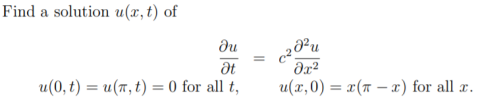 Find a solution u(x, t) of c20-u ди at u(0, t) = u(77,t) = 0 for all t, Әr2 u(x,0) = x(T – x) for all x.
 please do part b
lenterel t 2. For the signal u(-t-2) wh (a) graph the signal and provide y-axis values on the graph (t+1) T T -10 -5 -4 3 -2 -1 1 2 3 6 4 5 7 10 (b) calculate the signal energy or power, as appropriate LC
please do part b
lenterel t 2. For the signal u(-t-2) wh (a) graph the signal and provide y-axis values on the graph (t+1) T T -10 -5 -4 3 -2 -1 1 2 3 6 4 5 7 10 (b) calculate the signal energy or power, as appropriate LC
 please solve all parts
Problem #3 Knowing G(S) 2+2anS+wh Drive the Second Order System's response y(t) and Steady State Response yss to the Ramp Input u(t) t, for each one of these cases. A. Not Damped B. Critically Damped C. Over Damped D. Under Damped Partial fraction expansion for sections C and D is the same and is provided in the lecture notes
Problem #3 Knowing G(S) 2+2anS+wh Drive the Second Order System's response y(t) and Steady State Response yss...
please solve all parts
Problem #3 Knowing G(S) 2+2anS+wh Drive the Second Order System's response y(t) and Steady State Response yss to the Ramp Input u(t) t, for each one of these cases. A. Not Damped B. Critically Damped C. Over Damped D. Under Damped Partial fraction expansion for sections C and D is the same and is provided in the lecture notes
Problem #3 Knowing G(S) 2+2anS+wh Drive the Second Order System's response y(t) and Steady State Response yss...
 Wh chi a t the cial task of avoid interior d Acknowledge accomplishments.
 1. Let x(t)-u(t-1) _ u(t-3) + δ(t-2) and h(t)-u(t) _ u(t-1) + u(t-3)-u(t-5) a. Find and sketch x(t-t) and h(t). (Hint: Break x(t) into two signals) b. Find and sketch y(t) - x(t)*h(t) using the quasi-graphical method. Label and show every step (drawings and calculations)
 Sketch the product of these, viz., g(t)=u(t-3) u(-t-4) f g(t)dt = u(t-3) u(-t-4)dt Evaluate t=-oo t=-oo Evaluate ) f u(C)dt and (i) f u()dt t-500 t=-oo
Sketch the product of these, viz., g(t)=u(t-3) u(-t-4) f g(t)dt = u(t-3) u(-t-4)dt Evaluate t=-oo t=-oo Evaluate ) f u(C)dt and (i) f u()dt t-500 t=-oo
Sketch the product of these, viz., g(t)=u(t-3) u(-t-4) f g(t)dt = u(t-3) u(-t-4)dt Evaluate t=-oo t=-oo Evaluate ) f u(C)dt and (i) f u()dt t-500 t=-oo
 6. t-butyl alcohol / reflux
 So the time domain for this is
v(t) = (1-cos(10pi))[u(t) - u(t-0.1)] + 2[u(t-0.1) - u(t-0.15)] +
(-40t+0.2)[u(t-0.15) - u(t-0.25)] + (-2)[u(t-0.25)-u(t-0.3)] +
(2e^(-5(t-0.3)))[u(t-0.3)]
but the equation was reduced before converting into S-domain and
it was reduced to :
v(t) = (-cos(10pi))u(t) + u(t) + cos(10pi)u(t-0.1) + u(t-0.1) -
40(t-0.1))u(t-0.15) + 40(t-0.25)u(t-0.25) + 2u(t-0.3) +
2e^(-5(t-0.3))u(t-0.3)
How do you adjust the time delay? Not sure if I understand how
it was done, if you can show and explain step by...
So the time domain for this is
v(t) = (1-cos(10pi))[u(t) - u(t-0.1)] + 2[u(t-0.1) - u(t-0.15)] +
(-40t+0.2)[u(t-0.15) - u(t-0.25)] + (-2)[u(t-0.25)-u(t-0.3)] +
(2e^(-5(t-0.3)))[u(t-0.3)]
but the equation was reduced before converting into S-domain and
it was reduced to :
v(t) = (-cos(10pi))u(t) + u(t) + cos(10pi)u(t-0.1) + u(t-0.1) -
40(t-0.1))u(t-0.15) + 40(t-0.25)u(t-0.25) + 2u(t-0.3) +
2e^(-5(t-0.3))u(t-0.3)
How do you adjust the time delay? Not sure if I understand how
it was done, if you can show and explain step by...
 Find a solution u(x, t) of c20-u ди at u(0, t) = u(77,t) = 0 for all t, Әr2 u(x,0) = x(T – x) for all x.
Most questions answered within 3 hours.
-
Where is the error in this code sequence?
String s1 = "Hello";
String s2 = "ello";...
asked 11 months ago -
Financial data for Joel de Paris, Inc., for last year
follow:
Joel de Paris, Inc.
Balance...
asked 11 months ago -
Consider this reaction:
Al2(SO4)3 (aq)+ BaCl3
(aq) Al2Cl6 (aq)- +
3BaSO4(s) . What is the...
asked 11 months ago -
Suppose that Savneet is considering increasing her
recent random sample from 20 car rentals to 40...
asked 11 months ago -
Trucks arrive at an unloading terminal at an average rate of 120
per hour.
Trucks arrive...
asked 11 months ago -
Why are methanol and ethanol completely soluble in water while
octanol is not very little soluble....
asked 11 months ago -
A facilities manager at a university reads in a research report
that the mean amount of...
asked 11 months ago -
When the CuSO4 is rehydrated by adding water to the anhydrous
compound, is this an endothermic...
asked 11 months ago -
A ray of sunlight is passing from diamond into crown glass; the
angle of incidence is...
asked 11 months ago -
A block of mass 0.249 kg is placed on top of a light, vertical
spring of...
asked 11 months ago -
how do the kidneys compensate in the presences of acidosis
a) trigger hyperventilate
b) reserve acid...
asked 11 months ago -
Question 501 pts
The rental rate of capital to the firm increases. Which of the
following...
asked 11 months ago