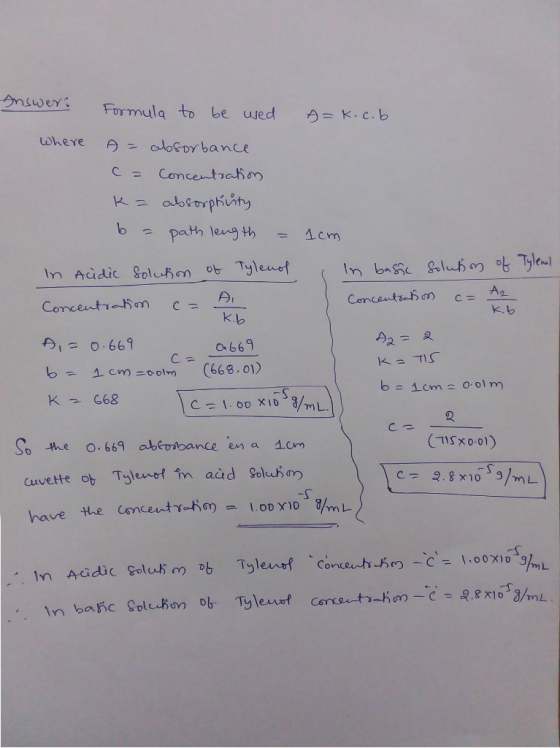
Tylenol is found to absorb at: If an acid solution in a 1 cm cuvette was...
Tylenol is found to absorb at:
|
|
If an acid solution in a 1 cm cuvette was found to have an absorbance of 0.669 absorbance units, what was the concentration of tylenol in the solution? If the absorbance of a basic solution of tylenol was 2.0, what would its concentration be? Explain your answer
Homework Answers
Add Answer to:
Tylenol is found to absorb at:
If an acid solution in a 1 cm cuvette was...
If 2.0 mL of distilled water is added to 3.0 mL of a 0.150 M solution...
 If 2.0 mL of distilled water is added to 3.0 mL of a 0.150 M solution of CoCly, what is the concentration of the resulting solution? Show your work. (a) What is a calibration curve? (b) Why do we use a calibration curve to determine the concentration of our unknown 5. A colored sample with a concentration of 0.160 M has an absorbance of 0.80 in a 1.0 cm path length cuvette. (a) What would be the absorbance expected if...
The transmittance recorded at 565 nm in a 1 cm cuvette is 0.865. What is the...
The transmittance recorded at 565 nm in a 1 cm cuvette is 0.865. What is the absorbance of this solution?
A cuvette of length l is filled with a solution of aspirin with concentration c. You...
 A cuvette of length l is filled with a solution
of aspirin with concentration c. You are recording
the transmission of light of a certain wavelength and record a
transmission of T=90%. A= -log(%T / 100%), A=*b*c.
Show your work to receive credit.
a) What is the absorbance of the solution?
b) The concentration of aspirin is increased by a factor of 2.
What is the absorbance of the cell? What is the transmission of the
cell?
c) The concentration...
A cuvette of length l is filled with a solution
of aspirin with concentration c. You are recording
the transmission of light of a certain wavelength and record a
transmission of T=90%. A= -log(%T / 100%), A=*b*c.
Show your work to receive credit.
a) What is the absorbance of the solution?
b) The concentration of aspirin is increased by a factor of 2.
What is the absorbance of the cell? What is the transmission of the
cell?
c) The concentration...
You are measuring the concentration of Fe2+ in a sample by measuring the absorbance of its...
You are measuring the concentration of Fe2+ in a sample by measuring the absorbance of its complex with ferroxine. Your sample, measured in a 1.00-cm pathlength cuvette, has an absorbance of 0.350. What would be the Percent Transmittance of this solution if measured in a cuvette with 4.00 cm pathlength?
A solution of Red Dye 40 is analysed via UV-Vis spectroscopy, and is found to have...
 A solution of Red Dye 40 is analysed via UV-Vis spectroscopy, and is found to have an absorbance of 0.192. If the absorp- tion coefficient (£) for Red Dye 40 is 11 502 M2 cm- and the length of the cuvette used is 1.00 cm, what is the concentra- tion of Red Dye 40 in the solution? (You will need to read the pre-lab material to solve this problem.)
Name: Determination of Solution Concentration by Spectrophotometry PRELAB QUESTIONS 1. A student measures the absorbance of...
 Name: Determination of Solution Concentration by Spectrophotometry PRELAB QUESTIONS 1. A student measures the absorbance of an unknown after placing a sample in a cuvette which contained some water. How will this affect the concentration he reports? 2. Explain why it is all right to leave water in the volumetric flask before you put in the 10.00 mL of your unknown. 3. A 1.3 x 10-M solution of an unknown substance has an absorbance of 0.345 at its max. a)...
The concentration of a solution is 10.0 M. It has an absorbance of 0.200 when placed...
The concentration of a solution is 10.0 M. It has an absorbance of 0.200 when placed in a 1.00 cm cuvette at the wavelength of 250 nm. What would be the absorbance if the solution is 5.00 M? Assume both concentrations are in the analytical range (within linear).
The absorbance of an iron thiocyanate solution containing 0.005 mg Fe/mL was reported as 0.43 at...
The absorbance of an iron thiocyanate solution containing 0.005 mg Fe/mL was reported as 0.43 at 540 nm using a 1.00 cm cuvette. What will be the absorbance if the solution is diluted to twice its original volume and is placed in a 2 cm cuvette? Write answer to three decimal places.
The measured absorbance of the solution of a substance A was 0.65. What was the concentration...
The measured absorbance of the solution of a substance A was 0.65. What was the concentration of substance A, if the thickness of cuvette was 1 cm, and molar absorption coefficient of this substance was 650 [dm3/mol cm]?
You have a compound that has an absorption at 291 nm. At a concentration of 0.025...
 You have a compound that has an absorption at 291 nm. At a
concentration of 0.025 mM, the absorbance A291 = 0.40.
What is its molar absorptivity of this sample (in
M-1cm-1)? Assume you are using a 1 cm cuvette
for your experiment.
Incorrect Question 1 0/2 pts You have a compound that has an absorption at 291 nm. At a concentration of 0.025 mM, the absorbance A291 = 0.40. What is its molar absorbtivity of this sample (in M?cm-?)?...
You have a compound that has an absorption at 291 nm. At a
concentration of 0.025 mM, the absorbance A291 = 0.40.
What is its molar absorptivity of this sample (in
M-1cm-1)? Assume you are using a 1 cm cuvette
for your experiment.
Incorrect Question 1 0/2 pts You have a compound that has an absorption at 291 nm. At a concentration of 0.025 mM, the absorbance A291 = 0.40. What is its molar absorbtivity of this sample (in M?cm-?)?...
 If 2.0 mL of distilled water is added to 3.0 mL of a 0.150 M solution of CoCly, what is the concentration of the resulting solution? Show your work. (a) What is a calibration curve? (b) Why do we use a calibration curve to determine the concentration of our unknown 5. A colored sample with a concentration of 0.160 M has an absorbance of 0.80 in a 1.0 cm path length cuvette. (a) What would be the absorbance expected if...
 A cuvette of length l is filled with a solution
of aspirin with concentration c. You are recording
the transmission of light of a certain wavelength and record a
transmission of T=90%. A= -log(%T / 100%), A=*b*c.
Show your work to receive credit.
a) What is the absorbance of the solution?
b) The concentration of aspirin is increased by a factor of 2.
What is the absorbance of the cell? What is the transmission of the
cell?
c) The concentration...
A cuvette of length l is filled with a solution
of aspirin with concentration c. You are recording
the transmission of light of a certain wavelength and record a
transmission of T=90%. A= -log(%T / 100%), A=*b*c.
Show your work to receive credit.
a) What is the absorbance of the solution?
b) The concentration of aspirin is increased by a factor of 2.
What is the absorbance of the cell? What is the transmission of the
cell?
c) The concentration...
 A solution of Red Dye 40 is analysed via UV-Vis spectroscopy, and is found to have an absorbance of 0.192. If the absorp- tion coefficient (£) for Red Dye 40 is 11 502 M2 cm- and the length of the cuvette used is 1.00 cm, what is the concentra- tion of Red Dye 40 in the solution? (You will need to read the pre-lab material to solve this problem.)
 Name: Determination of Solution Concentration by Spectrophotometry PRELAB QUESTIONS 1. A student measures the absorbance of an unknown after placing a sample in a cuvette which contained some water. How will this affect the concentration he reports? 2. Explain why it is all right to leave water in the volumetric flask before you put in the 10.00 mL of your unknown. 3. A 1.3 x 10-M solution of an unknown substance has an absorbance of 0.345 at its max. a)...
 You have a compound that has an absorption at 291 nm. At a
concentration of 0.025 mM, the absorbance A291 = 0.40.
What is its molar absorptivity of this sample (in
M-1cm-1)? Assume you are using a 1 cm cuvette
for your experiment.
Incorrect Question 1 0/2 pts You have a compound that has an absorption at 291 nm. At a concentration of 0.025 mM, the absorbance A291 = 0.40. What is its molar absorbtivity of this sample (in M?cm-?)?...
You have a compound that has an absorption at 291 nm. At a
concentration of 0.025 mM, the absorbance A291 = 0.40.
What is its molar absorptivity of this sample (in
M-1cm-1)? Assume you are using a 1 cm cuvette
for your experiment.
Incorrect Question 1 0/2 pts You have a compound that has an absorption at 291 nm. At a concentration of 0.025 mM, the absorbance A291 = 0.40. What is its molar absorbtivity of this sample (in M?cm-?)?...
Most questions answered within 3 hours.
-
Where is the error in this code sequence?
String s1 = "Hello";
String s2 = "ello";...
asked 10 months ago -
Financial data for Joel de Paris, Inc., for last year
follow:
Joel de Paris, Inc.
Balance...
asked 10 months ago -
Consider this reaction:
Al2(SO4)3 (aq)+ BaCl3
(aq) Al2Cl6 (aq)- +
3BaSO4(s) . What is the...
asked 10 months ago -
Suppose that Savneet is considering increasing her
recent random sample from 20 car rentals to 40...
asked 10 months ago -
Trucks arrive at an unloading terminal at an average rate of 120
per hour.
Trucks arrive...
asked 10 months ago -
Why are methanol and ethanol completely soluble in water while
octanol is not very little soluble....
asked 10 months ago -
A facilities manager at a university reads in a research report
that the mean amount of...
asked 10 months ago -
When the CuSO4 is rehydrated by adding water to the anhydrous
compound, is this an endothermic...
asked 10 months ago -
A ray of sunlight is passing from diamond into crown glass; the
angle of incidence is...
asked 10 months ago -
A block of mass 0.249 kg is placed on top of a light, vertical
spring of...
asked 10 months ago -
how do the kidneys compensate in the presences of acidosis
a) trigger hyperventilate
b) reserve acid...
asked 10 months ago -
Question 501 pts
The rental rate of capital to the firm increases. Which of the
following...
asked 10 months ago