
Please answer all parts of the question. Thank you.
Homework Answers
Request Answer!
We need at least 10 more requests to produce the answer.
0 / 10 have requested this problem solution
The more requests, the faster the answer.
Add Answer to:
Please answer all parts of the question. Thank you.
Consider the iron structure in the figure...
2. The magnetic circuit of Fig. 1 consists of rings of magnetic material in a stack...
 2. The magnetic circuit of Fig. 1 consists of rings of magnetic material in a stack of height h. The rings have inner radius Ri and outer radius Ro. Assume that the iron is of infinite permeability (μ → x) and neglect the effects of magnetic leakage and fringing Ri N turns For Ri-3.2 cm, Roー4.1 cm, ћ-1.8 cm, g = 0.15 cm, N-72 turns, calculate a. The mean core length le and the core corss-sectional area Ac. b. The...
QUESTION 2 a) Given a magnetic circuit as shown in Figure Q2 where its core is...
 QUESTION 2 a) Given a magnetic circuit as shown in Figure Q2 where its core is cast steel. The center limb has a cross-sectional area of 800mm2 and the other side limbs have a cross sectional area of 500mm2. The effective air gap length, lac is Imm, core length, loc= 150mm . ladb = laeb = 340mm . A coil of 400 turns is wound on the center limb. Neglect any magnetic leakage and fringing effect. i. Draw the equivalent...
94 Exercise :4.A square magnetic core Figure :4. has four 0.5 mm air gaps. The core...
 94 Exercise :4.A square magnetic core Figure :4. has four 0.5 mm air gaps. The core material has a relative permeability of us = 800 and a coil of 1400 turns is wound around it. The core has a square cross-sectional area of dimensions 4 cm and a magnetic path length (including the air gaps) is 20 cm. A = 4 cm 2 N = 1400 4 Air gaps = 0.5 mm each Figure : 4. = 20 cm including...
ET 103 - ELECTRICAL MACHINES I Assignment 01 QUESTION # 04 A ferromagnetic core with a...
 ET 103 - ELECTRICAL MACHINES I Assignment 01 QUESTION # 04 A ferromagnetic core with a relative permeability of 1500 is shown in Figure The dimensions are as shown in the diagram, and the depth of the core is 5 cm. The air gaps on the left and right sides of the core are 0.050 and 0.070 cm, respectively. Because of fringing effects, the effective area of the air gaps is 5 percent larger than their physical size. If there...
b) A portion of a solenoid is shown as in Figure Q3(b). The magnetic circuit comprises...
 b) A portion of a solenoid is shown as in Figure Q3(b). The magnetic circuit comprises of cast iron yoke, sheet steel plunger, cast steel plunger and air gaps. The yoke and plunger have a cross section area of 4.8x10 m´and 4.5x10m respectively. A coil is wound on the center of the yoke. The effective length of the cast iron yake, sheet steel plunger and cast steel plunger are la = 0.25 m; 4 = 0.12 m and l =...
6) Figure Q4(b) shows a coils of 200 turns. The coil is uniformly wound around a...
 6) Figure Q4(b) shows a coils of 200 turns. The coil is uniformly wound around a wooden ring with a mean circumference of 600mm and cross-section area of 500mm%. The current flowing into the call is 4A. (Permeability of free space fle = 4ex 10' Hm'. Calculate: L. the magnetic field strength (2 marks) flux density (1 marks) total flux (1 marks) turn I meter Figure Q4 (b) A magnetic circuit made of cast steel is arranged as in Figure...
For problem f), the current value is not on the picture. How to find the force...
 For problem f), the current value is not on the picture. How
to find the force and get the flux without current since F=Ni. Same
for problem g)
5. (34 points) A ferromagnetic core with a constant relative permeability of 2000 is shown in the following figure. The core depth is 6 cm, and all dimensions are as shown in the figure. The air gap length on the leftmost column of the core is 0.01 cm. Because of fringing effects,...
For problem f), the current value is not on the picture. How
to find the force and get the flux without current since F=Ni. Same
for problem g)
5. (34 points) A ferromagnetic core with a constant relative permeability of 2000 is shown in the following figure. The core depth is 6 cm, and all dimensions are as shown in the figure. The air gap length on the leftmost column of the core is 0.01 cm. Because of fringing effects,...
Question 7 A magnetic core is shown in Figure 1. Relative permeability of the core is...
 Question 7 A magnetic core is shown in Figure 1. Relative permeability of the core is 14 = 2000. Total number of winding turns in the left winding is NL = 100 and in the right winding is Nr = 10. Assume that the core cross section is uniform and the combined length of all air-gaps is much smaller than the dimensions of the core cross-section. Calculate the following: a) The magnetomotive force in the core if i = 2...
1. Consider the toroidal core shown in the Figure. Find the current needed to produce a...
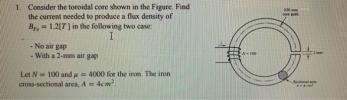 1. Consider the toroidal core shown in the Figure. Find the current needed to produce a flux density of BFe = 1.2[T] in the following two case - No air gap - With a 2-mm air gap Let N = 100 and u = 4000 for the iron. The iron cross-sectional area, A = 4cm.
Magnetic Circuits y Part A - Calculate reluctances Learning Goal: To understand how magnetic structures can...
 Magnetic Circuits y Part A - Calculate reluctances Learning Goal: To understand how magnetic structures can be analyzed by drawing an equivalent circuit, and to use the equivalent circuit to calculate magnetic fluxes and coll currents. When analyzing magnetic structures, the geometry is often complex enough that using the fundamental rules can be very difficult without numerical methods. However, there are approximate methods that are often sufficient for engineering calculations. When the magnetic field is mostly contained within cores of...
 2. The magnetic circuit of Fig. 1 consists of rings of magnetic material in a stack of height h. The rings have inner radius Ri and outer radius Ro. Assume that the iron is of infinite permeability (μ → x) and neglect the effects of magnetic leakage and fringing Ri N turns For Ri-3.2 cm, Roー4.1 cm, ћ-1.8 cm, g = 0.15 cm, N-72 turns, calculate a. The mean core length le and the core corss-sectional area Ac. b. The...
 QUESTION 2 a) Given a magnetic circuit as shown in Figure Q2 where its core is cast steel. The center limb has a cross-sectional area of 800mm2 and the other side limbs have a cross sectional area of 500mm2. The effective air gap length, lac is Imm, core length, loc= 150mm . ladb = laeb = 340mm . A coil of 400 turns is wound on the center limb. Neglect any magnetic leakage and fringing effect. i. Draw the equivalent...
 94 Exercise :4.A square magnetic core Figure :4. has four 0.5 mm air gaps. The core material has a relative permeability of us = 800 and a coil of 1400 turns is wound around it. The core has a square cross-sectional area of dimensions 4 cm and a magnetic path length (including the air gaps) is 20 cm. A = 4 cm 2 N = 1400 4 Air gaps = 0.5 mm each Figure : 4. = 20 cm including...
 ET 103 - ELECTRICAL MACHINES I Assignment 01 QUESTION # 04 A ferromagnetic core with a relative permeability of 1500 is shown in Figure The dimensions are as shown in the diagram, and the depth of the core is 5 cm. The air gaps on the left and right sides of the core are 0.050 and 0.070 cm, respectively. Because of fringing effects, the effective area of the air gaps is 5 percent larger than their physical size. If there...
 b) A portion of a solenoid is shown as in Figure Q3(b). The magnetic circuit comprises of cast iron yoke, sheet steel plunger, cast steel plunger and air gaps. The yoke and plunger have a cross section area of 4.8x10 m´and 4.5x10m respectively. A coil is wound on the center of the yoke. The effective length of the cast iron yake, sheet steel plunger and cast steel plunger are la = 0.25 m; 4 = 0.12 m and l =...
 6) Figure Q4(b) shows a coils of 200 turns. The coil is uniformly wound around a wooden ring with a mean circumference of 600mm and cross-section area of 500mm%. The current flowing into the call is 4A. (Permeability of free space fle = 4ex 10' Hm'. Calculate: L. the magnetic field strength (2 marks) flux density (1 marks) total flux (1 marks) turn I meter Figure Q4 (b) A magnetic circuit made of cast steel is arranged as in Figure...
 For problem f), the current value is not on the picture. How
to find the force and get the flux without current since F=Ni. Same
for problem g)
5. (34 points) A ferromagnetic core with a constant relative permeability of 2000 is shown in the following figure. The core depth is 6 cm, and all dimensions are as shown in the figure. The air gap length on the leftmost column of the core is 0.01 cm. Because of fringing effects,...
For problem f), the current value is not on the picture. How
to find the force and get the flux without current since F=Ni. Same
for problem g)
5. (34 points) A ferromagnetic core with a constant relative permeability of 2000 is shown in the following figure. The core depth is 6 cm, and all dimensions are as shown in the figure. The air gap length on the leftmost column of the core is 0.01 cm. Because of fringing effects,...
 Question 7 A magnetic core is shown in Figure 1. Relative permeability of the core is 14 = 2000. Total number of winding turns in the left winding is NL = 100 and in the right winding is Nr = 10. Assume that the core cross section is uniform and the combined length of all air-gaps is much smaller than the dimensions of the core cross-section. Calculate the following: a) The magnetomotive force in the core if i = 2...
 1. Consider the toroidal core shown in the Figure. Find the current needed to produce a flux density of BFe = 1.2[T] in the following two case - No air gap - With a 2-mm air gap Let N = 100 and u = 4000 for the iron. The iron cross-sectional area, A = 4cm.
 Magnetic Circuits y Part A - Calculate reluctances Learning Goal: To understand how magnetic structures can be analyzed by drawing an equivalent circuit, and to use the equivalent circuit to calculate magnetic fluxes and coll currents. When analyzing magnetic structures, the geometry is often complex enough that using the fundamental rules can be very difficult without numerical methods. However, there are approximate methods that are often sufficient for engineering calculations. When the magnetic field is mostly contained within cores of...
Most questions answered within 3 hours.
-
Where is the error in this code sequence?
String s1 = "Hello";
String s2 = "ello";...
asked 11 months ago -
Financial data for Joel de Paris, Inc., for last year
follow:
Joel de Paris, Inc.
Balance...
asked 11 months ago -
Consider this reaction:
Al2(SO4)3 (aq)+ BaCl3
(aq) Al2Cl6 (aq)- +
3BaSO4(s) . What is the...
asked 11 months ago -
Suppose that Savneet is considering increasing her
recent random sample from 20 car rentals to 40...
asked 11 months ago -
Trucks arrive at an unloading terminal at an average rate of 120
per hour.
Trucks arrive...
asked 11 months ago -
Why are methanol and ethanol completely soluble in water while
octanol is not very little soluble....
asked 11 months ago -
A facilities manager at a university reads in a research report
that the mean amount of...
asked 11 months ago -
When the CuSO4 is rehydrated by adding water to the anhydrous
compound, is this an endothermic...
asked 11 months ago -
A ray of sunlight is passing from diamond into crown glass; the
angle of incidence is...
asked 11 months ago -
A block of mass 0.249 kg is placed on top of a light, vertical
spring of...
asked 11 months ago -
how do the kidneys compensate in the presences of acidosis
a) trigger hyperventilate
b) reserve acid...
asked 11 months ago -
Question 501 pts
The rental rate of capital to the firm increases. Which of the
following...
asked 11 months ago