
Homework Answers
Add Answer to:
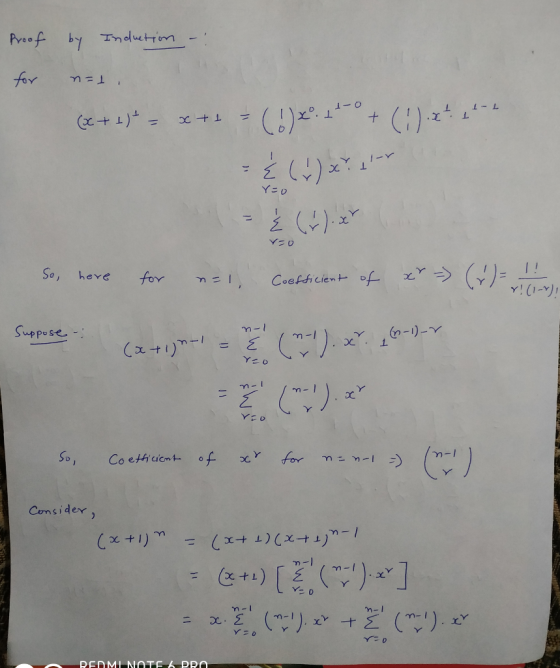
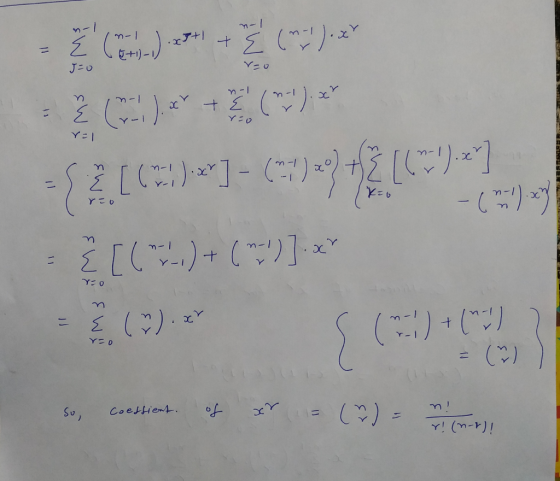
et a, ,be the coefficient of the x term in the polynomial ( on n to...
1. Prove the following statement by mathematical induction. For all positive integers n. 2++ n+1) =...
 1. Prove the following statement by mathematical induction. For all positive integers n. 2++ n+1) = 2. Prove the following statement by mathematical induction. For all nonnegative integers n, 3 divides 22n-1. 3. Prove the following statement by mathematical induction. For all integers n 27,3" <n!
29. Suppose B is an n x n board and r,(B) is the coefficient of " in the rook polynomial R(C, B)....
 Combinatorics
29. Suppose B is an n x n board and r,(B) is the coefficient of " in the rook polynomial R(C, B). Use recurrence relations to compute r(B) if (a) B has all squares darkened; (b) B has only the main diagonal lightened.
29. Suppose B is an n x n board and r,(B) is the coefficient of " in the rook polynomial R(C, B). Use recurrence relations to compute r(B) if (a) B has all squares darkened; (b)...
Combinatorics
29. Suppose B is an n x n board and r,(B) is the coefficient of " in the rook polynomial R(C, B). Use recurrence relations to compute r(B) if (a) B has all squares darkened; (b) B has only the main diagonal lightened.
29. Suppose B is an n x n board and r,(B) is the coefficient of " in the rook polynomial R(C, B). Use recurrence relations to compute r(B) if (a) B has all squares darkened; (b)...
Prove using mathematical induction that for every positive integer n, = 1/i(i+1) = n/n+1. 2) Suppose...
 Prove using mathematical induction that for every positive integer n, = 1/i(i+1) = n/n+1. 2) Suppose r is a real number other than 1. Prove using mathematical induction that for every nonnegative integer n, = 1-r^n+1/1-r. 3) Prove using mathematical induction that for every nonnegative integer n, 1 + i+i! = (n+1)!. 4) Prove using mathematical induction that for every integer n>4, n!>2^n. 5) Prove using mathematical induction that for every positive integer n, 7 + 5 + 3 +.......
For an integer n > 0, consider the positive integer F. = 22 +1. (a) Use...
 For an integer n > 0, consider the positive integer F. = 22 +1. (a) Use induction to prove that F. ends in digit 7 whenever n 2 is an integer (b) Use induction to prove that F= 2 + IT- Fholds for all neN. (c) Use (b) to prove that ged(F, F.) = 1 holds for all distinct nonnegative integers m, na (d) Use (e) to give a quick proof that there must be infinitely many primes! That is...
Question 3* For any n,T EN the biomial coefficient ( is the coefficient of in the expansion of (1...
 Question 3* For any n,T EN the biomial coefficient ( is the coefficient of in the expansion of (1 + z)". (E.g. (4) 6 because (1 + z)4-1 + 4x + 612 + 4r' + re) In particular, 0 whenever r >n and ()) for all nEN*. These facts, together with Pascal's identity (")+ )(), facilitate the calculation of the value of () for any particular values of n and r via the well-know 'Pascal's triangle'. a) Use Pascal's identity...
(6) Let A denote an m x n matrix. Prove that rank A < 1 if...
 (6) Let A denote an m x n matrix. Prove that rank A < 1 if and only if A = BC. Where B is an m x 1 matrix and C is a 1 xn matrix. Solution (7) Do the following: (a) Use proof by induction to find a formula for for all positive integers n and for alld E R. Solution ... 2 for all positive (b) Find a closed formula for each entry of A" where A...
Let n and r be nonnegative integers with r < n. Then n+ 1 r+1
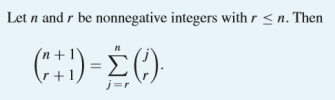 How to prove this equality?
Let n and r be nonnegative integers with r < n. Then n+ 1 r+1
Let n and r be nonnegative integers with r
How to prove this equality?
Let n and r be nonnegative integers with r < n. Then n+ 1 r+1
Let n and r be nonnegative integers with r
2. The polynomial p of degree n that interpolates a given function f at n+1 prescribed nodes is u...
 Please answer problem 4, thank you.
2. The polynomial p of degree n that interpolates a given function f at n+1 prescribed nodes is uniquely defined. Hence, there is a mapping f -> p. Denote this mapping by L and show that rl Show that L is linear; that is, 3. Prove that the algorithm for computing the coefficients ci in the Newton form of the interpolating polynomial involves n long operations (multiplications and divisions 4. Refer to Problem 2,...
Please answer problem 4, thank you.
2. The polynomial p of degree n that interpolates a given function f at n+1 prescribed nodes is uniquely defined. Hence, there is a mapping f -> p. Denote this mapping by L and show that rl Show that L is linear; that is, 3. Prove that the algorithm for computing the coefficients ci in the Newton form of the interpolating polynomial involves n long operations (multiplications and divisions 4. Refer to Problem 2,...
Identify the degree, leading term and leading coefficient of each polynomial function
1. Identify the degree, leading term and leading coefficient of each polynomial function.A. f(x)= x(x+1)(3x+1)(x-2)B. f(x)= -16+3x^4 - 9x^2 - x^6 + 4x^82. Describe the end behavior of a ninth-degree polynomial function with a negative leading coefficient.
(i) Find a non-zero polynomial in Z3 x| which induces a zero function on Z3. f(x), g(x) R have degree n and let co, c1,...
 (i) Find a non-zero polynomial in Z3 x| which induces a zero function on Z3. f(x), g(x) R have degree n and let co, c1,... , cn be distinct elements in R. Furthermore, let (ii) Let f(c)g(c) for all i = 0,1,2,...n. g(x) Prove that f(x - where r, s E Z, 8 ± 0 and gcd(r, s) =1. Prove that if x is a root of (iii) Let f(x) . an^" E Z[x], then s divides an. aoa1
(i)...
(i) Find a non-zero polynomial in Z3 x| which induces a zero function on Z3. f(x), g(x) R have degree n and let co, c1,... , cn be distinct elements in R. Furthermore, let (ii) Let f(c)g(c) for all i = 0,1,2,...n. g(x) Prove that f(x - where r, s E Z, 8 ± 0 and gcd(r, s) =1. Prove that if x is a root of (iii) Let f(x) . an^" E Z[x], then s divides an. aoa1
(i)...
 1. Prove the following statement by mathematical induction. For all positive integers n. 2++ n+1) = 2. Prove the following statement by mathematical induction. For all nonnegative integers n, 3 divides 22n-1. 3. Prove the following statement by mathematical induction. For all integers n 27,3" <n!
 Combinatorics
29. Suppose B is an n x n board and r,(B) is the coefficient of " in the rook polynomial R(C, B). Use recurrence relations to compute r(B) if (a) B has all squares darkened; (b) B has only the main diagonal lightened.
29. Suppose B is an n x n board and r,(B) is the coefficient of " in the rook polynomial R(C, B). Use recurrence relations to compute r(B) if (a) B has all squares darkened; (b)...
Combinatorics
29. Suppose B is an n x n board and r,(B) is the coefficient of " in the rook polynomial R(C, B). Use recurrence relations to compute r(B) if (a) B has all squares darkened; (b) B has only the main diagonal lightened.
29. Suppose B is an n x n board and r,(B) is the coefficient of " in the rook polynomial R(C, B). Use recurrence relations to compute r(B) if (a) B has all squares darkened; (b)...
 Prove using mathematical induction that for every positive integer n, = 1/i(i+1) = n/n+1. 2) Suppose r is a real number other than 1. Prove using mathematical induction that for every nonnegative integer n, = 1-r^n+1/1-r. 3) Prove using mathematical induction that for every nonnegative integer n, 1 + i+i! = (n+1)!. 4) Prove using mathematical induction that for every integer n>4, n!>2^n. 5) Prove using mathematical induction that for every positive integer n, 7 + 5 + 3 +.......
 For an integer n > 0, consider the positive integer F. = 22 +1. (a) Use induction to prove that F. ends in digit 7 whenever n 2 is an integer (b) Use induction to prove that F= 2 + IT- Fholds for all neN. (c) Use (b) to prove that ged(F, F.) = 1 holds for all distinct nonnegative integers m, na (d) Use (e) to give a quick proof that there must be infinitely many primes! That is...
 Question 3* For any n,T EN the biomial coefficient ( is the coefficient of in the expansion of (1 + z)". (E.g. (4) 6 because (1 + z)4-1 + 4x + 612 + 4r' + re) In particular, 0 whenever r >n and ()) for all nEN*. These facts, together with Pascal's identity (")+ )(), facilitate the calculation of the value of () for any particular values of n and r via the well-know 'Pascal's triangle'. a) Use Pascal's identity...
 (6) Let A denote an m x n matrix. Prove that rank A < 1 if and only if A = BC. Where B is an m x 1 matrix and C is a 1 xn matrix. Solution (7) Do the following: (a) Use proof by induction to find a formula for for all positive integers n and for alld E R. Solution ... 2 for all positive (b) Find a closed formula for each entry of A" where A...
 How to prove this equality?
Let n and r be nonnegative integers with r < n. Then n+ 1 r+1
Let n and r be nonnegative integers with r
How to prove this equality?
Let n and r be nonnegative integers with r < n. Then n+ 1 r+1
Let n and r be nonnegative integers with r
 Please answer problem 4, thank you.
2. The polynomial p of degree n that interpolates a given function f at n+1 prescribed nodes is uniquely defined. Hence, there is a mapping f -> p. Denote this mapping by L and show that rl Show that L is linear; that is, 3. Prove that the algorithm for computing the coefficients ci in the Newton form of the interpolating polynomial involves n long operations (multiplications and divisions 4. Refer to Problem 2,...
Please answer problem 4, thank you.
2. The polynomial p of degree n that interpolates a given function f at n+1 prescribed nodes is uniquely defined. Hence, there is a mapping f -> p. Denote this mapping by L and show that rl Show that L is linear; that is, 3. Prove that the algorithm for computing the coefficients ci in the Newton form of the interpolating polynomial involves n long operations (multiplications and divisions 4. Refer to Problem 2,...
 (i) Find a non-zero polynomial in Z3 x| which induces a zero function on Z3. f(x), g(x) R have degree n and let co, c1,... , cn be distinct elements in R. Furthermore, let (ii) Let f(c)g(c) for all i = 0,1,2,...n. g(x) Prove that f(x - where r, s E Z, 8 ± 0 and gcd(r, s) =1. Prove that if x is a root of (iii) Let f(x) . an^" E Z[x], then s divides an. aoa1
(i)...
(i) Find a non-zero polynomial in Z3 x| which induces a zero function on Z3. f(x), g(x) R have degree n and let co, c1,... , cn be distinct elements in R. Furthermore, let (ii) Let f(c)g(c) for all i = 0,1,2,...n. g(x) Prove that f(x - where r, s E Z, 8 ± 0 and gcd(r, s) =1. Prove that if x is a root of (iii) Let f(x) . an^" E Z[x], then s divides an. aoa1
(i)...
Most questions answered within 3 hours.
-
Where is the error in this code sequence?
String s1 = "Hello";
String s2 = "ello";...
asked 11 months ago -
Financial data for Joel de Paris, Inc., for last year
follow:
Joel de Paris, Inc.
Balance...
asked 11 months ago -
Consider this reaction:
Al2(SO4)3 (aq)+ BaCl3
(aq) Al2Cl6 (aq)- +
3BaSO4(s) . What is the...
asked 11 months ago -
Suppose that Savneet is considering increasing her
recent random sample from 20 car rentals to 40...
asked 11 months ago -
Trucks arrive at an unloading terminal at an average rate of 120
per hour.
Trucks arrive...
asked 11 months ago -
Why are methanol and ethanol completely soluble in water while
octanol is not very little soluble....
asked 11 months ago -
A facilities manager at a university reads in a research report
that the mean amount of...
asked 11 months ago -
When the CuSO4 is rehydrated by adding water to the anhydrous
compound, is this an endothermic...
asked 11 months ago -
A ray of sunlight is passing from diamond into crown glass; the
angle of incidence is...
asked 11 months ago -
A block of mass 0.249 kg is placed on top of a light, vertical
spring of...
asked 11 months ago -
how do the kidneys compensate in the presences of acidosis
a) trigger hyperventilate
b) reserve acid...
asked 11 months ago -
Question 501 pts
The rental rate of capital to the firm increases. Which of the
following...
asked 11 months ago