(Chapter 4): Solomon Brothers You are working at the fixed-income sector of Solomon Brothers. You were...
(Chapter 4): Solomon Brothers
You are working at the fixed-income sector of Solomon Brothers. You were asked to prepare a quiz for the new interns to assess their knowledge of bonds. To evaluate interns’ ability to apply their knowledge to real world, you would like to have the interns to analyze risk as well.
- Please calculate the following bond values, Yield to Maturity, current yield and capital gains.
- Value of 10-year, 10% coupon, semiannual bond if rd = 13%.
- Value of 10-year, 10% coupon, semiannual bond if rd = 7%.
- Value of 10-year, 10% coupon, semiannual bond if rd = 10%.
- YTM on a 10-year, 9% semi-annual coupon, $1,000 par value bond selling for $887
- Current yield and capital gains for case 4)
- What is the relation between bond value and years remaining till maturity?
- Calculate the yield to call a 10-year, 10% semiannual coupon, $1,000 par value bond is selling for $1,135.90 with an 8% yield to maturity. It can be called after 5 years at $1,050.
- Please explain price/interest rate risk and reinvestment risk. What kind of bond has higher price risk? What kind of bond has higher reinvestment risk?
Homework Answers
(a) Tenure = 10 years, Bond Face Value = $ 1000, rd (YTM) = 13 % and Coupon Rate = 10 % payable semi-annually
Semi-Annual Coupon Payment = 0.5 x 0.1 x 1000 = $ 50
Bond Value = Sum of Present Value of Bond Coupons + Present Value of Face Value = 50 x (1/0.065) x [1-{1/(1.065)^(20)}] + 1000 / (1.065)^(20) = $ 834.72
(b)
Tenure = 10 years, Bond Face Value = $ 1000, rd (YTM) = 7 % and Coupon Rate = 10 % payable semi-annually
Semi-Annual Coupon Payment = 0.5 x 0.1 x 1000 = $ 50
Bond Value = Sum of Present Value of Bond Coupons + Present Value of Face Value = 50 x (1/0.035) x [1-{1/(1.035)^(20)}] + 1000 / (1.035)^(20) = $ 1213.19
(c)
Tenure = 10 years, Bond Face Value = $ 1000, rd (YTM) = 10 % and Coupon Rate = 10 % payable semi-annually
Semi-Annual Coupon Payment = 0.5 x 0.1 x 1000 = $ 50
Bond Value = Sum of Present Value of Bond Coupons + Present Value of Face Value = 50 x (1/0.05) x [1-{1/(1.05)^(20)}] + 1000 / (1.05)^(20) = $ 1000
(d)
Tenure = 10 years or 20 half-years, Coupon Rate = 9 % payable semi-annually, Par Value = $ 1000 and Market Price = $ 887
Let the YTM be 2R
Semi-Annual Coupon = 0.5 x 0.045 x 1000 = $ 45
Therefore, 887 = 45 x (1/R) x [1-{1/(1+R)^(20)}] + 1000 / (1+R)^(20)
Using EXCEL's Goal Seek Function/ a financial calculator/ hit and trial method to solve the above equation we get:
R = 0.05441 or 5.441 %
Therefore, YTM = 2 x 5.441 = 10.882 %
NOTE: Please do raise separate queries for solutions to the remaining sub-parts, as one query is limited to the solution of only one complete question with a maximum of four sub-parts.
Add Answer to:
(Chapter 4): Solomon Brothers
You are working at the fixed-income sector of Solomon Brothers.
You were...
1. Assume that you are in the 40% federal-plus-state marginal tax bracket and that capital gains...
1. Assume that you are in the 40% federal-plus-state marginal tax bracket and that capital gains taxes are deferred until maturity. Assuming equal investment risk and a horizontal yield curve, rank the following investment opportunities on the basis of the effective annual yields: a. A $100 par value perpetual preferred stock with an annual coupon of 12%, quarterly payments, and selling at $105. b. A $1,000 par value, 20-year, non callable, semiannual bond with a coupon of 12% currently selling...
* You received no credit for this question in the previous attempt. View previous attempt A...
 * You received no credit for this question in the previous attempt. View previous attempt A 10-year maturity bond with par value of $1,000 makes semiannual coupon payments at a coupon rate of 8%. Find the bond equivalent and effective annual yield to maturity of the bond for the following bond prices. (Round your answers to 2 decimal places.) A 10-year maturity bond with par value of $1,000 makes sen points Bond Prices Effective Annual Yield to Maturity a. $...
• Comedy Corporation's bonds have a 15-year maturity, a 7% annual coupon paid with semiannual frequency,...
 • Comedy Corporation's bonds have a 15-year maturity, a 7% annual coupon paid with semiannual frequency, and a par value of $1,000. The annual interest rate (ra) is 6%, based on semiannual compounding, What is the bond's price? (10 points) 8. a. Find current yield of a 6% coupon bond, currently trading at $1,078. (5 points) b. If the yield to maturity is 4%, find the capital gains yield for the bond above. (5 points)
A 15-year maturity bond with par value of $1,000 makes semiannual coupon payments at a coupon...
 A 15-year maturity bond with par value of $1,000 makes semiannual coupon payments at a coupon rate of 8%. Find the bond equivalent and effective annual yield to maturity of the bond for the following bond prices. (Round your answers to 2 decimal places.) Bond Prices Bond Equivalent Annual Yield to Maturity Effective Annual Yield to Maturity a. b. c. $ $ $ 950 1,000 1,050
You just won the lottery, which promises you $540,000 per year for the next 20 years,...
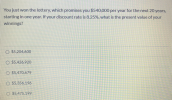 You just won the lottery, which promises you $540,000 per year for the next 20 years, starting in one year. If your discount rate is 8.25%, what is the present value of your winnings? O $5,204,600 O $5,426,920 O $5,470.679 O $5,356,196 O $5.475.199 What is the value of a bond with a par value of $1,000, a coupon rate of 8.50% (semiannual payments), and a yield to maturity of 5.80%? The bond has 14 years to maturity. O $1,256...
General Electric bonds have a par value of $1,000, sell for $1,070, mature in 6 years,...
General Electric bonds have a par value of $1,000, sell for $1,070, mature in 6 years, and have a 7% coupon rate paid annually. a. Calculate the current yield and yield to maturity for this bond. b. Calculate the realized compound yield for an investor with a 4-year horizon and a reinvestment rate of 5% over the period. At the end of the 4 years, assume that the coupon bonds will sell at a YTM of 6%. c. Explain why...
1a) You just learned from your sister that you can buy a $1,000 par value bond...
1a) You just learned from your sister that you can buy a $1,000 par value bond for $800. The coupon rate is ten percent (paid annually), and there are ten years left until the bond matures. You should purchase the bond if your require twelve percent return on bonds with this similar risk level. True/False? 1b) A corporate bond with ten years to maturity has an annual coupon rate of six percent. The bond today is selling for $1,000. With...
Sam Strother and Shawna Tibbs are vice presidents of Mutual of Seattle Insurance Company and co-directors...
Sam Strother and Shawna Tibbs are vice presidents of Mutual of Seattle Insurance Company and co-directors of the company’s pension fund management division. An important new client, the North-Western Municipal Alliance, has requested that Mutual of Seattle present an investment seminar to the mayors of the represented cities, and Strother and Tibbs who will make the presentation, have asked you to help them by answering the following questions. g. Suppose a 10 year 10% semiannual coupon bond with a par...
A coupon bond with a par value of $1,000 and a 10-year maturity pays semiannual coupons...
A coupon bond with a par value of $1,000 and a 10-year maturity pays semiannual coupons of $21. (a) Suppose the yield for this bond is 4% per year compounded semiannually. What is the price of the bond? (b) Is the bond selling above or below par value? Why?
A 10-year corporate bond has an annual coupon of 9%. The bond is currently selling at...
 A 10-year corporate bond has an annual coupon of 9%. The bond is currently selling at par ($1,000). Which of the following statements is CORRECT? The bond's current yield is above 9%. The bond's yield to maturity is above 9%. If the bond's yield to maturity declines, the bond will sell at a discount. The bond's expected capital gains yield is zero.
 * You received no credit for this question in the previous attempt. View previous attempt A 10-year maturity bond with par value of $1,000 makes semiannual coupon payments at a coupon rate of 8%. Find the bond equivalent and effective annual yield to maturity of the bond for the following bond prices. (Round your answers to 2 decimal places.) A 10-year maturity bond with par value of $1,000 makes sen points Bond Prices Effective Annual Yield to Maturity a. $...
 • Comedy Corporation's bonds have a 15-year maturity, a 7% annual coupon paid with semiannual frequency, and a par value of $1,000. The annual interest rate (ra) is 6%, based on semiannual compounding, What is the bond's price? (10 points) 8. a. Find current yield of a 6% coupon bond, currently trading at $1,078. (5 points) b. If the yield to maturity is 4%, find the capital gains yield for the bond above. (5 points)
 A 15-year maturity bond with par value of $1,000 makes semiannual coupon payments at a coupon rate of 8%. Find the bond equivalent and effective annual yield to maturity of the bond for the following bond prices. (Round your answers to 2 decimal places.) Bond Prices Bond Equivalent Annual Yield to Maturity Effective Annual Yield to Maturity a. b. c. $ $ $ 950 1,000 1,050
 You just won the lottery, which promises you $540,000 per year for the next 20 years, starting in one year. If your discount rate is 8.25%, what is the present value of your winnings? O $5,204,600 O $5,426,920 O $5,470.679 O $5,356,196 O $5.475.199 What is the value of a bond with a par value of $1,000, a coupon rate of 8.50% (semiannual payments), and a yield to maturity of 5.80%? The bond has 14 years to maturity. O $1,256...
 A 10-year corporate bond has an annual coupon of 9%. The bond is currently selling at par ($1,000). Which of the following statements is CORRECT? The bond's current yield is above 9%. The bond's yield to maturity is above 9%. If the bond's yield to maturity declines, the bond will sell at a discount. The bond's expected capital gains yield is zero.
Most questions answered within 3 hours.
-
Where is the error in this code sequence?
String s1 = "Hello";
String s2 = "ello";...
asked 10 months ago -
Financial data for Joel de Paris, Inc., for last year
follow:
Joel de Paris, Inc.
Balance...
asked 10 months ago -
Consider this reaction:
Al2(SO4)3 (aq)+ BaCl3
(aq) Al2Cl6 (aq)- +
3BaSO4(s) . What is the...
asked 10 months ago -
Suppose that Savneet is considering increasing her
recent random sample from 20 car rentals to 40...
asked 10 months ago -
Trucks arrive at an unloading terminal at an average rate of 120
per hour.
Trucks arrive...
asked 10 months ago -
Why are methanol and ethanol completely soluble in water while
octanol is not very little soluble....
asked 10 months ago -
A facilities manager at a university reads in a research report
that the mean amount of...
asked 10 months ago -
When the CuSO4 is rehydrated by adding water to the anhydrous
compound, is this an endothermic...
asked 10 months ago -
A ray of sunlight is passing from diamond into crown glass; the
angle of incidence is...
asked 10 months ago -
A block of mass 0.249 kg is placed on top of a light, vertical
spring of...
asked 10 months ago -
how do the kidneys compensate in the presences of acidosis
a) trigger hyperventilate
b) reserve acid...
asked 10 months ago -
Question 501 pts
The rental rate of capital to the firm increases. Which of the
following...
asked 10 months ago