
Homework Answers
Add Answer to:
Chapter 26-Homework Problem 26.36 24 of 24 Constants Part A A diffraction grating has 5570 lines/cm....
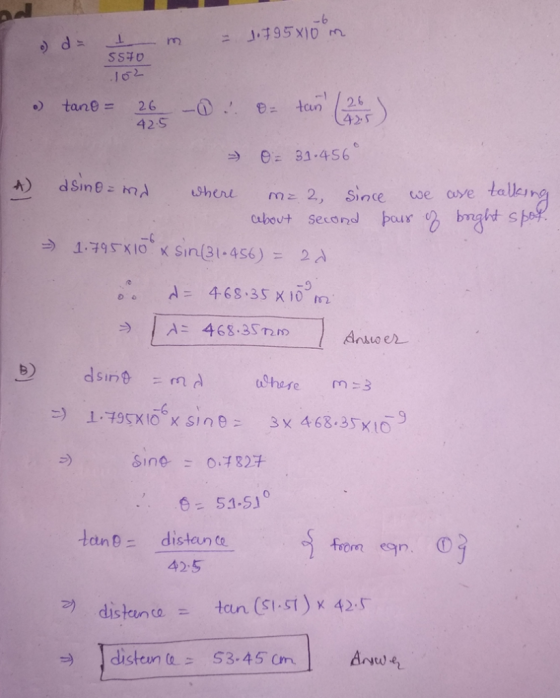
A diffraction grating has 5560 lines/cm . When a beam of monochromatic light goes through it,...
A diffraction grating has 5560 lines/cm . When a beam of monochromatic light goes through it, the second pair of bright spots occurs at ±26.0 cm from the central spot on a screen 42.6 cm past the grating. A) What is the wavelength of this light? in nm B) How far from the central spot does the next pair of bright spots occur on the screen?
A diffraction grating has 5500 lines/cm . When a beam of monochromatic light goes through it,...
A diffraction grating has 5500 lines/cm . When a beam of monochromatic light goes through it, the second pair of bright spots occurs at ±26.0 cm from the central spot on a screen 43.0 cm past the grating. A. What is the wavelength of this light? B. How far from the central spot does the next pair of bright spots occur on the screen?
A diffraction grating has 5590 lines/cm . When a beam of monochromatic light goes through it,...
A diffraction grating has 5590 lines/cm . When a beam of monochromatic light goes through it, the second pair of bright spots occurs at ±26.0 cm from the central spot on a screen 43.0 cm past the grating. A) What is the wavelength of this light? B) How far from the central spot does the next pair of bright spots occur on the screen? Please include steps so I can follow along and understand!
hi if you could please help that would be appreciated Part A If a diffraction grating...
 hi if you could please help that would be appreciated
Part A If a diffraction grating produces a third-order bright spot for red light (of wavelength 690 nm )at 67.0 from the central maximum, at what angle will the second-order bright spot be for violet light (of wavelength 445 nm)? VA ? Submit Request Answer Constants A slit 0.330 mm wide is illuminated by parallel rays of light that have a wavelength of 560 nm. The diffraction pattern is observed...
hi if you could please help that would be appreciated
Part A If a diffraction grating produces a third-order bright spot for red light (of wavelength 690 nm )at 67.0 from the central maximum, at what angle will the second-order bright spot be for violet light (of wavelength 445 nm)? VA ? Submit Request Answer Constants A slit 0.330 mm wide is illuminated by parallel rays of light that have a wavelength of 560 nm. The diffraction pattern is observed...
A thin beam of laser light of wavelength 514 nm passes through a diffraction grating having...
A thin beam of laser light of wavelength 514 nm passes through a diffraction grating having 3952 lines/cm. The resulting pattern is viewed on a distant curved screen that can show all bright fringes up to and including ?90.0? from the central spot. If the experiment were performed with all of the apparatus under water (which has an index of refraction of 1.33), what would be the TOTAL number of bright spots that would show up on the screen?
Short Answer (6 points diffraction grating has 5150 lines diffraction per centimeter ruled on it. It...
 Short Answer (6 points diffraction grating has 5150 lines diffraction per centimeter ruled on it. It is illuminated by a laser with wavelength 633 nm. The a) What is the angular separation between the first- and the third-order bright spots on the same side of the central maximum? pattern is observed on a very wide screen 2.0 meters behind the diffraction grating. b) How many bright spots would you observe on the screen?
A diffraction grating has 5150 lines per centimeter ruled on it. What is the angular separation...
 A diffraction grating has 5150 lines per centimeter ruled on it. What is the angular separation between the first- and the third-order bright spots on the same side of the central maximum when the grating is illuminated by a beam of light with wavelength 633 nm? Knowns, Finds, and Carefully-Drawn & Labeled Diagram
2. You have a diffraction grating with 2500 lines/cm. You also have a light source that...
2. You have a diffraction grating with 2500 lines/cm. You also have a light source that emits light at 2 different wavelengths, 540 nm and 690 nm, at the same time. The screen for your experiment is 1.2 meters from the diffraction grating. A. What is the line spacing for the grating? B. What is the difference in the angle of the 2nd bright fringe for each wavelength for this grating? C. Which wavelength is closer to the center of...
Monochromatic light shines on a diffraction grating with 8,600 lines uniformly distributed over 1.8 cm. The...
Monochromatic light shines on a diffraction grating with 8,600 lines uniformly distributed over 1.8 cm. The grating is illuminated using a laser of 630 nm wavelength. A diffraction pattern is formed on a screen located at 1.7 m away from the grating. (a) What is the angle of the first-order maximum of the 630-nm light incident upon the grating? (b) What is the separation on the screen between the first and the second order maxima? (c) What is the highest...
a red laser, with a wavelength of 640 nm, shines on a diffraction grating with a...
a red laser, with a wavelength of 640 nm, shines on a diffraction grating with a grating spacing of 500 lines/mm. The resulting diffraction pattern is observed on a screen 1.00 meters away from the grating. What is the distance from the central bright spot to the first bright spot on the side chegg
 hi if you could please help that would be appreciated
Part A If a diffraction grating produces a third-order bright spot for red light (of wavelength 690 nm )at 67.0 from the central maximum, at what angle will the second-order bright spot be for violet light (of wavelength 445 nm)? VA ? Submit Request Answer Constants A slit 0.330 mm wide is illuminated by parallel rays of light that have a wavelength of 560 nm. The diffraction pattern is observed...
hi if you could please help that would be appreciated
Part A If a diffraction grating produces a third-order bright spot for red light (of wavelength 690 nm )at 67.0 from the central maximum, at what angle will the second-order bright spot be for violet light (of wavelength 445 nm)? VA ? Submit Request Answer Constants A slit 0.330 mm wide is illuminated by parallel rays of light that have a wavelength of 560 nm. The diffraction pattern is observed...
 Short Answer (6 points diffraction grating has 5150 lines diffraction per centimeter ruled on it. It is illuminated by a laser with wavelength 633 nm. The a) What is the angular separation between the first- and the third-order bright spots on the same side of the central maximum? pattern is observed on a very wide screen 2.0 meters behind the diffraction grating. b) How many bright spots would you observe on the screen?
 A diffraction grating has 5150 lines per centimeter ruled on it. What is the angular separation between the first- and the third-order bright spots on the same side of the central maximum when the grating is illuminated by a beam of light with wavelength 633 nm? Knowns, Finds, and Carefully-Drawn & Labeled Diagram
Most questions answered within 3 hours.
-
Where is the error in this code sequence?
String s1 = "Hello";
String s2 = "ello";...
asked 10 months ago -
Financial data for Joel de Paris, Inc., for last year
follow:
Joel de Paris, Inc.
Balance...
asked 10 months ago -
Consider this reaction:
Al2(SO4)3 (aq)+ BaCl3
(aq) Al2Cl6 (aq)- +
3BaSO4(s) . What is the...
asked 10 months ago -
Suppose that Savneet is considering increasing her
recent random sample from 20 car rentals to 40...
asked 10 months ago -
Trucks arrive at an unloading terminal at an average rate of 120
per hour.
Trucks arrive...
asked 10 months ago -
Why are methanol and ethanol completely soluble in water while
octanol is not very little soluble....
asked 10 months ago -
A facilities manager at a university reads in a research report
that the mean amount of...
asked 10 months ago -
When the CuSO4 is rehydrated by adding water to the anhydrous
compound, is this an endothermic...
asked 10 months ago -
A ray of sunlight is passing from diamond into crown glass; the
angle of incidence is...
asked 10 months ago -
A block of mass 0.249 kg is placed on top of a light, vertical
spring of...
asked 10 months ago -
how do the kidneys compensate in the presences of acidosis
a) trigger hyperventilate
b) reserve acid...
asked 10 months ago -
Question 501 pts
The rental rate of capital to the firm increases. Which of the
following...
asked 10 months ago