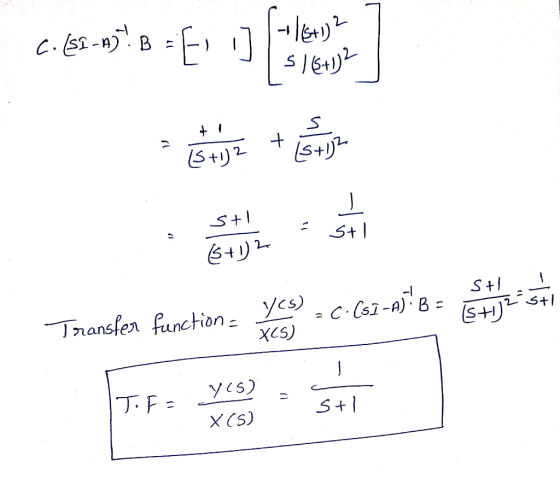
![Problem 1. Find the transfer function of: *10-fi) - arv(o)-e69-L v(e)= cx(o)=[-1 A 1981-C1-4 + |x2]](http://img.homeworklib.com/questions/0a4be610-a23d-11ea-a893-015afba1ae0b.png?x-oss-process=image/resize,w_560)
Homework Answers
![Given lo1 AX+) + B 4Lt) 12112 este Pin ) - 0 + oues 68 =)%] - [8 Juces Sto : x - [ ][3] A-[07],0-[],c-[11] 0-0 Transfer funct](http://img.homeworklib.com/questions/7ee21500-a841-11ea-8037-6dce99011307.png?x-oss-process=image/resize,w_560)
Add Answer to:
Problem 1. Find the transfer function of: *10-fi) - arv(o)-e69-L v(e)= cx(o)=[-1 A 1981-C1-4 + |x2]
Problem 4: Given the transfer function, 25pts 25 H(s) S2+6s 25 (a) (b) (c) Fi Find...
 Problem 4: Given the transfer function, 25pts 25 H(s) S2+6s 25 (a) (b) (c) Fi Find Please put the units. Find the poles of the system. Is this system overdamped, underdamped, the settling time, peak time, percent overshoot, and rise time. undamped or critically damped. Explain. nd the state space representation in phase variable form of the above transfer function H(s)
3 -0.751 (X1,X2, X3) be jointly Gaussian with ux (1,-2,3) and Cx 1. Let X =...
 3 -0.751 (X1,X2, X3) be jointly Gaussian with ux (1,-2,3) and Cx 1. Let X = 3 0.25 4 L-0.75 0.25 Hint: If a set of random variables (RVs) are jointly Gaussian, then any subset of those RVs are also jointly Gaussian. Similarly, adding constants to (or taking linear combinations of) jointly Gaussian RVs results in jointly Gaussian RVs. Using this property you can solve problem 1 without using integration. When appropriate, you may express your answer by saying that...
Find the transfer function using the state and output equations: (-10 1 |-27 0 1||x2|+ |0u;...
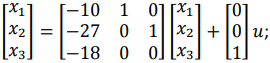 Find the transfer function using the state and output
equations:
(-10 1 |-27 0 1||x2|+ |0u; (-18 0 0l [x3. [X3] Y = [1 0 0] |x2.
Find the transfer function using the state and output
equations:
(-10 1 |-27 0 1||x2|+ |0u; (-18 0 0l [x3. [X3] Y = [1 0 0] |x2.
Question 3 (10 points) In the following multivariate function, find fi an d f2 and f12....
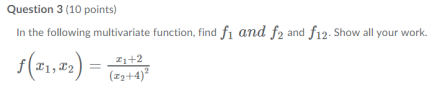 Question 3 (10 points) In the following multivariate function, find fi an d f2 and f12. Show all your work. C1+2 (2+4)2
Problem 1. Electrical Signal Filters Find the transfer function, G(s) = V., for each of the...
 Problem 1. Electrical Signal Filters Find the transfer function, G(s) = V., for each of the following systems. For full credit, use either impedance methods or the differential equation method. I would recommend doing both to prepare for the exam. a) Low-pass filter W R V(O) с V.O b) High-pass filter H! VO) V.) c) Band-pass filter HI R VO) C C2 = R2 V. ()
Find the transfer function H(jω) for the circuit above as a function of jω. (Leave R...
 Find the transfer function H(jω) for the
circuit above as a function of jω. (Leave R and L as variables).
Assume V R to be the output and V S to be the input.
С L RVR(t) vs (t) A. Find the transfer function H(jo) for the circuit above as a function of jaw. (Leave R and L as variables). Assume V to be the output and V to be the input. S R B. Find the Magnitude and Phase...
Find the transfer function H(jω) for the
circuit above as a function of jω. (Leave R and L as variables).
Assume V R to be the output and V S to be the input.
С L RVR(t) vs (t) A. Find the transfer function H(jo) for the circuit above as a function of jaw. (Leave R and L as variables). Assume V to be the output and V to be the input. S R B. Find the Magnitude and Phase...
Problem 4 17. Find the transfer function, G(s) = VL(s)/V(s), for each network shown in Figure...
 Problem 4 17. Find the transfer function, G(s) = VL(s)/V(s), for each network shown in Figure P2.4. [Section: 2.4] 2 H 22 1F -1000 v(t) 203 v(t) (+) 2hvLT 21 vL (1) - (a) FIGURE P2.4
2) (5 points) Find the system's transfer function G (s)--when R = 4 ? and L...
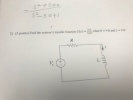 2) (5 points) Find the system's transfer function G (s)--when R = 4 ? and L = 2H. I(s) V,(s) L.
Problem-4: Find a) the transfer function using “Direct Method” if the input is e(t) and the...
 Problem-4: Find a) the transfer function using “Direct Method” if the input is e(t) and the output is eo. For parts b and c, take C = R=1. b) If e(t) = 15, use FVT (if applicable), to determine the steady state value of the zero-state response [(eo)zs]ss. c) If ei(t) = 3cos(2t + 7/3), find steady state response, (eo)ss. * Tivhinois eo Сео
Let X be a random variable with probability density function fx= c1-x2, -1<x<10, &nb...
Let X be a random variable with probability density function fx= c1-x2, -1<x<10, otherwise What is the support of X? What is the value of c? Sketch the probability density function of X. Find P(X<0). Find P(X<0.5). Find P(X<2). Determine the expected value of X.
 Problem 4: Given the transfer function, 25pts 25 H(s) S2+6s 25 (a) (b) (c) Fi Find Please put the units. Find the poles of the system. Is this system overdamped, underdamped, the settling time, peak time, percent overshoot, and rise time. undamped or critically damped. Explain. nd the state space representation in phase variable form of the above transfer function H(s)
 3 -0.751 (X1,X2, X3) be jointly Gaussian with ux (1,-2,3) and Cx 1. Let X = 3 0.25 4 L-0.75 0.25 Hint: If a set of random variables (RVs) are jointly Gaussian, then any subset of those RVs are also jointly Gaussian. Similarly, adding constants to (or taking linear combinations of) jointly Gaussian RVs results in jointly Gaussian RVs. Using this property you can solve problem 1 without using integration. When appropriate, you may express your answer by saying that...
 Find the transfer function using the state and output
equations:
(-10 1 |-27 0 1||x2|+ |0u; (-18 0 0l [x3. [X3] Y = [1 0 0] |x2.
Find the transfer function using the state and output
equations:
(-10 1 |-27 0 1||x2|+ |0u; (-18 0 0l [x3. [X3] Y = [1 0 0] |x2.
 Question 3 (10 points) In the following multivariate function, find fi an d f2 and f12. Show all your work. C1+2 (2+4)2
 Problem 1. Electrical Signal Filters Find the transfer function, G(s) = V., for each of the following systems. For full credit, use either impedance methods or the differential equation method. I would recommend doing both to prepare for the exam. a) Low-pass filter W R V(O) с V.O b) High-pass filter H! VO) V.) c) Band-pass filter HI R VO) C C2 = R2 V. ()
 Find the transfer function H(jω) for the
circuit above as a function of jω. (Leave R and L as variables).
Assume V R to be the output and V S to be the input.
С L RVR(t) vs (t) A. Find the transfer function H(jo) for the circuit above as a function of jaw. (Leave R and L as variables). Assume V to be the output and V to be the input. S R B. Find the Magnitude and Phase...
Find the transfer function H(jω) for the
circuit above as a function of jω. (Leave R and L as variables).
Assume V R to be the output and V S to be the input.
С L RVR(t) vs (t) A. Find the transfer function H(jo) for the circuit above as a function of jaw. (Leave R and L as variables). Assume V to be the output and V to be the input. S R B. Find the Magnitude and Phase...
 Problem 4 17. Find the transfer function, G(s) = VL(s)/V(s), for each network shown in Figure P2.4. [Section: 2.4] 2 H 22 1F -1000 v(t) 203 v(t) (+) 2hvLT 21 vL (1) - (a) FIGURE P2.4
 2) (5 points) Find the system's transfer function G (s)--when R = 4 ? and L = 2H. I(s) V,(s) L.
 Problem-4: Find a) the transfer function using “Direct Method” if the input is e(t) and the output is eo. For parts b and c, take C = R=1. b) If e(t) = 15, use FVT (if applicable), to determine the steady state value of the zero-state response [(eo)zs]ss. c) If ei(t) = 3cos(2t + 7/3), find steady state response, (eo)ss. * Tivhinois eo Сео
Most questions answered within 3 hours.
-
Where is the error in this code sequence?
String s1 = "Hello";
String s2 = "ello";...
asked 10 months ago -
Financial data for Joel de Paris, Inc., for last year
follow:
Joel de Paris, Inc.
Balance...
asked 10 months ago -
Consider this reaction:
Al2(SO4)3 (aq)+ BaCl3
(aq) Al2Cl6 (aq)- +
3BaSO4(s) . What is the...
asked 10 months ago -
Suppose that Savneet is considering increasing her
recent random sample from 20 car rentals to 40...
asked 10 months ago -
Trucks arrive at an unloading terminal at an average rate of 120
per hour.
Trucks arrive...
asked 10 months ago -
Why are methanol and ethanol completely soluble in water while
octanol is not very little soluble....
asked 10 months ago -
A facilities manager at a university reads in a research report
that the mean amount of...
asked 10 months ago -
When the CuSO4 is rehydrated by adding water to the anhydrous
compound, is this an endothermic...
asked 10 months ago -
A ray of sunlight is passing from diamond into crown glass; the
angle of incidence is...
asked 10 months ago -
A block of mass 0.249 kg is placed on top of a light, vertical
spring of...
asked 10 months ago -
how do the kidneys compensate in the presences of acidosis
a) trigger hyperventilate
b) reserve acid...
asked 10 months ago -
Question 501 pts
The rental rate of capital to the firm increases. Which of the
following...
asked 10 months ago