Could someone give some guidance on how to solve c and
d?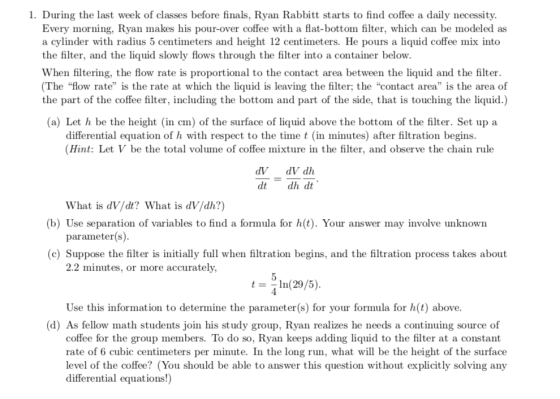
Homework Answers
As you mention only about the 3rd and 4th one, i'll go briefly for the first and 2nd one.
We can write ,
where
is the proportionality constant. And
.
So we get the differential equation as
.
After solving this we get
as,
,
where r is the radius of the cylinder and C is the unknown
arbitrary number, yet to find out.
Now we have to unknown in the equation k and C, to find these we need to two equation. This conditions are given the 3rd problem. Initially the filter was full i.e ate t=0, h=12 cm and when t=2.2 min, h=0 as filtration process was over.
Now inputting the 1st condition in the previous equation we get
,
and putting the 2nd condition we get,
,
rearranging this equation and putting the value of
we get
cm/min.
So
cm/min.
Getting k a -ve number was quite normal because
becomes a -ve number which means as time increase volume will
decrease.
For thew fourth part, as rate of volume is constant the filter
tube will maintain a height of
.
Add Answer to:
Could someone give some guidance on how to solve c and
d?
1. During the last...
I only want the answer for No 2 Note: The time it takes to get a two-liter bottle empty is given in the picture I only...
 I only want the answer for No 2
Note: The time it takes to get a two-liter
bottle empty is given in the picture
I only want the answer for No 2
Let h(t) and V(t) be the height and volume of water in a tank at time t. If water drains through a hole with area a at the bottom of the tank, then Torricelli's Law says that dV dt where g is the acceleration due to gravity. So...
I only want the answer for No 2
Note: The time it takes to get a two-liter
bottle empty is given in the picture
I only want the answer for No 2
Let h(t) and V(t) be the height and volume of water in a tank at time t. If water drains through a hole with area a at the bottom of the tank, then Torricelli's Law says that dV dt where g is the acceleration due to gravity. So...
Assume that the shape of the dispensers are surfaces of revolution so that A(h)=π[r(h)]²
 Designing a Drip Dispenser for a Hydrology ExperimentIn order to make laboratory measurements of water filtration and saturation rates in various types of soils under the condition of steady rainfall, a hydrologist wishes to design drip dispensing containers in such a way that the water drips out at a nearly constant rate. The containers are supported above glass cylinders that contain the soil samples (Figure 2.P.1). The hydrologist elects to use the following differential equation, based on Torricelli's principle to...
 I only want the answer for No 2
Note: The time it takes to get a two-liter
bottle empty is given in the picture
I only want the answer for No 2
Let h(t) and V(t) be the height and volume of water in a tank at time t. If water drains through a hole with area a at the bottom of the tank, then Torricelli's Law says that dV dt where g is the acceleration due to gravity. So...
I only want the answer for No 2
Note: The time it takes to get a two-liter
bottle empty is given in the picture
I only want the answer for No 2
Let h(t) and V(t) be the height and volume of water in a tank at time t. If water drains through a hole with area a at the bottom of the tank, then Torricelli's Law says that dV dt where g is the acceleration due to gravity. So...
 Designing a Drip Dispenser for a Hydrology ExperimentIn order to make laboratory measurements of water filtration and saturation rates in various types of soils under the condition of steady rainfall, a hydrologist wishes to design drip dispensing containers in such a way that the water drips out at a nearly constant rate. The containers are supported above glass cylinders that contain the soil samples (Figure 2.P.1). The hydrologist elects to use the following differential equation, based on Torricelli's principle to...
Most questions answered within 3 hours.
-
Where is the error in this code sequence?
String s1 = "Hello";
String s2 = "ello";...
asked 10 months ago -
Financial data for Joel de Paris, Inc., for last year
follow:
Joel de Paris, Inc.
Balance...
asked 10 months ago -
Consider this reaction:
Al2(SO4)3 (aq)+ BaCl3
(aq) Al2Cl6 (aq)- +
3BaSO4(s) . What is the...
asked 10 months ago -
Suppose that Savneet is considering increasing her
recent random sample from 20 car rentals to 40...
asked 10 months ago -
Trucks arrive at an unloading terminal at an average rate of 120
per hour.
Trucks arrive...
asked 10 months ago -
Why are methanol and ethanol completely soluble in water while
octanol is not very little soluble....
asked 10 months ago -
A facilities manager at a university reads in a research report
that the mean amount of...
asked 10 months ago -
When the CuSO4 is rehydrated by adding water to the anhydrous
compound, is this an endothermic...
asked 10 months ago -
A ray of sunlight is passing from diamond into crown glass; the
angle of incidence is...
asked 10 months ago -
A block of mass 0.249 kg is placed on top of a light, vertical
spring of...
asked 10 months ago -
how do the kidneys compensate in the presences of acidosis
a) trigger hyperventilate
b) reserve acid...
asked 10 months ago -
Question 501 pts
The rental rate of capital to the firm increases. Which of the
following...
asked 10 months ago