
Homework Answers
Add Answer to:
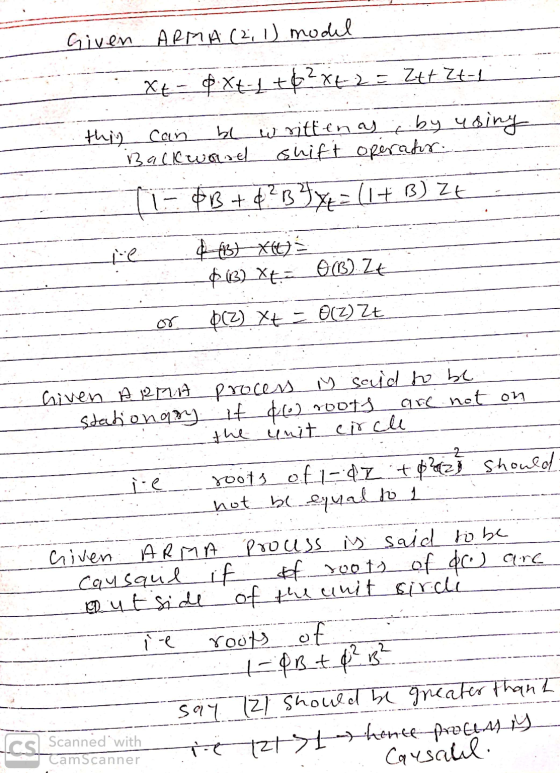
Consider ARMA(2.1) model X4 - X:-1 +62X-2 = 2+ 2-1. When the process is stationary and...
2. Consider an ARMA(1,1) process, X4 = 0.5X:-1 +0+ - 0.25a4-1, where az is white noise...
 2. Consider an ARMA(1,1) process, X4 = 0.5X:-1 +0+ - 0.25a4-1, where az is white noise with zero mean and unit variance. (a) Is the model stationary? Explain your answer briefly. (b) Is the model invertible? Explain your answer briefly. (c) Find the infinite moving-average representation of Xt. Namely, find b; such that X =< 0;&–; j=0 (d) Evaluate the first three lags of the ACF and PACF.
2. Consider an ARM A(2,2) model h" ф.xt-1-фг%2 :: at + at-NI 1at-1 + 20.-2, a. Under what condition, the above A...
 2. Consider an ARM A(2,2) model h" ф.xt-1-фг%2 :: at + at-NI 1at-1 + 20.-2, a. Under what condition, the above ARMA(2,2) model is causal/stationary. b. Under what condition, the above ARMA(2,2) model is invertible. State the reason for us to consider an invertible ARMA model. Suppose that xt is causal, i.e. C. Calculate , j = 1,2,3,4,5,6. d. Suppose that x is invertible, i.e. Calculate nj, j-1,2,3,4,5,6.
2. Consider an ARM A(2,2) model h" ф.xt-1-фг%2 :: at + at-NI...
2. Consider an ARM A(2,2) model h" ф.xt-1-фг%2 :: at + at-NI 1at-1 + 20.-2, a. Under what condition, the above ARMA(2,2) model is causal/stationary. b. Under what condition, the above ARMA(2,2) model is invertible. State the reason for us to consider an invertible ARMA model. Suppose that xt is causal, i.e. C. Calculate , j = 1,2,3,4,5,6. d. Suppose that x is invertible, i.e. Calculate nj, j-1,2,3,4,5,6.
2. Consider an ARM A(2,2) model h" ф.xt-1-фг%2 :: at + at-NI...
QUESTION 3 (a) Consider the ARMA (1, 1) process -Bat-1-where o and θ are model parame-...
 QUESTION 3 (a) Consider the ARMA (1, 1) process -Bat-1-where o and θ are model parame- are independent and identically distributed random variables with mean 0 z, oz,-1 ters, and a1, a2, and variance σ (i) Show that the variance of the process is γ,- (ii) Using (i) or otherwise, show that the autocorrelation function (ACF) of the process is: ifk=0. (b) Let Y be an AR(2) process of the special form Y-2Y-2e (i) Find the range of values of...
Q1. (10 points total) Consider an ARMA(1,1) model X4 = 0.9X-1 + Z+ +0.527-1, {Z4}~ IID...
 Q1. (10 points total) Consider an ARMA(1,1) model X4 = 0.9X-1 + Z+ +0.527-1, {Z4}~ IID N(0,1). 1. (2 points) (i) Generate n = 200 observations from this ARMA model. (ii) Find the maximum likelihood (ML) estimates of the three parameters o, e, and o2. 2. (8 points) Repeat (i) and (ii) in part 1 nine more times using all different seed numbers. Compare the estimates to their true values. Are the average of 10 estimates for each parameter close...
4. (Forecasting an ARMA(2,2) process) Consider the ARMA(2,2) process: y = 0,8-1 + 0,8-2 + 4...
 4. (Forecasting an ARMA(2,2) process) Consider the ARMA(2,2) process: y = 0,8-1 + 0,8-2 + 4 + 0,8-1 +0,4-2 a. Verify that the optimal 1-step ahead forecast made at time T is YT+1,0,+ $y- + 0,4 +0,9-1 b. Verify that the optimal 2-step ahead forecast made at time is YT.27 - $,$t1,7 * 0,81 +0, and express it purely in terms of elements of the time-T information set e. Verify that the optimal 3-step ahead forecast made at time is...
Consider the following ARMA(1,1) Process: Describe the ACF and the PACF plot for the process. Is...
Consider the following ARMA(1,1) Process: Describe the ACF and the PACF plot for the process. Is the process stationary or invertible? (Assume that Also, )
If you model a time series Yt using a stationary ARMA process with a nonzero constant...
If you model a time series Yt using a stationary ARMA process with a nonzero constant (µ unequal to 0) and use it to forecast future values of Yt, then as you forecast further and further into the future, the confidence interval widths for your forecasts will (a) continue to increase and eventually reach arbitrarily large values. (b) gradually decay to zero. (c) cutoff to zero after some lag. (d) converge to a non-zero limiting value.
Consider the following AR(2) model: Xt – Xt–1 + + X4-2 = Zt, Z4 ~ WN(0,1)....
 Consider the following AR(2) model: Xt – Xt–1 + + X4-2 = Zt, Z4 ~ WN(0,1). (a) Show that X+ is causal. (b) Find the first four coefficients (VO, ..., 43) of the MA(0) representation of Xt. (c) Find the pacf at lag 3, 233, of the AR(2) model.
QUESTION 3 (a) Consider the ARMA(1, 1) process Zt-oZt_itat-θ4-1 :Where φ and θ are model parame-...
 QUESTION 3 (a) Consider the ARMA(1, 1) process Zt-oZt_itat-θ4-1 :Where φ and θ are model parame- ters, and a, a are independent and identically distributed random variables with mean 0 and variance σ 1-1.4. (i) Show that the variance of the process is γ,- (i) Using () or otherwise, show that the autocorrelation function (ACF) of the process is: if k 0,
Consider the ARMA(2,1) model 2+ = 0.624-1 -0.092-2 + at – 0.204-1, a4~WN(0,1) Find the AR...
 Consider the ARMA(2,1) model 2+ = 0.624-1 -0.092-2 + at – 0.204-1, a4~WN(0,1) Find the AR representation of {Z}.
 2. Consider an ARMA(1,1) process, X4 = 0.5X:-1 +0+ - 0.25a4-1, where az is white noise with zero mean and unit variance. (a) Is the model stationary? Explain your answer briefly. (b) Is the model invertible? Explain your answer briefly. (c) Find the infinite moving-average representation of Xt. Namely, find b; such that X =< 0;&–; j=0 (d) Evaluate the first three lags of the ACF and PACF.
 2. Consider an ARM A(2,2) model h" ф.xt-1-фг%2 :: at + at-NI 1at-1 + 20.-2, a. Under what condition, the above ARMA(2,2) model is causal/stationary. b. Under what condition, the above ARMA(2,2) model is invertible. State the reason for us to consider an invertible ARMA model. Suppose that xt is causal, i.e. C. Calculate , j = 1,2,3,4,5,6. d. Suppose that x is invertible, i.e. Calculate nj, j-1,2,3,4,5,6.
2. Consider an ARM A(2,2) model h" ф.xt-1-фг%2 :: at + at-NI...
2. Consider an ARM A(2,2) model h" ф.xt-1-фг%2 :: at + at-NI 1at-1 + 20.-2, a. Under what condition, the above ARMA(2,2) model is causal/stationary. b. Under what condition, the above ARMA(2,2) model is invertible. State the reason for us to consider an invertible ARMA model. Suppose that xt is causal, i.e. C. Calculate , j = 1,2,3,4,5,6. d. Suppose that x is invertible, i.e. Calculate nj, j-1,2,3,4,5,6.
2. Consider an ARM A(2,2) model h" ф.xt-1-фг%2 :: at + at-NI...
 QUESTION 3 (a) Consider the ARMA (1, 1) process -Bat-1-where o and θ are model parame- are independent and identically distributed random variables with mean 0 z, oz,-1 ters, and a1, a2, and variance σ (i) Show that the variance of the process is γ,- (ii) Using (i) or otherwise, show that the autocorrelation function (ACF) of the process is: ifk=0. (b) Let Y be an AR(2) process of the special form Y-2Y-2e (i) Find the range of values of...
 Q1. (10 points total) Consider an ARMA(1,1) model X4 = 0.9X-1 + Z+ +0.527-1, {Z4}~ IID N(0,1). 1. (2 points) (i) Generate n = 200 observations from this ARMA model. (ii) Find the maximum likelihood (ML) estimates of the three parameters o, e, and o2. 2. (8 points) Repeat (i) and (ii) in part 1 nine more times using all different seed numbers. Compare the estimates to their true values. Are the average of 10 estimates for each parameter close...
 4. (Forecasting an ARMA(2,2) process) Consider the ARMA(2,2) process: y = 0,8-1 + 0,8-2 + 4 + 0,8-1 +0,4-2 a. Verify that the optimal 1-step ahead forecast made at time T is YT+1,0,+ $y- + 0,4 +0,9-1 b. Verify that the optimal 2-step ahead forecast made at time is YT.27 - $,$t1,7 * 0,81 +0, and express it purely in terms of elements of the time-T information set e. Verify that the optimal 3-step ahead forecast made at time is...
 Consider the following AR(2) model: Xt – Xt–1 + + X4-2 = Zt, Z4 ~ WN(0,1). (a) Show that X+ is causal. (b) Find the first four coefficients (VO, ..., 43) of the MA(0) representation of Xt. (c) Find the pacf at lag 3, 233, of the AR(2) model.
 QUESTION 3 (a) Consider the ARMA(1, 1) process Zt-oZt_itat-θ4-1 :Where φ and θ are model parame- ters, and a, a are independent and identically distributed random variables with mean 0 and variance σ 1-1.4. (i) Show that the variance of the process is γ,- (i) Using () or otherwise, show that the autocorrelation function (ACF) of the process is: if k 0,
 Consider the ARMA(2,1) model 2+ = 0.624-1 -0.092-2 + at – 0.204-1, a4~WN(0,1) Find the AR representation of {Z}.
Most questions answered within 3 hours.
-
Where is the error in this code sequence?
String s1 = "Hello";
String s2 = "ello";...
asked 10 months ago -
Financial data for Joel de Paris, Inc., for last year
follow:
Joel de Paris, Inc.
Balance...
asked 10 months ago -
Consider this reaction:
Al2(SO4)3 (aq)+ BaCl3
(aq) Al2Cl6 (aq)- +
3BaSO4(s) . What is the...
asked 10 months ago -
Suppose that Savneet is considering increasing her
recent random sample from 20 car rentals to 40...
asked 10 months ago -
Trucks arrive at an unloading terminal at an average rate of 120
per hour.
Trucks arrive...
asked 10 months ago -
Why are methanol and ethanol completely soluble in water while
octanol is not very little soluble....
asked 10 months ago -
A facilities manager at a university reads in a research report
that the mean amount of...
asked 10 months ago -
When the CuSO4 is rehydrated by adding water to the anhydrous
compound, is this an endothermic...
asked 10 months ago -
A ray of sunlight is passing from diamond into crown glass; the
angle of incidence is...
asked 10 months ago -
A block of mass 0.249 kg is placed on top of a light, vertical
spring of...
asked 10 months ago -
how do the kidneys compensate in the presences of acidosis
a) trigger hyperventilate
b) reserve acid...
asked 10 months ago -
Question 501 pts
The rental rate of capital to the firm increases. Which of the
following...
asked 10 months ago