CH 3CH 2OCH 2CH 3, is best classified as a ____.

Homework Answers

Add Answer to:
CH 3CH 2OCH 2CH 3, is best classified as a ____.
QUESTION 7 10 points S....
Part A: Part B: A small amount of methanol (CH,OH) is dissolved in a large amount...
 Part A:
Part B:
A small amount of methanol (CH,OH) is dissolved in a large amount of water. Imagine separating this process into the four stages sketched below. (These sketches show only a portion of the substances, so you can see the density and distribution of atoms and molecules in them.) A с D 09 CH OH H,0 solution Use these sketches to answer the questions in the table below. The enthalpy of solution AH soin is positive when CH3OH...
Part A:
Part B:
A small amount of methanol (CH,OH) is dissolved in a large amount of water. Imagine separating this process into the four stages sketched below. (These sketches show only a portion of the substances, so you can see the density and distribution of atoms and molecules in them.) A с D 09 CH OH H,0 solution Use these sketches to answer the questions in the table below. The enthalpy of solution AH soin is positive when CH3OH...
Page 1 37 The following compound is classified as a e. 38. CH,(CH). CH=CHCHOH O CH–NH-C(CH4)2CH,...
 Page 1 37 The following compound is classified as a e. 38. CH,(CH). CH=CHCHOH O CH–NH-C(CH4)2CH, CH--0-Carbohydrate a. sphingophospholipid b. phosphoglyceride c. glycosphingolipid d. triglyceride none of the above are correct The normal concentration of glucose in the blood should be about 65-95 mg/100 ml 140-160 mg/100 ml below 60 mg/100 ml d. above 160 mg/100 ml The following compound is classified as CH,(CH,), CO,CHỊCH,CHÚCH,CHÚCH CHÍCH CHÚCH,CH,CH,CHỊCH, an oil. a wax glyceride. d. terpene. a. b. c. 39. a. b....
Q8 The molecular structure of an organic compound is shown in the accompanying image. Based upon...
 Q8 The molecular structure of an organic compound is shown in the accompanying image. Based upon the molecular structure this compound most likely is a(n) _ H2 C. H Select an answer and submit. For keyboard navigation, use the up/down arrow keys to select an answer. a Arrhenius base b Arrhenius acid с Brønsted - Lowry acid d Brønsted - Lowry base both an Arrhenius and Brønsted - Lowry acid f both an Arrhenius and Brønsted - Lowry base Answered...
Al(OH)3 + OH- → Al(OH)4- Identify whether this reaction can be classified as a Bronsted-Lowry and/or Lewis...
Al(OH)3 + OH- → Al(OH)4- Identify whether this reaction can be classified as a Bronsted-Lowry and/or Lewis acid/base reaction. Group of answer choices A. Only Bronsted-Lowry B. Only Lewis C. Both Bronsted-Lowry and Lewis D. Neither
For each of the following problems, pick the choice that BEST fits the statement. In the...
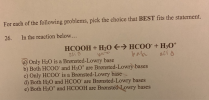 For each of the following problems, pick the choice that BEST fits the statement. In the reaction below... 26. HCOO + H30* HCOOH+ H20 aOnly H20 is a Brønsted-Lowry base b) Both HCOO and H30* are Breønsted-Lowry bases c) Only HCOO is a Brønsted-Lowry base d) Both H20 and HCOO are Brønsted-Lowry bases e) Both H3O* and HCOOH are Brønsted Lowry bases
Procaine is used as an anesthetic. What is the best description of procaine? A a diprotic...
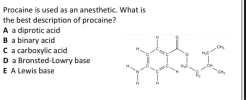 Procaine is used as an anesthetic. What is the best description of procaine? A a diprotic acid B a binary acid C a carboxylic acid D a Bronsted-Lowry base E A Lewis base 0 CH3 ње CH CH3 H2
CHM 201 Organic Chemistry 1 Homework Assignment #3 Chapter 03 Introduction to Organic Reaction Mechanism (Acid-Base)...
 CHM 201 Organic Chemistry 1 Homework Assignment #3 Chapter 03 Introduction to Organic Reaction Mechanism (Acid-Base) (Total: 100 points) (1-10: 5 pts/each) 1. What is/are the product(s) of the following acid-base mechanism? Li Li +(CH3)2NH a) b) он (CH3)2NH + + (CH3)2NH c) d) Li e) None of these choices. 2. Which of these is not a true statement? a) All Lewis bases are also Bronsted-Lowry bases. b) All Lewis acids contain hydrogen. c) All Bronsted-Lowry acids contain hydrogen. d)...
4. Explain things in the following question(s) In each reaction, identify the Brønsted-Lowry acid, the Brønsted-Lowry...
 4. Explain things in the following question(s) In each reaction, identify the Brønsted-Lowry acid, the Brønsted-Lowry base, the conjugate acid, and the conjugate base. (a) H2SO4(aq) + H2O(l) —— HSO4 (aq) + H30+(aq) (b) HCO3(aq) + H20(1) = H,CO3(aq) + OH(aq) 5. Using examples, distinguish between a Nucleophile vs Electrophile. Give at least 2 differences between the 2 concepts 6. What are curved arrows or "curly arrows" in Organic Chemistry? What do they represent? Give an example (b) Using Ammonia...
3(b). Define an Arrhenius Acid vs An Arrhenius Base? Give examples in cach case? (c) Define...
 3(b). Define an Arrhenius Acid vs An Arrhenius Base? Give examples in cach case? (c) Define a Brownstead -Lorry Acid vs A base. Give Examples 4. Explain things in the following question(s) In each reaction, identify the Brønsted-Lowry acid, the Brønsted-Lowry base, the conjugate acid, and the conjugate base. (a) H2SO4(aq) + H2O(1) - HSO4 (aq) + H30+(aq) (b) HCO3(aq) + H20(I) = H,CO3(aq) + OH(aq) 5. Using examples, distinguish between a Nucleophile vs Electrophile. Give at least 2 differences...
question 7 8 9 10 11 12 (7) Use HSAB theory to predict the following reactions...
 question 7 8 9 10 11 12
(7) Use HSAB theory to predict the following reactions will go or not go (a) CH3-CH3 + H2O → CH,OH+CH (AH = 12 kcal/mol) (b) CH3COCH3 + H2O → CH3COOH + CH, (AH--13 kcal/mol ) (6%) (8) Predict the order of solubility: (9%) (a) MgSO4, CaSO4, SISOs, and Baso. (c) AgF, AgCl, AgBr, and Ag! (b) PbCI, PbBry, and Pbi! (9) List the following acids in order of acid strength in aqueous solution:...
question 7 8 9 10 11 12
(7) Use HSAB theory to predict the following reactions will go or not go (a) CH3-CH3 + H2O → CH,OH+CH (AH = 12 kcal/mol) (b) CH3COCH3 + H2O → CH3COOH + CH, (AH--13 kcal/mol ) (6%) (8) Predict the order of solubility: (9%) (a) MgSO4, CaSO4, SISOs, and Baso. (c) AgF, AgCl, AgBr, and Ag! (b) PbCI, PbBry, and Pbi! (9) List the following acids in order of acid strength in aqueous solution:...
 Part A:
Part B:
A small amount of methanol (CH,OH) is dissolved in a large amount of water. Imagine separating this process into the four stages sketched below. (These sketches show only a portion of the substances, so you can see the density and distribution of atoms and molecules in them.) A с D 09 CH OH H,0 solution Use these sketches to answer the questions in the table below. The enthalpy of solution AH soin is positive when CH3OH...
Part A:
Part B:
A small amount of methanol (CH,OH) is dissolved in a large amount of water. Imagine separating this process into the four stages sketched below. (These sketches show only a portion of the substances, so you can see the density and distribution of atoms and molecules in them.) A с D 09 CH OH H,0 solution Use these sketches to answer the questions in the table below. The enthalpy of solution AH soin is positive when CH3OH...
 Page 1 37 The following compound is classified as a e. 38. CH,(CH). CH=CHCHOH O CH–NH-C(CH4)2CH, CH--0-Carbohydrate a. sphingophospholipid b. phosphoglyceride c. glycosphingolipid d. triglyceride none of the above are correct The normal concentration of glucose in the blood should be about 65-95 mg/100 ml 140-160 mg/100 ml below 60 mg/100 ml d. above 160 mg/100 ml The following compound is classified as CH,(CH,), CO,CHỊCH,CHÚCH,CHÚCH CHÍCH CHÚCH,CH,CH,CHỊCH, an oil. a wax glyceride. d. terpene. a. b. c. 39. a. b....
 Q8 The molecular structure of an organic compound is shown in the accompanying image. Based upon the molecular structure this compound most likely is a(n) _ H2 C. H Select an answer and submit. For keyboard navigation, use the up/down arrow keys to select an answer. a Arrhenius base b Arrhenius acid с Brønsted - Lowry acid d Brønsted - Lowry base both an Arrhenius and Brønsted - Lowry acid f both an Arrhenius and Brønsted - Lowry base Answered...
 For each of the following problems, pick the choice that BEST fits the statement. In the reaction below... 26. HCOO + H30* HCOOH+ H20 aOnly H20 is a Brønsted-Lowry base b) Both HCOO and H30* are Breønsted-Lowry bases c) Only HCOO is a Brønsted-Lowry base d) Both H20 and HCOO are Brønsted-Lowry bases e) Both H3O* and HCOOH are Brønsted Lowry bases
 Procaine is used as an anesthetic. What is the best description of procaine? A a diprotic acid B a binary acid C a carboxylic acid D a Bronsted-Lowry base E A Lewis base 0 CH3 ње CH CH3 H2
 CHM 201 Organic Chemistry 1 Homework Assignment #3 Chapter 03 Introduction to Organic Reaction Mechanism (Acid-Base) (Total: 100 points) (1-10: 5 pts/each) 1. What is/are the product(s) of the following acid-base mechanism? Li Li +(CH3)2NH a) b) он (CH3)2NH + + (CH3)2NH c) d) Li e) None of these choices. 2. Which of these is not a true statement? a) All Lewis bases are also Bronsted-Lowry bases. b) All Lewis acids contain hydrogen. c) All Bronsted-Lowry acids contain hydrogen. d)...
 4. Explain things in the following question(s) In each reaction, identify the Brønsted-Lowry acid, the Brønsted-Lowry base, the conjugate acid, and the conjugate base. (a) H2SO4(aq) + H2O(l) —— HSO4 (aq) + H30+(aq) (b) HCO3(aq) + H20(1) = H,CO3(aq) + OH(aq) 5. Using examples, distinguish between a Nucleophile vs Electrophile. Give at least 2 differences between the 2 concepts 6. What are curved arrows or "curly arrows" in Organic Chemistry? What do they represent? Give an example (b) Using Ammonia...
 3(b). Define an Arrhenius Acid vs An Arrhenius Base? Give examples in cach case? (c) Define a Brownstead -Lorry Acid vs A base. Give Examples 4. Explain things in the following question(s) In each reaction, identify the Brønsted-Lowry acid, the Brønsted-Lowry base, the conjugate acid, and the conjugate base. (a) H2SO4(aq) + H2O(1) - HSO4 (aq) + H30+(aq) (b) HCO3(aq) + H20(I) = H,CO3(aq) + OH(aq) 5. Using examples, distinguish between a Nucleophile vs Electrophile. Give at least 2 differences...
 question 7 8 9 10 11 12
(7) Use HSAB theory to predict the following reactions will go or not go (a) CH3-CH3 + H2O → CH,OH+CH (AH = 12 kcal/mol) (b) CH3COCH3 + H2O → CH3COOH + CH, (AH--13 kcal/mol ) (6%) (8) Predict the order of solubility: (9%) (a) MgSO4, CaSO4, SISOs, and Baso. (c) AgF, AgCl, AgBr, and Ag! (b) PbCI, PbBry, and Pbi! (9) List the following acids in order of acid strength in aqueous solution:...
question 7 8 9 10 11 12
(7) Use HSAB theory to predict the following reactions will go or not go (a) CH3-CH3 + H2O → CH,OH+CH (AH = 12 kcal/mol) (b) CH3COCH3 + H2O → CH3COOH + CH, (AH--13 kcal/mol ) (6%) (8) Predict the order of solubility: (9%) (a) MgSO4, CaSO4, SISOs, and Baso. (c) AgF, AgCl, AgBr, and Ag! (b) PbCI, PbBry, and Pbi! (9) List the following acids in order of acid strength in aqueous solution:...
Most questions answered within 3 hours.
-
Where is the error in this code sequence?
String s1 = "Hello";
String s2 = "ello";...
asked 10 months ago -
Financial data for Joel de Paris, Inc., for last year
follow:
Joel de Paris, Inc.
Balance...
asked 10 months ago -
Consider this reaction:
Al2(SO4)3 (aq)+ BaCl3
(aq) Al2Cl6 (aq)- +
3BaSO4(s) . What is the...
asked 10 months ago -
Suppose that Savneet is considering increasing her
recent random sample from 20 car rentals to 40...
asked 10 months ago -
Trucks arrive at an unloading terminal at an average rate of 120
per hour.
Trucks arrive...
asked 10 months ago -
Why are methanol and ethanol completely soluble in water while
octanol is not very little soluble....
asked 10 months ago -
A facilities manager at a university reads in a research report
that the mean amount of...
asked 10 months ago -
When the CuSO4 is rehydrated by adding water to the anhydrous
compound, is this an endothermic...
asked 10 months ago -
A ray of sunlight is passing from diamond into crown glass; the
angle of incidence is...
asked 10 months ago -
A block of mass 0.249 kg is placed on top of a light, vertical
spring of...
asked 10 months ago -
how do the kidneys compensate in the presences of acidosis
a) trigger hyperventilate
b) reserve acid...
asked 10 months ago -
Question 501 pts
The rental rate of capital to the firm increases. Which of the
following...
asked 10 months ago