
Homework Answers
Add Answer to:
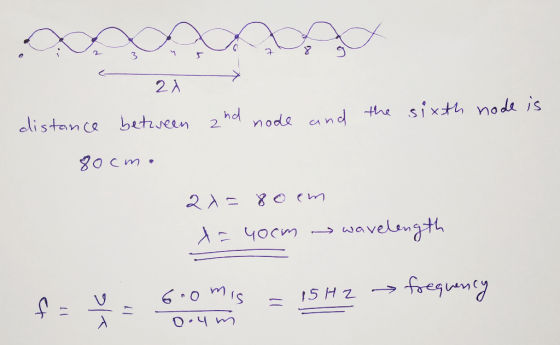
maade wam c an... 4. Standing waves are produced in a string by two waves traveling...
Two sinusoidal waves traveling in opposite directions interfere to produce a standing wave with the following...
 Two sinusoidal waves traveling in opposite directions interfere to produce a standing wave with the following wave function, where x is in meters and t is in seconds. y = (3.00 m) sin(0.200x) cos(2006) Determine the wavelength of the interfering waves. What is the frequency of the interfering waves? Hz Find the speed of the interfering waves. m/s Two sinusoidal waves combining in a medium are described by the following wave functions, where x is in centimeters and t is...
Two sinusoidal waves traveling in opposite directions interfere to produce a standing wave with the following...
 Two sinusoidal waves traveling in opposite directions interfere to produce a standing wave with the following wave function, where x is in meters and t is in seconds. y = (3.00 m) sin(0.900x) cos(6000) Determine the wavelength of the interfering waves. m What is the frequency of the interfering waves? Hz Find the speed of the interfering waves. m/s
Two sinusoidal waves traveling in opposite directions interfere to produce a standing wave with the following...
Two sinusoidal waves traveling in opposite directions interfere to produce a standing wave with the following wave function, where x is in meters and t is in seconds. y = (3.00 m) sin(0.800x) cos(600t) Determine the wavelength of the interfering waves. m What is the frequency of the interfering waves? Hz Find the speed of the interfering waves. m/s
no 1 and 2 Homework 3A: Standing Waves 1. Two waves propagate in one direction on...
 no 1 and 2
Homework 3A: Standing Waves 1. Two waves propagate in one direction on a stretched rope. The frequency of the waves is 120 Hz. Both have the same amplitude of 4 cm and wavelength of 0.04 m. (a) Determine the amplitude of the resultant wave if the two original waves differ in phase by Tm/3? (b) What is the phase difference between the two waves if the amplitude of the resultant wave is 0.05 cm? 2. Two...
no 1 and 2
Homework 3A: Standing Waves 1. Two waves propagate in one direction on a stretched rope. The frequency of the waves is 120 Hz. Both have the same amplitude of 4 cm and wavelength of 0.04 m. (a) Determine the amplitude of the resultant wave if the two original waves differ in phase by Tm/3? (b) What is the phase difference between the two waves if the amplitude of the resultant wave is 0.05 cm? 2. Two...
Two waves traveling on a string in the same direction both have a frequency of 100...
Two waves traveling on a string in the same direction both have a frequency of 100 Hz, a wavelength of 2 cm and an amplitude of 0.02 m. What is the amplitude of the resultant wave if the original wave differ in phase by: π/6 π/3 What is the phase difference between the waves if the amplitude of the resultant wave is 0.02 m, the same as the original wave?
Two waves traveling on a string in the same direction both have a frequency of 125...
 Two waves traveling on a string in the same direction both have a frequency of 125 Hz, a wavelength of 2 cm, and an amplitude of 0.06 m. What is the amplitude of the resultant wave if the original waves differ in phase by each of the following values? (a) */6 cm (b) / cm eBook
Two waves traveling on a string in the same direction both have a frequency of 100...
Two waves traveling on a string in the same direction both have a frequency of 100 Hz, a wavelength of 2 cm, and an amplitude of 0.06 m. What is the amplitude of the resultant wave if the original waves differ in phase by each of the following values? (a) π/6 cm (b) π/3 cm
In the standing waves experiment done in physics lab, a string of mass density 0.375 ±...
In the standing waves experiment done in physics lab, a string of mass density 0.375 ± 0.002 g/m was used. The distance between the (fixed) ends of the string is approximately 1.50 ± 0.02 m. Determine the wavelength of the n = 3 standing waves. If the oscillator frequency is 80.0 ± 0.2 Hz, determine the tension in the string needed for the n = 5 standing waves. answers >>[1.00 ± 0.01 m, 0.864 ± 0.032 N]
Question 8 (2 points) Two harmonic waves traveling in opposite directions interfere to produce a standing...
 Question 8 (2 points) Two harmonic waves traveling in opposite directions interfere to produce a standing wave described by y = 2 (sin nx) (cos 3nt) where X is in meters and t is in seconds. What is the distance between a pair of neighboring antinodes? 0.5 m 1.0 m 2.0 m 4.Om 8.0 m
Question 4 to 11 plz Dr? Standing Waves on a String Physics Topics If necessary, review...
 Question 4 to 11 plz Dr?
Standing Waves on a String Physics Topics If necessary, review the following topics and relevant textbook sections from Serway / Jewett "Physics for Scientists and Engineers", 9th Ed. • Mathematics of Traveling Waves (Serway 17.2) • Speed of Waves on a String (Serway 17.3) • Superposition of Waves (Serway 18.1) • Standing Waves on a string (Serway 18.2, 18.3) Introduction Imagine two sinusoidal traveling waves with equal amplitudes and frequencies moving in opposite directions....
Question 4 to 11 plz Dr?
Standing Waves on a String Physics Topics If necessary, review the following topics and relevant textbook sections from Serway / Jewett "Physics for Scientists and Engineers", 9th Ed. • Mathematics of Traveling Waves (Serway 17.2) • Speed of Waves on a String (Serway 17.3) • Superposition of Waves (Serway 18.1) • Standing Waves on a string (Serway 18.2, 18.3) Introduction Imagine two sinusoidal traveling waves with equal amplitudes and frequencies moving in opposite directions....
 Two sinusoidal waves traveling in opposite directions interfere to produce a standing wave with the following wave function, where x is in meters and t is in seconds. y = (3.00 m) sin(0.200x) cos(2006) Determine the wavelength of the interfering waves. What is the frequency of the interfering waves? Hz Find the speed of the interfering waves. m/s Two sinusoidal waves combining in a medium are described by the following wave functions, where x is in centimeters and t is...
 Two sinusoidal waves traveling in opposite directions interfere to produce a standing wave with the following wave function, where x is in meters and t is in seconds. y = (3.00 m) sin(0.900x) cos(6000) Determine the wavelength of the interfering waves. m What is the frequency of the interfering waves? Hz Find the speed of the interfering waves. m/s
 no 1 and 2
Homework 3A: Standing Waves 1. Two waves propagate in one direction on a stretched rope. The frequency of the waves is 120 Hz. Both have the same amplitude of 4 cm and wavelength of 0.04 m. (a) Determine the amplitude of the resultant wave if the two original waves differ in phase by Tm/3? (b) What is the phase difference between the two waves if the amplitude of the resultant wave is 0.05 cm? 2. Two...
no 1 and 2
Homework 3A: Standing Waves 1. Two waves propagate in one direction on a stretched rope. The frequency of the waves is 120 Hz. Both have the same amplitude of 4 cm and wavelength of 0.04 m. (a) Determine the amplitude of the resultant wave if the two original waves differ in phase by Tm/3? (b) What is the phase difference between the two waves if the amplitude of the resultant wave is 0.05 cm? 2. Two...
 Two waves traveling on a string in the same direction both have a frequency of 125 Hz, a wavelength of 2 cm, and an amplitude of 0.06 m. What is the amplitude of the resultant wave if the original waves differ in phase by each of the following values? (a) */6 cm (b) / cm eBook
 Question 8 (2 points) Two harmonic waves traveling in opposite directions interfere to produce a standing wave described by y = 2 (sin nx) (cos 3nt) where X is in meters and t is in seconds. What is the distance between a pair of neighboring antinodes? 0.5 m 1.0 m 2.0 m 4.Om 8.0 m
 Question 4 to 11 plz Dr?
Standing Waves on a String Physics Topics If necessary, review the following topics and relevant textbook sections from Serway / Jewett "Physics for Scientists and Engineers", 9th Ed. • Mathematics of Traveling Waves (Serway 17.2) • Speed of Waves on a String (Serway 17.3) • Superposition of Waves (Serway 18.1) • Standing Waves on a string (Serway 18.2, 18.3) Introduction Imagine two sinusoidal traveling waves with equal amplitudes and frequencies moving in opposite directions....
Question 4 to 11 plz Dr?
Standing Waves on a String Physics Topics If necessary, review the following topics and relevant textbook sections from Serway / Jewett "Physics for Scientists and Engineers", 9th Ed. • Mathematics of Traveling Waves (Serway 17.2) • Speed of Waves on a String (Serway 17.3) • Superposition of Waves (Serway 18.1) • Standing Waves on a string (Serway 18.2, 18.3) Introduction Imagine two sinusoidal traveling waves with equal amplitudes and frequencies moving in opposite directions....
Most questions answered within 3 hours.
-
Where is the error in this code sequence?
String s1 = "Hello";
String s2 = "ello";...
asked 11 months ago -
Financial data for Joel de Paris, Inc., for last year
follow:
Joel de Paris, Inc.
Balance...
asked 11 months ago -
Consider this reaction:
Al2(SO4)3 (aq)+ BaCl3
(aq) Al2Cl6 (aq)- +
3BaSO4(s) . What is the...
asked 11 months ago -
Suppose that Savneet is considering increasing her
recent random sample from 20 car rentals to 40...
asked 11 months ago -
Trucks arrive at an unloading terminal at an average rate of 120
per hour.
Trucks arrive...
asked 11 months ago -
Why are methanol and ethanol completely soluble in water while
octanol is not very little soluble....
asked 11 months ago -
A facilities manager at a university reads in a research report
that the mean amount of...
asked 11 months ago -
When the CuSO4 is rehydrated by adding water to the anhydrous
compound, is this an endothermic...
asked 11 months ago -
A ray of sunlight is passing from diamond into crown glass; the
angle of incidence is...
asked 11 months ago -
A block of mass 0.249 kg is placed on top of a light, vertical
spring of...
asked 11 months ago -
how do the kidneys compensate in the presences of acidosis
a) trigger hyperventilate
b) reserve acid...
asked 11 months ago -
Question 501 pts
The rental rate of capital to the firm increases. Which of the
following...
asked 11 months ago