
Homework Answers
Add Answer to:
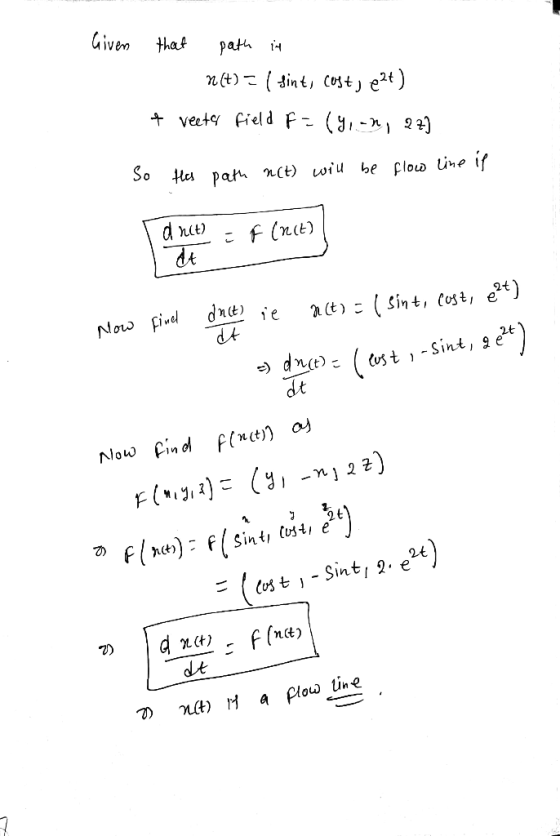
In Exercises 17–19, verify that the path given is a flow line of the indicated vector...
8Two vector fields are given: F(x,y,z) - (esin(yz), ze* cos(yz), ye* cos(yz)) and F(x,y,z) = (z...
 8Two vector fields are given: F(x,y,z) - (esin(yz), ze* cos(yz), ye* cos(yz)) and F(x,y,z) = (z cos y, xz sin y, x cos y). a) Determine which vector field above is conservative. Justify. Foly = fjol so, <ea sin(J2), 20% cos(82), y acos (92)) Conservative. b) For the vector field that is conservative, find a function f such that F - Vf. Lxelsing2, zetos yea, yet cosy 2 c) Use the Fundamental Theorem of Line Integrals to find the work...
(2) For the vector field f 2z(ri yi)(22)k use the definition of line integral to evaluate the line integral J f.dr along the helical path r-costi + sintj+tk, 0St (3) You are given that the vector fie...
 (2) For the vector field f 2z(ri yi)(22)k use the definition of line integral to evaluate the line integral J f.dr along the helical path r-costi + sintj+tk, 0St (3) You are given that the vector field f in Q2 is conservative. Find the corresponding potential function and use this to check the line integral evaluated in Q2
(2) For the vector field f 2z(ri yi)(22)k use the definition of line integral to evaluate the line integral J f.dr along...
(2) For the vector field f 2z(ri yi)(22)k use the definition of line integral to evaluate the line integral J f.dr along the helical path r-costi + sintj+tk, 0St (3) You are given that the vector field f in Q2 is conservative. Find the corresponding potential function and use this to check the line integral evaluated in Q2
(2) For the vector field f 2z(ri yi)(22)k use the definition of line integral to evaluate the line integral J f.dr along...
#7, #11, #17 please Calculating the Curl and the Divergence In Exercises 1-20, calculate curl F...
 #7, #11, #17 please
Calculating the Curl and the Divergence In Exercises 1-20, calculate curl F and divF of the given vector fields F. F = 1 1. F= (°yz?, xyz, wy) 2. F= (x+y23, xyz2, xz) 3. F= (zey, well, ye**) 4. F = (xeyz, zety, ye** ) 5. F= (xsin yz, y sin xz, zsin zy) 6. F = (y sin uz, e sinyz, 2 sinxy) 7, F = (sin x cos z, sin y cos x, sin...
#7, #11, #17 please
Calculating the Curl and the Divergence In Exercises 1-20, calculate curl F and divF of the given vector fields F. F = 1 1. F= (°yz?, xyz, wy) 2. F= (x+y23, xyz2, xz) 3. F= (zey, well, ye**) 4. F = (xeyz, zety, ye** ) 5. F= (xsin yz, y sin xz, zsin zy) 6. F = (y sin uz, e sinyz, 2 sinxy) 7, F = (sin x cos z, sin y cos x, sin...
Evaluate the line integral f F dr for the vector field F(x, y, z) curve C...
 Evaluate the line integral f F dr for the vector field F(x, y, z) curve C parametrised by Vf (x, y, z) along the with tE [0, 2 r() -(Vt sin(2πt), t cos (2πi), ?) ,
Evaluate the line integral f F dr for the vector field F(x, y, z) curve C parametrised by Vf (x, y, z) along the with tE [0, 2 r() -(Vt sin(2πt), t cos (2πi), ?) ,
Evaluate the line integral f F dr for the vector field F(x, y, z) curve C parametrised by Vf (x, y, z) along the with tE [0, 2 r() -(Vt sin(2πt), t cos (2πi), ?) ,
a) Find the length of the curve traced by the given vector function on the indicated...
 a) Find the length of the curve traced by the given vector function on the indicated interval: r(t)e' costie' sin tj+e'k 0<t<In2 b) Find the gradient of the scalar function f 6xyz + 2x+ xz at (1, 1, -1) c) Find the curl of the given vector field: F(x, y,z) 4xyi + (2x2 +2yz)j+(3z2+y2)k
(1 point) Consider the vector field F(x, y, z) = (2z + 3y)i + (2z +...
 (1 point) Consider the vector field F(x, y, z) = (2z + 3y)i + (2z + 3x)j + (2y + 2x)k. a) Find a function f such that F = Vf and f(0,0,0) = 0. f(x, y, z) = b) Suppose C is any curve from (0,0,0) to (1,1,1). Use part a) to compute the line integral / F. dr. (1 point) Verify that F = V and evaluate the line integral of F over the given path: F =...
Verify that the indicated function is an explicit solution of the given differential equation. Give an...
 Verify that the indicated function is an explicit solution of the given differential equation. Give an interval of definition I for the solution. y" + y = sec(x); y = x sin(x) + (cos(x)) In(cos(x)) O [0,7) O (-0,0) O (-0,-) O (0 ) O(
Evaluate the line integral ∫C.F·dr, where C is given by the vector function r(t).
Evaluate the line integral ∫C.F·dr, where C is given by the vector function r(t).F(x, y, z) = sin(x) i + cos(y) j + xz k r(t) = t3 i- t3j + tk, 0 ≤ t ≤ 1 .
The initial and terminal points of a vector are given. Write the vector as a linear...
 The initial and terminal points of a vector are given. Write the vector as a linear combination of the standard unit vectors i ands Initial Point Terminal Point (-1,2) (5,-4) X Need Help? Read it Find the component form of v, where u = 21 - 3 |(2, - 1) Sketch the vector operation geometrically, y 5 NIN 5 - 5 5 NI . s | sin Find the magnitude and direction angle of the vector v. v = 7(cos...
Help Entering Answers (1 point) Verify that Stokes' Theorem is true for the vector field F -yi+ z...
 Verify that Stokes' Theorem is true for the vector field
Help Entering Answers (1 point) Verify that Stokes' Theorem is true for the vector field F -yi+ zj + xkand the surface S the hemisphere x2 + y2 + z2-25, y > 0oriented in the direction of the positive y- axis To verify Stokes' Theorem we will compute the expression on each side. First compute curl F dS curl F The surface S can be parametrized by S(s, t) -...
Verify that Stokes' Theorem is true for the vector field
Help Entering Answers (1 point) Verify that Stokes' Theorem is true for the vector field F -yi+ zj + xkand the surface S the hemisphere x2 + y2 + z2-25, y > 0oriented in the direction of the positive y- axis To verify Stokes' Theorem we will compute the expression on each side. First compute curl F dS curl F The surface S can be parametrized by S(s, t) -...
 8Two vector fields are given: F(x,y,z) - (esin(yz), ze* cos(yz), ye* cos(yz)) and F(x,y,z) = (z cos y, xz sin y, x cos y). a) Determine which vector field above is conservative. Justify. Foly = fjol so, <ea sin(J2), 20% cos(82), y acos (92)) Conservative. b) For the vector field that is conservative, find a function f such that F - Vf. Lxelsing2, zetos yea, yet cosy 2 c) Use the Fundamental Theorem of Line Integrals to find the work...
 (2) For the vector field f 2z(ri yi)(22)k use the definition of line integral to evaluate the line integral J f.dr along the helical path r-costi + sintj+tk, 0St (3) You are given that the vector field f in Q2 is conservative. Find the corresponding potential function and use this to check the line integral evaluated in Q2
(2) For the vector field f 2z(ri yi)(22)k use the definition of line integral to evaluate the line integral J f.dr along...
(2) For the vector field f 2z(ri yi)(22)k use the definition of line integral to evaluate the line integral J f.dr along the helical path r-costi + sintj+tk, 0St (3) You are given that the vector field f in Q2 is conservative. Find the corresponding potential function and use this to check the line integral evaluated in Q2
(2) For the vector field f 2z(ri yi)(22)k use the definition of line integral to evaluate the line integral J f.dr along...
 #7, #11, #17 please
Calculating the Curl and the Divergence In Exercises 1-20, calculate curl F and divF of the given vector fields F. F = 1 1. F= (°yz?, xyz, wy) 2. F= (x+y23, xyz2, xz) 3. F= (zey, well, ye**) 4. F = (xeyz, zety, ye** ) 5. F= (xsin yz, y sin xz, zsin zy) 6. F = (y sin uz, e sinyz, 2 sinxy) 7, F = (sin x cos z, sin y cos x, sin...
#7, #11, #17 please
Calculating the Curl and the Divergence In Exercises 1-20, calculate curl F and divF of the given vector fields F. F = 1 1. F= (°yz?, xyz, wy) 2. F= (x+y23, xyz2, xz) 3. F= (zey, well, ye**) 4. F = (xeyz, zety, ye** ) 5. F= (xsin yz, y sin xz, zsin zy) 6. F = (y sin uz, e sinyz, 2 sinxy) 7, F = (sin x cos z, sin y cos x, sin...
 Evaluate the line integral f F dr for the vector field F(x, y, z) curve C parametrised by Vf (x, y, z) along the with tE [0, 2 r() -(Vt sin(2πt), t cos (2πi), ?) ,
Evaluate the line integral f F dr for the vector field F(x, y, z) curve C parametrised by Vf (x, y, z) along the with tE [0, 2 r() -(Vt sin(2πt), t cos (2πi), ?) ,
Evaluate the line integral f F dr for the vector field F(x, y, z) curve C parametrised by Vf (x, y, z) along the with tE [0, 2 r() -(Vt sin(2πt), t cos (2πi), ?) ,
 a) Find the length of the curve traced by the given vector function on the indicated interval: r(t)e' costie' sin tj+e'k 0<t<In2 b) Find the gradient of the scalar function f 6xyz + 2x+ xz at (1, 1, -1) c) Find the curl of the given vector field: F(x, y,z) 4xyi + (2x2 +2yz)j+(3z2+y2)k
 (1 point) Consider the vector field F(x, y, z) = (2z + 3y)i + (2z + 3x)j + (2y + 2x)k. a) Find a function f such that F = Vf and f(0,0,0) = 0. f(x, y, z) = b) Suppose C is any curve from (0,0,0) to (1,1,1). Use part a) to compute the line integral / F. dr. (1 point) Verify that F = V and evaluate the line integral of F over the given path: F =...
 Verify that the indicated function is an explicit solution of the given differential equation. Give an interval of definition I for the solution. y" + y = sec(x); y = x sin(x) + (cos(x)) In(cos(x)) O [0,7) O (-0,0) O (-0,-) O (0 ) O(
 The initial and terminal points of a vector are given. Write the vector as a linear combination of the standard unit vectors i ands Initial Point Terminal Point (-1,2) (5,-4) X Need Help? Read it Find the component form of v, where u = 21 - 3 |(2, - 1) Sketch the vector operation geometrically, y 5 NIN 5 - 5 5 NI . s | sin Find the magnitude and direction angle of the vector v. v = 7(cos...
 Verify that Stokes' Theorem is true for the vector field
Help Entering Answers (1 point) Verify that Stokes' Theorem is true for the vector field F -yi+ zj + xkand the surface S the hemisphere x2 + y2 + z2-25, y > 0oriented in the direction of the positive y- axis To verify Stokes' Theorem we will compute the expression on each side. First compute curl F dS curl F The surface S can be parametrized by S(s, t) -...
Verify that Stokes' Theorem is true for the vector field
Help Entering Answers (1 point) Verify that Stokes' Theorem is true for the vector field F -yi+ zj + xkand the surface S the hemisphere x2 + y2 + z2-25, y > 0oriented in the direction of the positive y- axis To verify Stokes' Theorem we will compute the expression on each side. First compute curl F dS curl F The surface S can be parametrized by S(s, t) -...
Most questions answered within 3 hours.
-
Where is the error in this code sequence?
String s1 = "Hello";
String s2 = "ello";...
asked 10 months ago -
Financial data for Joel de Paris, Inc., for last year
follow:
Joel de Paris, Inc.
Balance...
asked 10 months ago -
Consider this reaction:
Al2(SO4)3 (aq)+ BaCl3
(aq) Al2Cl6 (aq)- +
3BaSO4(s) . What is the...
asked 10 months ago -
Suppose that Savneet is considering increasing her
recent random sample from 20 car rentals to 40...
asked 10 months ago -
Trucks arrive at an unloading terminal at an average rate of 120
per hour.
Trucks arrive...
asked 10 months ago -
Why are methanol and ethanol completely soluble in water while
octanol is not very little soluble....
asked 10 months ago -
A facilities manager at a university reads in a research report
that the mean amount of...
asked 10 months ago -
When the CuSO4 is rehydrated by adding water to the anhydrous
compound, is this an endothermic...
asked 10 months ago -
A ray of sunlight is passing from diamond into crown glass; the
angle of incidence is...
asked 10 months ago -
A block of mass 0.249 kg is placed on top of a light, vertical
spring of...
asked 10 months ago -
how do the kidneys compensate in the presences of acidosis
a) trigger hyperventilate
b) reserve acid...
asked 10 months ago -
Question 501 pts
The rental rate of capital to the firm increases. Which of the
following...
asked 10 months ago